

Semrush Guide 2026: Complete Tutorial for Beginners & Expert
If you have ever wondered why some websites consistently dominate Google’s first page while others struggle to even get indexed, the answer often comes down to one thing — the tools and strategy behind the scenes. In 2026, Semrush has cemented itself as the most comprehensive, most trusted, and most widely used digital marketing platform on the planet, with over 10 million marketers relying on it daily.
Whether you are a complete beginner setting up your first website or a seasoned SEO professional managing dozens of client campaigns, Semrush delivers everything you need in one unified dashboard. From deep keyword intelligence to competitive analysis, from a powerful free SEO audit engine to an AI-driven visibility tracker, Semrush has evolved far beyond a simple ranking tool. It is now an end-to-end marketing intelligence system built for the modern search landscape — one that includes not just Google, but AI answer engines like ChatGPT, Google Gemini, and Perplexity.
This guide breaks down every major feature of Semrush, walks you through how to use the platform step by step, and equips you with the knowledge to make smart, data-backed decisions for your website’s growth.
What Is Semrush?
Semrush is an all-in-one SEO and digital marketing platform that gives website owners, content creators, marketers, and agencies the tools they need to grow organic traffic, outrank competitors, and build authoritative online presences. Founded in 2008 and now tracking over 27.5 billion keywords, 43 trillion backlinks, and 808 million domains across 142 databases, Semrush is arguably the most data-rich SEO platform available today.
In 2026, Semrush launched Semrush One — a unified platform update that merged its traditional SEO suite with AI Visibility tracking. This means Semrush now helps you rank on Google and get cited inside AI-generated answers, covering the entire modern discovery ecosystem in one place.
At its core, Semrush helps you answer three critical questions:
– What keywords should I target?
– What is my competition doing?
– What is technically wrong with my website?
With these answers, you can build a content and SEO strategy grounded in real data — not guesswork.
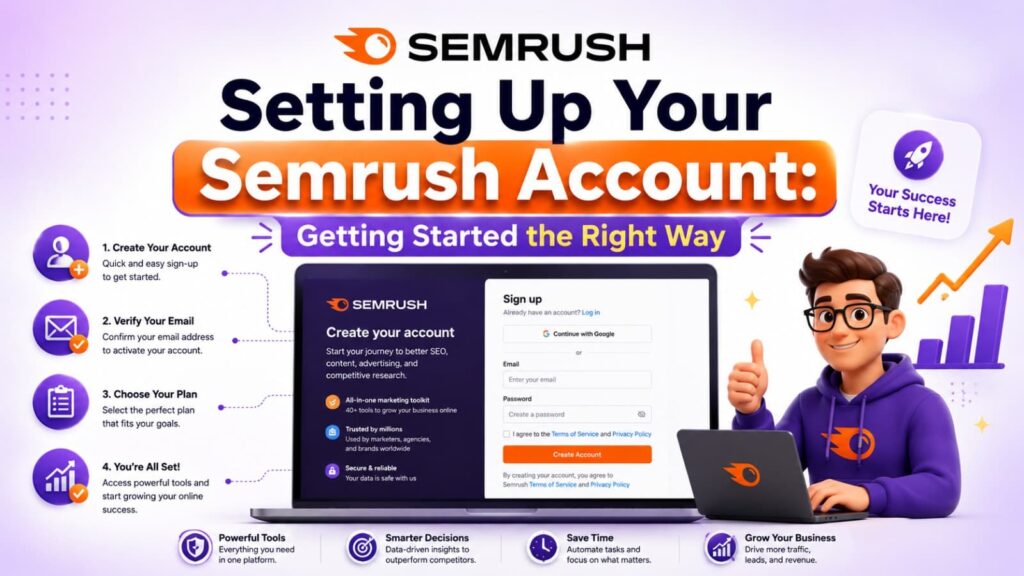
Setting Up Your Semrush Account: Getting Started the Right Way
Before diving into features, here is how to set up Semrush correctly from day one.
Step 1 — Create Your Account
Visit Semrush.com and sign up. A free account gives you limited but useful access to most core features. Paid plans (Pro at $139.95/month, Guru at $249.95/month, and Business at $499.95/month) unlock higher limits and advanced tools.
Step 2 — Create Your First Project
Your Project is the hub where It tracks your domain. Enter your root domain (no www or https), give it a memorable name, and set your target country. This is critical — if you serve a local or regional audience, your location setting drives the search database it uses for position tracking.
Step 3 — Connect Your Data Sources
Connect Google Analytics, Google Search Console, and your Google Business Profile. Every connected source multiplies the insight it gives you. This integration allows Semrush to cross-reference your real traffic data against its keyword database, surfacing gaps and opportunities you would never find manually.
Step 4 — Run Your First Site Audit
The very first thing every new Semrush user should do is run a free SEO audit on their domain. This scans your entire site and produces a health score from 0–100, along with a categorized breakdown of errors, warnings, and notices. Think of this as your website’s medical checkup — and Semrush is the doctor.
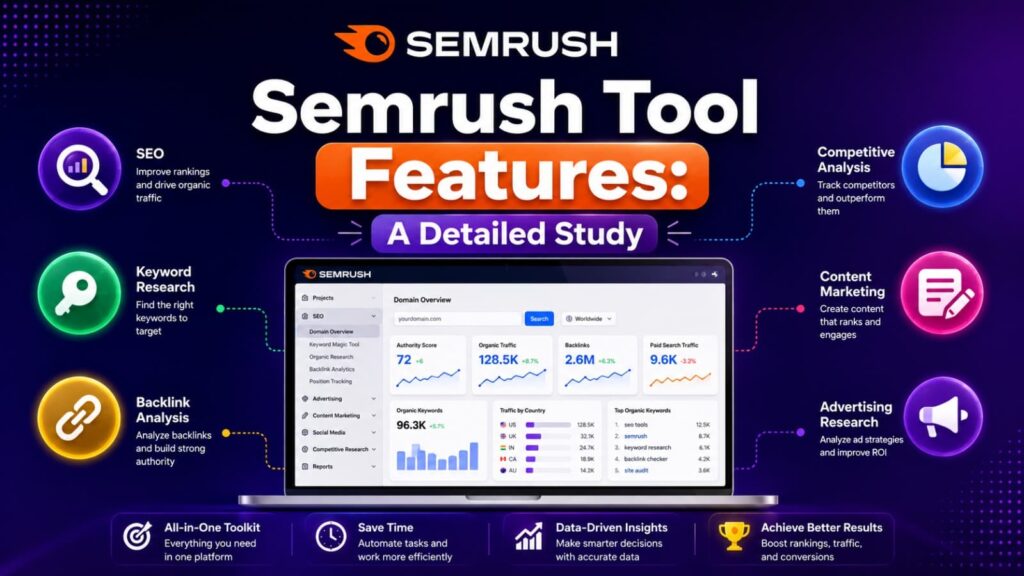
Semrush Tool Features: A Detailed Study
Semrush is home to over 55 tools and reports. Here is a deep-dive into the most important ones.
1. Keyword Magic Tool – The World’s Most Powerful Keyword Planner Free Checker
The Keyword Magic Tool is Semrush’s crown jewel for keyword research. With a database of over 25 billion keywords, it functions as an elite keyword planner free checker — surfacing keyword ideas you would never find in Google’s Keyword Planner alone.
Type any seed keyword and Semrush instantly returns:
– Search Volume — monthly average searches
– Keyword Difficulty (KD%) — how hard it is to rank
– CPC — cost-per-click for paid ad planning
– SERP Features — whether featured snippets, video carousels, or AI overviews exist
– Intent Classification — informational, navigational, commercial, or transactional
For beginners, Semrush recommends targeting keywords with a KD% below 40 — these are easier wins that build domain authority over time. For experts, the tool’s filtering by intent, volume range, and question-based keywords unlocks sophisticated content cluster strategies.
The keyword planner free checker functionality inside Semrush is particularly useful for building content that answers specific user questions — the kind of content that not only ranks on Google but also gets cited in AI-generated responses, which is a growing source of referral traffic in 2026.
2. Site Audit – Your Free SEO Audit Engine
The Semrush Site Audit tool is one of the most powerful free SEO audit solutions available. It crawls up to 100,000 pages per project and flags 140+ categories of technical issues, organized by severity.
What it checks:
– Broken pages (4xx/5xx errors)
– Missing or duplicate title tags and meta descriptions
– Redirect loops and chains
– Core Web Vitals (LCP, CLS, FID)
– Internal linking gaps and orphan pages
– Structured data and schema markup issues
– Crawlability and indexation problems
– Images missing alt text
Once your free SEO audit is complete, Semrush generates a prioritized fix list so you always know what to tackle first. The audit can be scheduled to run automatically — weekly or monthly — so you catch new issues as your site evolves. The internal linking report alone, often overlooked by beginners, can lift traffic by 15–25% without publishing a single new page.
3. On-Page SEO Checker – The Smart SEO Checker
The SEO checker in Semrush takes a different approach from the Site Audit. While the audit focuses on technical health, the On-Page SEO checker focuses on *ranking improvement* for existing pages. It analyzes each page against the top 10 current competitors for your target keyword and provides:
– Content depth recommendations
– Missing semantic keywords and LSI terms
– Backlink opportunity targets
– Featured snippet optimization ideas
– User experience improvement signals
This SEO checker is especially valuable for content that ranks on pages 2–3 of Google. It tells you precisely what the ranking pages are doing differently and gives you a roadmap to close the gap.
4. Keyword Overview & Position Tracking
Semrush Keyword Overview gives you an instant snapshot of any keyword’s key metrics — search volume, difficulty, trend data, SERP analysis, and related keyword clusters. It is the fastest way to evaluate whether a keyword is worth pursuing before investing time creating content.
Position Tracking, meanwhile, monitors your live rankings for any set of keywords, updated daily. You can track by country, city, or even specific device type. Semrush also highlights ranking volatility and SERP feature opportunities, making it easy to spot when your competitors slip — and capitalize fast.
5. Competitor & Domain Analysis
Semrush built its reputation on competitive intelligence, and the Domain Overview + Organic Research tools remain unmatched in the industry. Enter any competitor’s domain and Semrush reveals:
– All organic keywords they rank for
– Their estimated monthly traffic
– Their top-performing pages
– Their paid advertising strategy
– Their backlink profile
The Keyword Gap tool takes this further — enter up to five domains and Semrush shows you the exact keywords your competitors rank for that you do not. This is where smart content calendars get built: not from guesswork, but from data showing where the opportunity gaps exist.
6. Backlink Analytics & Link Building Tools
Semrush maintains a database of 43 trillion backlinks, making its backlink analysis one of the deepest available. The Backlink Analytics tool shows every inbound link to any domain, the authority of the linking site, anchor text distribution, and the toxic score of individual links.
The Backlink Gap tool mirrors the Keyword Gap concept — it shows sites that link to your competitors but not to you, generating a highly targeted list of link-building prospects. Cold outreach to random sites converts below 5%; reaching out to sites already linking to competitors in your niche converts dramatically higher.
The Link Building Tool inside Semrush even automates outreach — managing email templates, tracking responses, and recording link acquisition progress all within the platform.
Follow Us on LinkedIn
7. AI Visibility Tracking – Semrush for the Answer Engine Era
This is the most significant Semrush upgrade of 2026. The AI Visibility Toolkit (part of Semrush One) tracks how often your brand and content appear in responses generated by ChatGPT, Google Gemini, Perplexity, Microsoft Copilot, and Google AI Overviews.
Semrush monitors over 90 million real user prompts to estimate your “AI Share of Voice” — essentially how often AI engines recommend your brand versus competitors. This is mission-critical data in 2026 because a growing share of purchase and research decisions now begin with an AI assistant, not a traditional search query.
Brands that appear consistently in AI answers are establishing the same kind of authority that top Google rankings provided in earlier years. Semrush even provides an AI Site Audit that checks whether your site structure, schema markup, and content formatting are optimized for large language model indexing — a new frontier that most SEO tools have not yet addressed.
8. Content Marketing Toolkit
Semrush provides a full content marketing suite including:
– Topic Research — discover content ideas with proven demand
– SEO Content Template — get a content brief based on top-ranking pages
– SEO Writing Assistant — real-time readability and optimization scoring as you write
– Content Audit — evaluate the performance of existing content and identify what to update, merge, or delete
These tools help content creators produce material that is genuinely useful, deeply researched, and optimized for both readers and search engines — the combination that earns lasting rankings.
9. Advertising & PPC Tools
Semrush extends beyond organic SEO into paid search with its Advertising Research and PLA Research tools. You can see which keywords competitors are bidding on, what their ad copy looks like, and how their spend has changed over time. This is invaluable for both PPC managers and organic SEOs who want to understand the commercial intent landscape.
10. Local SEO & Listing Management
For businesses serving local markets, It offers a Listing Management tool that syncs your business information across 70+ directories, including Google, Yelp, Facebook, and Apple Maps. Consistent NAP (Name, Address, Phone) data across directories is a foundational local ranking signal — and It also automates the process that would otherwise take hours of manual effort.
Why Trustworthiness, Depth, and Authoritativeness Matter When Using Semrush
One of the most important shifts in search in recent years is that search engines — and increasingly AI systems — do not just evaluate keywords and backlinks. They evaluate signals of genuine expertise, real-world credibility, and content that serves users deeply.
Semrush is the ideal platform for building this kind of presence because its tools guide you toward creating content grounded in real data, covering topics comprehensively, and backing every claim with credible information. The On-Page SEO checker rewards depth and semantic coverage. The Content Audit flags thin or outdated pages that erode your site’s overall trustworthiness. The AI Visibility Toolkit ensures your brand is cited as a reliable source inside AI-generated responses, not just traditional search results.
Marketers who use this to guide their content strategy — not just their keyword targeting — naturally build the kind of websites that search engines and AI systems trust and recommend. This is why Semrush is not just an SEO tool. It is a platform for building genuine digital authority.
Benefits of Semrush
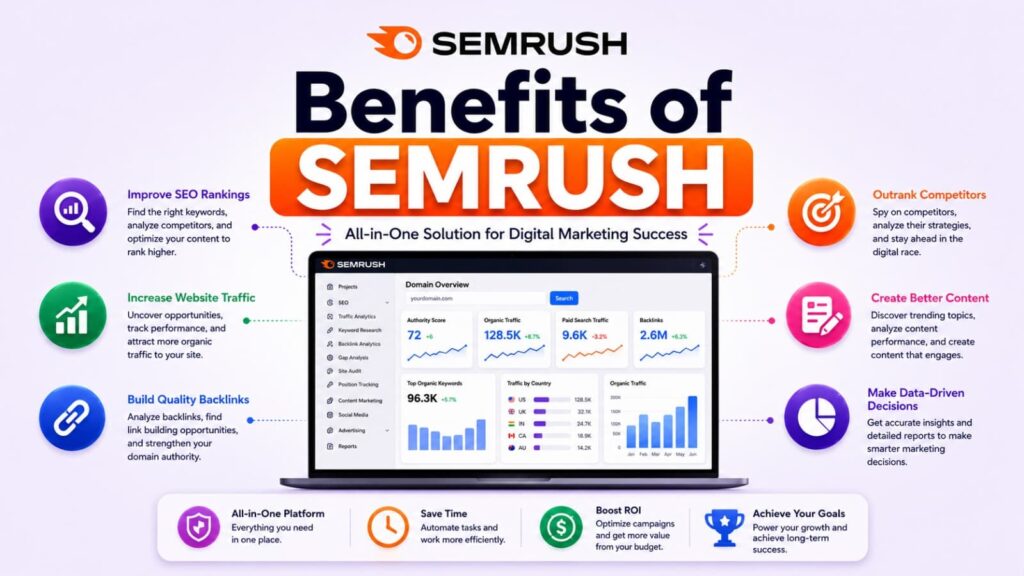
1. All-in-One Platform
Semrush replaces four to six separate tools — keyword research, rank tracking, backlink analysis, site audit, and content optimization — in a single interface. This saves time, reduces cost, and ensures all your data is connected and consistent.
2. Unmatched Keyword Database
With 25+ billion keywords across 142 country databases, Semrush offers the most comprehensive keyword intelligence available. Its keyword planner free checker functionality is far more powerful than free alternatives.
3. Deep Competitive Intelligence
Semrush reveals exactly what competitors are doing — which keywords they rank for, which pages drive their traffic, and which sites link to them. This transforms guesswork into strategic precision.
4. Comprehensive Free SEO Audit
The Semrush site audit checks 140+ technical SEO factors and generates an actionable health score. It is one of the most thorough free SEO audit tools available, even for users on the basic plan.
5. AI-Era Visibility
In 2026, Semrush is one of the only platforms tracking your brand’s presence inside AI-generated answers — a capability that will only grow in importance as AI search behavior continues to expand.
6. Semrush Academy — Free Training
Semrush provides 40+ hours of free digital marketing courses for users on any paid plan. This makes it an educational resource, not just a tool — particularly valuable for beginners building their SEO knowledge.
7. Automation Capabilities
Automated audits, scheduled reports, and ranking alerts mean Semrush works for you in the background — surfacing issues and opportunities without requiring daily manual check-ins.
Limitations of Semrush
1. Pricing Can Be Steep for Individuals
The Semrush Pro plan starts at $139.95/month, which can feel significant for freelancers or hobby bloggers. The value is clear for businesses and agencies, but solo users running a single website may find the cost hard to justify without a revenue-generating site.
2. Learning Curve for Beginners
Semrush is feature-rich to the point of being overwhelming for first-time users. The sheer number of tools, reports, and dashboards can make it difficult to know where to start. The Semrush Academy helps, but the onboarding experience could be smoother.
3. Data Estimation Limitations
Like all third-party SEO tools, Semrush estimates traffic and keyword data rather than accessing Google’s internal numbers. These estimates are generally reliable but can diverge from actual analytics data, particularly for very niche or low-volume keywords.
4. Limited Free Plan Access
While Semrush offers a free tier, it imposes tight limits on the number of reports and results you can access daily. Users hoping to rely heavily on Semrush for a free SEO checker experience will quickly hit those caps.
5. Interface Complexity
With 55+ tools, the Semrush interface can feel cluttered. Finding specific reports sometimes requires navigating multiple menus, which slows down workflows for users who are not yet familiar with the platform’s structure.
How Semrush Fits Into the Modern Search Landscape
Search in 2026 is no longer just Google. Users ask questions in AI chatbots. They get answers without clicking any website. They trust what AI engines surface as authoritative and reliable. This shift has made it more important than ever to build a brand that is *cited*, not just *ranked*.
Semrush is ahead of this curve. Its AI Visibility Toolkit monitors your presence across the AI answer landscape. Its content tools guide you toward producing material that AI engines recognize as credible and worth citing. Its SEO checker ensures your site is technically sound enough for both Google’s crawlers and large language model indexing.
Brands that are winning in 2026 are those that combine traditional search ranking strength with AI citation visibility — and It is one of the few platforms that addresses both simultaneously. By using Semrush to optimize for how answers are generated — not just how pages are ranked — you position your brand at the intersection of the old and new search ecosystems.
This approach also feeds directly into building the kind of structured, clearly-authored, deeply-sourced content that both Google and AI systems reward. Semrush data shows which topics are underserved in AI responses, which questions have high search volume but weak AI coverage, and which content formats earn the most AI citations — turning a traditional keyword planner free checker into a full-spectrum content intelligence platform.
Step-by-Step Semrush Workflow for Beginners
If you are brand new to Semrush, here is a simple 7-step workflow to get results fast:
1. Run a Free SEO Audit – Identify your site’s biggest technical problems first.
2. Fix Critical Errors – Broken pages, missing titles, redirect issues — fix these before anything else.
3. Research 10–20 Target Keywords – Use the Keyword Magic Tool to find low-KD opportunities in your niche.
4. Analyze 3 Top Competitors – Use Domain Overview to see what keywords drive their traffic.
5. Identify Keyword Gaps – Use the Keyword Gap tool to find terms competitors rank for that you do not.
6. Create or Optimize Content – Use the SEO Content Template and Writing Assistant to build content that covers your topics thoroughly.
7. Track Rankings Weekly – Set up Position Tracking and monitor progress. Adjust based on what Semrush data shows.
This loop — audit, research, create, track, repeat — is the core of what Semrush enables. Execute it consistently and results follow.
Frequently Asked Questions (FAQs)
Q1. Is Semrush suitable for complete beginners with no prior SEO knowledge?
Yes, absolutely. Semrush is designed to serve both beginners and experts, and the platform includes a full onboarding wizard that walks you through setting up your first project step by step. The Semrush Academy also offers 40+ hours of free beginner-friendly digital marketing courses. The Site Audit and On-Page SEO checker generate plain-language recommendations so you always know what to do next, even without technical SEO experience.
Q2. Does Semrush offer a free SEO audit for my website?
Yes. It’s includes a powerful free SEO audit tool as part of both its free and paid accounts. The Site Audit crawls your website, generates a health score, and lists all technical issues by severity — from critical errors like broken pages to minor notices like orphaned content. Free accounts have limited crawl capacity, but even a partial crawl gives useful insight. Paid plans unlock full-site audits across unlimited pages for larger websites.
Q3. How accurate is Semrush’s keyword data compared to Google’s actual search volumes?
Semrush uses a combination of clickstream data, search engine results analysis, and machine learning models to estimate keyword search volumes. These estimates are generally reliable and consistent, though they are approximations rather than exact Google figures. For strategic direction — identifying which keywords are worth targeting, how competitive they are, and what intent they carry — Semrush data is more than sufficient and is trusted by professional SEO teams globally.
Q4. Can Semrush help me track my brand’s visibility in AI tools like ChatGPT and Google Gemini?
Yes — and this is one of Semrush’s most significant capabilities in 2026. Through its AI Visibility Toolkit (part of Semrush One), Semrush monitors over 90 million real user prompts and tracks how often your brand appears in responses generated by ChatGPT, Gemini, Perplexity, and Microsoft Copilot. It provides an “AI Share of Voice” metric, lets you compare your AI presence against competitors, and includes an AI Site Audit that checks whether your content and site structure are optimized for language model indexing.
Q5. What is the difference between the Semrush Pro and Guru plans — and which one should I choose?
The Pro plan ($139.95/month) is best for individual freelancers or small business owners managing up to 5 projects. It includes all core tools — keyword research, site audit, position tracking, backlink analysis — but excludes historical data and the Content Marketing Toolkit. The Guru plan ($249.95/month) adds historical data access, the full Content Marketing Toolkit, multi-location position tracking, and support for up to 15 projects. If content marketing and long-term trend analysis matter to your strategy — which they should in 2026 — the Guru plan offers significantly more value per dollar for growing teams.
Know More About Us

Mohammed Viqar Ali is a Digital Marketer, UI/UX Designer, and content creator passionate about AI, technology, SEO, and digital growth. As the UI/UX Designer of aiblogmind, he focuses on creating user-friendly digital experiences while sharing practical insights on artificial intelligence, marketing trends, productivity tools, and online business growth. Through his content, he helps readers discover innovative solutions, stay updated with emerging technologies, and make informed decisions in the digital world.