

7 Powerful Ways AI Is Revolutionizing UI/UX Design in 2026
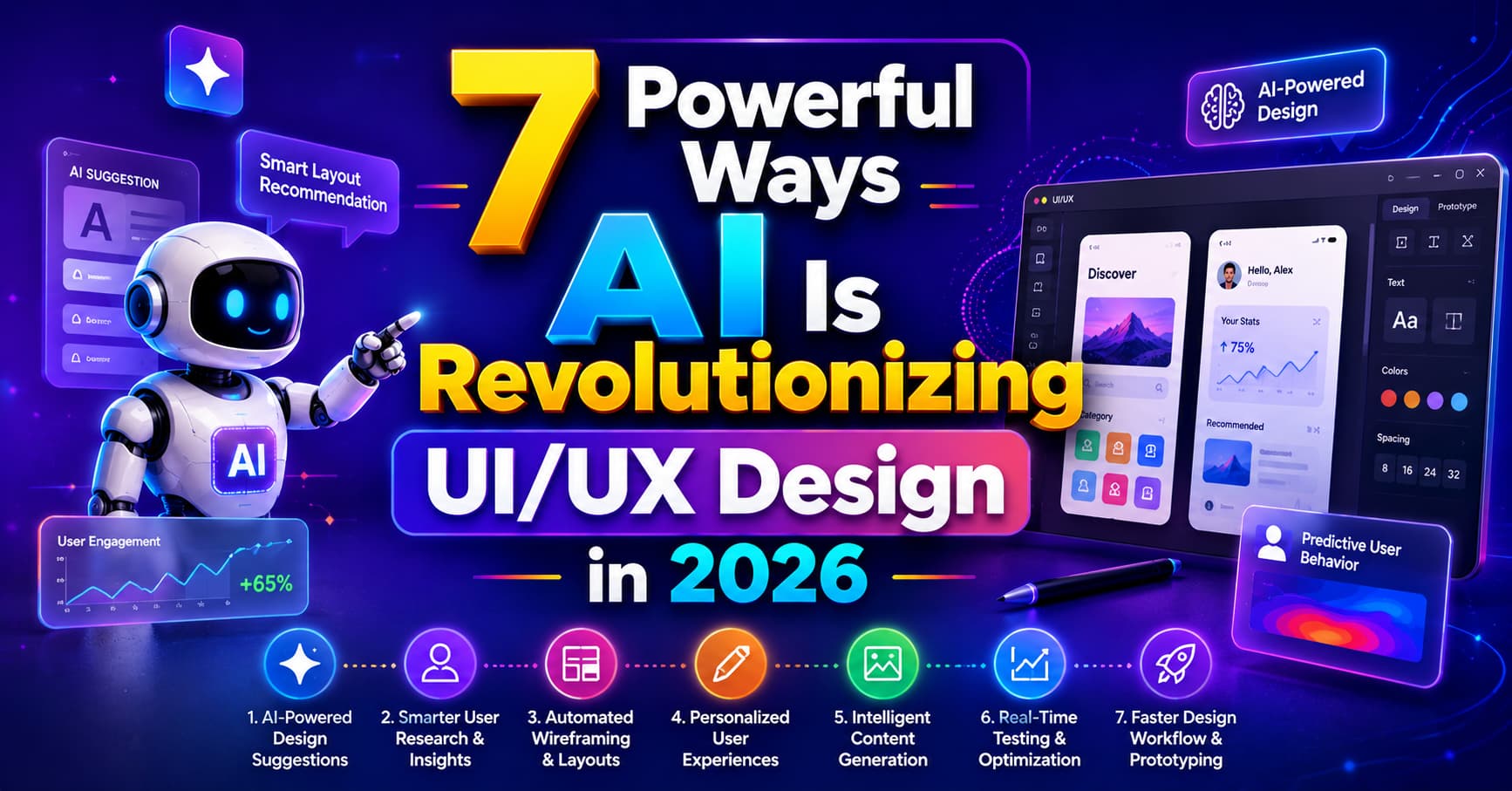
The world of digital design is changing faster than ever before. Designers who once spent days creating wireframes, prototypes, and user journeys are now completing the same tasks within hours using artificial intelligence. In 2026, AI UI/UX design is no longer just an experimental trend. It has become one of the biggest transformations in the creative and tech industries. From automated layouts to personalized user experiences, AI is redefining how websites, mobile apps, and digital products are designed.
Businesses today want faster workflows, smarter interfaces, and better customer experiences. This demand has fueled the rise of advanced AI design tools, intelligent automation systems, and next-generation AI UX tools capable of understanding user behavior in real time. Designers are no longer working alone. AI now acts like a creative assistant that can generate ideas, optimize interfaces, analyze user interactions, and even predict how users will behave before a product launches.
The impact of AI UI design goes far beyond aesthetics. Companies are using AI to increase engagement, reduce bounce rates, improve accessibility, and create highly personalized digital experiences. Meanwhile, startups and enterprises investing in AI in web design are reducing development costs and launching products much faster than traditional workflows allowed. This shift is transforming not only design processes but also the future of digital business itself.
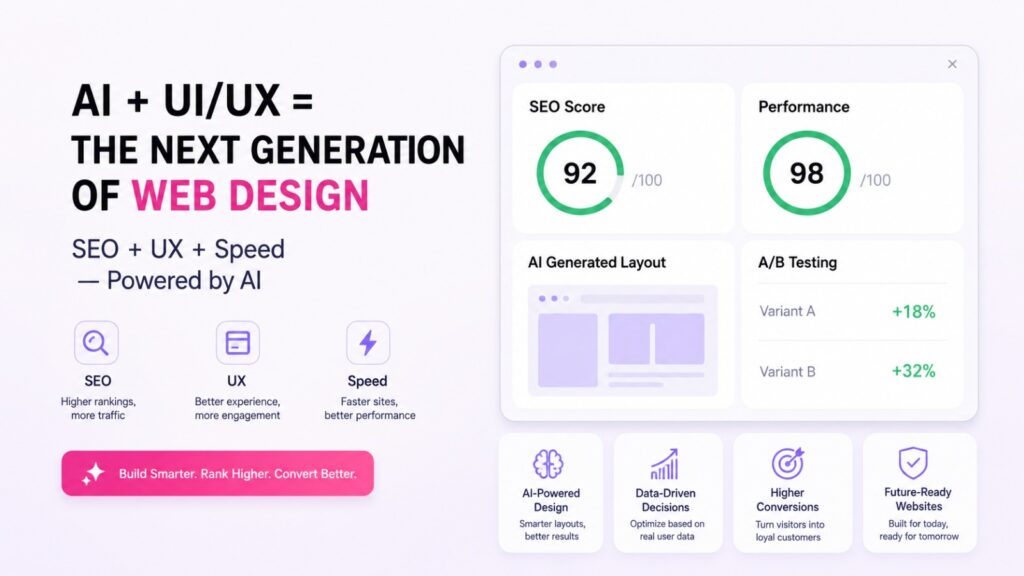
Why AI UI/UX Design Is Growing Rapidly
The Evolution of Digital Design
Design has evolved dramatically over the last decade. Earlier, designers manually created wireframes, researched user behavior, and tested interfaces through long and repetitive processes. While creativity was always at the center of UI/UX work, the workflow itself was often slow and resource-intensive. In 2026, artificial intelligence has changed this completely. The rise of AI UI/UX design allows designers to automate repetitive tasks and focus more on creativity, strategy, and innovation.
Imagine building a mobile app interface in just a few minutes instead of spending days adjusting layouts manually. Modern AI systems can generate complete interface structures based on prompts, brand guidelines, or user preferences. These tools are helping designers work faster while maintaining consistency across products. This evolution is similar to moving from hand-drawn blueprints to smart architectural software that predicts and improves designs automatically.
The growing complexity of digital products is another reason businesses are adopting AI-powered design workflows. Websites and apps today must work smoothly across mobile devices, tablets, desktops, and even smart wearables. Managing these experiences manually is becoming increasingly difficult. Advanced AI design tools help teams optimize interfaces for different screen sizes, accessibility standards, and user behaviors automatically. This efficiency is making AI a central part of modern product design.
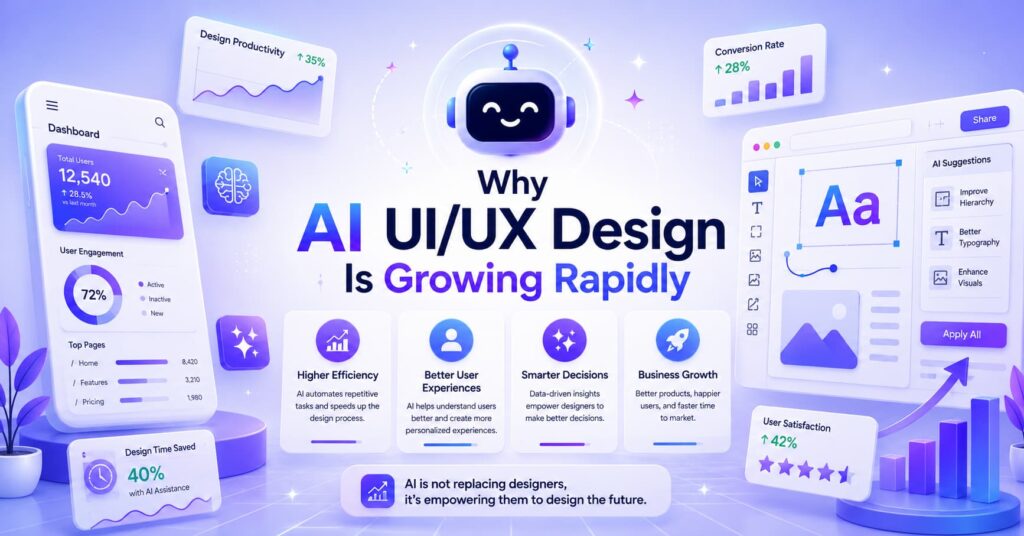
Why Businesses Are Adopting AI Design Tools
Businesses care deeply about user experience because poor design directly impacts revenue. If users find an app confusing or slow, they leave almost instantly. AI helps companies solve this problem by analyzing huge amounts of user data and identifying patterns humans may overlook.
Modern AI UX tools can track how users interact with interfaces, where they get frustrated, and which elements improve engagement. This data-driven approach allows businesses to create smarter products faster than ever before. Instead of relying only on assumptions, companies now make design decisions based on real behavioral insights.
Another major factor is speed. Startups especially need to launch products quickly to compete in crowded markets. AI dramatically reduces the time required for prototyping, wireframing, and testing. Businesses using AI UI design workflows can move from idea to product launch much faster compared to traditional design teams.
How AI Is Changing the UI/UX Industry
Automation in Design Workflows
One of the biggest transformations in AI UI/UX design is workflow automation. Designers spend a huge amount of time on repetitive tasks like resizing elements, aligning layouts, creating design systems, and generating variations. AI tools automate many of these processes instantly.
For example, modern design platforms can:
- Generate responsive layouts automatically
- Suggest color palettes
- Create typography combinations
- Convert sketches into digital wireframes
- Build reusable design components
This automation does not replace designers. Instead, it acts like an intelligent assistant that speeds up production and improves efficiency. Designers still make creative decisions, but AI handles repetitive technical tasks behind the scenes.
Smarter User Experience Personalization
Personalization has become one of the most important aspects of digital products. Users expect apps and websites to adapt to their preferences automatically. AI makes this possible by analyzing user behavior in real time.
Streaming platforms already personalize recommendations using AI, but modern AI UX tools go even further. Websites can now dynamically adjust layouts, content, and navigation based on individual user behavior. This creates more engaging and intuitive experiences.
Businesses investing in AI in web design are discovering that personalized interfaces significantly improve customer retention and conversions. Users feel more connected to products that adapt to their preferences naturally.
To Know More About AI follow us
Way #1 – AI Generates UI Layouts Instantly
One of the most powerful advancements in AI UI design is automated layout generation. Designers can now describe a product idea using text prompts, and AI tools instantly generate complete interface concepts.
This process dramatically reduces the time required for early-stage design exploration. Instead of staring at a blank canvas, designers can quickly iterate through multiple layout variations and refine the best options.
AI-generated layouts also improve consistency. Design systems often become messy when multiple team members work on large projects. AI helps maintain alignment, spacing, typography, and branding standards automatically.
For startups and agencies, this speed creates a huge competitive advantage. Faster design workflows mean quicker product launches and lower development costs.
Way #2 – AI UX Tools Improve User Research
User research has traditionally been one of the most time-consuming parts of UI/UX work. Conducting interviews, analyzing feedback, and interpreting behavioral data requires significant effort.
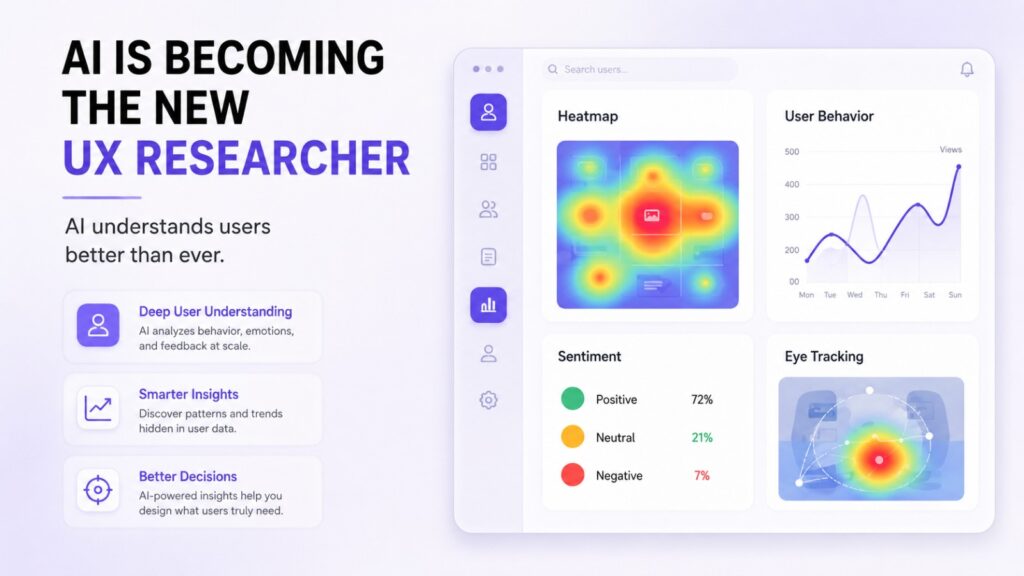
Modern AI UX tools simplify this process dramatically. AI systems can analyze user recordings, heatmaps, click patterns, and feedback data automatically to identify usability issues faster than humans alone.
For example, AI can detect:
- Frustration points
- Confusing navigation paths
- High-dropoff sections
- Engagement patterns
- Conversion bottlenecks
This data-driven insight allows designers to make better decisions quickly. Instead of relying entirely on intuition, teams can use AI-powered analytics to optimize interfaces more effectively.
Way #3 – AI Personalizes User Experiences
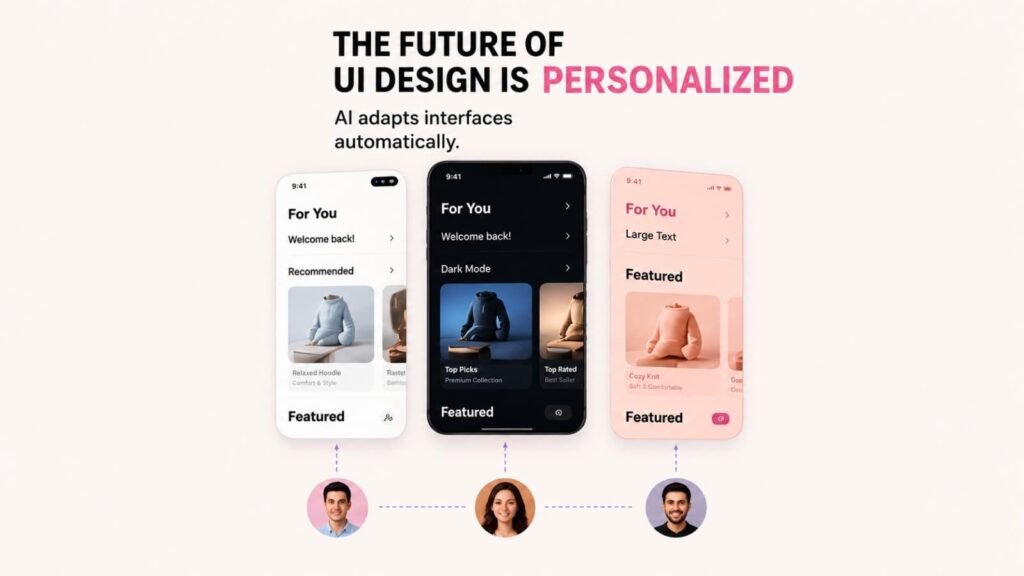
Personalization is becoming a defining feature of modern digital products. AI systems now tailor interfaces based on user preferences, behaviors, and interaction history.
Imagine visiting an e-commerce website where the homepage layout changes dynamically depending on your browsing habits. Or a fitness app that adjusts its interface based on your goals and activity patterns. This level of personalization is only possible through advanced AI UI/UX design systems.
Personalized experiences improve:
- Engagement
- User retention
- Conversion rates
- Customer satisfaction
Businesses using AI personalization strategies often see significantly higher interaction rates because users feel like the product understands their needs.
Way #4 – AI Improves Accessibility and Inclusivity
Accessibility has become a major priority in digital design, and AI is helping make products more inclusive for everyone.
Modern AI design tools can automatically:
- Detect low-contrast text
- Suggest accessibility improvements
- Optimize font readability
- Generate alt text for images
- Improve navigation for screen readers
This automation helps designers create products that work better for users with disabilities. Accessibility improvements also benefit general usability, making interfaces easier for everyone to navigate.
As regulations around accessibility continue growing worldwide, AI-powered accessibility optimization is becoming essential for modern web and app development.
Way #5 – AI Accelerates Prototyping and Testing
Prototyping and testing are critical parts of UI/UX design, but they often consume huge amounts of time. AI dramatically speeds up both processes.
Designers can now generate interactive prototypes quickly using AI UI design platforms. AI can also simulate user interactions and predict usability issues before products launch.
Testing becomes more efficient because AI systems analyze:
- User flows
- Click behavior
- Engagement metrics
- Session recordings
This allows teams to identify and fix design problems earlier in the development cycle, reducing costly revisions later.
Way #6 – AI in Web Design Enhances SEO and Performance
AI is transforming not only design aesthetics but also website performance and search optimization. Businesses investing in AI in web design are improving both user experience and visibility simultaneously.
AI-powered systems can optimize:
- Website loading speed
- Mobile responsiveness
- SEO structures
- Content hierarchy
- Navigation architecture
These improvements help websites rank better on search engines while delivering smoother user experiences.
For businesses competing online, combining SEO optimization with intelligent design creates a powerful advantage.
Way #7 – AI Helps Designers Make Data-Driven Decisions
One of the biggest strengths of AI is its ability to analyze massive datasets quickly. In UI/UX design, this means teams can make smarter decisions based on actual user behavior instead of assumptions.
AI tools can predict:
- Which layouts perform best
- Which colors improve conversions
- Where users lose interest
- Which elements drive engagement
This analytical power helps designers create more effective products while reducing guesswork significantly.
The future of AI UX tools lies in combining creativity with deep behavioral analytics to create experiences optimized for both aesthetics and performance.
Best AI Design Tools in 2026
Several powerful platforms are leading the AI design revolution in 2026.
| Tool | Main Purpose |
|---|---|
| Figma AI | UI design automation |
| Adobe Firefly | AI creative generation |
| Canva AI | Quick design generation |
| Framer AI | AI website building |
| Uizard | Wireframe generation |
These platforms are helping designers build interfaces faster while improving creativity and productivity.
How AI UI/UX Design Is Helping Startups Compete Faster
Startups are benefiting massively from the rise of AI UI/UX design because speed has become one of the most important advantages in modern digital markets. Earlier, small startups struggled to compete with large companies because professional design teams, researchers, and developers required huge budgets. Today, advanced AI design tools allow startups to create professional interfaces, prototypes, and complete design systems without needing massive teams or expensive resources. A founder with a small budget can now generate website layouts, mobile app screens, user flows, and branding concepts within hours instead of spending weeks on manual design processes. This dramatic reduction in development time allows startups to validate ideas quickly and launch products before competitors dominate the market.
Another major advantage of modern AI UX tools is the ability to improve products continuously using real-time behavioral insights. Startups often fail because they build interfaces based on assumptions instead of actual user behavior. AI-powered analytics platforms solve this problem by tracking clicks, engagement patterns, scrolling behavior, and conversion rates automatically. Instead of guessing which layout works best, businesses can rely on AI-generated insights to optimize user experiences scientifically. This data-driven approach helps startups increase retention and improve customer satisfaction much faster than traditional design methods. As competition grows online, businesses using intelligent UX optimization strategies gain a significant advantage in both customer acquisition and long-term growth.
The rise of AI in web design is also changing the relationship between designers and developers. Earlier, design and development teams often worked separately, which slowed down product creation significantly. AI-powered platforms now bridge this gap by generating responsive designs and even converting prototypes into functional code automatically. This integration accelerates workflows and reduces communication errors between teams. Modern AI UI design systems are becoming collaborative environments where creativity, automation, and development work together seamlessly. In the future, businesses will likely rely on AI-powered platforms capable of designing, coding, testing, and optimizing entire digital products with minimal human intervention.
Challenges of AI UI/UX Design
Despite its advantages, AI-powered design still faces several challenges.
Some concerns include:
- Overreliance on automation
- Loss of creative uniqueness
- Ethical issues in personalization
- Privacy concerns with user data
- Generic design outputs
Designers must balance AI efficiency with human creativity to avoid producing repetitive or emotionally disconnected experiences.
Why Human Creativity Still Matters in AI UI/UX Design
Even though artificial intelligence is transforming digital product creation rapidly, human creativity still remains the heart of successful AI UI/UX design. AI can generate layouts, automate repetitive workflows, and analyze user behavior at massive scale, but it still struggles to understand emotions, storytelling, and deep human psychology the way experienced designers do. Great design is not only about alignment, spacing, or color combinations. It is about creating emotional connections between users and digital products. Human designers understand cultural trends, emotional triggers, and brand personality in ways that AI systems cannot fully replicate. This is why the future of design will likely revolve around collaboration between humans and intelligent automation systems instead of complete replacement.
Modern AI design tools work best when they act like creative assistants rather than decision-makers. Designers can use AI to speed up ideation, generate multiple concepts quickly, and optimize workflows, while still maintaining full control over creative direction and user experience strategy. For example, AI may suggest a layout structure based on user engagement data, but a human designer decides whether that experience feels emotionally engaging, visually memorable, and aligned with the brand identity. This balance between automation and creativity is becoming one of the defining characteristics of successful AI UI design workflows in 2026. Businesses that rely entirely on automation often risk producing generic interfaces that lack uniqueness and emotional depth.
The growing influence of AI UX tools is also pushing designers to focus more on strategic thinking and innovation instead of repetitive technical work. Earlier, designers spent large amounts of time adjusting spacing, testing layouts manually, and organizing design systems. AI now automates many of those tasks, allowing creative professionals to spend more time understanding user psychology, crafting storytelling experiences, and improving digital engagement. As AI in web design continues evolving, the role of human designers will shift from pure execution toward higher-level creative problem solving. Instead of replacing creativity, AI is actually amplifying it by giving designers more time and freedom to focus on ideas that truly improve user experiences.
Future of AI in UI/UX Design
The future of AI UI/UX design looks incredibly exciting. AI systems will likely become even more collaborative, adaptive, and intelligent over the next few years.
Future AI design platforms may:
- Generate complete apps from prompts
- Predict user emotions
- Build personalized interfaces dynamically
- Automate full product workflows
- Integrate deeply with development systems
The relationship between designers and AI will become more collaborative rather than competitive.
Conclusion
Artificial intelligence is completely transforming the future of digital product design. From automated layouts and smarter research to personalized interfaces and accessibility optimization, AI UI/UX design is reshaping how websites and applications are created in 2026.
The rise of advanced AI design tools, intelligent AI UX tools, and automation systems allows businesses to build better products faster while improving user experiences significantly. Companies investing in AI UI design and AI in web design are gaining major competitive advantages through personalization, efficiency, and data-driven optimization.
The future of UI/UX design will not replace human creativity. Instead, AI will amplify creativity by removing repetitive tasks and helping designers focus on innovation, strategy, and emotional user experiences.
FAQs
What is AI UI/UX design?
AI UI/UX design refers to using artificial intelligence to automate, improve, and personalize user interface and user experience design processes.
Which AI design tools are popular in 2026?
Popular AI design tools include AI-powered platforms for wireframing, prototyping, website generation, and user analytics.
How do AI UX tools help designers?
AI UX tools analyze user behavior, improve usability testing, identify design problems, and provide data-driven recommendations.
Is AI replacing UI/UX designers?
No. AI automates repetitive tasks, but human creativity, strategy, and emotional understanding remain essential in design.
How is AI in web design improving websites?
AI in web design improves personalization, accessibility, SEO optimization, responsiveness, and user engagement through intelligent automation.

Syed Abubakkar is a content and SEO specialist responsible for article publishing, on-page SEO, keyword optimization, and AI-powered image generation. He is passionate about digital marketing and helping websites grow their online presence.