




AI Development Guide: Key Technologies Driving Digital Transformation
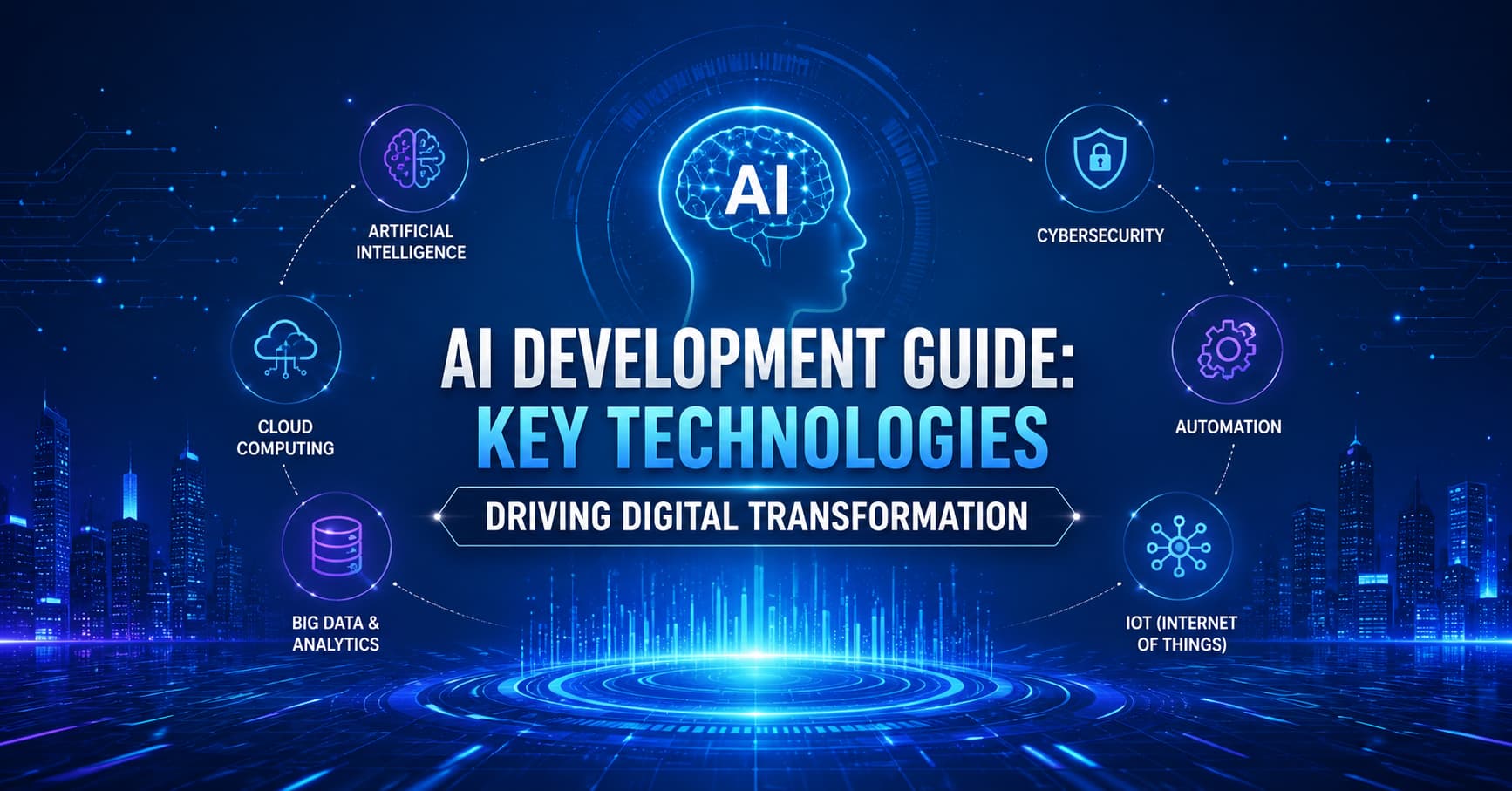
Artificial Intelligence (AI) has become one of the most transformative technologies of the modern era. Businesses across industries are increasingly adopting AI solutions to automate operations, improve customer experiences, enhance decision-making, and gain competitive advantages. As organizations continue their digital transformation journeys, understanding the technologies behind AI development is essential for success.
AI development involves creating systems that can perform tasks traditionally requiring human intelligence, such as learning, reasoning, problem-solving, language understanding, and pattern recognition. From healthcare and finance to retail and manufacturing, AI is revolutionizing how organizations operate and deliver value.
This comprehensive guide explores the key technologies driving AI development and digital transformation, helping businesses understand the tools and innovations shaping the future.
What Is AI Development?
AI development refers to the process of designing, building, training, and deploying intelligent systems capable of performing complex tasks with minimal human intervention. These systems use algorithms, data, and computational power to learn from experience and improve over time.
Modern AI development encompasses several disciplines, including:
- Machine Learning
- Deep Learning
- Natural Language Processing
- Computer Vision
- Robotics
- Predictive Analytics
- Generative AI
Together, these technologies enable organizations to transform traditional business processes into intelligent, data-driven operations.
Why AI Is Essential for Digital Transformation
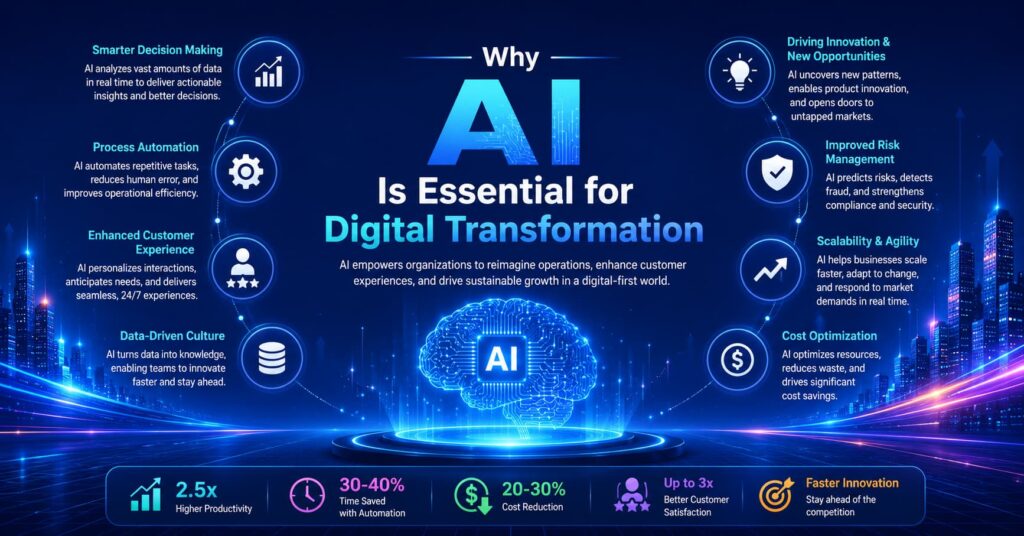
Digital transformation is the integration of digital technologies into all aspects of business operations. AI development serves as a critical component of this transformation by enabling automation, improving efficiency, and unlocking valuable insights from large volumes of data.
Key benefits of AI-driven digital transformation include:
Improved Operational Efficiency
AI automates repetitive tasks, reducing manual workloads and increasing productivity. Businesses can streamline workflows and optimize resource allocation.
Enhanced Customer Experience
AI-powered chatbots, recommendation systems, and virtual assistants provide personalized experiences that improve customer satisfaction and engagement.
Better Decision-Making
Advanced analytics and predictive models help organizations make informed decisions based on real-time data rather than assumptions.
Cost Reduction
Automation reduces operational costs while improving accuracy and minimizing human errors.
Competitive Advantage
Organizations leveraging AI can innovate faster, respond to market changes more effectively, and deliver superior products and services.
Understanding AI Development in the Modern Era
What AI Development Means Today
AI Development has evolved from a futuristic concept into one of the most influential forces driving business transformation worldwide. A decade ago, artificial intelligence was primarily associated with research labs and experimental projects. Today, organizations across healthcare, finance, manufacturing, retail, education, and logistics are integrating AI into everyday operations. This shift is happening because AI can analyze massive datasets, identify patterns, automate repetitive tasks, and generate insights faster than traditional systems. Businesses are no longer viewing AI as an optional technology; they see it as a strategic asset that helps them remain competitive in increasingly digital markets.
The rise of cloud computing, big data, and advanced algorithms has accelerated the adoption of AI technologies. Organizations now have access to scalable computing resources that make sophisticated AI models more affordable and practical. At the same time, the growth of digital interactions has generated enormous amounts of data, providing the fuel that AI systems need to learn and improve. AI development today involves designing intelligent systems that can understand language, recognize images, predict outcomes, and even create original content. As digital transformation continues to reshape industries, AI serves as the engine that powers smarter decision-making, enhanced productivity, and innovative customer experiences.
Why Businesses Are Investing in AI
Organizations are investing heavily in AI because the technology delivers measurable business value. Recent industry studies indicate that AI adoption has reached mainstream levels, with a significant percentage of enterprises already using AI in at least one business function. Research also suggests that companies implementing AI effectively report productivity gains, improved operational efficiency, and stronger innovation outcomes. Businesses recognize that AI enables them to process information faster, reduce costs, and uncover opportunities that might otherwise remain hidden. These advantages make AI a critical component of long-term growth strategies.
Another major driver is the increasing demand for personalization. Customers expect tailored recommendations, faster support, and seamless experiences across digital channels. AI helps businesses meet these expectations by analyzing customer behavior and delivering relevant interactions in real time. Companies are also leveraging AI-powered automation to reduce manual workloads and allow employees to focus on higher-value activities. As competition intensifies across industries, organizations that embrace AI development are positioning themselves to adapt faster, innovate more effectively, and create sustainable competitive advantages. Recent surveys show that AI is becoming a core enabler of business innovation and digital transformation across global markets.
The Role of AI in Digital Transformation
Connecting Technology with Business Goals
Digital transformation is not simply about adopting new technologies; it is about using technology to achieve meaningful business outcomes. AI plays a central role in this process because it bridges the gap between raw data and actionable insights. Organizations generate vast amounts of information every day, but without intelligent systems, much of that data remains underutilized. AI transforms data into strategic knowledge, helping leaders make informed decisions and respond quickly to changing market conditions.
Businesses implementing AI-driven digital transformation often experience improvements in operational efficiency, customer satisfaction, and revenue growth. AI-powered analytics can identify trends, forecast demand, and optimize resource allocation with remarkable accuracy. Imagine AI as a highly skilled navigator guiding a ship through unpredictable waters. Instead of relying solely on historical experience, organizations can use real-time intelligence to chart the most effective course. This ability to adapt and respond quickly has become increasingly important in today’s fast-paced digital economy, where customer expectations and market dynamics evolve constantly.
Transforming Customer Experiences
Customer experience has become one of the most important competitive differentiators in modern business. AI enables organizations to understand customer preferences, predict future behavior, and deliver highly personalized interactions. From recommendation engines used by e-commerce platforms to AI-powered chatbots handling customer inquiries, intelligent systems are transforming the way businesses engage with consumers. Customers increasingly expect brands to anticipate their needs and provide seamless experiences across multiple touchpoints.
AI also enhances customer support by enabling faster response times and more accurate problem resolution. Advanced natural language processing systems can understand customer questions, interpret intent, and provide relevant answers in real time. These capabilities improve satisfaction while reducing operational costs. Businesses that successfully integrate AI into customer-facing processes often build stronger relationships, increase customer loyalty, and generate higher lifetime value. As digital transformation continues to evolve, customer-centric AI solutions will remain a key driver of business success.
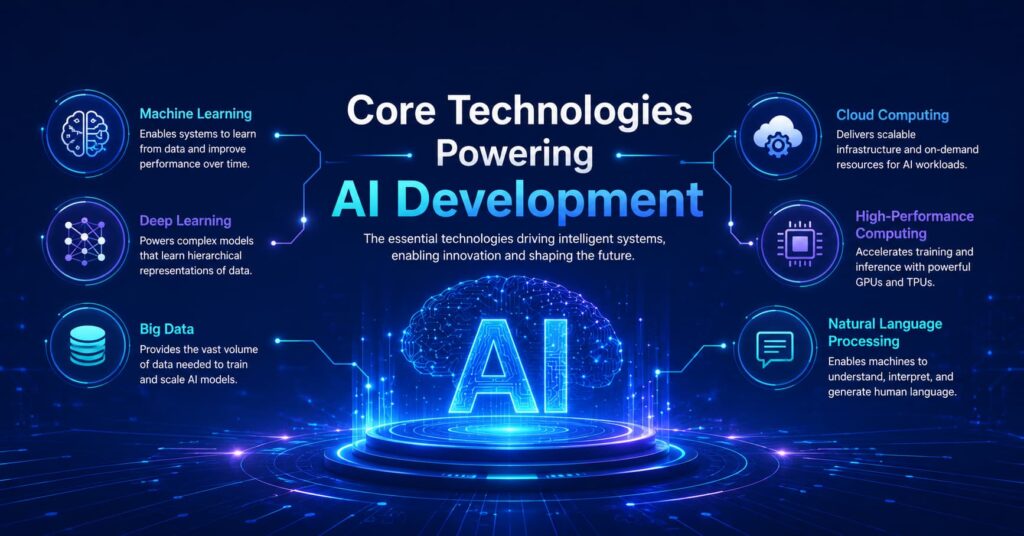
Core Technologies Powering AI Development
Machine Learning
Machine learning serves as the foundation of modern AI development. This technology enables systems to learn from data and improve performance without explicit programming. Instead of following rigid rules, machine learning algorithms identify patterns, make predictions, and adapt based on new information. Applications range from fraud detection and recommendation systems to predictive maintenance and demand forecasting. The versatility of machine learning makes it one of the most widely adopted AI technologies across industries.
Organizations use machine learning to extract insights from complex datasets that would be impossible for humans to analyze manually. For example, retailers can predict purchasing trends, healthcare providers can identify potential health risks, and financial institutions can detect suspicious transactions. Machine learning continues to evolve as researchers develop more sophisticated algorithms capable of handling increasingly complex tasks. Its ability to transform raw data into valuable intelligence makes it a cornerstone of digital transformation initiatives worldwide.
Deep Learning
Deep learning is a specialized branch of machine learning inspired by the structure of the human brain. It uses artificial neural networks with multiple layers to process information and recognize complex patterns. Deep learning has driven many of the most impressive breakthroughs in AI, including image recognition, speech processing, and autonomous systems. The technology excels at handling unstructured data such as images, audio, and text, making it essential for modern AI applications.
One reason deep learning has gained widespread adoption is its ability to achieve remarkable accuracy in tasks that were once considered uniquely human. Whether identifying objects in photographs or translating languages in real time, deep learning systems continue to push the boundaries of what machines can accomplish. As computing power increases and datasets grow larger, deep learning will remain a critical driver of innovation in AI development.
Natural Language Processing
Natural Language Processing (NLP) enables computers to understand, interpret, and generate human language. This technology powers virtual assistants, chatbots, translation tools, sentiment analysis platforms, and advanced conversational AI systems. NLP has advanced significantly in recent years, allowing machines to engage in increasingly natural and meaningful interactions with users. Businesses rely on NLP to improve communication, automate customer support, and analyze large volumes of text data efficiently.
The importance of NLP extends beyond customer service. Organizations use it to extract insights from documents, monitor brand sentiment on social media, and streamline internal workflows. By bridging the communication gap between humans and machines, NLP makes technology more accessible and intuitive. As language models continue to improve, NLP will play an even greater role in shaping the future of AI-powered digital experiences.
Computer Vision
Computer vision allows machines to interpret and understand visual information from images and videos. This technology has applications in healthcare diagnostics, manufacturing quality control, security systems, autonomous vehicles, and retail analytics. By analyzing visual data, computer vision systems can detect objects, recognize faces, identify defects, and monitor environments with impressive accuracy.
The adoption of computer vision continues to grow because visual information represents a significant portion of the data generated worldwide. Businesses use computer vision to improve operational efficiency, enhance safety, and gain deeper insights into customer behavior. As camera technology and AI algorithms become more advanced, computer vision will unlock new possibilities across industries and contribute significantly to digital transformation efforts.
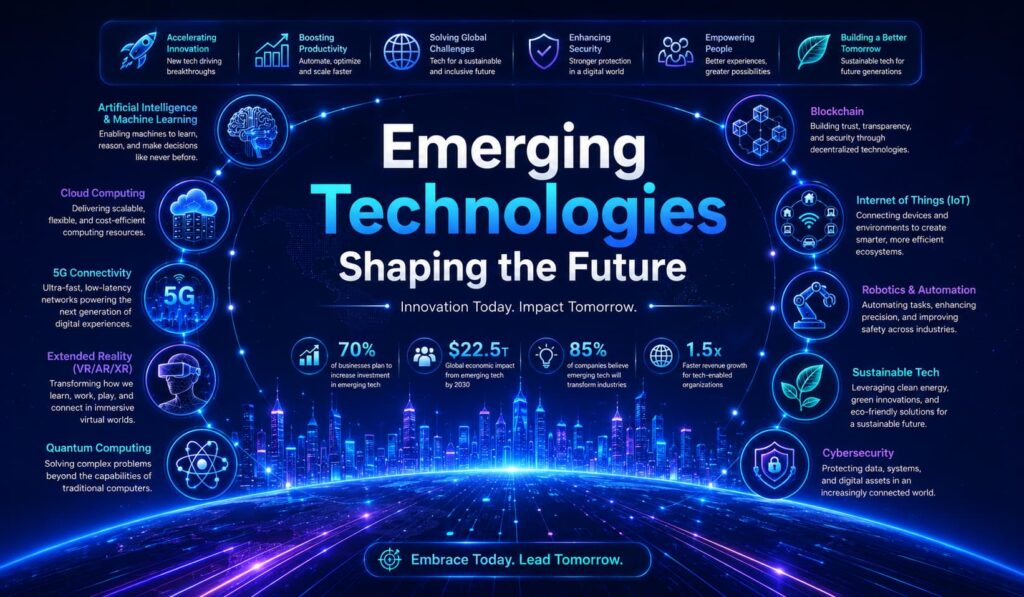
Emerging Technologies Shaping the Future
Generative AI
Generative AI has emerged as one of the most transformative innovation trends in recent years. Unlike traditional AI systems that focus on analysis and prediction, generative AI creates new content, including text, images, videos, code, and audio. This capability is revolutionizing industries by enabling faster content creation, accelerating software development, and enhancing creativity.
Organizations are leveraging generative AI to improve productivity and streamline workflows. Marketing teams use it to generate content, developers use it to write code, and businesses use it to create personalized customer experiences. As generative AI models become more sophisticated, their impact on digital transformation will continue to expand, creating new opportunities for innovation and growth.
AI Agents and Agentic Systems
AI agents represent the next stage in the evolution of artificial intelligence. These systems can perform tasks autonomously, make decisions, and collaborate with other agents to achieve complex objectives. Industry reports indicate growing interest in agentic AI, with many organizations actively exploring its potential to automate business processes and improve operational efficiency.
Unlike traditional automation tools, AI agents can adapt to changing conditions and make context-aware decisions. This flexibility makes them valuable for customer service, workflow management, and strategic planning. As organizations continue to experiment with agentic systems, these technologies are expected to become a major force in the future of AI development.
Edge AI
Edge AI brings intelligence closer to where data is generated. Instead of sending information to centralized cloud servers, edge AI processes data directly on devices such as smartphones, sensors, and industrial equipment. This approach reduces latency, improves privacy, and enables real-time decision-making.
Industries such as manufacturing, healthcare, and transportation are increasingly adopting edge AI because it supports faster and more reliable operations. As connected devices become more common, edge AI will play a crucial role in enabling intelligent systems to operate efficiently in distributed environments.
Quantum Computing and AI
Quantum computing remains an emerging technology, but its potential impact on AI development is enormous. Quantum computers can process certain types of calculations exponentially faster than traditional systems, potentially solving problems that are currently beyond reach. Researchers are exploring how quantum computing can improve machine learning algorithms, optimize complex systems, and accelerate scientific discovery.
Although widespread adoption is still years away, quantum computing represents an exciting frontier for AI innovation. Organizations investing in research and AI development today may gain significant advantages as the technology matures and becomes commercially viable.
Follow Us on LinkedIn
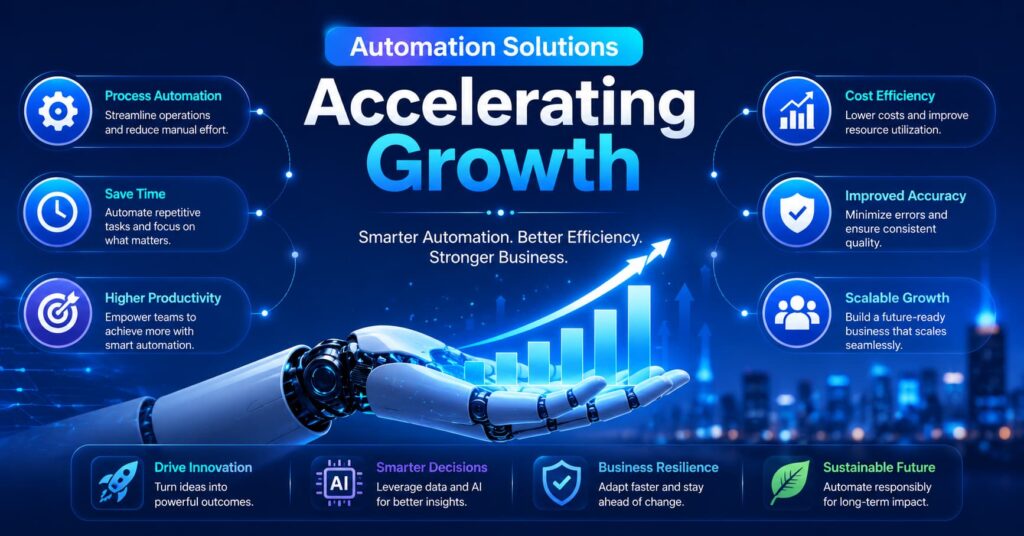
Automation Solutions Accelerating Growth
Intelligent Process Automation
Automation solutions have become essential for organizations seeking to improve efficiency and reduce operational costs. Intelligent Process Automation combines AI with traditional automation technologies to handle repetitive tasks, process data, and make decisions with minimal human intervention. Recent industry research indicates that automation investment continues to grow as organizations pursue productivity gains and operational excellence.
By automating routine activities, businesses can reduce errors, improve consistency, and free employees to focus on strategic initiatives. Intelligent Process Automation is particularly valuable in finance, human resources, customer service, and supply chain management. As AI development capabilities continue to advance, automation solutions will become increasingly sophisticated and impactful.
Predictive Analytics
Predictive analytics uses AI development and machine learning to forecast future outcomes based on historical data. Businesses rely on predictive analytics to anticipate customer behavior, optimize inventory, identify risks, and improve decision-making. This capability enables organizations to move from reactive management to proactive strategy.
The value of predictive analytics lies in its ability to transform uncertainty into opportunity. Rather than guessing what might happen next, businesses can use data-driven insights to make informed decisions. As organizations collect more data and refine their analytical capabilities, predictive analytics will remain a key component of successful digital transformation strategies.
Innovation Trends Influencing AI Development
Hyper-Personalization
Hyper-personalization represents one of the most powerful innovation trends shaping modern business. By combining AI, data analytics, and real-time insights, organizations can deliver highly individualized experiences to customers. This approach goes beyond traditional segmentation by tailoring interactions to each person’s preferences, behaviors, and needs.
Responsible AI
As AI becomes more integrated into society, responsible AI practices are gaining importance. Organizations must address issues such as fairness, transparency, accountability, and privacy to build trust with customers and stakeholders. Responsible AI ensures that technological progress aligns with ethical principles and societal expectations.
Human-AI Collaboration
The future of AI is not about replacing people; it is about enhancing human capabilities. Successful organizations are focusing on human-AI collaboration, where intelligent systems support employees by automating routine tasks and providing valuable insights. Studies suggest that AI delivers the greatest value when combined with human expertise rather than operating independently. This collaborative approach enables businesses to achieve higher productivity while maintaining creativity, judgment, and empathy.
Challenges in AI Implementation
Data Privacy and Security
Data privacy remains one of the most significant challenges in AI development. Organizations must collect, store, and process vast amounts of information while complying with regulatory requirements and protecting sensitive data. Failure to address privacy concerns can damage trust and create legal risks.
Skills and Talent Gaps
AI development Another major challenge is the shortage of skilled AI professionals. Organizations often struggle to find experts in machine learning, data science, and AI engineering. At the same time, employees require training to work effectively alongside AI systems. Addressing this talent gap will be essential for maximizing the benefits of AI-driven digital transformation.
Conclusion
AI development has become a cornerstone of modern digital transformation. Technologies such as machine learning, deep learning, natural language processing, computer vision, generative AI, and agentic systems are reshaping industries and creating new opportunities for growth. Businesses that embrace emerging technologies, implement effective automation solutions, and follow responsible innovation practices will be better positioned to compete in an increasingly digital world.
The future belongs to organizations that view AI not as a standalone technology but as a strategic capability woven into every aspect of their operations. As innovation trends continue to evolve, AI development will remain one of the most powerful drivers of business transformation, operational excellence, and customer value creation.
FAQs
1. What is AI Development?
AI Development is the process of designing, building, and deploying intelligent systems that can learn, analyze data, automate tasks, and make decisions.
2. Why is AI important for digital transformation?
AI helps organizations improve efficiency, automate processes, gain insights from data, and deliver personalized customer experiences.
3. What are the key technologies in AI Development?
Machine Learning, Deep Learning, Natural Language Processing, Computer Vision, Generative AI, and AI Agents are among the most important technologies.
4. How do automation solutions support business growth?
Automation solutions reduce manual work, improve accuracy, increase productivity, and allow employees to focus on strategic activities.
5. What are the biggest challenges in AI implementation?
Data privacy concerns, security risks, talent shortages, ethical considerations, and integration complexities are among the primary challenges organizations face.
Know more About Us

Hi, I’m Rufqha, the SEO Manager at AIBlogMind. I focus on building content strategies that help websites improve visibility, attract the right audience, and create sustainable organic growth. My expertise includes on-page SEO, keyword research, content optimization, and aligning SEO with user experience and business goals.