

Video Marketing: 15 Proven Strategies to Increase Engagement and Sales
Imagine scrolling through your social media feed and stopping dead in your tracks not because of a text post or a static image, but because of a short, punchy video that grabs your attention in less than three seconds. That is the power of video marketing in today’s digital world.
Businesses everywhere are struggling with the same problem: they create content, they post consistently, but their engagement stays flat and sales remain stagnant. The reason is simple people no longer want to read walls of text. They want to watch, listen, and feel. If your brand is not using video marketing as a core part of its strategy, you are already falling behind.
The good news is that video marketing is not reserved for big corporations with massive budgets. Whether you are a solo entrepreneur, a small business owner, or a growing brand, a smart video marketing strategy can transform how your audience connects with you. In this article, you will discover 15 proven video marketing strategies that will help you increase engagement, build trust, and drive real sales results.
What Is Video Marketing and Why Does It Matter?
Video marketing is the practice of using video content to promote your brand, products, or services across digital platforms. It includes everything from short-form social media clips and product demos to long-form tutorials, webinars, and live streams.
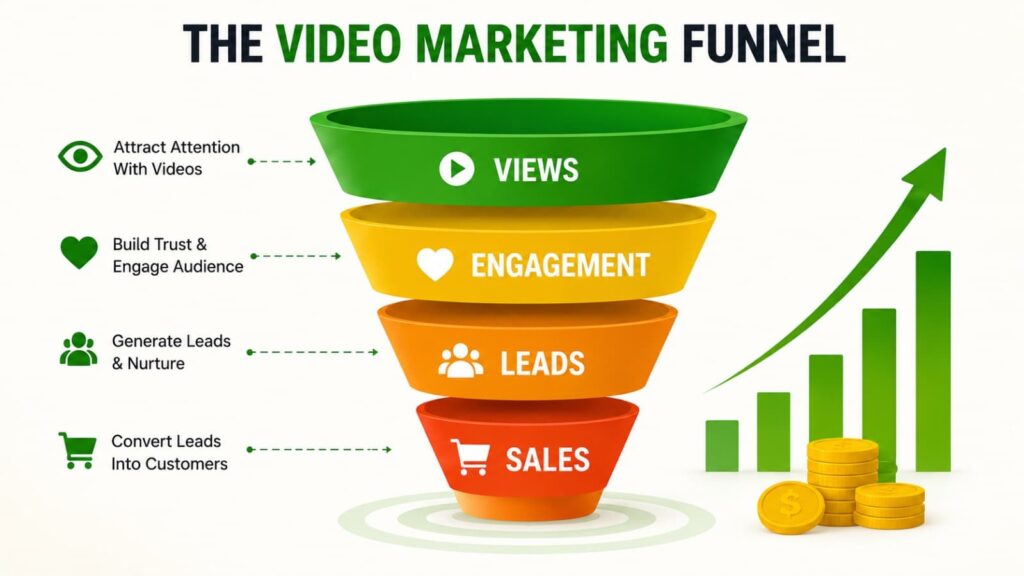
The numbers tell a powerful story. According to industry data, people watch an average of 17 hours of online video per week. Websites that feature video content are 53 times more likely to appear on the first page of Google search results. And video marketing on landing pages can increase conversions by up to 80%.
Video marketing works because it combines visual storytelling with emotion. When someone watches a well-crafted video, they are not just consuming information — they are experiencing your brand. That experience builds the kind of trust and connection that converts viewers into buyers.
Benefits of Using Video Marketing Tools
Modern video marketing is powered by a wide range of tools from AI-assisted editing platforms to advanced analytics dashboards. These tools make it easier than ever to create professional-quality videos without a studio, a film crew, or a huge budget.
The key benefits of using video marketing tools include faster production time, consistent brand visuals, automated captioning, performance tracking, and easy distribution across multiple platforms. When used correctly, these tools allow even the smallest teams to execute a high-impact video marketing strategy.
AI-powered tools in particular are changing the game. They can help you generate scripts, edit raw footage automatically, add music, create subtitles, and even optimize video titles and thumbnails for better search visibility. This means more time for creativity and strategy, and less time on technical execution.
Limitations of Video Marketing Tools
As powerful as these tools are, they do have limitations. No tool can replace genuine human creativity and authentic storytelling. Over-reliance on AI-generated content can make your videos feel generic, robotic, or disconnected from your audience.
Some platforms also have steep learning curves, expensive pricing tiers, or limited customization options. Analytics tools may track surface-level data like views and clicks, but struggle to measure deeper metrics like emotional resonance or brand recall.
The takeaway is to use video marketing tools as a support system, not a replacement for strategy. The best results always come from combining smart tools with a clear video marketing strategy and a human touch.
Video Marketing: 15 Proven Strategies to Increase Engagement and Sales
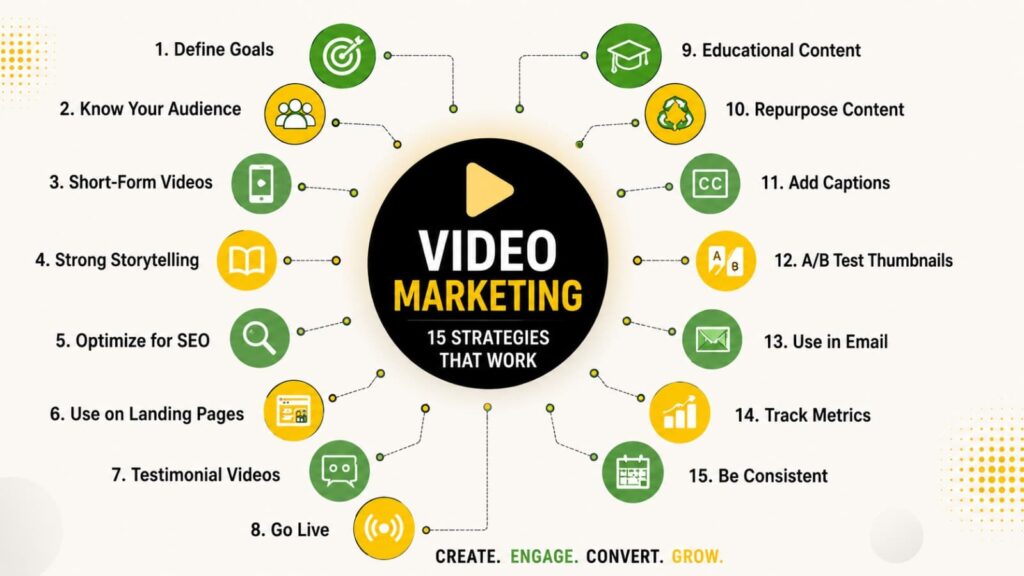
Strategy 1: Define Your Video Marketing Goals Before You Press Record
Every successful video marketing strategy starts with clarity. Before you create a single frame, ask yourself: what do you want this video to do? Are you trying to build brand awareness, generate leads, explain a product, or close a sale?
Setting clear goals shapes everything your script, your tone, your call to action, and where you distribute the video. A video made without a goal is just content. A video made with a goal is a marketing asset.
Strategy 2: Know Your Audience Inside and Out
Video marketing only works when it speaks directly to the right people. Study your target audience their pain points, their desires, the questions they ask, the platforms they use, and the type of content they respond to.
When your video marketing strategy is rooted in deep audience understanding, every video you make will feel personal and relevant. That personal connection is what drives engagement and keeps viewers coming back.
Strategy 3: Use Short-Form Video to Capture Attention Fast
The human attention span online is shorter than ever. Short-form video marketing content under 60 seconds is one of the most effective ways to grab attention and communicate value quickly.
Platforms like Instagram Reels, TikTok, and YouTube Shorts have made short-form video marketing one of the fastest-growing content categories in the world. Use this format for tips, product highlights, behind-the-scenes moments, and micro-tutorials.
Strategy 4: Invest in Strong Storytelling
The most effective video marketing does not just sell it tells a story. Stories activate the emotional centers of the brain, making your message more memorable and your brand more relatable.
Build your video marketing content around a beginning, middle, and end. Introduce a problem, build tension, and offer a resolution ideally one that involves your product or service. Great storytelling is the single biggest differentiator in video marketing today.
Strategy 5: Optimize Videos for SEO
Video marketing and SEO are closely connected. Search engines like Google love video content, but they can only find it if it is properly optimized.
This means writing keyword-rich titles and descriptions, adding transcripts and captions, using relevant tags, and creating compelling thumbnails. A strong video marketing strategy always includes SEO at its core, because a video that no one can find is a video that cannot convert.
Strategy 6: Use Video Marketing on Landing Pages
Placing a video on your landing page is one of the highest-return moves in video marketing. Studies consistently show that video on landing pages significantly boosts conversion rates.
Whether it is a short product explainer, a testimonial reel, or a founder story, video marketing on landing pages gives visitors a fast, engaging way to understand what you offer and why it matters. Keep these videos short, focused, and action-oriented.
Strategy 7: Leverage Social Proof Through Testimonial Videos
Customer testimonial videos are among the most powerful tools in your video marketing strategy. Real customers sharing real results build credibility in a way that polished ad copy simply cannot.
Ask your happiest customers to record a short video sharing their experience. Even a simple, unpolished testimonial filmed on a smartphone can outperform a slick promotional video because authenticity resonates. Testimonial video marketing builds trust at scale.
Strategy 8: Go Live to Build Real-Time Connection
Live streaming is one of the most underused opportunities in video marketing. Going live on platforms like YouTube, Instagram, Facebook, or LinkedIn creates a sense of urgency, exclusivity, and authentic connection.
Use live video marketing for product launches, Q&A sessions, tutorials, webinars, or behind-the-scenes events. The unscripted nature of live streams makes your brand feel more human and approachable, which deepens audience loyalty and fuels long-term engagement.
Strategy 9: Create Educational Video Content That Solves Real Problems
People search for solutions every single day. If your video marketing strategy includes helpful, educational content, you position your brand as an expert and a trusted resource.
Tutorial videos, how-to guides, explainer videos, and FAQ-style content are all forms of educational video marketing that attract organic traffic and build lasting authority in your niche. When you solve someone’s problem for free, they remember who helped them.
Strategy 10: Repurpose Video Content Across Multiple Platforms
One of the most efficient approaches in video marketing is content repurposing. A single long-form video can become dozens of pieces of content across different platforms.
Clip a 60-minute webinar into 10 short highlights for social media. Turn a product demo into a series of tutorial clips. Pull quotes from an interview for static posts. A smart video marketing strategy multiplies the reach of every piece of content you create, maximizing your return on investment.
Strategy 11: Add Subtitles and Captions to Every Video
A surprising number of people watch videos with the sound off particularly on mobile devices. If your video marketing content does not have captions, you are losing a significant portion of your potential audience.
Captions also improve accessibility, increase watch time, and boost SEO performance. Adding subtitles to your video marketing content is a simple step that has a measurable impact on reach and engagement across every platform.
Strategy 12: A/B Test Your Video Thumbnails and Titles
In video marketing, the thumbnail and title are your first impression. They determine whether someone clicks or scrolls past. A/B testing different thumbnails and titles gives you real data on what resonates with your audience.
Test bright vs. dark thumbnails, text overlays vs. clean images, question-based titles vs. statement-based titles. Over time, these insights refine your entire videos marketing strategy and significantly improve your click-through rates.
Strategy 13: Use Video Marketing in Email Campaigns
Email and videos marketing are a powerful combination. Adding the word “video” in an email subject line has been shown to increase open rates by 19% and click-through rates by up to 65%.
You do not even need to embed a full video in your email. Simply include a thumbnail image with a play button that links to your video. This simple videos marketing tactic can dramatically boost the performance of your email campaigns.
Strategy 14: Track the Right Video Marketing Metrics
You cannot improve what you do not measure. A data-driven videos marketing strategy tracks the metrics that actually matter: watch time, audience retention, click-through rate, conversion rate, and return on investment.
Avoid getting distracted by vanity metrics like total views. Instead, focus on how long people watch, where they drop off, and what actions they take after watching. These insights allow you to continuously refine and improve your videos marketing content.
Strategy 15: Be Consistent and Build a Video Marketing Habit
Consistency is the secret ingredient in every successful videos marketing strategy. Brands that publish video content regularly build stronger audience relationships, rank higher in search results, and stay top-of-mind with potential buyers.
You do not need to post daily. You need to post consistently. Create a realistic videos marketing content calendar and stick to it. Over time, consistency compounds each video builds on the last, growing your audience, authority, and sales.
Comparing Different Video Marketing Formats
Not all video formats serve the same purpose, and understanding the differences helps you build a smarter videos marketing strategy.
Short-form videos marketing (under 60 seconds) is best for top-of-funnel awareness, trend-driven content, and social engagement. It is fast, shareable, and ideal for introducing your brand to new audiences.
Long-form videos marketing (10 minutes or more) works well for deep-dive tutorials, webinars, and documentary-style content. It builds deeper authority and is highly effective on platforms like YouTube, where longer watch time signals credibility.
Live videos marketing sits in the middle — it can run from a few minutes to several hours. Its greatest strength is real-time interaction and community building.
Animated and explainer marketing is particularly effective for software products, complex services, or any concept that is easier to show than explain in words.
The best marketing strategies use a mix of all formats, matching each type to the right stage of the buyer journey.
Connect with us on Linkedln
How to Choose the Right Video Marketing Strategy for Your Business
Choosing the right videos marketing strategy depends on three things: your audience, your goals, and your resources.
Start by identifying where your target audience spends time online. If they are mostly on LinkedIn, invest in professional videos marketing content — thought leadership, case studies, and corporate storytelling. If they are on TikTok or Instagram, short-form videos marketing with a casual, entertaining tone will perform best.
Next, align your video marketings strategy with your business goals. If you want to drive awareness, prioritize reach and shareability. If you want to convert leads, focus on product demos, testimonials, and landing page videos.
Finally, be honest about your resources. A videos marketing strategy that requires a full production crew every week is not sustainable for a small team. Start with what you can do consistently and scale from there. Even a smartphone and good lighting can produce videos marketing content that converts.
Final Verdict
Video marketing is no longer optional it is essential. In a digital landscape overflowing with content, video is the format that cuts through the noise, builds genuine connection, and drives measurable business results.
The 15 video marketing strategies outlined in this article are not theoretical. They are proven approaches used by successful brands of every size, in every industry. Whether you are just starting with videos marketing or looking to take your existing efforts to the next level, applying even a handful of these strategies consistently will produce meaningful results.
The most important step is simply to start. Pick one videos marketing strategy, execute it well, learn from the data, and build from there. Your audience is already watching make sure it is your video they are watching.
Frequently Asked Questions
What is video marketing? Videos marketing is the use of video content to promote a brand, product, or service across digital platforms. It is one of the most effective forms of content marketing available today, combining visual storytelling with emotional engagement to drive awareness, trust, and sales.
How do I create a video marketing strategy? A videos marketing strategy starts with defining your goals, understanding your audience, choosing the right platforms, creating consistent content, and measuring your results. Start simple, stay consistent, and refine your approach based on data.
How often should I post video marketing content? Consistency matters more than frequency. For most businesses, posting one to three pieces of marketing content per week is a sustainable and effective starting point. The key is to maintain a regular schedule that your audience can rely on.
Is video marketing expensive? Video marketing does not have to be expensive. Many brands produce high-performing marketing content using just a smartphone, natural lighting, and free or affordable editing tools. As your strategy grows, you can invest in better equipment and production quality.
What platforms are best for video marketing? The best platforms for video marketings depend on your target audience. YouTube is ideal for long-form content and search-driven video marketing. Instagram and TikTok excel for short-form video market. LinkedIn works well for B2B marketing, while Facebook remains strong for community-building and live video marketing.
How does video marketing increase sales? Video marketings increases sales by building trust, educating buyers, and reducing friction in the decision-making process. Product demos, testimonials, and explainer videos all address buyer objections and move people closer to a purchase with greater confidence.
How does video marketing increase sales? Videos increases sales by building trust, educating buyers, and reducing friction in the decision-making process. Product demos, testimonials, and explainer videos all address buyer objections and move people closer to a purchase with greater confidence.
Know More About Us

Mohammed Viqar Ali is a Digital Marketer, UI/UX Designer, and content creator passionate about AI, technology, SEO, and digital growth. As the UI/UX Designer of aiblogmind, he focuses on creating user-friendly digital experiences while sharing practical insights on artificial intelligence, marketing trends, productivity tools, and online business growth. Through his content, he helps readers discover innovative solutions, stay updated with emerging technologies, and make informed decisions in the digital world.