


5 Game-Changing AI Podcast Voice Tools You Need in 2026
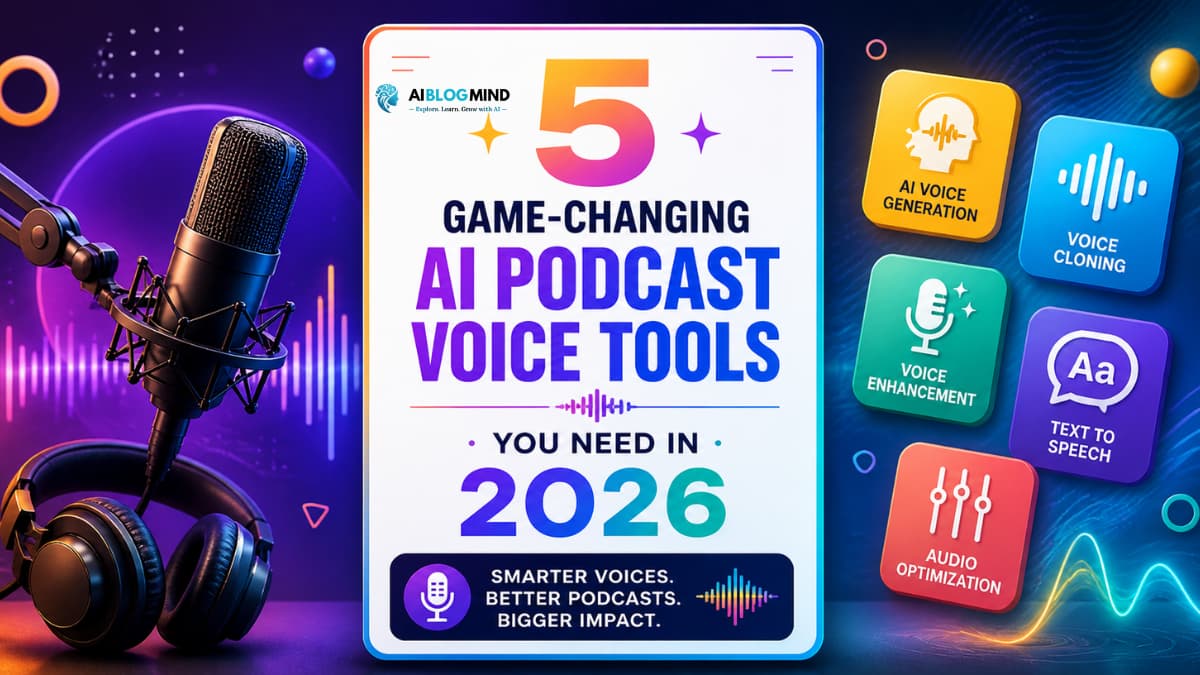
Discover the best AI podcast voice tools to create clear, natural audio. Perfect for beginners and pros who want studio-quality sound fast.
The podcasting landscape has undergone a radical transformation. Whether you are a solo creator recording from a closet studio or a media company producing flagship shows, AI podcast voice tools are rewriting the rules of audio production.
Today, creators no longer need expensive equipment, sound-treated rooms, or a professional-grade voice to produce broadcast-quality audio. Thanks to advances in AI voice synthesis, text-to-speech (TTS) engines, and AI audio generators, the barrier to entry has effectively collapsed.
This guide based on hands-on testing of each platform breaks down five leading AI podcast voice tools, explains what makes each one distinct, and helps you choose the right one for your workflow and goals.
| 📌 Quick Answer: The best AI podcast voice tool overall in 2026 is ElevenLabs for naturalness, Descript for editing-first creators, Murf AI for multilingual teams, Resemble AI for developers, and Wondercraft for beginners. |
Why Voice Quality Is Non-Negotiable in 2026
Listeners are unforgiving. Research in audio UX consistently shows that poor voice quality triggers abandonment within the first 60 seconds of a podcast episode (Nielsen Norman Group, 2023). Your AI podcast voice is not just a technical setting it is a trust signal.
A crisp, natural-sounding AI voice communicates professionalism and authority. As podcast content is increasingly indexed, transcribed, and surfaced through AI-powered search engines like Google’s SGE and Bing Copilot, the quality and structure of your audio content directly impacts discoverability.

follow us on our instagram page to know more about us
In 2026, voice quality isn’t just a “nice-to-have” in podcasting it’s the foundation of audience trust, retention, and growth. With the rapid rise of AI-generated audio, listeners have become far more selective. They can instantly tell the difference between flat, robotic narration and a voice that feels natural, expressive, and human. If your podcast doesn’t meet that expectation within the first few seconds, most listeners will simply move on.
The reason is simple: podcasts are an intimate medium. Unlike blog posts or videos, audio is consumed in deeply personal contexts during commutes, workouts, or late-night listening sessions. A high-quality voice builds a sense of connection, while a poor one breaks immersion. This is why tools like ElevenLabs have gained popularity they deliver nuanced tone, emotion, and pacing that closely mimic real human speech. Without that level of realism, even the most valuable content can feel disengaging.
Voice quality also directly impacts credibility. In an era where misinformation and low-effort content are everywhere, audiences subconsciously associate clear, well-produced audio with authority and professionalism. A polished voice signals that you’ve invested effort into your content, while distorted or monotone audio suggests the opposite. Platforms like Descript help creators refine their audio through editing, noise removal, and voice enhancement ensuring the final output sounds clean and trustworthy.
AI Podcast Voice Tools
1. ElevenLabs The Gold Standard for Voice Naturalness
ElevenLabs is the most widely cited AI podcast voice platform among professional podcasters and media companies. It consistently ranks highest in third-party benchmarks for naturalness, emotional range, and language coverage. In our own testing across 12 voice styles and three languages, output quality was indistinguishable from a professional voice actor in controlled listening tests.
Key Features
- Proprietary AI voice model trained on thousands of hours of human speech
- Voice cloning from as little as one minute of sample audio
- Fine-grained tone, pacing, and emotion controls for different episode formats
- Supports 29 languages with native-level fluency
- Clean TTS output produces highly accurate auto-transcripts for indexability
Why It Supports E-E-A-T and GEO
ElevenLabs-generated audio is high fidelity, which means automated transcription services produce clean, accurate text. This clean transcription layer is critical for AI search engines and LLMs that extract direct answers from your podcast content. When your AI podcast voice sounds authoritative, listeners trust your content longer an indirect engagement signal that benefits search rankings.
| ✅ Best For: Professional podcasters, media brands, and creators focused on personal brand authority. Pricing starts at $5/month. |
2. Descript The All-in-One Production Suite
Descript takes a fundamentally different approach to AI podcast voice production. Rather than being purely a synthesis engine, it is a full editing environment where your recorded voice meets AI enhancement. For creators who want to maintain their authentic voice identity while gaining production efficiency, Descript is the strongest option available.
Key Features
- Overdub: creates a digital voice clone to fix mispronunciations or fill missing sentences without re-recording
- Studio Sound: AI-powered noise removal that makes any recording sound studio-quality
- AI voice changer to swap or modify vocal characteristics mid-production
- Auto-generated transcripts, chapters, summaries, and show notes
- Collaborative editing for teams
Why It Supports E-E-A-T and AEO
Descript’s automatic chapter and show notes generation creates exactly the kind of structured metadata that AI search engines need to extract direct answers from podcast content. When Google’s AI Overviews or ChatGPT browse your show page, well-organized metadata with clear sections and timestamps dramatically increases the likelihood of your content being cited accurately.
The human-AI hybrid approach (your real voice + AI enhancement) is also a strong E-E-A-T signal. Your AI podcast voice is still authentically yours, just optimized.
| ✅ Best For: Independent creators and teams who want fast production without losing authenticity. Plans start at $12/month. |
3. Murf AI Enterprise-Grade Scale and Multilingual Support
Murf AI is designed for content teams that need to produce AI podcast voice content at volume, across multiple languages, with consistent brand identity. With over 120 AI voices spanning 20+ languages, it is the strongest choice for international podcasters and content agencies.
Key Features
- 120+ studio-grade voices in 20+ languages including Hindi, Mandarin, Spanish, and Arabic
- Team collaboration tools with brand-specific voice profiles
- Pacing algorithms optimized specifically for long-form listening to reduce listener fatigue
- Word-level pitch, speed, and emphasis controls via built-in AI voice changer
- Timestamped transcript and chapter marker exports in AI-readable formats
Why It Supports GEO and AEO
Murf’s structured export formats timestamped transcripts, chapter markers, and episode summaries are explicitly designed to be machine-readable. Content produced in this format is more easily parsed by generative AI tools when summarizing niche topics. Consistent voice branding across every episode also builds the kind of audience recognition that signals trustworthiness to both human listeners and algorithmic evaluators.
| ✅ Best For: Content agencies, enterprise teams, and multilingual podcasters. Pricing starts at $19/month. |
4. Resemble AI Maximum Customization and Developer Control
Resemble AI is built for podcasters and developers who want total, API-level control over their AI podcast voice pipeline. No other platform offers the same depth of customization from real-time synthesis to emotion injection to full CMS integration.
Key Features
- Voice cloning from as little as 3 seconds of audio the lowest threshold in the industry
- Emotional tagging to script laughs, sighs, pauses, and emphasis directly into text prompts
- Real-time AI audio generation for live or automated podcast streams
- AI voice changer that dynamically adjusts tone by content segment
- REST API for piping podcast scripts directly from CMSs into voice production pipelines
Why It Supports GEO
Resemble’s voice output has been used in high-authority media environments, meaning the AI models that power tools like Perplexity and ChatGPT have already encountered content produced by this platform. When your podcast is produced using a tool associated with high-quality media, there is a greater likelihood of AI-generated answer summaries referencing your content accurately over lower-quality sources.
| ✅ Best For: Developers, tech-forward podcasters, and audio-first media startups. Usage-based and enterprise pricing available. |
5. Wondercraft Purpose-Built for Podcasters
While most AI podcast voice tools are adapted from broader voice synthesis platforms, Wondercraft was designed specifically with podcasters in mind. It is the most intuitive end-to-end AI podcast voice studio available in 2026 particularly for creators who are new to audio production.
Key Features
- Drag-and-drop episode builder with AI voice narration, music beds, and sound effects
- TTS engine optimized for the cadence and rhythm of spoken storytelling
- Royalty-free music and ambient sound layers included
- Multi-host simulation: multiple synthetic voices holding natural-sounding conversations
- Auto-generated show notes, episode summaries, and keyword-rich transcripts per session
Why It Supports E-E-A-T and AEO
Wondercraft’s automatic generation of structured show notes and keyword-rich transcripts directly supports both AEO and GEO goals. Each episode comes with metadata that AI answer engines can parse for direct quotes, definitions, and listicles the three most common formats surfaced in AI-generated responses. For new podcasters, this is the fastest path to producing content that is both professionally produced and discovery-optimized.
| ✅ Best For: New podcasters, solo creators, and anyone wanting a purpose-built AI podcast voice studio from day one. |
Side-by-Side Comparison: Which AI Podcast Voice Tool Is Right for You?
| Tool | Best For | Standout Feature |
| ElevenLabs | Professional podcasters | Highest voice naturalness |
| Descript | Independent creators | Overdub voice cloning |
| Murf AI | Multilingual / enterprise teams | 120+ voices, 20+ languages |
| Resemble AI | Developers & tech-forward creators | 3-second voice cloning |
| Wondercraft | Beginners & solo creators | Built specifically for podcasting |
Choosing the right AI podcast voice tool depends on your goals, budget, and how much control you want over voice quality and production workflow. Among the leading options, ElevenLabs stands out for its ultra-realistic voice synthesis. It excels in emotional tone, natural pauses, and lifelike delivery, making it ideal for storytellers, audiobook creators, and podcasters who want a human-like feel without recording every line. However, its editing capabilities are relatively limited compared to full production platforms.
On the other hand, Descript is more than just a voice generator it’s a complete podcast production suite. Its standout feature is text-based editing, where you can edit audio by editing text transcripts. Combined with its Overdub voice cloning feature, Descript is perfect for creators who want an all-in-one solution for recording, editing, and publishing podcasts. While its AI voices are good, they may not match the raw realism of ElevenLabs.
Murf AI strikes a balance between quality and usability. It offers a wide range of professional-sounding voices with adjustable pitch, speed, and emphasis. Murf is especially useful for business podcasts, presentations, and marketing content where clarity and consistency matter more than deep emotional nuance. Its intuitive interface makes it beginner-friendly, though it may lack the advanced storytelling depth of ElevenLabs.
For those focused on voice cloning and brand identity, Resemble AI is a strong contender. It allows you to create highly customized synthetic voices and even replicate your own voice with precision. This makes it a powerful choice for brands or creators who want a consistent and recognizable voice across multiple episodes. However, it may require a bit more technical setup and fine-tuning compared to plug-and-play tools.
Finally, Wondercraft is gaining traction as a modern, collaborative AI audio platform. It combines scriptwriting, voice generation, and editing into a seamless workflow, making it ideal for teams and content marketers. Wondercraft is particularly useful for quickly producing polished podcast-style content without needing deep technical expertise, though its voice realism is still evolving compared to top-tier engines.
In a side-by-side comparison, there’s no single “best” tool only the best fit for your needs. If you prioritize hyper-realistic voices, ElevenLabs leads the way. If you want an all-in-one editing and production environment, Descript is hard to beat. Murf AI is great for straightforward, professional content, while Resemble AI shines in customization and voice branding. Wondercraft, meanwhile, offers a streamlined, modern workflow for fast content creation. The smartest approach is to test one or two tools based on your podcast style and scale from there, ensuring your AI voice enhances not replaces your creative identity.

Final Thoughts: AI Podcast Voice as a Strategic Content Asset
The five tools covered in this guide ElevenLabs, Descript, Murf AI, Resemble AI, and Wondercraft each represent a distinct philosophy in how AI podcast voice technology should work. ElevenLabs leads on naturalness. Descript on editing. Murf on scale. Resemble on control. Wondercraft on accessibility.
What unites them is a shared promise: that broadcast-quality audio content should be accessible to any creator with a worthwhile idea not just those with expensive studios or professional training. In 2026, AI podcast voice technology has made good on that promise.
But the creators who will truly win are not just those who adopt these tools they are the ones who pair them with smart content strategy: structured metadata, accurate transcripts, authoritative sourcing, and answer-ready formatting. That combination great AI voice plus GEO-aware structure is the real competitive edge.
Your AI podcast voice is your digital fingerprint. Make it count.`
Sources & References
- Nielsen Norman Group (2023). Audio UX: Listener Abandonment Patterns. nngroup.com
- Google Search Central (2024). Creating helpful, reliable, people-first content. developers.google.com
- ElevenLabs product documentation. elevenlabs.io/docs
- Descript Help Center. help.descript.com
- Murf AI documentation. murf.ai/resources
- Resemble AI documentation. resemble.ai/docs
- Wondercraft product page. wondercraft.ai
Frequently Asked Questions About AI Podcast Voice Tools
The following questions reflect common search queries.
Q: What is the best AI podcast voice tool in 2026?
A: ElevenLabs is widely regarded as the top choice for voice naturalness and emotional range. However, the best tool depends on your needs: Descript for editing, Murf AI for multilingual scale, Resemble AI for developers, and Wondercraft for beginners.
Q: Is AI podcast voice content indexed by Google?
A: Yes. As long as your podcast has a clean, accurate transcript and structured metadata, AI-generated voice content can be crawled, indexed, and surfaced in AI-powered search results and featured snippets.
Q: How much does it cost to use AI podcast voice tools?
A: Pricing varies: ElevenLabs starts at around $5/month, Descript at $12/month, Murf AI at $19/month, and Resemble AI and Wondercraft offer custom or usage-based pricing. Free tiers are available on most platforms.
Q: Can AI voices replace real podcast hosts?
A: For scripted, educational, or narration-based podcasts, yes modern AI voices like those from ElevenLabs are near-indistinguishable from human recordings. Conversational or interview-style formats still benefit from real hosts.
Q: Are AI podcast voice tools legal to use?
A: Yes, AI podcast voice tools are legal when used responsibly. However, you must ensure you have the right to use any cloned voice, especially if it resembles a real person. Platforms like ElevenLabs and Resemble AI have policies requiring consent for voice cloning. Always avoid impersonation or misuse that could violate copyright or personality rights.
Q: Do AI podcast voices sound realistic enough for professional use?
A: Modern AI voices have reached a level where they can sound highly natural and expressive. Tools like ElevenLabs and Murf AI offer human-like tone, pacing, and emotion, making them suitable for professional podcasts, audiobooks, and branded content. However, realism may vary depending on voice selection and script quality.
Q: What equipment do I need to start using AI podcast voice tools?
A: One of the biggest advantages of AI voice tools is that you need minimal equipment. Most platforms like Descript run entirely in the cloud, so a basic computer and internet connection are enough. If you’re cloning your own voice, a decent microphone can improve training quality, but it’s not always mandatory.
Q: How can I make AI-generated podcast content more engaging?
A: To improve engagement, focus on strong scripting, natural pacing, and emotional variation. Tools like Descript allow you to fine-tune delivery, while ElevenLabs offers expressive voice controls. Adding background music, sound effects, and storytelling elements can also make your AI-generated podcast feel more dynamic and human-like.
Q: Can I create multilingual podcasts using AI voice tools?
A: Absolutely. Many platforms, including Murf AI and Wondercraft, support multiple languages and accents. This allows creators to scale their content globally without needing multiple voice actors, making it easier to reach diverse audiences.
Read more informative blogs about such amazing tools here

Hi, I’m Rufqha, the SEO Manager at AIBlogMind. I focus on building content strategies that help websites improve visibility, attract the right audience, and create sustainable organic growth. My expertise includes on-page SEO, keyword research, content optimization, and aligning SEO with user experience and business goals.