


Will AI Replace Jobs? The Reality of AI in 2026 Full Guide
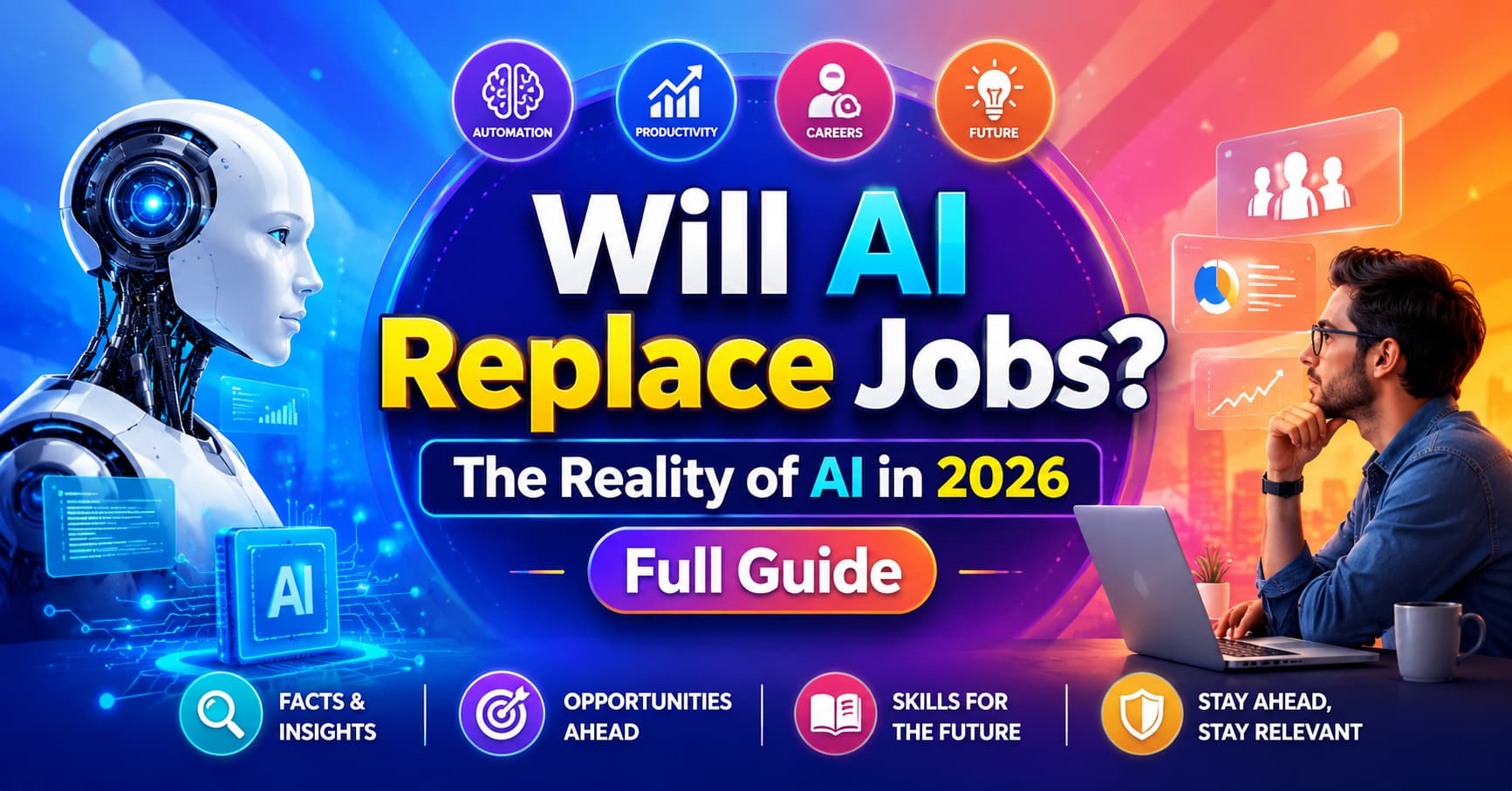
Artificial intelligence is no longer a futuristic idea. In 2026, AI tools are already transforming industries, changing workflows, and forcing businesses to rethink how work gets done. The biggest question people ask today is simple: Will AI replace jobs completely?
The truth is more complicated than a simple yes or no. AI is replacing some repetitive tasks, improving productivity, and creating new opportunities at the same time. Many workers fear AI job replacement, while others see AI as a tool that can improve careers and open new paths.
From customer service bots to AI-powered design tools and automated factories, the impact of AI automation jobs is visible everywhere. Companies are investing billions into automation because it saves time, reduces costs, and improves efficiency. However, human creativity, emotional intelligence, leadership, and strategic thinking still remain difficult for AI to fully replace.
This guide explores the reality behind the “AI replace jobs” debate in 2026, including industries most affected, jobs at risk, careers likely to grow, and how workers can prepare for the future jobs AI is creating.
The reality of AI automation jobs in 2026 is that companies are increasingly using AI tools to reduce repetitive workloads while expecting employees to focus on creativity, strategy, communication, and decision-making. Workers who adapt to these changes are more likely to thrive in the future AI economy.
This guide explores the truth behind jobs replaced by AI, the industries most affected, careers that are growing because of AI, and how workers can prepare for the next decade.
Understanding AI Job Replacement in 2026
Artificial intelligence has advanced rapidly due to machine learning, generative AI, robotics, and automation systems. In 2026, AI can already perform tasks such as:
- Writing content
- Analyzing data
- Handling customer support
- Generating software code
- Managing schedules
- Processing financial reports
- Creating images and videos
The fear surrounding AI replace jobs comes from how efficiently these systems can perform repetitive work. According to research discussed by the World Economic Forum, AI capabilities are improving faster than expected, with AI potentially influencing trillions of dollars worth of labor value globally.
However, experts consistently emphasize that AI mainly automates tasks rather than entire professions. A job is made up of many different activities. AI may handle repetitive parts, but humans are still essential for judgment, emotional intelligence, leadership, and creativity.
This is why many economists describe the future as collaboration between humans and AI instead of complete replacement.
The Rise of AI Automation in 2026
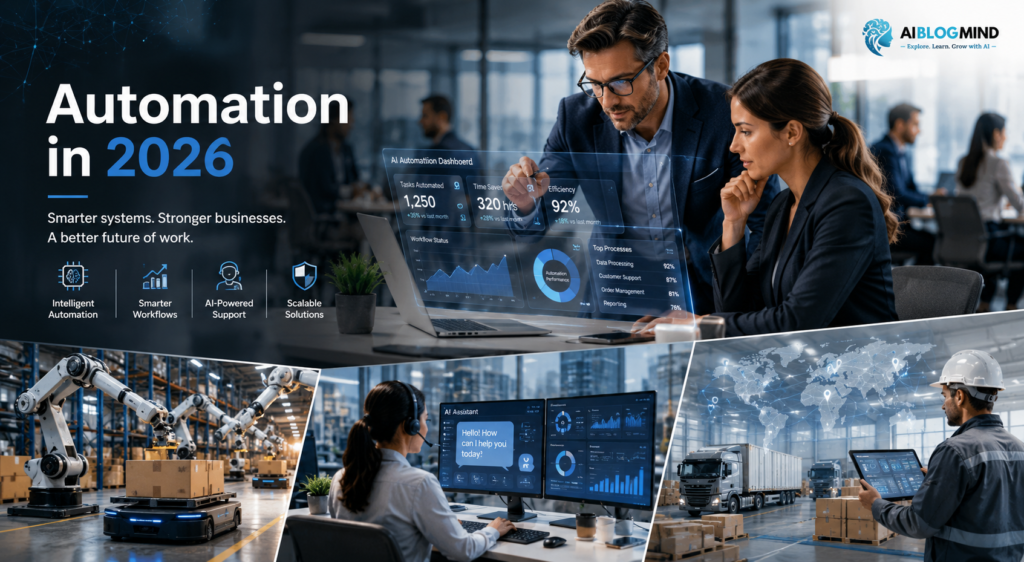
AI adoption accelerated massively after the release of advanced generative AI systems between 2023 and 2025. By 2026, businesses are integrating AI into daily operations because it reduces costs, increases productivity, and improves efficiency.
Large companies are now using AI to:
- Automate customer support
- Generate reports and summaries
- Analyze data
- Write marketing copy
- Assist in coding
- Detect cybersecurity threats
- Manage scheduling and workflows
- Improve hiring processes
- Automate repetitive office tasks
This rapid shift explains why the phrase AI replace jobs has become one of the most searched employment-related topics globally.
Recent workforce studies show that employers increasingly prefer workers who understand AI tools over workers who rely only on traditional methods.
Even major financial institutions have begun restructuring around automation. In 2026, Standard Chartered announced large-scale workforce reductions while expanding AI-driven operations and automation systems.
This does not mean humans are becoming useless. Instead, businesses are redesigning work around AI collaboration.
Why People Fear AI Job Replacement
The fear surrounding AI job replacement is understandable. Throughout history, technological revolutions have disrupted labor markets. The Industrial Revolution replaced manual labor. Computers automated clerical work. The internet transformed retail and media industries.
However, AI feels different because it targets both physical and cognitive work.
For decades, people believed creative and intellectual jobs were safe from automation. In 2026, AI can now:
- Write articles
- Generate artwork
- Produce videos
- Analyze legal documents
- Assist in programming
- Translate languages
- Create presentations
- Handle customer conversations
This creates anxiety among professionals who once believed their careers were future-proof.
Recent discussions at the World Economic Forum Annual Meeting 2026 highlighted growing concerns about disrupted career pathways, especially for entry-level office workers.
Some AI leaders even predict that many white-collar roles could face major disruption within the next few years.
Still, history suggests that technological progress usually transforms work rather than eliminating all employment entirely.
Jobs Replaced by AI in 2026
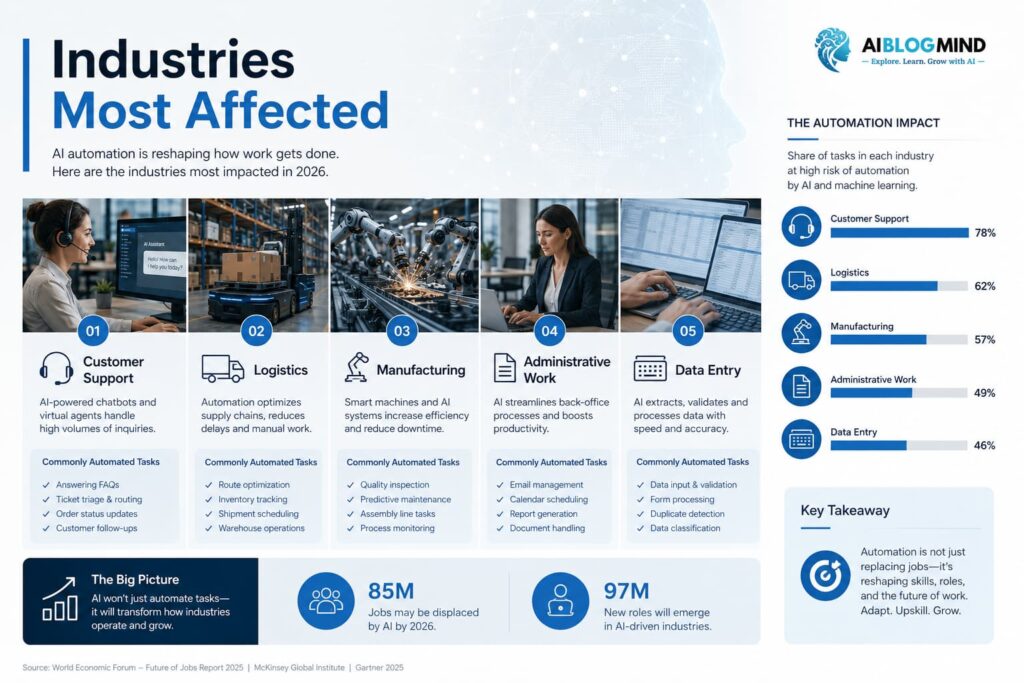
Certain industries are experiencing automation faster than others. The most vulnerable jobs are repetitive, predictable, and rule-based roles.
Administrative and Data Entry Jobs
Administrative assistants, scheduling coordinators, and data entry operators are among the first workers affected by AI automation jobs. AI systems can process documents, organize information, manage calendars, and automate workflows much faster than humans.
Companies now use AI assistants to:
- Schedule meetings
- Sort emails
- Generate reports
- Update databases
- Handle invoices
- Process paperwork
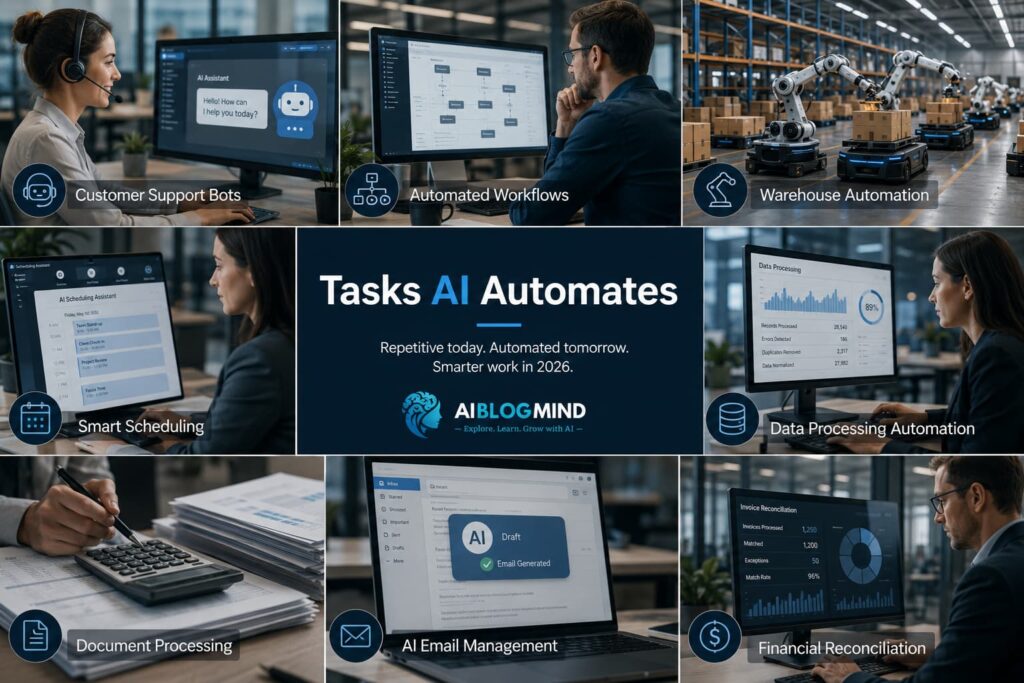
Because these tasks follow predictable patterns, AI performs them efficiently with minimal supervision.
Customer Support Roles
AI chatbots and voice assistants have become highly advanced in 2026. Businesses increasingly rely on conversational AI to manage customer service requests 24/7.
Many companies now use AI systems for:
- Answering FAQs
- Tracking orders
- Resolving common complaints
- Processing refunds
- Technical troubleshooting
Human support agents are still needed for emotional or complex cases, but basic support roles continue declining.
Basic Content Writing
Generative AI tools can now create blogs, product descriptions, email drafts, and social media captions in seconds. This has heavily impacted low-level freelance writing and content mill jobs.
However, AI-generated content still requires:
- Human editing
- Fact verification
- Brand alignment
- Strategic storytelling
- Emotional intelligence
This means skilled writers are evolving rather than disappearing.
Entry-Level Coding Jobs
AI coding assistants are changing software development dramatically. Junior developers who only perform repetitive coding tasks are increasingly competing against automation.
AI can now:
- Generate code snippets
- Detect bugs
- Suggest optimizations
- Build simple applications
- Automate testing
Yet senior engineers remain highly valuable because businesses still need human decision-making, architecture planning, and problem-solving expertise.
Manufacturing and Logistics
Robotics powered by AI continue replacing repetitive factory and warehouse tasks.
Automated systems now handle:
- Packaging
- Sorting
- Inventory management
- Assembly line operations
- Quality control
Warehouses increasingly use autonomous robots to improve speed and reduce labor costs.
Future Jobs AI Will Create
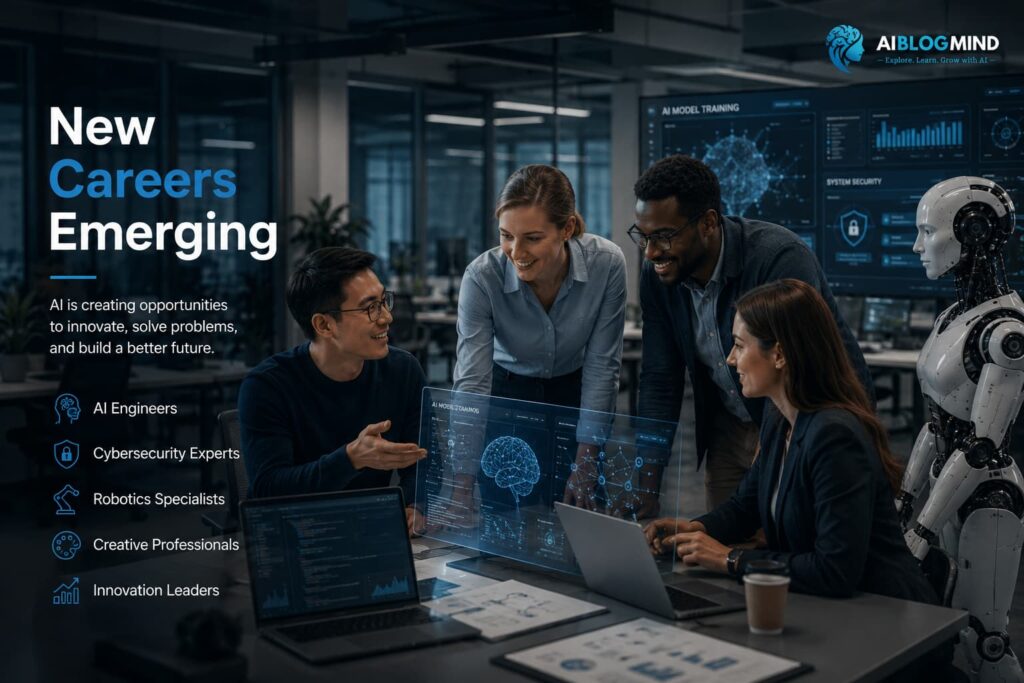
Despite fears surrounding AI replace jobs trends, the technology is also creating entirely new career opportunities.
Historically, technological revolutions generated more advanced jobs while eliminating outdated ones. AI appears to be following a similar pattern.
The fastest-growing future jobs AI is creating include:
AI Specialists and Engineers
Demand for AI developers, prompt engineers, machine learning experts, and AI integration consultants has exploded globally.
Businesses need professionals who can:
- Train AI systems
- Fine-tune models
- Build AI workflows
- Integrate automation into operations
- Monitor AI performance
Reports indicate that AI-skilled professionals earn significantly higher salaries than average workers.
AI Ethics and Governance Roles
As AI becomes more powerful, companies and governments need specialists who ensure ethical AI use.
These professionals focus on:
- Data privacy
- AI regulations
- Bias prevention
- Transparency
- Responsible automation
This field barely existed a few years ago but is now rapidly expanding.
Human-AI Collaboration Jobs
One of the biggest employment shifts in 2026 is the rise of hybrid work.
Workers increasingly collaborate with AI instead of competing against it.
Examples include:
- AI-assisted marketers
- AI-supported designers
- AI-enhanced researchers
- Human editors supervising AI-generated content
- AI-powered healthcare professionals
This “co-pilot economy” model is one of the major workforce scenarios discussed by the World Economic Forum.
Cybersecurity Professionals
AI is creating new cybersecurity challenges alongside new protections.
Organizations now urgently need professionals who can:
- Defend against AI-driven cyberattacks
- Monitor automated threats
- Secure AI systems
- Manage digital risk
The cybersecurity sector is expected to grow significantly because AI increases both defensive and offensive cyber capabilities.
Creative Strategy and Branding
AI can generate content, but businesses still need humans who understand culture, psychology, storytelling, and emotional branding.
Future creative professionals will focus more on:
- Strategy
- Creative direction
- Brand identity
- Human engagement
- Emotional communication
The value of authentic human creativity is actually increasing in premium markets.
Will AI Replace Jobs Completely?
The simple answer is no.
AI will not eliminate all human employment. Instead, AI is restructuring labor markets.
Most experts believe the future of work will involve:
- Human-AI collaboration
- Task automation instead of full job elimination
- Increased demand for adaptable workers
- Rapid skill transformation
Research suggests that augmentation is more common than total replacement.
Many businesses discover that AI works best when combined with human oversight.
For example:
- Doctors use AI for diagnostics but still make final medical decisions
- Lawyers use AI research tools but still argue cases
- Designers use AI generation tools but guide creativity
- Programmers use AI assistants but solve complex system problems
This means the future workforce will likely consist of humans enhanced by AI systems rather than humans completely removed from work.
Why Companies Are Investing Heavily in AI Automation Jobs
Businesses are adopting AI because it saves time, lowers operational costs, and improves productivity. Companies using AI can often complete tasks faster with smaller teams. This trend is one reason the phrase AI automation jobs has become so important in 2026.
Some workers are experiencing the impact of AI job replacement directly, especially in repetitive office roles, customer support, and administrative work. At the same time, many experts argue that AI is creating new opportunities, increasing productivity, and generating entirely new career paths. Reports from organizations like the World Economic Forum, McKinsey & Company, and OECD show that AI will likely reshape jobs more than completely eliminate them.
Industries are using AI for several purposes:
Faster Operations
AI systems can process information much faster than humans. Customer support chatbots can respond instantly, while AI analytics tools can review massive datasets in seconds.
Lower Costs
Businesses reduce labor expenses when AI automates repetitive work. Some companies have already reduced hiring or downsized departments due to automation.
Higher Productivity
The World Economic Forum reports that AI could significantly improve productivity across industries over the next few years.
24/7 Performance
Unlike humans, AI systems can operate continuously without breaks, making them attractive for industries like customer service, cybersecurity, and logistics.
Because of these advantages, the discussion about AI replace jobs continues to grow stronger every year.
Which Jobs Are Most Likely to Be Replaced by AI?
The biggest impact of AI job replacement is currently happening in jobs involving repetitive, predictable tasks. Roles that rely heavily on data processing or standard workflows are more vulnerable.
Customer Support Roles
AI chatbots and virtual assistants are now capable of handling thousands of customer interactions simultaneously. Many businesses use AI systems to answer common questions without human involvement.
Data Entry and Administrative Work
AI software can organize spreadsheets, schedule meetings, manage emails, and process invoices much faster than humans.
Basic Content Creation
Generative AI tools can now create articles, social media posts, marketing captions, and summaries. While human editing is still necessary, some entry-level writing jobs are changing rapidly.
Manufacturing and Logistics
Robotics and automation systems continue replacing repetitive factory work and warehouse operations.
Basic Coding Tasks
AI coding assistants can generate software code, detect errors, and automate programming tasks. This does not eliminate developers entirely, but it changes what developers focus on.
Research from McKinsey & Company suggests that more than half of current work activities could theoretically be automated over time, though adoption will happen gradually.
Jobs That AI Cannot Easily Replace
Despite concerns about jobs replaced by AI, many careers remain highly resistant to automation because they require emotional intelligence, creativity, ethics, leadership, or physical adaptability.
Healthcare Professionals
Doctors, nurses, therapists, and caregivers rely heavily on empathy and human interaction. AI may assist diagnosis, but human trust remains essential.
Skilled Trades
Electricians, plumbers, mechanics, and construction workers perform unpredictable physical tasks that are difficult for robots to manage.
Leadership and Management
Business leadership requires strategic thinking, negotiation, and emotional understanding.
Creative Professions
Although AI can generate images and text, originality and emotional storytelling still depend on human creativity.
Education and Training
Teachers and mentors provide guidance, motivation, and emotional support that AI cannot fully replicate.
This is why many experts believe the future of future jobs AI will revolve around human-AI collaboration instead of total automation.
The Real Truth About AI Replace Jobs in 2026
One of the biggest misconceptions is that AI will suddenly eliminate millions of jobs overnight. Current evidence shows a more gradual transformation.
The Bank of Canada recently stated that there is currently no evidence of widespread job destruction caused by AI, although job transformation is clearly increasing.
Most businesses are still experimenting with AI integration. Many companies use AI tools to assist employees instead of replacing entire teams. Workers are increasingly expected to use AI systems to improve productivity.
This creates a major shift in workplace expectations:
- Employees must learn AI tools
- Companies prioritize digital skills
- AI literacy becomes essential
- Hybrid human-AI workflows become normal
In reality, the biggest risk is not AI itself but workers failing to adapt to technological change.
Industries Changing Fast Due to AI Automation Jobs
Several industries are already experiencing rapid disruption because of AI automation.
Finance
AI systems now analyze markets, detect fraud, automate reports, and assist investment strategies. Banks and financial firms increasingly rely on AI for efficiency.
Marketing
AI tools generate advertisements, analyze audience behavior, automate campaigns, and create content.
Media and Entertainment
AI-generated videos, music, and graphics are transforming digital media production.
Software Development
Developers increasingly use AI coding assistants to improve speed and efficiency.
Transportation
Self-driving technology and logistics automation continue reshaping delivery and transport systems.
The World Economic Forum predicts that AI-related productivity gains could arrive faster than expected across many industries.
Future Jobs AI Will Create
While many people focus on jobs replaced by AI, fewer discuss the careers AI is creating.
New opportunities are emerging in:
- AI engineering
- Prompt engineering
- Cybersecurity
- AI ethics
- Robotics maintenance
- Data science
- AI training
- Human-AI collaboration management
- Automation consulting
The future of future jobs AI depends heavily on workers learning adaptable skills.
Experts increasingly believe that workers with hybrid expertise will dominate the future job market. Examples include:
- Healthcare + AI
- Marketing + AI analytics
- Finance + automation
- Education + AI tools
- Engineering + robotics
These hybrid roles are becoming some of the most valuable careers in 2026.
Skills You Need to Survive AI Job Replacement
The most important response to AI replace jobs fears is skill development. Workers who continue learning are more likely to stay competitive.
AI Literacy
Understanding how AI tools work is becoming essential across industries.
Communication Skills
Human interaction remains extremely valuable.
Problem-Solving
Complex thinking and strategic decision-making are difficult for AI to replicate.
Creativity
Original ideas and storytelling remain highly human strengths.
Emotional Intelligence
Empathy, leadership, and relationship-building continue to matter deeply.
Adaptability
Technology changes quickly. Workers who adapt faster have stronger career security.
Research increasingly shows that AI works best alongside humans rather than independently replacing them.
Is AI More Dangerous for Entry-Level Jobs?
One major concern in 2026 is the effect of AI on beginners entering the workforce.
Many entry-level tasks are repetitive and therefore easier to automate. Companies now use AI tools for:
- Basic customer support
- Research summaries
- Data processing
- Scheduling
- Drafting reports
This means young professionals may need stronger technical and communication skills earlier in their careers.
However, entry-level workers who learn AI tools can become significantly more productive and valuable to employers.
Will AI Cause Mass Unemployment?
The fear of mass unemployment dominates conversations about AI job replacement, but economists remain divided.
Some predictions warn that automation could disrupt hundreds of millions of jobs globally.
At the same time, history shows that technological revolutions often create new industries and opportunities. During previous industrial revolutions, many old jobs disappeared, but entirely new professions emerged.
The most likely outcome in 2026 is:
- Some jobs disappear
- Many jobs evolve
- New jobs emerge
- Workers need reskilling
The transition may still be painful for workers who cannot adapt quickly.
How Governments and Businesses Are Responding
Governments and organizations worldwide are preparing for the future impact of AI on employment.
Upskilling Programs
Many countries are investing in digital education and AI training.
AI Regulations
Governments are discussing ethical AI usage, worker protection, and transparency laws.
Workforce Transformation
Companies increasingly train employees to work with AI instead of replacing them immediately.
The OECD continues emphasizing the importance of policies that help workers adapt to AI-driven economies.
Human-AI Collaboration Is the Real Future
The strongest evidence in 2026 suggests the future workplace will involve humans and AI working together.
AI excels at:
- Speed
- Pattern recognition
- Automation
- Data analysis
Humans excel at:
- Creativity
- Ethics
- Leadership
- Emotional intelligence
- Complex judgment
This balance is shaping the next generation of future jobs AI careers.
Instead of asking whether AI will completely replace humans, experts increasingly ask how humans can use AI effectively.
Conclusion: Should You Be Worried About AI Replace Jobs?
The reality of AI replace jobs in 2026 is neither complete panic nor total safety. Artificial intelligence is already changing the workforce rapidly, especially in repetitive digital tasks. Some industries will experience significant disruption, while others will evolve more gradually.
The biggest risk is not AI itself but refusing to adapt.
Workers who learn AI tools, build creative and communication skills, and stay flexible will likely remain valuable in the future economy. AI may replace certain tasks, but human abilities still matter deeply.
The future belongs to people who can work alongside AI rather than compete against it.
As technology continues evolving, one thing is becoming clear: the future of work will not be humans versus machines. It will be humans and machines building the next generation of industries together.
Frequently Asked Questions
Will AI replace jobs completely in 2026?
No, AI is not completely replacing most jobs in 2026. Instead, AI is automating repetitive tasks while transforming how people work. Many jobs are evolving rather than disappearing entirely.
Which jobs are most affected by AI automation?
Customer support, data entry, repetitive administrative work, basic content creation, and some manufacturing roles are among the jobs most affected by AI automation.
What jobs are safe from AI?
Jobs requiring emotional intelligence, creativity, leadership, healthcare expertise, skilled trades, and human interaction are currently more resistant to AI replacement.
Will AI create new jobs?
Yes. AI is already creating careers in AI engineering, cybersecurity, robotics, automation consulting, AI ethics, and data science.
How can workers prepare for the future of AI?
Workers should focus on learning AI tools, improving communication skills, developing creativity, and staying adaptable as technology evolves.
Is AI more likely to replace low-skill jobs?
Generally, repetitive and predictable jobs face higher automation risk. However, even high-skill professions are being transformed by AI assistance tools.
Will AI increase unemployment globally?
AI may cause temporary disruption in some industries, but experts believe new industries and opportunities will also emerge over time.
To be ready to the world! And to know more about such content, do follow our page.

Syed Abubakkar is a content and SEO specialist responsible for article publishing, on-page SEO, keyword optimization, and AI-powered image generation. He is passionate about digital marketing and helping websites grow their online presence.