




AI Cybersecurity Trends Every Business Must Know in 2026
The digital world is evolving faster than ever, and with that evolution comes a dramatic rise in cyber threats. Businesses across industries are now facing highly advanced attacks powered by automation, machine learning, and intelligent hacking systems. In response, organizations are rapidly adopting AI cybersecurity trends to strengthen digital protection, improve response times, and secure sensitive information before damage occurs.
In 2026, cybersecurity is no longer only about firewalls and passwords. Artificial intelligence has become the backbone of modern security infrastructure. From real-time monitoring to predictive analytics, cybersecurity AI is helping businesses detect suspicious behavior instantly and stop attacks before they spread. Companies that fail to adapt to these technologies are increasingly vulnerable to ransomware, phishing campaigns, data breaches, and AI-driven cybercrime.
The growth of remote work, cloud computing, IoT devices, and digital transactions has expanded the attack surface for organizations worldwide. As cybercriminals become smarter, businesses need intelligent systems capable of learning, adapting, and responding automatically. This is where AI security tools and advanced AI threat detection systems are transforming the future of online protection.
The Rise of AI in Modern Cybersecurity
Artificial intelligence has completely changed how businesses approach cybersecurity. Traditional security systems depended heavily on human monitoring and rule-based detection. While these methods still exist, they are no longer enough to combat modern threats. Hackers now use automated attack systems capable of launching thousands of attacks within minutes.
The latest AI cybersecurity trends show that businesses are investing heavily in machine learning algorithms that can identify unusual activity patterns in real time. These systems analyze huge amounts of data instantly, something impossible for human analysts alone.
Why AI Cybersecurity Matters in 2026
Businesses today handle enormous volumes of sensitive customer information, financial data, and intellectual property. One successful cyberattack can destroy trust, damage reputation, and result in severe financial losses. Modern cybersecurity AI solutions provide:
- Faster incident response
- Predictive threat analysis
- Automated malware detection
- Intelligent fraud prevention
- Enhanced endpoint security
- Reduced operational costs
AI systems continuously learn from new attack methods, allowing businesses to stay ahead of evolving threats. This adaptive capability is one of the biggest reasons why AI cybersecurity trends are dominating the security industry in 2026.
How AI Threat Detection is Changing Digital Security
One of the most important developments in modern cybersecurity is advanced AI threat detection. Unlike traditional software that relies on predefined threat signatures, AI-powered systems can identify suspicious activities even if the threat has never been seen before.
Behavioral Analysis and Pattern Recognition
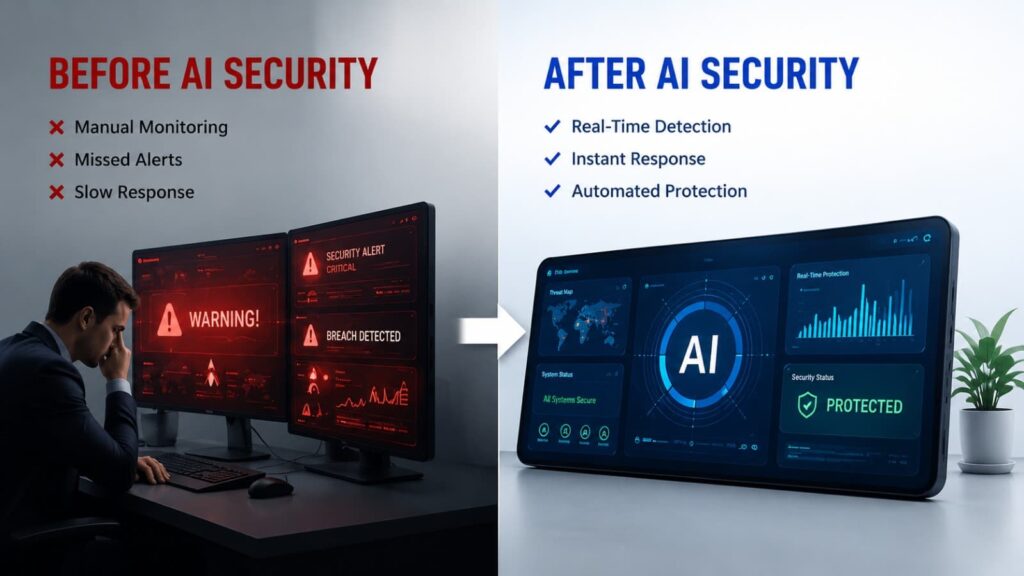
Modern AI security tools use behavioral analysis to study user activity patterns. If an employee suddenly accesses sensitive files at unusual hours or downloads large amounts of data unexpectedly, the system flags the behavior immediately.
This proactive form of AI threat detection allows businesses to prevent insider threats, account compromises, and unauthorized access before major damage occurs.
Real-Time Threat Intelligence
Another major advantage of cybersecurity AI is real-time intelligence gathering. AI systems continuously scan global databases, dark web activity, and threat networks to identify emerging risks.
For example, if ransomware attacks increase in a specific industry, AI-driven security platforms automatically adjust detection models to improve defense mechanisms. This rapid adaptation is a defining feature of modern AI cybersecurity trends.
Security Insight Box
Businesses using advanced AI threat detection systems can identify cyber threats significantly faster than organizations relying only on manual monitoring methods. Faster detection often means reduced financial and operational damage.
AI Security Tools Businesses Are Using in 2026
The market for intelligent security platforms is growing rapidly. Organizations of all sizes are integrating AI security tools into their infrastructure to improve protection and automate security operations.
Intelligent Endpoint Protection
Endpoint devices such as laptops, smartphones, and IoT devices are primary attack targets. AI-powered endpoint protection platforms monitor device behavior continuously and isolate suspicious activity instantly.
These advanced AI cybersecurity trends help organizations reduce malware infections and ransomware attacks across remote work environments.
Automated Security Operations Centers
Security Operations Centers (SOCs) traditionally required large teams of analysts monitoring systems around the clock. In 2026, many businesses are adopting AI-driven SOC automation.
Using cybersecurity AI, these systems automatically:
- Prioritize threats
- Analyze attack severity
- Generate alerts
- Initiate response protocols
- Reduce false positives
This automation improves efficiency while allowing security professionals to focus on strategic decision-making.
AI-Based Email Security
Phishing remains one of the biggest cybersecurity threats globally. Modern AI security tools analyze language patterns, sender behavior, attachment structures, and suspicious links to detect phishing attempts before users interact with them.
Advanced AI threat detection systems can even identify highly personalized spear-phishing attacks generated using artificial intelligence.
Advanced AI Cybersecurity Trends Every Business Must Know in 2026
The rapid growth of artificial intelligence is transforming cybersecurity faster than ever before. In 2026, businesses are no longer relying only on traditional firewalls and antivirus software. Instead, companies are adopting intelligent AI-powered security systems that can detect, predict, and prevent cyber threats in real time. As cyberattacks become more sophisticated, organizations must understand the latest AI cybersecurity trends to stay protected in an increasingly digital world.
Cybercriminals are now using AI technologies themselves to automate phishing attacks, create advanced malware, and exploit system vulnerabilities. This has forced businesses to fight AI with AI. Modern cybersecurity strategies now depend heavily on machine learning, predictive analytics, behavioral monitoring, and autonomous threat response systems.
According to IBM Security, AI-driven cybersecurity tools significantly reduce breach detection time and help organizations respond to threats more efficiently. Similarly, CrowdStrike highlights how AI-powered endpoint protection is becoming essential for enterprise security infrastructure.
AI-Powered Threat Detection Is Becoming Smarter
One of the biggest AI cybersecurity trends in 2026 is intelligent threat detection. Traditional cybersecurity systems mostly rely on pre-programmed rules and known malware databases. However, modern AI systems can identify suspicious behavior even when a threat has never been seen before.
AI security platforms analyze massive amounts of data in seconds, including:
- Network traffic
- User behavior
- Login activity
- Device performance
- Cloud infrastructure data
These systems learn normal patterns and instantly detect unusual activities that may indicate a cyberattack. For example, if an employee suddenly accesses sensitive company files from another country at midnight, AI systems can automatically flag or block the activity.
This predictive capability is reshaping the future of AI in cybersecurity because businesses no longer need to wait for damage before responding.
Autonomous Security Systems Are Reducing Human Error
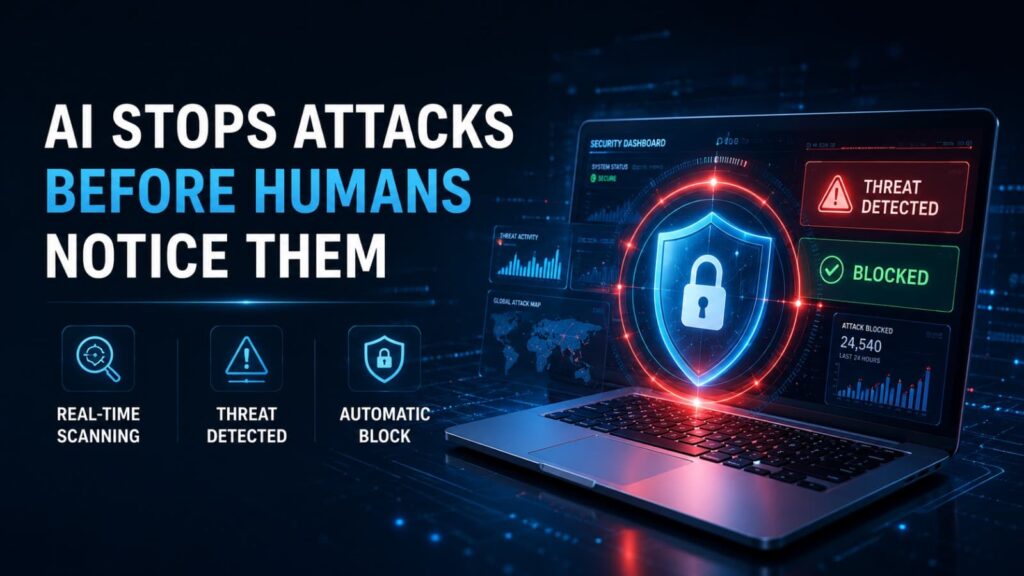
Human error remains one of the leading causes of data breaches worldwide. Employees may accidentally click phishing links, reuse weak passwords, or mishandle confidential data. In response, businesses are increasingly deploying autonomous AI security systems that require minimal human intervention.
Upcoming AI technology in cybersecurity can now:
- Automatically isolate infected devices
- Block suspicious login attempts
- Shut down malicious software
- Generate incident reports
- Launch real-time countermeasures
This automation improves response speed dramatically. Instead of waiting hours for security teams to investigate threats manually, AI systems react within seconds.
The future AI trends in cybersecurity show that businesses will rely heavily on self-healing systems capable of repairing vulnerabilities automatically before attackers exploit them.
AI-Driven Cybersecurity for Cloud Protection
As more businesses move their operations to the cloud, cybersecurity challenges are increasing. Cloud environments contain sensitive customer data, financial records, and internal communications, making them attractive targets for hackers.
AI technologies are helping companies secure cloud infrastructure by continuously monitoring:
| Cloud Security Area | AI Security Function |
|---|---|
| User authentication | Detect unusual access patterns |
| Data storage | Prevent unauthorized access |
| APIs | Monitor suspicious interactions |
| Applications | Identify vulnerabilities |
| Multi-cloud systems | Centralized threat detection |
AI-powered cloud security platforms can also provide risk scoring systems that prioritize the most dangerous threats first. This helps IT teams focus on critical vulnerabilities rather than wasting time on low-risk alerts.
Businesses adopting cloud computing in 2026 must integrate AI cybersecurity tools into their infrastructure to maintain strong digital protection.
Behavioral Biometrics and Identity Security
Another major AI cybersecurity trend is the use of behavioral biometrics for identity verification. Passwords alone are no longer secure enough. Cybercriminals can steal credentials through phishing scams, malware, or social engineering attacks.
Behavioral AI systems verify users by analyzing patterns such as:
- Typing speed
- Mouse movements
- Swipe behavior
- Voice recognition
- Facial expressions
These systems create unique digital behavior profiles for every user. If unusual activity occurs, the AI can request additional verification or deny access completely.
The future of AI in identity security is expected to move toward passwordless authentication systems, reducing both cyber risks and user frustration.
Generative AI Is Creating New Cybersecurity Challenges
While generative AI offers many business benefits, it also introduces serious cybersecurity risks. Cybercriminals are now using AI-generated content to create more convincing phishing emails, fake websites, and deepfake videos.
For example, attackers can generate realistic fake voices that imitate executives or employees to trick businesses into transferring money or revealing confidential information.
Because of this, companies are investing heavily in AI detection systems capable of identifying:
- Deepfake media
- AI-generated phishing messages
- Synthetic identities
- Fake customer accounts
- Automated scam campaigns
Businesses must train employees to recognize AI-driven threats as these attacks become more advanced and harder to detect.
Zero Trust Security Models Powered by AI
Zero Trust architecture has become one of the most important future AI trends in enterprise cybersecurity. The concept is simple: trust no one automatically, whether inside or outside the network.
AI enhances Zero Trust systems by continuously monitoring users and devices in real time. Instead of granting permanent access after login, AI systems constantly verify identity, behavior, and risk levels.
Key benefits of AI-powered Zero Trust security include:
- Reduced insider threats
- Better remote work protection
- Real-time access control
- Faster breach containment
- Improved compliance management
As hybrid work environments continue growing in 2026, Zero Trust frameworks supported by AI technologies are becoming critical for modern businesses.
AI Cybersecurity Compliance and Data Privacy
Governments worldwide are introducing stricter cybersecurity and privacy regulations. Businesses must now comply with complex data protection laws while defending against cyber threats.
AI cybersecurity tools help organizations:
- Monitor compliance violations
- Detect sensitive data exposure
- Generate automated audit reports
- Track user consent
- Protect customer privacy
The future of AI in regulatory compliance is expected to simplify risk management for businesses operating across multiple countries.
Organizations that fail to strengthen cybersecurity may face:
- Financial penalties
- Reputation damage
- Legal action
- Customer trust loss
Therefore, AI-powered compliance monitoring is becoming a necessary business investment rather than an optional feature.
AI Cybersecurity Skills Businesses Need in 2026
As AI technologies evolve, companies need skilled professionals who understand both cybersecurity and artificial intelligence.
Important skills include:
- Machine learning security
- Threat intelligence analysis
- Ethical hacking
- Cloud security management
- AI governance
- Data privacy protection
Businesses are also investing in cybersecurity awareness programs to educate employees about modern cyber risks.
The future of AI cybersecurity depends not only on technology but also on trained professionals who can manage and improve these intelligent systems effectively.
The Future of AI Cybersecurity Beyond 2026
Looking ahead, future AI technologies in cybersecurity will likely become even more autonomous and predictive. Security systems may eventually anticipate cyberattacks before they happen by analyzing global threat patterns and hacker behavior.
Future developments could include:
- Fully autonomous AI security agents
- Quantum-resistant encryption
- AI-powered digital identity ecosystems
- Advanced cyber deception technologies
- Real-time global threat intelligence sharing
Businesses that adopt these innovations early may gain stronger resilience against evolving cyber threats.
In the coming years, cybersecurity will no longer be just an IT responsibility. It will become a core business strategy essential for survival in the digital economy.
The Role of Machine Learning in Cybersecurity AI

Machine learning is the core technology driving modern cybersecurity AI systems. These algorithms improve continuously by analyzing new data and adapting to changing attack strategies.
Predictive Cyber Defense
One of the leading AI cybersecurity trends in 2026 is predictive defense. Instead of simply reacting to attacks, AI systems now forecast potential vulnerabilities before exploitation occurs.
Machine learning models analyze:
- Network behavior
- Login patterns
- Traffic anomalies
- Historical attacks
- Device interactions
This predictive capability allows businesses to strengthen defenses proactively.
Reduced False Positives
Traditional cybersecurity systems often generate overwhelming numbers of alerts, many of which are harmless. This creates alert fatigue among security teams.
Modern AI security tools reduce false positives by understanding context and prioritizing genuine risks. As a result, businesses can respond faster to real threats while improving operational efficiency.
Cybersecurity AI and Zero Trust Security
Zero Trust security has become a dominant framework in enterprise protection strategies. The principle is simple: never trust, always verify.
In 2026, AI cybersecurity trends are deeply integrated into Zero Trust architectures. AI systems verify every user, device, and application continuously rather than relying on a single login authentication.
Continuous Authentication
Using AI threat detection, businesses can monitor user behavior throughout an active session. If unusual activity occurs, access permissions are adjusted automatically.
For example:
- Sudden location changes
- Abnormal typing patterns
- Unauthorized file access
- Suspicious network behavior
These signals help cybersecurity AI systems detect compromised accounts instantly.
Identity Protection
Identity theft and credential attacks continue to rise globally. AI-powered identity management systems analyze biometric behavior, login history, and device reputation to enhance security.
This approach significantly improves business resilience against credential-based attacks.
Technology Trend Box
Experts predict that AI-powered Zero Trust systems will become standard cybersecurity infrastructure for enterprises by the end of 2026 due to increasing cloud adoption and remote workforce expansion.
AI Cybersecurity Trends in Cloud Security
Cloud computing continues to dominate modern business operations, but cloud environments also introduce new vulnerabilities. Protecting cloud infrastructure is now a major focus for organizations adopting AI cybersecurity trends.
AI-Driven Cloud Monitoring
Cloud security platforms powered by cybersecurity AI continuously monitor workloads, applications, and user access patterns across cloud environments.
These systems can:
- Detect unauthorized access
- Identify misconfigurations
- Prevent data leaks
- Monitor API activity
- Analyze cross-cloud traffic
Automated Threat Response
Modern AI security tools automatically respond to cloud threats without waiting for manual intervention. If suspicious behavior is detected, systems can isolate affected resources immediately.
This rapid automation reduces downtime and minimizes damage from cyber incidents.
Generative AI and Emerging Cyber Threats
While AI strengthens cybersecurity, cybercriminals are also using artificial intelligence to launch more sophisticated attacks. This dual-use nature of AI is shaping the future of cyber warfare.
AI-Powered Phishing Attacks
Hackers now use generative AI to create highly convincing phishing emails, fake websites, and social engineering scams. These attacks are harder to identify because they mimic human communication naturally.
As a result, businesses are investing heavily in advanced AI threat detection systems capable of identifying subtle anomalies in communication patterns.
Deepfake Security Risks
Deepfake technology has become a growing cybersecurity concern. Criminals can generate fake voice recordings or videos impersonating executives or employees.
Modern AI security tools are now integrating deepfake detection capabilities to verify authenticity during communications and financial approvals.
Why Small Businesses Need AI Security Tools
Cybersecurity is no longer only a concern for large corporations. Small and medium-sized businesses are increasingly targeted because they often lack advanced protection systems.
The latest AI cybersecurity trends show growing adoption among smaller organizations due to affordable cloud-based security platforms.
Cost-Effective Security Automation
AI-powered solutions reduce the need for large internal security teams. Businesses can automate monitoring, detection, and response processes without massive investments.
Faster Incident Recovery
Small businesses often struggle to recover after cyberattacks. Intelligent cybersecurity AI platforms help minimize disruption by containing attacks quickly and restoring operations faster.
Compliance, Privacy, and Ethical AI Security
As AI becomes central to cybersecurity, businesses must also address privacy concerns and regulatory compliance.
Responsible AI Usage
Organizations implementing AI security tools must ensure transparency, fairness, and ethical use of customer data. Regulations surrounding AI governance are expanding globally in 2026.
Data Protection Compliance
Modern AI threat detection systems help businesses comply with privacy regulations by identifying data exposure risks and monitoring unauthorized access attempts.
Compliance frameworks increasingly require continuous monitoring, making AI-driven protection essential for regulated industries.
Compliance Insight Box
Businesses using intelligent monitoring systems are better positioned to meet evolving global cybersecurity compliance standards while improving customer trust and operational transparency.
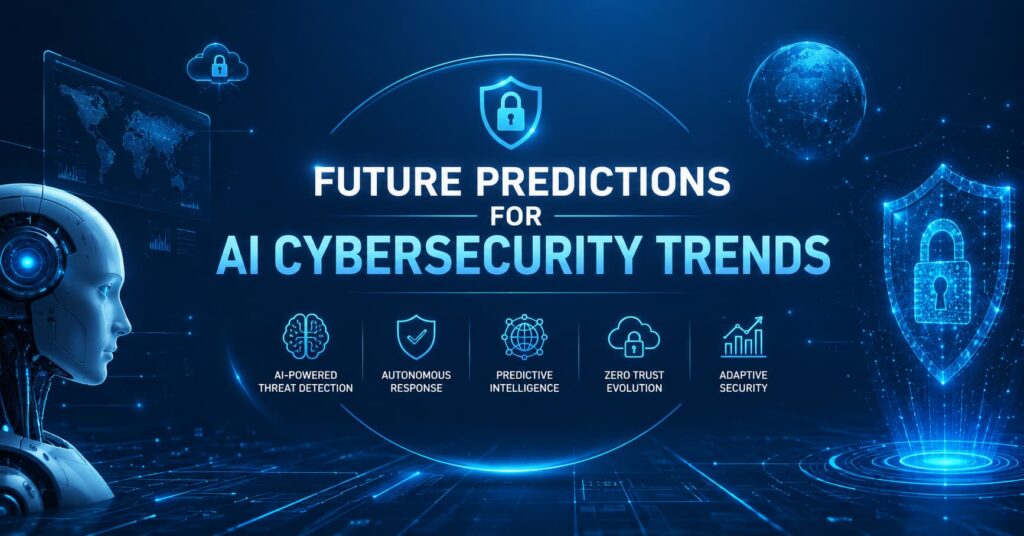
Future Predictions for AI Cybersecurity Trends
The future of cybersecurity will be heavily shaped by automation, intelligent analytics, and adaptive learning systems. Experts believe the next generation of cybersecurity AI will become even more autonomous and predictive.
Autonomous Security Platforms
Future AI security tools will likely manage entire security ecosystems independently, including threat hunting, vulnerability patching, and incident recovery.
Quantum-Resistant Security
As quantum computing develops, businesses will need advanced encryption methods capable of resisting future attacks. AI will play a critical role in managing these complex security systems.
Human and AI Collaboration
Despite automation growth, human expertise will remain essential. The strongest cybersecurity strategies will combine skilled professionals with advanced AI threat detection technologies.
Conclusion
The cybersecurity landscape in 2026 is more advanced, intelligent, and unpredictable than ever before. Businesses can no longer rely solely on traditional defense systems to protect critical data and digital infrastructure. The rapid evolution of AI cybersecurity trends has transformed how organizations detect threats, prevent attacks, and respond to security incidents.
From intelligent automation to predictive analytics, cybersecurity AI is becoming essential for organizations of every size. Businesses adopting modern AI security tools gain stronger protection, faster response times, and better resilience against sophisticated cyber threats. At the same time, advanced AI threat detection systems allow organizations to identify risks proactively before they escalate into major breaches.
As cybercriminals continue using artificial intelligence to launch smarter attacks, businesses must stay ahead by investing in adaptive security technologies. Organizations that embrace the latest AI cybersecurity trends today will be better prepared to protect customer trust, maintain compliance, and secure long-term digital growth in the future.
Frequently Asked Questions
What are AI cybersecurity trends?
AI cybersecurity trends refer to the growing use of artificial intelligence technologies in cybersecurity systems to improve threat detection, automate security operations, and strengthen digital protection against evolving cyber threats.
How does AI threat detection work?
AI threat detection uses machine learning algorithms and behavioral analysis to identify suspicious activities, unusual network behavior, and potential cyberattacks in real time.
Why are AI security tools important for businesses?
AI security tools help businesses automate monitoring, reduce response times, improve accuracy, and prevent cyberattacks more effectively than traditional security systems alone.
Can cybersecurity AI stop ransomware attacks?
Modern cybersecurity AI systems can significantly reduce ransomware risks by detecting suspicious behavior early, isolating infected systems, and automating incident response processes.
Are AI cybersecurity solutions expensive?
Many cloud-based AI security tools are now affordable for small and medium-sized businesses, making advanced cybersecurity accessible to organizations with limited budgets.
What industries benefit most from AI cybersecurity trends?
Industries handling sensitive data such as healthcare, finance, eCommerce, education, and government sectors benefit heavily from advanced AI cybersecurity trends and intelligent security automation.
For more ai related information, follow us on Instagram . Thank you!

Mohammed Viqar Ali is a Digital Marketer, UI/UX Designer, and content creator passionate about AI, technology, SEO, and digital growth. As the UI/UX Designer of aiblogmind, he focuses on creating user-friendly digital experiences while sharing practical insights on artificial intelligence, marketing trends, productivity tools, and online business growth. Through his content, he helps readers discover innovative solutions, stay updated with emerging technologies, and make informed decisions in the digital world.