



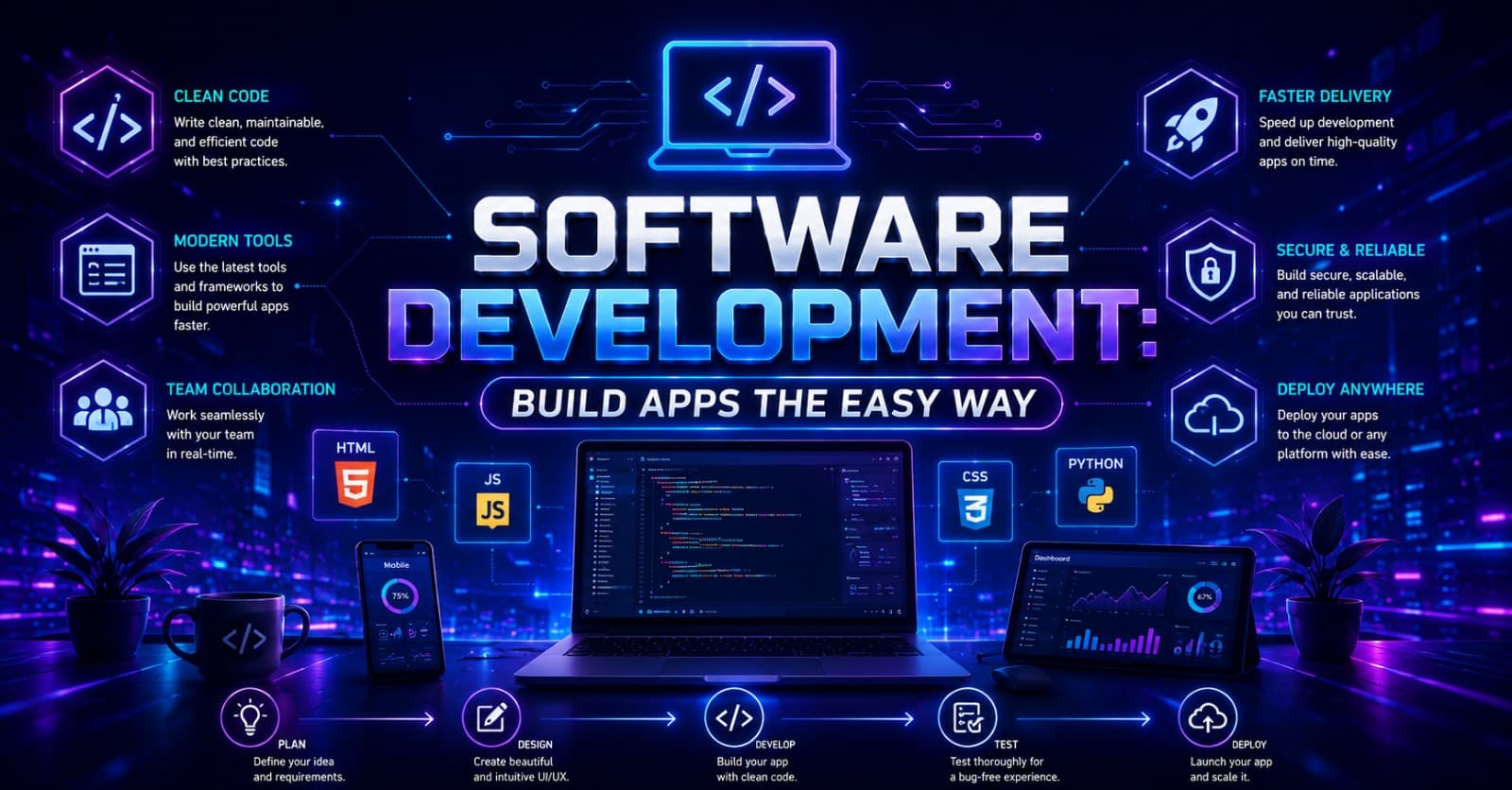
Software Development: Build Apps the Easy Way
There has never been a better time to be a builder. Whether you are an experienced programmer or someone who has never written a single line of code, software development today offers tools, platforms, and pathways that make turning an idea into a working application more accessible than ever before. The barriers are lower, the resources are richer, and the demand for software has never been higher.
Software development is the process of designing, coding, testing, and maintaining applications, systems, and programs that run on computers, smartphones, servers, and embedded devices. It is the engine behind every app on your phone, every website you visit, every digital service you use daily. And as the world becomes increasingly dependent on digital infrastructure, software development becomes not just a technical skill but a fundamental literacy.
This article explores it from the ground up, covering its core concepts, modern tools, real-world applications, the role of a firmware engineer, and how app development software is transforming the way products are built. We also examine the benefits, limitations, features, and most commonly asked questions around this field.
What Is Software Development?
Software development is a structured process through which developers create software products. It involves multiple stages, from understanding what a user needs, to writing the code that meets those needs, to testing and refining the product until it works reliably. It is both a science and a craft. It requires logical precision and creative problem-solving in equal measure.
At its core, It breaks down into several broad categories:
- Web development – building websites and web-based applications
- Mobile development – creating apps for iOS and Android platforms
- Desktop development – software that runs natively on Windows, macOS, or Linux
- Embedded and firmware development – software that runs on hardware devices
- Enterprise software development – large-scale systems for businesses and organizations
- Game development – interactive software experiences
- AI and data software development – applications powered by machine learning and analytics
Each category of software development has its own tools, languages, and workflows, but all share the same underlying discipline of turning a problem into a working digital solution.
The Evolution of Software Development
Software development has come an enormously long way since its origins in the mid-twentieth century. Early development was done by mathematicians and scientists who wrote machine code directly. Programs were fed into computers on punch cards. There was no internet, no IDE, no Stack Overflow.
The 1970s and 1980s brought structured programming languages like C, Pascal, and BASIC. It became more systematic and began attracting a dedicated professional class of programmers and engineers. The personal computer revolution turned software developing into a commercial enterprise.
The 1990s transformed development again with the rise of object-oriented programming, graphical user interfaces, and the World Wide Web. Languages like Java, Python, and JavaScript emerged as dominant forces. It became more collaborative, more visual, and more user-focused.
The 2000s and 2010s brought agile methodologies, open-source ecosystems, cloud computing, and mobile platforms. It became a team sport. Version control systems like Git, continuous integration pipelines, and collaborative platforms like GitHub changed how software teams worked together.
Today, software development is being reshaped once again by artificial intelligence, low-code and no-code platforms, cloud-native architectures, and global developer communities. Building an app that reaches millions of users is something a single motivated developer can accomplish in months, sometimes weeks.
Key Concepts in Software Development
Programming Languages
The foundation of software development is the programming language. Different languages are suited to different tasks. Python is widely used in software development for data science, automation, and web backends. JavaScript dominates front-end web software development and is increasingly used on servers too. Swift and Kotlin are the primary languages for iOS and Android software respectively. C and C++ remain essential in systems programming and embedded development of software.
Choosing the right language is one of the first decisions in any software developing project, and it depends on the target platform, performance requirements, team expertise, and available libraries.
Development Frameworks
Frameworks are pre-built collections of code that give software teams a structured foundation to build on. React and Angular are popular frameworks for front-end web development. Django and Node.js are used for back-end software development. Flutter and React Native are leading frameworks for cross-platform mobile software. These frameworks save enormous amounts of time and reduce the chance of errors in the software development process.
Follow Us on LinkedIn
Version Control
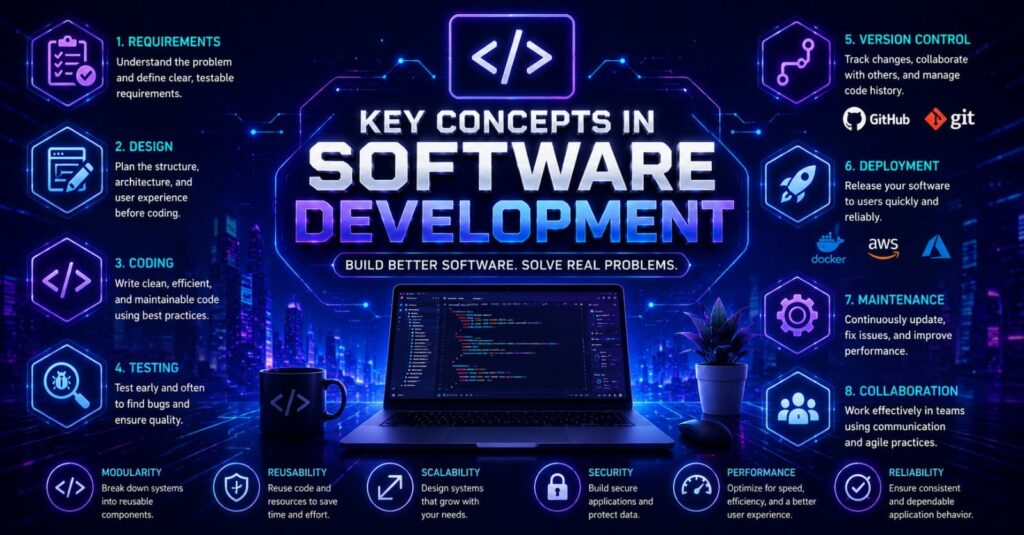
Version control is the practice of tracking every change made to code over time. Git is the dominant version control system in development of software today. It allows teams to collaborate without overwriting each other’s work, roll back to previous versions when bugs appear, and maintain a clear record of how a software development project has evolved.
Agile and DevOps
Agile is a philosophy of development of software that emphasizes iterative progress, frequent releases, and close collaboration with users. Rather than spending years building a perfect product in isolation, agile software development teams ship small improvements regularly and adjust based on real-world feedback.
DevOps is a related practice in development of software that brings development and operations teams together. It focuses on automation, continuous integration, continuous delivery, and monitoring to make development of software and deployment faster and more reliable.
App Development Software: The Modern Toolkit
One of the most significant shifts in modern development of software is the explosion of app development software that makes building applications faster and easier than ever before.
App development software includes integrated development environments (IDEs), low-code platforms, no-code builders, testing tools, deployment pipelines, and design systems. Together, these tools form a comprehensive ecosystem that supports every stage of the software development lifecycle.
Visual Studio Code is the world’s most popular IDE for development of software. It supports dozens of programming languages, offers thousands of extensions, and is free to use. For web and back-end development of software, it is the tool of choice for millions of developers globally.
Xcode and Android Studio are the official app development software environments for iOS and Android development of software respectively. They include simulators, debuggers, profilers, and publishing tools that guide developers through the entire mobile software development process.
Flutter is an open-source app development software framework created by Google. It allows developers to write software development code once and deploy it on iOS, Android, web, and desktop simultaneously. This dramatically reduces the time and cost of cross-platform development of software.
Bubble and Webflow represent the growing category of no-code app development software. These platforms allow non-programmers to build functional web applications through visual drag-and-drop interfaces, without writing traditional development of software code at all. They are democratizing development of software at an extraordinary rate.
Firebase is a backend app development software platform from Google that handles databases, authentication, cloud functions, and hosting for software development teams. It removes much of the infrastructure complexity from development of software, letting developers focus on building features rather than managing servers.
The rise of AI-powered app development software is also transforming software development. Tools like GitHub Copilot use large language models to suggest code in real time, helping software development teams write faster, catch bugs earlier, and learn new patterns as they work.
The Role of a Firmware Engineer in Software Development
While much of the conversation around development of software focuses on apps and websites, there is an equally important and often overlooked discipline happening at the hardware level. This is where the firmware engineer plays a critical role.
A firmware engineer is a specialized software development professional who writes code that runs directly on hardware devices. Firmware is the low-level software that controls how a device operates at the most fundamental level. It lives in the memory of microcontrollers, embedded processors, and IoT devices.
Firmware engineers are involved in development of software for products like medical devices, automotive systems, consumer electronics, industrial machinery, smart home devices, and networking equipment. When you press a button on your thermostat or your car’s infotainment system loads a map, firmware written by a firmware engineer is making that happen.
The software development work of a firmware engineer is quite different from app or web development. It requires deep knowledge of computer architecture, real-time operating systems, low-level programming languages like C and Assembly, and hardware communication protocols like I2C, SPI, and UART.
As the Internet of Things continues to grow, the demand for firmware engineers in development of software is rising sharply. Every connected device requires firmware, and the explosion of smart devices means the firmware engineer is becoming one of the most sought-after specialists in the entire software development field.
Firmware engineers also work closely with hardware design teams, which makes their software development role uniquely interdisciplinary. They must understand how software interacts with physical components in ways that most software development professionals never need to consider.
Software Development Methodologies
How a software development team organizes its work is just as important as the code it writes. Several methodologies guide modern software development practice.
Waterfall is a traditional development of software methodology where each phase, requirements, design, implementation, testing, and deployment, flows sequentially into the next. It works well for software development projects with clearly defined requirements that are unlikely to change.
Agile software breaks work into short cycles called sprints, typically two weeks long. Teams review progress frequently and adapt to changing requirements. Agile is the dominant methodology in modern development of software.
Scrum is a specific agile framework used widely in development of software. It involves defined roles like the product owner and scrum master, regular ceremonies like standups and retrospectives, and a prioritized backlog of development of software tasks.
Kanban is a visual workflow management approach in development of software that focuses on limiting work in progress and maximizing flow. Software development teams use Kanban boards, physical or digital, to visualize tasks and track progress.
Extreme Programming (XP) is an agile software development methodology that emphasizes technical excellence through practices like test-driven development, pair programming, and continuous integration.
Software Development Across Industries
Software development is not confined to technology companies. It is the lifeblood of virtually every modern industry.
In healthcare, development of software powers electronic health records, diagnostic imaging software, telemedicine platforms, and medical device firmware. A firmware engineer working in a hospital-grade monitor is doing that work that directly affects patient safety.
In finance, development of software underpins trading platforms, banking apps, fraud detection systems, and blockchain infrastructure. The reliability and security of financial software is paramount.
In retail and e-commerce, development of software drives recommendation engines, inventory management systems, payment gateways, and customer experience platforms. Companies that invest in strong software capabilities outcompete those that do not.
In education, development of software has enabled online learning platforms, adaptive testing tools, virtual classrooms, and gamified learning experiences that reach students around the world.
In manufacturing, development of software powers robotics, automation systems, quality control tools, and supply chain management platforms. Firmware engineers are central to this industrial software ecosystem.
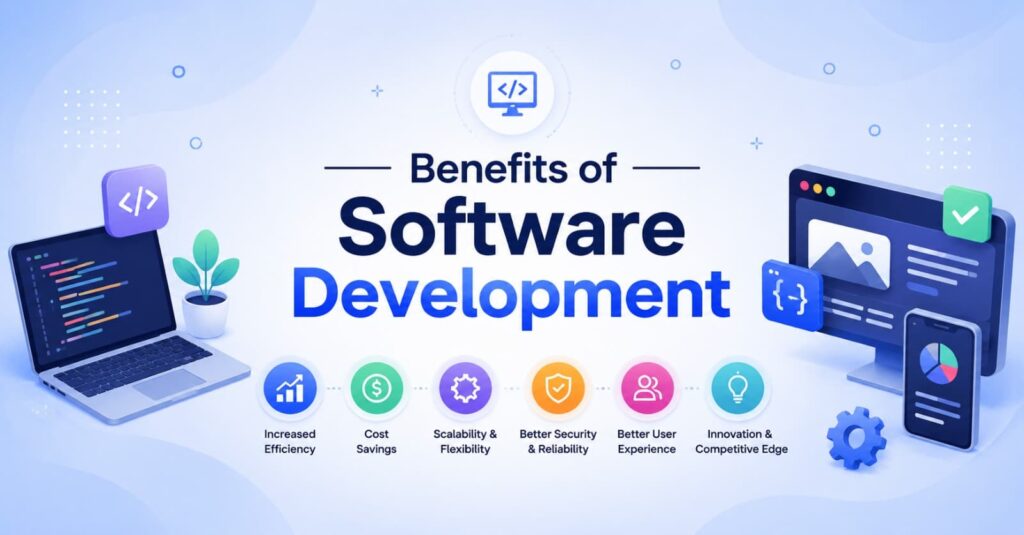
Benefits of Software Development
Software development delivers transformative benefits across personal, professional, and societal dimensions.
1. Problem Solving at Scale: Development of software allows a single solution to be deployed to millions of users simultaneously. A well-built piece of development of software work can solve problems for people across the globe without requiring proportional increases in resources.
2. Career Opportunity: Development of software is one of the highest-demand skill sets in the global economy. Professionals across specializations, from front-end to firmware engineer roles, enjoy strong salaries, remote work opportunities, and job security.
3. Innovation Enablement: Development of software is the primary vehicle for innovation in the digital age. New business models, services, and experiences all start with development of software.
4. Efficiency and Automation: Development of software eliminates repetitive manual tasks through automation. Businesses that invest in development of software consistently operate more efficiently than those that do not.
5. Customization: Unlike off-the-shelf products, custom development of software allows organizations to build precisely what they need, tailored to their unique workflows, users, and goals.
6. Scalability: Software development products can scale to handle growing user bases without proportional increases in cost, making development of software one of the most leverage-friendly disciplines in business.
7. Global Reach: Development of software makes it possible to build products that serve users in any country, in any language, on any device, giving even small teams global reach.
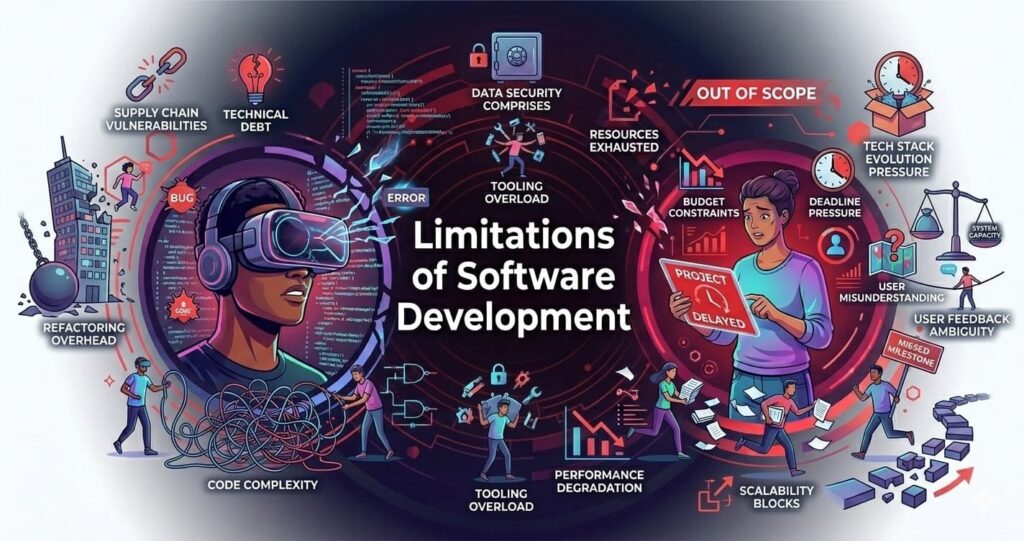
Limitations of Software Development
Despite its enormous potential, software development also has real limitations worth understanding.
1. Complexity and Technical Debt: Software development projects can grow enormously complex over time. When shortcuts are taken, technical debt accumulates, making future development of software slower and more expensive.
2. Security Vulnerabilities: Every piece of software development output is a potential attack surface. Security flaws in development of software can expose users and organizations to data breaches, fraud, and operational disruptions.
3. High Initial Cost: Quality development of software, especially custom solutions, requires significant investment in talent, tools, and time. Many organizations underestimate the true cost of development of software.
4. Talent Shortage: Despite millions of developers worldwide, skilled software development professionals, particularly firmware engineers and AI specialists, remain in short supply relative to demand.
5. Maintenance Burden: Development of software does not end at launch. Applications require ongoing updates, bug fixes, security patches, and feature additions. The long-term maintenance cost of development of software is often underestimated.
6. Rapidly Changing Landscape: The software development field evolves so quickly that skills and tools can become outdated within a few years. Continuous learning is not optional in development of software.
7. User Adoption Challenges: Even the best software development output can fail if users do not adopt it. User experience design and change management are critical components of successful development of software that are often overlooked.
Detailed Software Development Tool Features Study
Modern development of software is powered by a rich ecosystem of tools. Here is a detailed look at the key features that define them:
Integrated Development Environments (IDEs): IDEs like Visual Studio Code, IntelliJ IDEA, and Eclipse provide syntax highlighting, code completion, debugging, version control integration, and terminal access. These features makedevelopment of software faster and less error-prone. Modern IDEs also support AI-assisted development of software through plugins like GitHub Copilot.
Version Control Systems (Git/GitHub): Git provides branching, merging, conflict resolution, and a complete history of every development of software change. GitHub adds collaboration features like pull requests, code reviews, issue tracking, and CI/CD pipeline integration. Together they are the backbone of modern collaborative development of software.
App Development Software Platforms: Platforms like Flutter, React Native, and Xamarin offer single-codebase cross-platform software developing with native performance. Features include hot reload for instant testing, rich widget libraries, and deep integration with device APIs, making mobile development of software dramatically more efficient.
Low-Code and No-Code Tools: Platforms like Bubble, OutSystems, and Microsoft Power Apps enable software development without deep coding knowledge. Features include visual workflow builders, pre-built components, database integrations, and one-click deployment. These tools are expanding who can participate in software development.
Testing and QA Tools: Selenium, Jest, Cypress, and Postman automate testing across UI, API, and unit levels. Automated testing in software development catches bugs before they reach users and ensures new changes do not break existing functionality.
Cloud and DevOps Platforms: AWS, Google Cloud, and Azure provide the infrastructure for modern software development deployment. Features include auto-scaling, containerization with Docker and Kubernetes, managed databases, and global content delivery networks.
Firmware Development Tools: For the firmware engineer, tools like Keil MDK, IAR Embedded Workbench, and PlatformIO provide specialized software development environments for embedded systems. Features include real-time debugging via JTAG, memory analysis, and hardware-in-the-loop testing.
Frequently Asked Questions (FAQs)
Q1. What is software development and how do I get started?
Software development is the process of designing, writing, testing, and maintaining software applications and systems. To get started, choose a beginner-friendly programming language like Python or JavaScript, pick a free learning platform, and start building small projects. The best way to learn software development is to practice consistently and build things that solve real problems.
Q2. What does a firmware engineer do in software development?
A firmware engineer is a software development professional who writes code that controls hardware devices at a low level. They work on products like routers, medical devices, smart appliances, and automotive systems. Their software developed work requires knowledge of embedded programming languages like C, hardware communication protocols, and real-time operating systems. As IoT expands, the firmware engineer is one of the most in-demand roles in software development.
Q3. What is the best app development software for beginners?
For beginners entering software development, excellent app development software options include Flutter for mobile apps, Bubble or Webflow for no-code web applications, and Thunkable for simple mobile software development without coding. As skills grow, beginners can graduate to professional software development tools like Xcode, Android Studio, or Visual Studio Code.
Q4. How long does software development take for a typical app?
The timeline for software development varies widely depending on complexity. A simple mobile app might take two to four months of software development work. A complex enterprise platform could take one to three years. Agile software development methodologies help teams deliver value incrementally, releasing working features early rather than waiting for a fully complete product.
Q5. Is software development a good career in 2025 and beyond?
Absolutely. Software development remains one of the strongest career paths globally. Demand for software development professionals continues to outpace supply across web, mobile, cloud, AI, and embedded systems. Roles like firmware engineer, full-stack developer, and AI software development specialist are particularly high-demand. With remote work widely available and salaries consistently strong, software development offers exceptional career prospects for those willing to invest in the skills.
Conclusion
Software development is the defining craft of the digital age. From the apps that connect us to the firmware that powers the devices around us, software development shapes nearly every aspect of modern life. Whether you are a seasoned developer exploring new frameworks, a firmware engineer working at the intersection of hardware and code, or a founder using app development software to bring your first idea to life, the world of software development has a place for you.
The tools are better than they have ever been. The community is larger and more supportive than ever. The opportunities, both creative and commercial, are extraordinary. Software development is not just about building apps the easy way. It is about building the future, one line of code at a time.
Know more About Us

Hi, I’m Rufqha, the SEO Manager at AIBlogMind. I focus on building content strategies that help websites improve visibility, attract the right audience, and create sustainable organic growth. My expertise includes on-page SEO, keyword research, content optimization, and aligning SEO with user experience and business goals.