



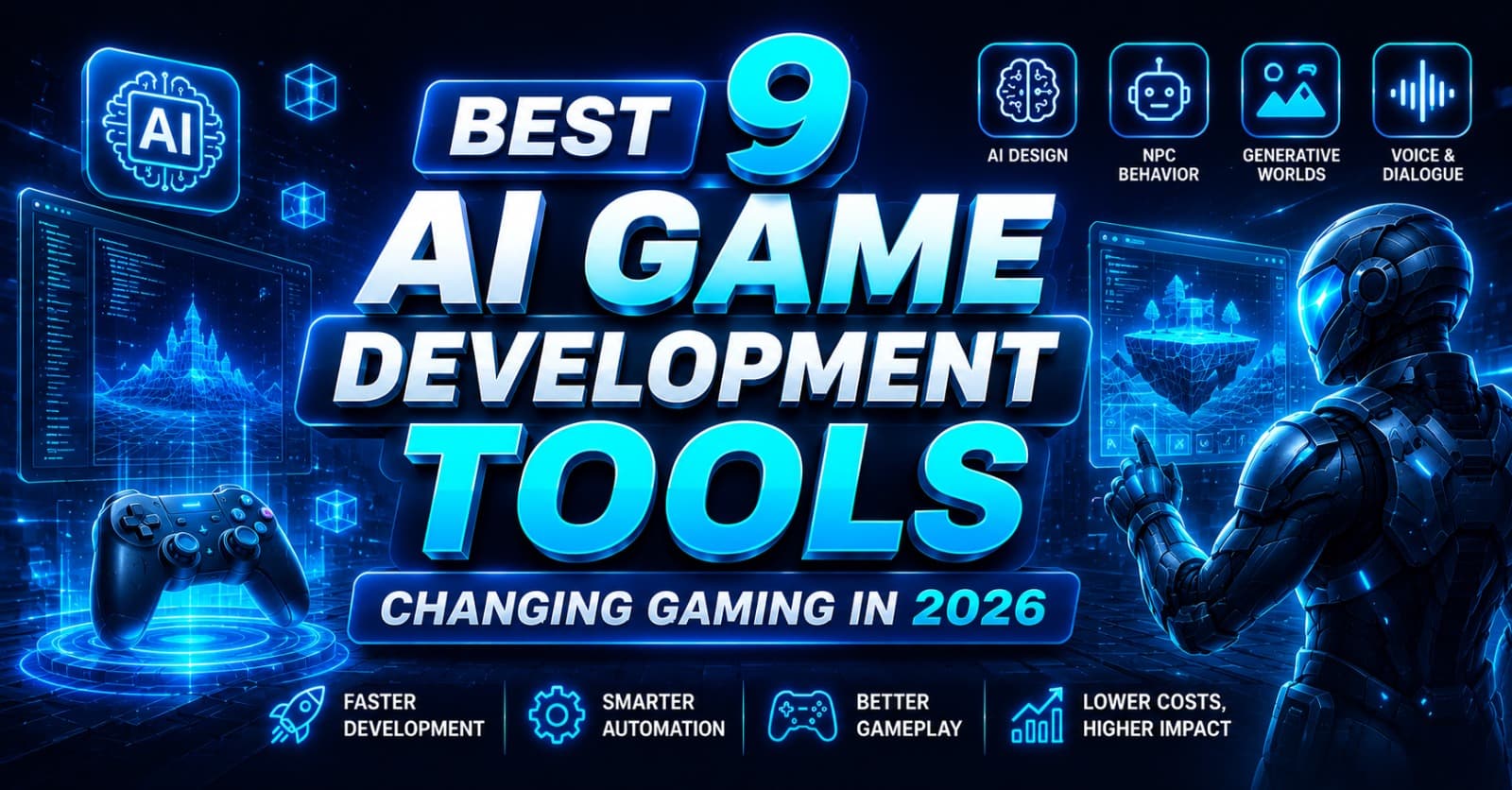
Best 9 AI Game Development Tools Changing Gaming in 2026
Gaming in 2026 feels completely different from what it was just a few years ago. Developers are no longer spending endless months manually building every texture, coding every movement system, or recording thousands of voice lines one by one. The rise of AI game development tools has changed the entire creative process. Small indie teams can now compete with large studios because AI can automate repetitive work, improve workflows, and speed up production. It is almost like giving developers an extra team member that never sleeps.
The gaming industry is moving fast, and players expect larger worlds, smarter characters, and more immersive experiences. Meeting those expectations without AI has become extremely difficult. This is where AI game development tools are making a massive impact. From AI-generated characters to automated coding suggestions, these tools help creators save time while improving quality. Recent industry reports show that AI-assisted studios are shipping projects much faster than traditional teams.
At the same time, AI game design is becoming more accessible for beginners. A solo creator with strong ideas can now build stunning worlds using modern AI gaming tools. The combination of automation, procedural generation, and intelligent coding support has opened doors for thousands of new developers. Whether someone is creating a mobile game, RPG, survival title, or multiplayer experience, modern AI tools for developers are reshaping how games are built from start to finish.
Why AI Is Reshaping Modern Gaming
The modern gaming landscape is extremely competitive. Players expect realistic graphics, lifelike NPCs, detailed environments, and endless replayability. Building those features manually requires massive budgets and huge teams. That is why AI game development tools are now considered essential rather than optional. They reduce repetitive tasks while allowing developers to focus more on creativity and gameplay innovation.
One major reason for this shift is automation. AI can generate textures, animations, scripts, music, and dialogue in minutes. Developers who once spent weeks creating placeholder assets can now use AI gaming tools to produce professional-quality results instantly. This dramatically reduces production time and helps studios prototype ideas faster. According to recent developer discussions, AI-generated workflows are becoming a standard part of software and gaming pipelines in 2026.
Another reason is accessibility. In the past, building games required advanced programming skills and expensive software. Today, many AI tools for developers allow creators to describe ideas using natural language. AI then converts those prompts into code, assets, or dialogue systems. This lowers the barrier to entry and encourages more innovation from independent creators. The result is a gaming industry filled with experimental titles, unique art styles, and faster development cycles.
How AI Game Development Tools Are Transforming Studios
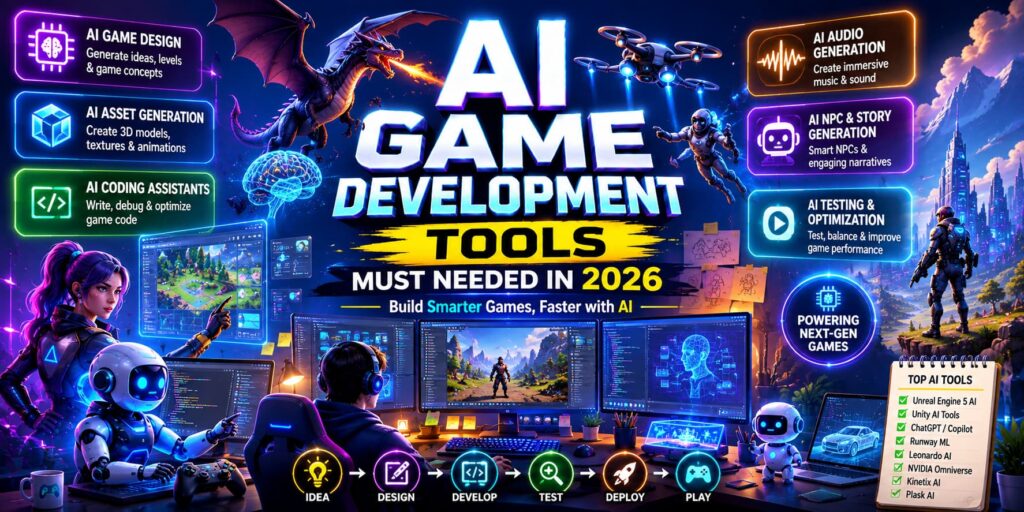
Large gaming studios are using AI game development tools to optimize nearly every department. Art teams use AI to generate environmental concepts and textures. Programmers rely on intelligent coding assistants for debugging and scripting. Audio teams create synthetic voiceovers and adaptive soundtracks. Even quality assurance departments are experimenting with automated testing systems powered by AI.
One of the biggest advantages is speed. Traditional development pipelines often slow down because every asset must be manually reviewed and created. With modern AI gaming tools, developers can generate multiple variations instantly. Need ten versions of a fantasy sword? AI can create them in seconds. Need alternate dialogue for NPCs? AI can write it almost immediately. This rapid experimentation helps studios make better design choices earlier in production.
Indie developers benefit even more. Small teams with limited budgets can now produce visuals and gameplay systems that once required massive resources. AI game design platforms help creators balance mechanics, generate quests, and brainstorm ideas without hiring large teams. Many developers say AI allows them to focus more on storytelling and player experience instead of repetitive technical tasks. Research also suggests AI-assisted workflows improve both productivity and code quality for developers.
What Makes a Great AI Gaming Tool in 2026
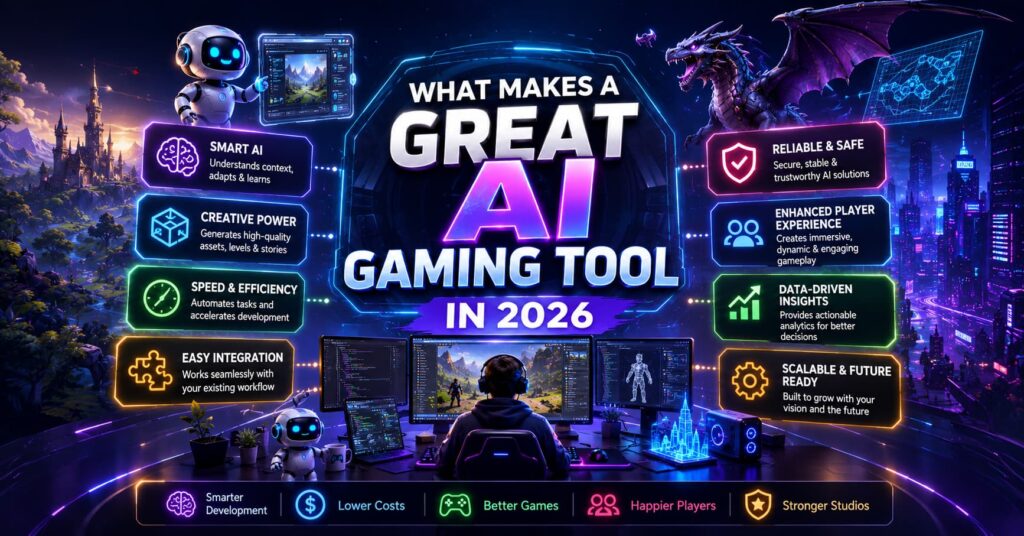
Not every AI platform deserves attention. The best AI game development tools share several important qualities. First, they integrate smoothly with popular engines like Unity, Unreal Engine, and Godot. Developers do not want tools that create extra complexity. They need systems that fit naturally into existing workflows.
Second, strong automation features matter. Great AI gaming tools reduce repetitive tasks without taking away creative control. Developers still want to guide the artistic vision of their games. AI should act like a smart assistant rather than a replacement for creativity. This balance is critical because many gamers and artists remain cautious about fully automated creative systems.
Third, flexibility is essential. The best AI tools for developers can handle multiple tasks, including scripting, art generation, dialogue writing, and testing. Developers prefer platforms that save time across the entire production pipeline. Security and accuracy also matter because buggy AI-generated code can create serious issues during production.
The final factor is scalability. Some tools work perfectly for solo creators, while others are designed for enterprise studios managing huge projects. In 2026, the most successful AI game design platforms are the ones that can scale from indie experiments to full AAA productions without slowing teams down.
Cursor AI
Why Developers Love Cursor
Cursor has quickly become one of the most talked-about AI game development tools in 2026. Built as an AI-powered coding environment, Cursor helps developers write, edit, and debug entire game systems using natural language instructions. Instead of manually coding every mechanic, developers can describe features in plain English and let AI generate working code.
Game programmers love Cursor because it understands complex game engine structures. Whether a team is using Unity with C#, Unreal Engine with C++, or Godot with GDScript, Cursor can navigate codebases intelligently. Developers can ask it to build inventory systems, improve enemy AI, or optimize rendering scripts. This makes Cursor one of the most efficient AI tools for developers available today.
Another major advantage is speed. Cursor can analyze multiple files simultaneously and suggest improvements across entire projects. For indie developers, this means fewer hours spent debugging repetitive problems. For large studios, it means faster collaboration between teams. The rise of intelligent coding assistants like Cursor reflects a broader industry trend where AI handles increasingly complex development workflows.
GitHub Copilot
AI Coding Assistance for Game Logic
GitHub Copilot continues to dominate conversations around AI game development tools because of its reliability and deep coding support. It acts like an intelligent coding partner that predicts what developers want to write next. For game development, this is incredibly useful because repetitive gameplay systems often follow predictable structures.
Developers use Copilot to create movement mechanics, state machines, inventory systems, and multiplayer networking logic. It speeds up coding while reducing repetitive typing. Many teams combine Copilot with other AI gaming tools to build entire prototypes in a fraction of the normal time. According to recent reports, AI-assisted coding is becoming a major part of software engineering in 2026.
What makes Copilot valuable is its adaptability. It learns from project structures and coding styles, making suggestions feel increasingly personalized over time. Beginners benefit because they can learn coding patterns faster, while experienced developers save hours on boilerplate tasks. As AI game design workflows continue evolving, coding assistants like Copilot are becoming essential components of modern development environments.
Scenario
AI Asset Generation for Consistent Art Styles
Scenario is one of the most specialized AI game development tools for visual asset creation. Unlike general image generators, Scenario focuses specifically on gaming assets. Developers can train AI models using their own art styles and then generate new assets that remain visually consistent.
Consistency is incredibly important in game production. A fantasy RPG cannot suddenly have characters that look like they belong in a sci-fi shooter. Scenario solves this problem by helping teams maintain a unified visual identity. Developers use it to generate sprites, weapons, environmental textures, and user interface elements. This makes it one of the most practical AI gaming tools for artists and indie studios.
The biggest benefit is scalability. Creating hundreds of matching assets manually can take months. Scenario reduces that workload dramatically while still allowing artists to refine outputs. Instead of replacing artists, it acts more like a creative accelerator. In modern AI game design, speed matters, and Scenario helps teams produce polished content much faster than traditional pipelines.
Meshy AI
Text-to-3D Modeling Revolution
3D asset creation has always been one of the most time-consuming aspects of game production. Meshy AI is changing that completely. This platform allows developers to generate 3D models directly from text prompts or concept art. A creator can describe a futuristic robot or fantasy castle, and Meshy produces a usable 3D asset within minutes.
This capability is transforming how studios approach prototyping. Developers no longer need to wait for fully modeled assets before testing gameplay ideas. They can generate placeholders instantly and iterate much faster. This makes Meshy one of the most powerful AI game development tools for both indie creators and professional studios.
Another reason Meshy stands out among AI tools for developers is compatibility. Generated assets can be exported into popular engines and modified further by artists. Developers use Meshy for characters, props, environmental pieces, and even experimental creatures. The combination of speed and flexibility has made text-to-3D generation one of the most exciting trends in gaming technology.
Midjourney
Concept Art and Environment Design
Concept art shapes the visual identity of every game. Midjourney has become one of the most influential AI gaming tools because it allows developers to explore artistic ideas rapidly. Instead of spending weeks sketching multiple versions of environments or characters, artists can generate high-quality concepts within minutes.
Studios often use Midjourney during early production stages. Teams experiment with lighting, architecture, costumes, and world-building ideas before committing to final assets. This accelerates brainstorming sessions and improves collaboration between artists and designers. According to industry reports, many indie teams rely on Midjourney for style exploration and marketing visuals.
Midjourney also supports AI game design by helping developers visualize gameplay experiences before full production begins. Whether creating dark fantasy landscapes or futuristic cyberpunk cities, the tool offers endless creative possibilities. It does not replace human imagination, but it dramatically expands how quickly ideas can evolve into polished concepts.
ElevenLabs
Realistic AI Voices for NPCs
Voice acting is expensive and time-consuming, especially for games with massive dialogue trees. ElevenLabs has emerged as one of the leading AI game development tools for synthetic voice generation. Developers can create realistic character voices for NPCs, narrators, and dynamic dialogue systems without booking traditional recording sessions.
The quality of AI-generated speech has improved dramatically in 2026. Many players struggle to distinguish between real recordings and synthetic voices created using advanced AI models. This allows developers to build richer worlds filled with interactive characters. Indie studios especially benefit because they can include voiced dialogue without massive budgets.
ElevenLabs also supports localization by generating multiple language versions quickly. This expands global reach for developers and improves accessibility. As AI gaming tools continue evolving, dynamic voice generation could become a standard feature in open-world RPGs and narrative-driven games.
Claude AI
Storytelling and Narrative Creation
Strong storytelling remains one of the most important parts of memorable gaming experiences. Claude AI is becoming popular among developers because it assists with narrative design, dialogue creation, quest writing, and world-building. It helps teams brainstorm ideas while maintaining coherent storytelling structures.
Game writers often face creative burnout during large projects. Claude acts like a collaborative writing assistant, helping developers expand lore, refine quests, and improve pacing. This makes it one of the most versatile AI tools for developers working on RPGs, visual novels, and adventure games.
Another advantage is analysis. Claude can review game design documents and identify inconsistencies or balancing issues. This supports better AI game design practices by helping teams refine mechanics and progression systems early in development. While human creativity still drives storytelling, AI assistance helps writers move faster and explore more possibilities.
Stable Diffusion
Flexible Image and Texture Creation
Stable Diffusion remains one of the most flexible AI game development tools because developers can run it locally and customize outputs extensively. Artists use it for concept art, texture generation, UI elements, and environmental assets. Combined with ControlNet workflows, Stable Diffusion gives creators detailed control over generated imagery.
One major advantage is affordability. Unlike subscription-based services, Stable Diffusion can operate on local hardware. This makes it attractive for indie developers who want powerful image generation without recurring costs. Teams can train custom models for unique visual styles and generate massive libraries of assets efficiently.
Stable Diffusion also encourages experimentation in AI game design. Developers can test different aesthetics rapidly before finalizing artistic directions. Whether creating horror environments, fantasy landscapes, or sci-fi interfaces, the tool offers flexibility that traditional pipelines often cannot match.
Convai
Smarter NPC Conversations
NPC interaction has historically been limited by scripted dialogue trees. Convai changes that by enabling dynamic AI-driven conversations. Players can speak naturally with NPCs, and the AI responds intelligently in real time. This creates immersive interactions that feel less robotic and more human.
Convai integrates with popular engines and supports advanced conversational systems. Developers use it to create shopkeepers, quest givers, companions, and interactive story characters. This makes it one of the most innovative AI gaming tools available today.
The impact on immersion is huge. Instead of repeatedly clicking dialogue options, players can have flowing conversations with game characters. This represents a major leap forward for AI game development tools, especially in RPGs and open-world games where player choice matters deeply.
Comparing the Top AI Game Development Tools
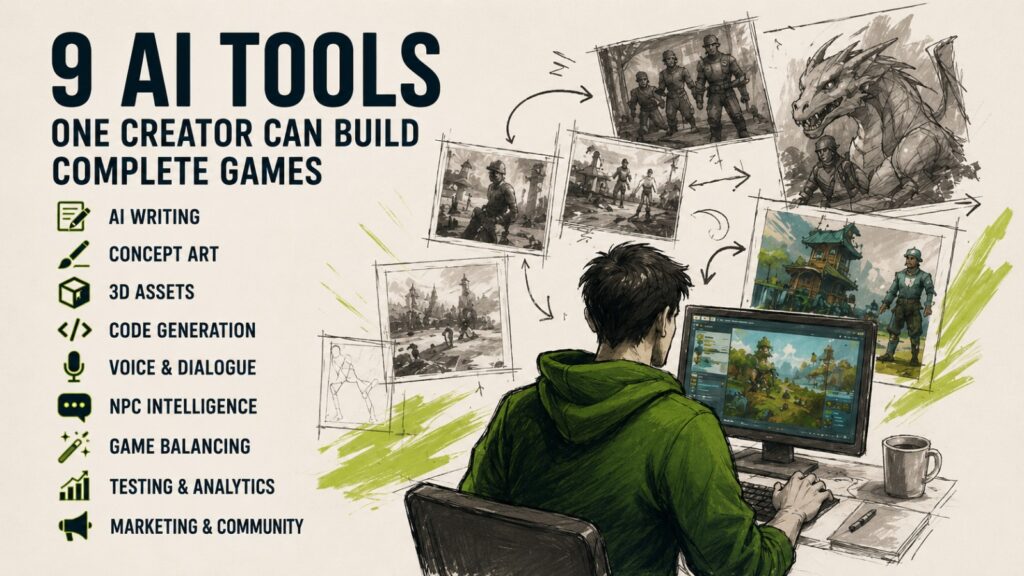
| Tool | Main Purpose | Best For | Key Advantage |
|---|---|---|---|
| Cursor | AI coding IDE | Programmers | Multi-file code generation |
| GitHub Copilot | Coding assistant | Gameplay scripting | Fast autocomplete |
| Scenario | Asset generation | Artists | Consistent visual styles |
| Meshy AI | Text-to-3D models | 3D developers | Rapid prototyping |
| Midjourney | Concept art | Designers | Fast visual exploration |
| ElevenLabs | Voice generation | Narrative games | Realistic NPC voices |
| Claude AI | Story writing | RPG creators | Strong narrative support |
| Stable Diffusion | Image generation | Indie studios | Flexible local workflows |
| Convai | NPC conversations | Open-world games | Dynamic AI dialogue |
For such amazing content, follow us on Instagram.
Challenges and Ethical Concerns in AI Game Design
Despite the excitement around AI game development tools, there are still important concerns. Some artists worry about AI replacing creative jobs, while players sometimes criticize games that rely too heavily on generated content. The debate around AI-generated art and storytelling continues growing across the gaming industry.
Another issue is quality control. AI-generated code and assets are not always perfect. Developers still need human oversight to avoid bugs, inconsistencies, and copyright concerns. Research has also highlighted the risk of “comprehension debt,” where teams use AI-generated systems they do not fully understand.
There are also ethical questions around voice cloning, job displacement, and originality. Some studios are careful about using AI responsibly, while others push automation aggressively. The future of AI game design will likely depend on finding the right balance between efficiency and human creativity.
Why AI Game Development Tools Are Essential for Future Gaming
The gaming industry is becoming more competitive every year, and developers are under constant pressure to create larger worlds, smarter NPCs, and more immersive gameplay experiences in shorter development cycles. This is exactly why AI game development tools are becoming the backbone of modern game studios in 2026. Instead of relying only on traditional workflows, developers now use AI game development tools to automate repetitive production tasks, improve coding efficiency, and generate creative assets much faster. Whether it is character design, animation, scripting, testing, or world-building, AI game development tools are helping studios reduce production costs while increasing overall quality.
One major reason behind the rapid adoption of AI game development tools is speed. Modern gamers expect frequent updates, realistic environments, and highly interactive gameplay systems. Building all of that manually can take years. With advanced AI game development tools, developers can generate textures, create dialogue systems, optimize code, and even build 3D environments within minutes. This allows teams to focus more on creativity and gameplay innovation rather than spending endless hours on repetitive technical tasks. Many indie studios are now competing with larger companies because AI game development tools give small teams access to enterprise-level capabilities without requiring massive budgets.
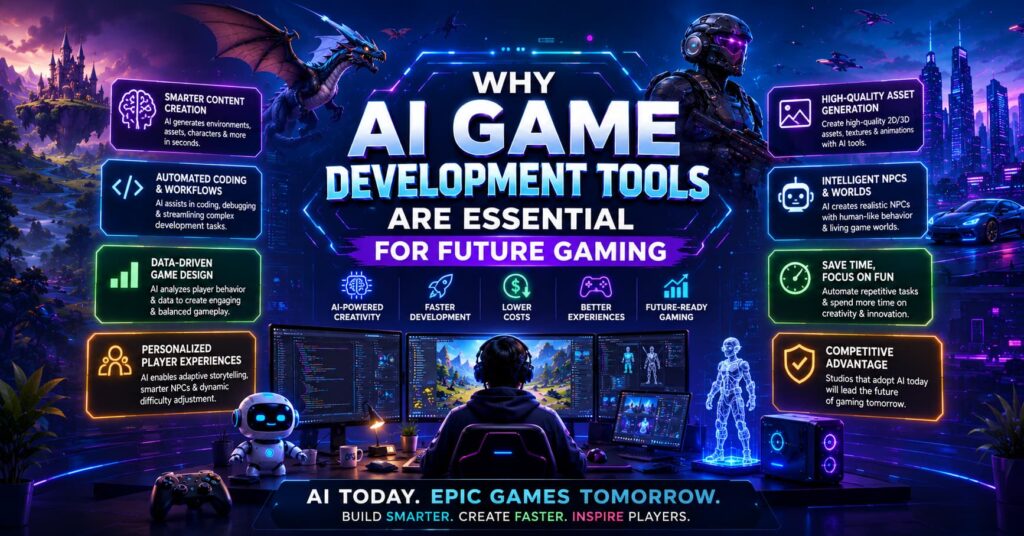
Another important advantage of AI game development tools is accessibility. In the past, game creation required strong programming knowledge and expensive production teams. Today, beginner creators can use AI game development tools to simplify coding, generate visual assets, and experiment with game mechanics without advanced technical expertise. This shift is creating a new generation of independent developers who can produce professional-quality games faster than ever before. As the technology continues evolving, experts believe AI game development tools will become standard components in every stage of game production, from concept design to post-launch support.
The future of gaming will heavily depend on how effectively developers use AI game development tools alongside human creativity. AI cannot replace imagination, storytelling, or artistic direction, but it can dramatically improve productivity and efficiency. Developers who understand how to combine traditional design skills with modern AI game development tools will have a huge advantage in the gaming industry. This is why studios, indie creators, and even educational institutions are rapidly adopting AI-powered workflows to stay competitive in the evolving world of game development.
Final Verdict
The gaming industry is entering a completely new era, and AI game development tools are leading the transformation. These platforms are not simply trendy add-ons anymore. They are becoming core parts of modern production pipelines. From coding assistants and asset generators to AI-powered storytelling systems, the tools available in 2026 are helping developers create richer games faster than ever before.
What makes this moment exciting is accessibility. Solo developers can now compete with established studios using advanced AI gaming tools that dramatically reduce production barriers. At the same time, professional teams are scaling projects more efficiently through automation and intelligent workflows. The combination of creativity and machine assistance is unlocking possibilities that once seemed impossible.
The future of gaming will not belong entirely to AI or entirely to humans. It will belong to teams that understand how to combine both effectively. Developers who embrace modern AI tools for developers while maintaining strong creative direction will shape the next generation of unforgettable gaming experiences.
FAQs
1. What are AI game development tools?
AI game development tools are software platforms that use artificial intelligence to help developers create games faster. They assist with coding, asset generation, voice creation, storytelling, testing, and NPC behavior.
2. Which AI tool is best for beginner game developers?
Cursor and GitHub Copilot are excellent starting points because they simplify coding tasks and help beginners learn programming patterns faster.
3. Can AI completely replace game developers?
No. AI can automate repetitive tasks, but human creativity, storytelling, artistic direction, and gameplay innovation still require developers and designers.
4. Are AI-generated assets safe to use commercially?
It depends on the platform and licensing terms. Developers should always review usage rights and ensure generated content does not violate copyrights.
5. Why are AI gaming tools becoming so popular in 2026?
They reduce development time, lower production costs, improve productivity, and allow small teams to build larger and more detailed games efficiently.

Syed Abubakkar is a content and SEO specialist responsible for article publishing, on-page SEO, keyword optimization, and AI-powered image generation. He is passionate about digital marketing and helping websites grow their online presence.