

Social Media Trends: What’s Hot Right Now in 2026
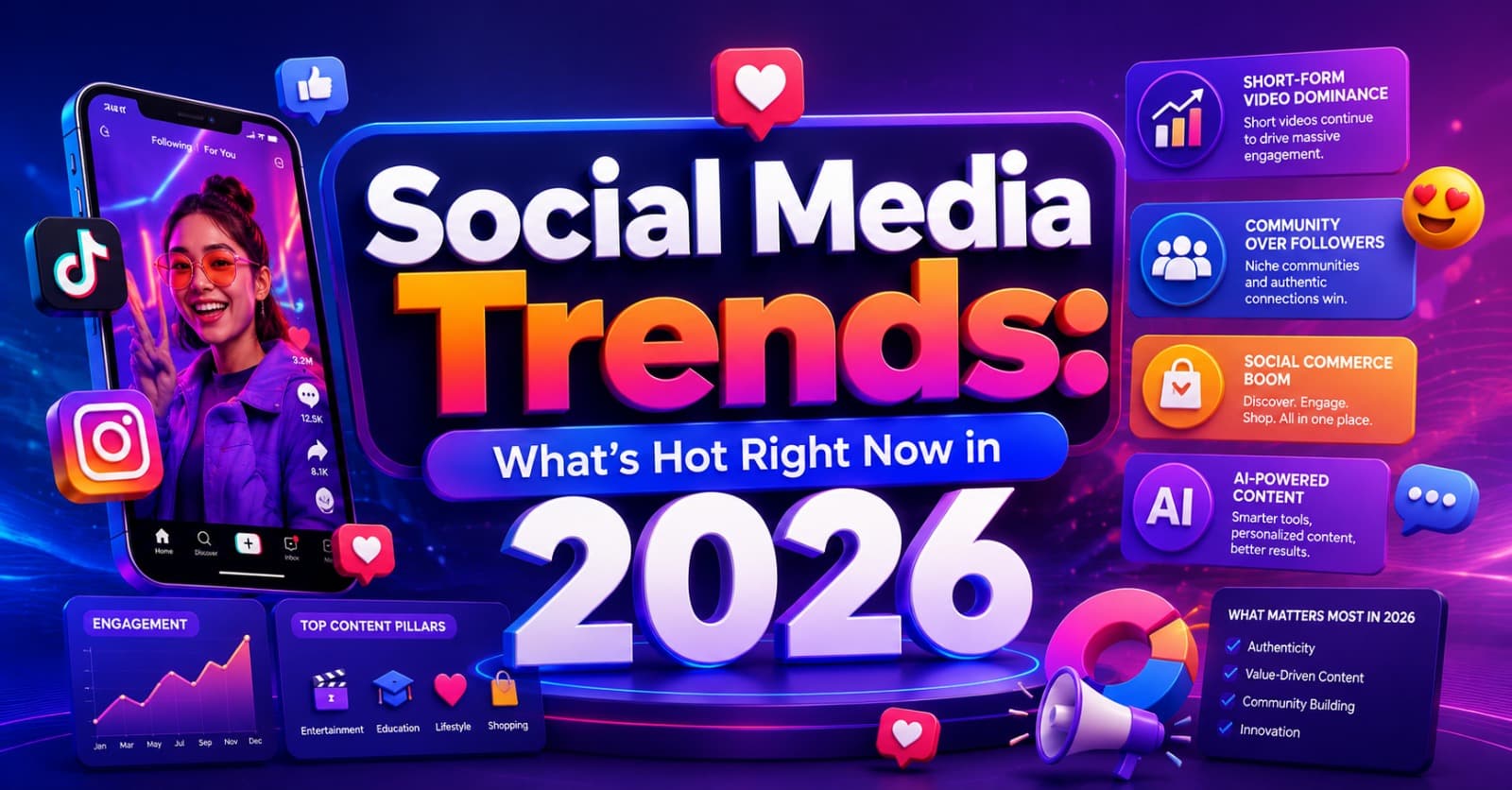
If you blinked in 2025, you may have missed an entire revolution. Algorithms rewrote themselves. Platforms reinvented their purpose. Audiences grew smarter, more selective, and more demanding than ever before. And now, in 2026, the pace has not slowed down — it has accelerated.
Understanding social media trends is no longer optional for brands, creators, marketers, and professionals. It is a survival skill. Whether you are managing a business account, building a personal brand, or simply trying to make sense of what is happening in your feed, staying current on social media trends is what separates those who grow from those who get left behind.
This guide offers a comprehensive, expert-informed look at the most important social media trends shaping the digital world right now. We cover platforms, content formats, audience behavior, technology, and what all of it means for you – practically and professionally.
The Big Picture: Social Media in 2026
Before diving into individual social media trends, it helps to understand the scale of what we are dealing with. There are now 5.66 billion social media users worldwide – a figure that means social media users outnumber non-users by nearly two to one globally. Social media is no longer a niche activity. It is the primary layer of the internet for most of humanity.
What was once a place for sharing personal updates with friends has become a platform for commerce, news, entertainment, search, customer service, political organizing, education, and cultural creation. The social media trends of 2026 reflect this maturity – platforms are not growing in novelty anymore; they are growing in depth, sophistication, and integration into daily life.
Four forces are driving today’s most important social media trends: artificial intelligence, the demand for authentic human connection, the rise of social platforms as search engines, and the explosive growth of video in all its forms.
Trend 1: Social Platforms Are Now Search Engines
One of the most transformative social media trends of 2026 is the shift from social platforms as browsing destinations to discovery engines people actively search.
Users – especially Gen Z and younger millennials – are increasingly turning to TikTok, Instagram, and even LinkedIn instead of traditional search engines when they want to find restaurants, tutorials, product reviews, travel ideas, or professional advice. This shift has major implications for anyone creating content online.
Optimizing captions, using relevant keywords, adding searchable text overlays, and structuring content so it can appear in platform search results are becoming essential skills for any team that wants to keep up with the latest social media trends. Social networks are investing more in search features and recommendation algorithms, meaning that if your content isn’t optimized to be found, it simply won’t reach people regardless of its quality.
This search-first approach to social media trends demands that creators think like SEO strategists. The words spoken in a video, the text overlaid on screen, the alt text on an image – all of it now feeds into discoverability. Creators can now produce even more personalized content in less time, giving them an edge over other media that can take more time and resources to launch.
For businesses, this is one of the current social media trends with the most direct commercial impact: being findable on social platforms now drives purchase decisions the same way Google rankings once did.
Trend 2: AI Is Everywhere – But Authenticity Is the Real Currency
Artificial intelligence has woven itself into every layer of social media trends in 2026. From AI-generated captions and automated video editing to AI-powered content recommendations and synthetic influencers, the technology is impossible to ignore.
Facebook has added AI-powered features including AI-generated voiceovers, AI translation features for voiceovers, and an “Imagine yourself” feature for users. Meta, TikTok, and YouTube have all embedded generative AI tools directly into their creation platforms, making it easier than ever to produce content at scale.
Yet one of the most important social media trends of the moment is a direct reaction to this AI explosion: audiences are craving authentic human voices more than ever. Brands getting genuine engagement aren’t the ones with the fastest turnaround on trending audio. They’re the ones building recognizable characters, lore, and brand worlds that feel distinctly theirs. Trends can be a tool, but they can’t be your entire strategy.
The lesson for anyone following social media trends is nuanced: use AI as a production tool, not as a replacement for genuine human personality. The platforms themselves are reinforcing this – Facebook is now focusing on demoting “unoriginal” repurposed content with a new algorithm update, while expanding the reach of high-quality content.
Among the social media trends that practitioners are watching most closely, this tension between AI efficiency and human authenticity is perhaps the most critical to navigate correctly.
Trend 3: Short-Form Video Still Dominates – But Long-Form Is Making a Comeback
Short-form video has been king for several years, and it remains one of the most powerful social media trends going into the second half of 2026. Reels, TikToks, and YouTube Shorts continue to receive the highest organic reach of any content format across almost every major platform.
However, a new nuance is emerging among social media trends: long-form video is staging a genuine comeback. Video dominates – short-form for attention, long-form for depth. Both formats work, and smart brands run them in parallel. Serialized content is outperforming one-off posts, with episodes building trust, anticipation, and keeping audiences coming back.
This serialized, episodic approach to content represents one of the most exciting social media trends for creators. Instead of chasing one-off viral moments, builders are creating content “worlds” – recurring characters, inside jokes, running storylines – that keep audiences invested over time.
Facebook Lives get more views, watch time, and interactions than normal videos. With Facebook trends focusing on video content in 2026, live streaming is increasingly important for brands and businesses – particularly for product launches and real-time event coverage, which is seen as more authentic and therefore more appealing.
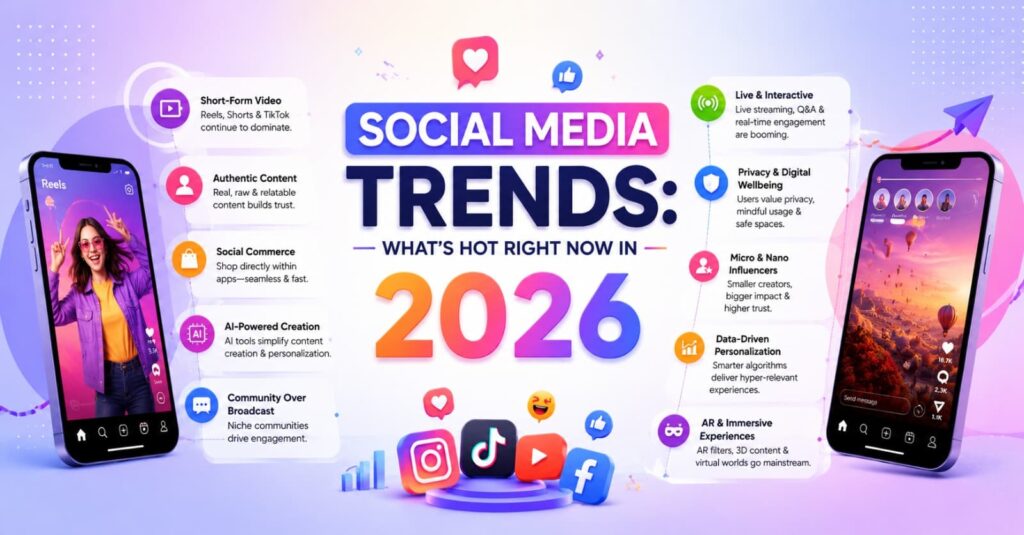
Trend 4: Facebook Trends 2026 – The Platform Is Reinventing Itself
It became fashionable in some circles to declare Facebook irrelevant, but the current social media trends data tells a different story. Facebook – and its parent company Meta – are among the most aggressive movers in the 2026 platform landscape.
Facebook trends 2026 center on several key shifts: the maturation of social commerce, the growth of private community spaces, AI-powered personalization, and a strengthening of video across all formats.
Over 82% of consumers globally use social media for product discovery and research before making a purchase. Facebook’s commerce ecosystem is changing more aggressively as we head into 2026 – AI-powered product matching, richer catalog listings, seller ratings, and automated descriptions now make Marketplace feel closer to a retail platform than the classifieds tool it used to be.
On the privacy side, Facebook trends 2026 reflect growing user demand for data protection. Facebook has rolled out features such as end-to-end messaging encryption and two-factor authentication, and Meta launched a new privacy center providing users with a central location to manage their privacy settings and data across Instagram, WhatsApp, and Facebook.
Community is another pillar of Facebook trends 2026. In 2026, groups will become even more prominent on the platform, with the Facebook algorithm recommending groups based on users’ interests, activity, and demographics.
For marketers, ignoring Facebook trends 2026 means ignoring a platform that, according to recent projections, is expected to surpass Google in digital ad revenue both in the U.S. and internationally for the first time in 2026. That is not a platform in decline – that is a platform at the peak of its commercial power.
Trend 5: The Rise of Private and Community-First Engagement
Among current social media trends, one of the clearest signals is the migration of meaningful engagement from public feeds to private spaces. Discord servers, Facebook Groups, WhatsApp communities, Telegram channels, and closed Instagram broadcast channels are now where the most loyal audiences gather.
One of the most noticeable social media marketing trends right now is the shift from public reach to private interaction. As algorithms become more unpredictable and organic visibility continues to fluctuate, brands are starting to focus less on chasing virality and more on building spaces where they can create real, long-term relationships with their audience.
This shift in social media trends reflects a deeper audience fatigue with performative public posting. People are tired of one-way broadcasts from brands and influencers. They want conversation, community, and the feeling of being known – not just marketed to.
Community management is finally getting its moment again as a key social media marketing trend in 2026. Brands that invest in community managers – people whose job is to genuinely engage, moderate, welcome, and nurture community members – are seeing dramatically higher loyalty and long-term engagement than those focused purely on broadcast content.
Trend 6: Social Trends Around Nostalgia and the “2026 is the New 2016” Moment
Among the most fascinating current social media trends is a wave of digital nostalgia that has taken root across TikTok, Instagram, and beyond. Both brands and creators are leaning into the 2016 era of “digital innocence,” reviving its most iconic features: over-saturated Snapchat filters, “full beat” glam, and Mannequin and Bottle Flip Challenges.
This nostalgia-driven wave of social trends is not simply about aesthetics. It represents a deeper emotional reaction to AI saturation, algorithm fatigue, and the feeling that social media has become too polished, too optimized, and too fake. The micro-viral or niche-viral trend – content that doesn’t try to reach everyone but explodes within specific subcultures is replacing the era of universal virality.
Understanding these social trends is essential for creators and brands. The audiences that once rewarded slick production now respond with enthusiasm to imperfect, genuine, character-driven content. Authenticity is not just a buzzword in 2026’s social trends landscape – it is the algorithm.
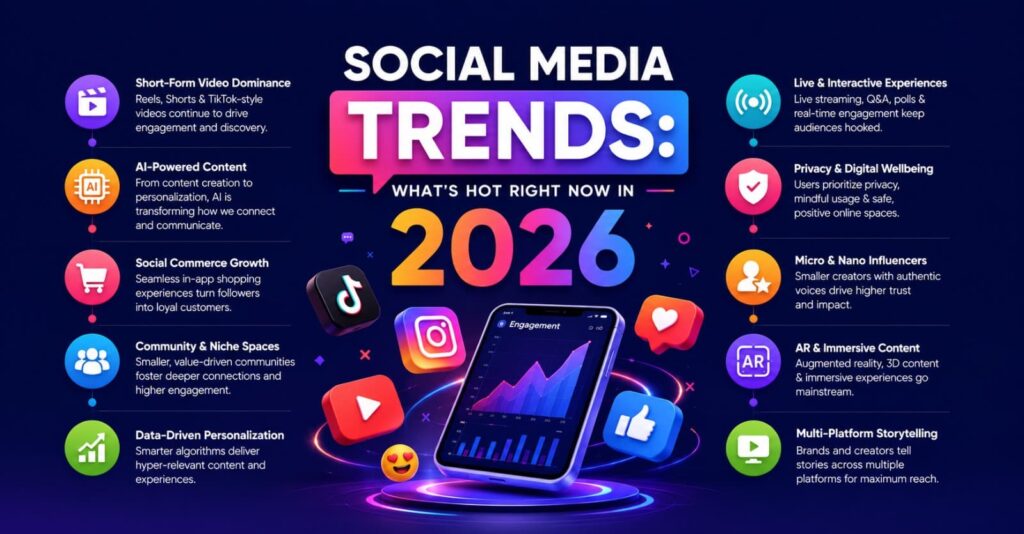
Trend 7: Creator Economy Maturity and Influencer Trust
The creator economy has entered a new phase as one of the defining social media trends of 2026. The era of mega-influencer dominance is giving way to something more nuanced: audiences trust nano – and micro-influencers who feel like real people, not walking advertisements.
Creators can now produce even more personalized content in less time. Gen Z spends 54% more time than the average consumer per day on social platforms and watching user-generated content, and 26% less time watching TV and movies.
Brands following current social media trends are shifting their influencer budgets accordingly – spreading spend across many smaller voices rather than concentrating it in a few celebrity accounts. The return on investment from authentic micro-influencer partnerships consistently outperforms mega-influencer campaigns in 2026’s trust-driven environment.
Employee-generated content (EGC) is also emerging as one of the hottest social media trends for brands. Employee-generated content is among the biggest trends shaping social media in 2026 – content created by real employees delivers the kind of credibility and relatability that polished brand content struggles to match.
Trend 8: Social Commerce – Buy Without Leaving the App
Social commerce has been a promised land for years, and 2026’s social media trends suggest it has finally arrived. The friction between discovery and purchase is collapsing. Users can now find a product, read reviews, watch a demonstration, and complete a purchase – all without leaving Instagram, TikTok, or Facebook.
Meta is building one integrated system where users can browse, compare, and buy without leaving the platform. Combined with Shops and in-app checkout, managing product catalogs, Shops, and checkout flows is becoming much simpler.
For e-commerce businesses, adapting to these social media trends is a direct revenue opportunity. Brands that have not yet integrated shoppable posts, in-app storefronts, and live shopping events into their strategy are falling behind competitors who have.
Benefits of Tracking and Applying Social Media Trends
Staying ahead of social media trends delivers concrete, measurable benefits for businesses, creators, and professionals:
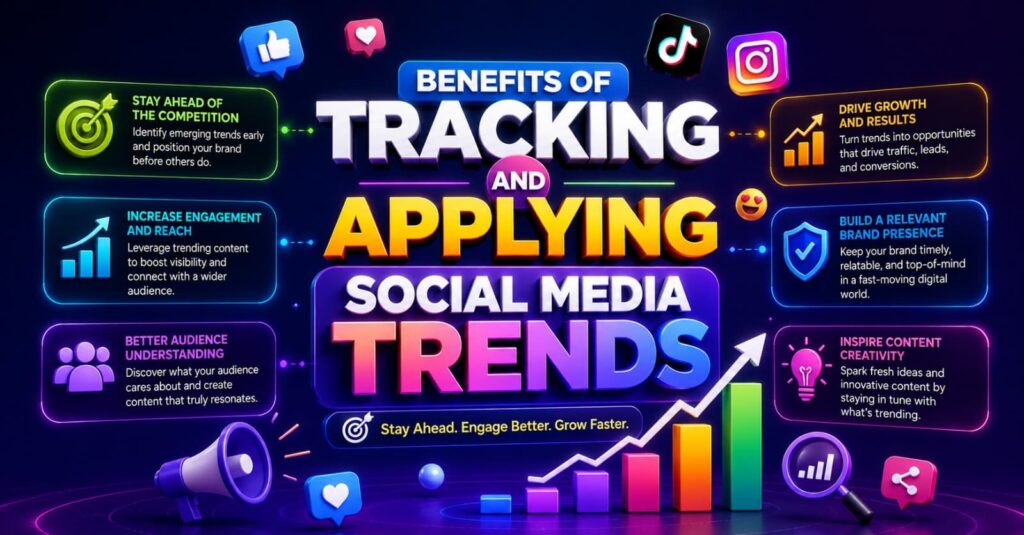
- Competitive advantage: Brands that adopt social media trends early gain visibility before markets become saturated with similar content.
- Audience growth: Trend-aligned content is rewarded by algorithms with organic reach, helping accounts grow without paid promotion.
- Higher engagement: Content that taps into current social media trends resonates emotionally with audiences, generating more meaningful interactions.
- Better ROI: Understanding which social media trends drive purchase behavior allows marketers to allocate budgets more effectively.
- Stronger brand identity: Knowing which social media trends fit your brand — and which to ignore – sharpens your overall content strategy.
- Talent attraction: Companies seen as forward-thinking in social media trends attract better digital talent.
- Informed product development: Consumer conversations surfaced through social media trends offer real-time market research.
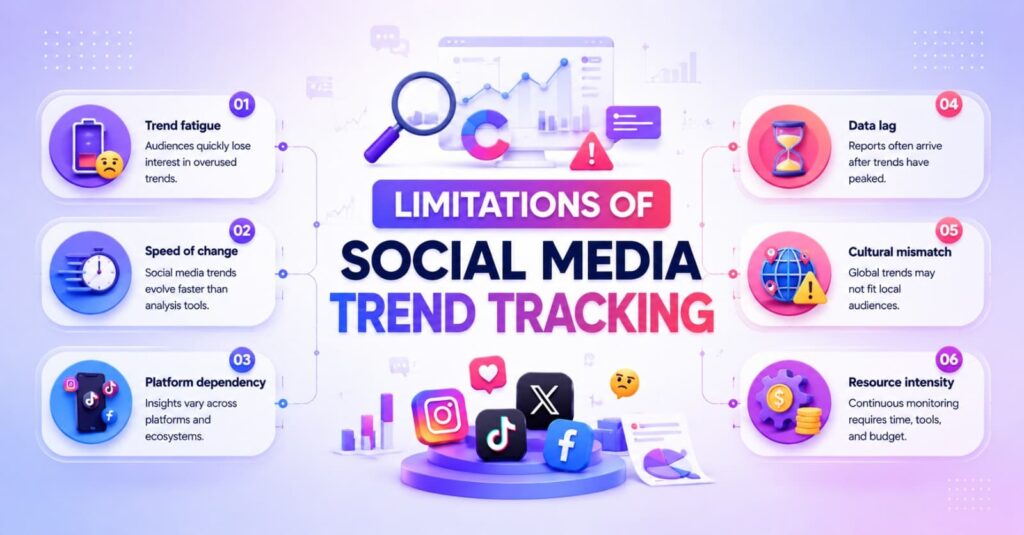
Limitations of Social Media Trend Tracking
Despite its many benefits, following social media trends comes with genuine limitations that practitioners must acknowledge:
- Trend fatigue: Over-reliance on social media trends can lead to reactive content with no strategic coherence or brand identity.
- Speed of change: Social media trends can peak and fade within days, making it difficult to capitalize on them before they become oversaturated.
- Platform dependency: Building a strategy entirely around current social media trends on one platform creates vulnerability to algorithm changes or platform decline.
- Data lag: Trend reports reflect past behavior; by the time social media trends are formally documented, early adopters have already moved on.
- Cultural mismatch: A social media trend popular in one market may be irrelevant or inappropriate in another, creating risks for global brands.
- Resource intensity: Consistently tracking and acting on social media trends requires significant time, staff, and budget investment.
Connect with us on LinkedIn
Detailed Tool Features: Social Media Trends Monitoring Platforms
For anyone serious about staying current with social media trends, dedicated tracking tools offer structured, data-driven capabilities. Here is a feature-by-feature breakdown of what leading social media trends monitoring platforms offer:
Real-Time Trend Detection
Scans millions of posts, hashtags, and keywords across platforms simultaneously to surface emerging social media trends before they peak. Allows users to set alerts for trend velocity thresholds – flagging content that is accelerating rapidly.
Competitor Benchmarking Module
Tracks how competitors are engaging with social media trends – including what formats they use, how frequently they post trend-driven content, and what engagement rates they achieve. Provides side-by-side comparisons and gap analysis.
Audience Sentiment Analysis
Uses natural language processing to assess how audiences feel about specific social media trends – identifying whether a trend carries positive, negative, or polarizing sentiment before a brand commits to it.
Platform-Specific Trend Segmentation
Breaks down social media trends by platform (TikTok, Instagram, Facebook, LinkedIn, YouTube, X) so users can understand which trends are gaining traction where, and which are already declining.
Trend Lifecycle Tracker
Maps the growth, peak, and decline phases of social media trends, helping content teams time their entries and exits strategically rather than reacting late.
Content Performance Forecasting
Uses historical trend data and machine learning to predict which emerging social media trends are most likely to deliver strong engagement for a given account type, industry, or audience demographic.
Hashtag and Keyword Research Engine
Identifies the specific hashtags, audio tracks, phrases, and visual styles associated with top-performing social media trends, giving creators a ready-made optimization toolkit.
Trend Reporting Dashboard
Generates visual reports on social media trends performance over time, suitable for sharing with stakeholders, clients, or leadership teams. Customizable by time period, platform, and trend category.
Frequently Asked Questions (FAQs)
1. What are the biggest social media trends in 2026?
The biggest social media trends in 2026 include the transformation of social platforms into search engines, the dominance of short-form and serialized video content, the rise of AI-assisted content creation alongside growing demand for authenticity, the explosive growth of social commerce, and the shift toward private community engagement over public broadcast. Facebook trends 2026 specifically highlight AI-powered features, community group growth, and the platform’s emergence as a dominant digital advertising force. Together, these social media trends represent a landscape that rewards genuine connection, strategic content optimization, and platform-specific expertise.
2. How do current social media trends affect small businesses?
Current social media have leveled the playing field significantly for small businesses. The rise of micro-influencers, community-first engagement, and search-driven discovery means that smaller brands with authentic voices and well-optimized content can compete effectively with much larger competitors. Social commerce features on Facebook, Instagram, and TikTok allow small businesses to sell directly without the overhead of a traditional e-commerce operation. However, current social media also require consistency and strategy — sporadic or untargeted posting rarely yields results in 2026’s algorithm-driven environment.
3. What are social trends driving Gen Z behavior online in 2026?
The social trends most strongly driving Gen Z behavior in 2026 include nostalgia content (particularly the “2026 is the new 2016” wave), niche-viral content within specific subcultures, creator-led authenticity over brand polish, and short-form video with strong personality-driven presentation. Gen Z is also a primary driver of the search-first social trend, preferring to search TikTok or Instagram for product recommendations and information rather than using traditional search engines. Their skepticism of AI-generated content and virtual influencers is also shaping broader social trends toward real human voices and unfiltered storytelling.
4. How are Facebook trends 2026 different from previous years?
Facebook trends 2026 represent a significant evolution from prior years. The platform has shifted from a general social network into a multi-layered ecosystem combining community groups, video entertainment, social commerce, AI personalization, and enhanced privacy tools. Unlike earlier years when Facebook was primarily about news feed posts and page marketing, Facebook trends 2026 center on private group engagement, in-app shopping, live video authenticity, and AI-powered content discovery. The platform’s projected overtaking of Google in digital ad revenue in 2026 further underscores how dramatically its commercial role has matured.
5. How often should businesses update their strategy based on social media trends?
Businesses should conduct a formal review of social media trends at least quarterly, with ongoing informal monitoring happening weekly or monthly through dedicated tools or curated industry newsletters. Social media in fast-moving categories (entertainment, fashion, food) may require more frequent strategic adjustments, while B2B sectors can typically operate on a slower review cycle. The key principle is to build a core brand strategy that is independent of any single trend, then layer in social media trends as tactical opportunities — not as the foundation of your entire approach. Brands that chase every trend without strategic grounding risk losing their identity and audience trust over time.

Mohammed Viqar Ali is a Digital Marketer, UI/UX Designer, and content creator passionate about AI, technology, SEO, and digital growth. As the UI/UX Designer of aiblogmind, he focuses on creating user-friendly digital experiences while sharing practical insights on artificial intelligence, marketing trends, productivity tools, and online business growth. Through his content, he helps readers discover innovative solutions, stay updated with emerging technologies, and make informed decisions in the digital world.