

Cloud Computing in 2026: Benefits, Challenges, and Best Practices
Introduction: The World Runs on Cloud Computing Now
Think about the last time you saved a photo, joined a video call, streamed a movie, or checked your bank balance on your phone. Every single one of those actions was powered by cloud computing. And yet, most people still do not fully understand what cloud computing is, how it works, or why it matters so deeply in 2026.
Here is the problem: businesses of all sizes are under enormous pressure to move faster, spend smarter, and scale bigger — all at the same time. Traditional IT infrastructure cannot keep up. Maintaining physical servers is expensive, slow to upgrade, and vulnerable to failure. Organizations that rely on outdated systems are falling behind competitors who have already embraced cloud computing to work with greater speed and efficiency.
The solution is cloud computing. By shifting computing resources — storage, software, processing power — to the internet, cloud computing gives businesses and individuals instant access to powerful technology without owning or managing physical hardware. In 2026, cloud computing is not just a technology trend. It is the foundation of the modern digital economy.
This article offers a complete guide to cloud computing in 2026 — covering what it is, the latest cloud computing news, the top cloud computing services available, the benefits, the challenges, and the best practices to help any organization get the most from the cloud.
What Is Cloud Computing?
Before diving into benefits and tools, it helps to answer the most fundamental question directly: what is cloud computing?
Cloud computing is the delivery of computing services — including servers, storage, databases, networking, software, analytics, and intelligence — over the internet, commonly referred to as “the cloud.” Instead of buying and maintaining physical servers in your office or data center, you access these resources on demand from a cloud provider and pay only for what you use.
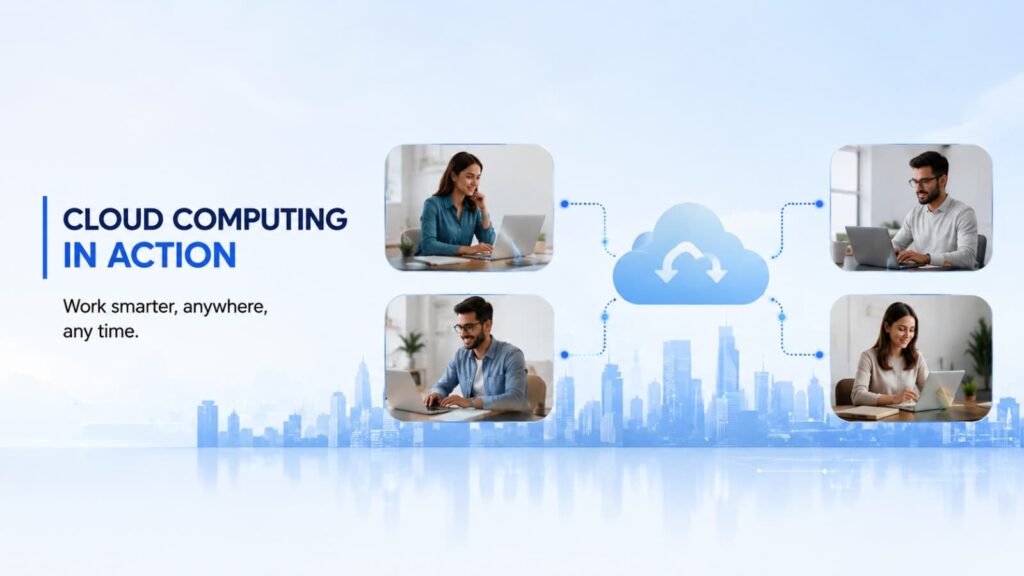
What is cloud computing in practical terms? It means a startup in Mumbai can access the same enterprise-grade infrastructure used by global corporations, without spending millions on hardware. It means a hospital can securely store patient records and access them from any device, anywhere. It means a software team can build, test, and deploy applications in hours instead of weeks.
Cloud computing explained simply: the cloud is someone else’s powerful computer that you rent over the internet. That simplicity, however, contains enormous power. Cloud computing services can be scaled up or down instantly, accessed globally, and paid for flexibly — making them ideal for businesses of every size and type.
There are three main types of cloud computing services. Infrastructure as a Service (IaaS) provides raw computing resources like virtual machines and storage. Platform as a Service (PaaS) provides tools for developers to build and deploy applications. Software as a Service (SaaS) delivers finished applications directly over the internet, like email, CRM software, or document editing tools.
Cloud Computing News in 2026: What Is Happening Right Now
The cloud computing landscape in 2026 is evolving faster than ever. Staying current with cloud computing news is essential for any business making technology decisions today.
The biggest cloud computing news of 2026 is the deep integration of artificial intelligence into every major cloud platform. AWS, Microsoft Azure, and Google Cloud are no longer just infrastructure providers — they are AI platforms. Every cloud computing service now comes with built-in AI capabilities, from machine learning tools to generative AI models that help businesses automate processes, analyze data, and build intelligent applications.
Another major story in cloud computing news is the rise of edge computing. Rather than sending all data to centralized cloud servers, edge computing processes data closer to where it is generated — on devices, sensors, or local servers. This combination of cloud and edge computing is transforming industries like manufacturing, healthcare, and smart cities, where real-time data processing is critical.
Multi-cloud adoption is also a dominant cloud computing news trend in 2026. Most large organizations now use two or more cloud providers simultaneously, spreading workloads across AWS, Azure, Google Cloud, and regional providers to avoid vendor lock-in and improve resilience. Managing this complexity has made cloud thinking governance and cost optimization top priorities for IT leaders.
Finally, sustainability is reshaping cloud thinking news globally. Major providers have committed to running on 100% renewable energy, and cloud computing’s energy efficiency compared to on-premise infrastructure is making it a preferred choice for organizations with environmental goals.
Benefits of Cloud Computing Services
Cloud computing delivers transformative advantages to organizations across every industry. Here is why cloud computing adoption continues to accelerate in 2026.
Cost Efficiency One of the most compelling benefits of cloud thinking is its cost model. Instead of large upfront capital expenditure on hardware, cloud services use a pay-as-you-go model. Organizations only pay for the resources they actually use, turning IT spending from a fixed cost into a variable one that scales with the business.
Scalability and Flexibility Cloud computing allows businesses to scale resources up or down in minutes. A retail company can handle a surge in traffic during a sale event and scale back immediately after paying only for the extra capacity used. This elasticity is something traditional IT infrastructure simply cannot match. Cloud thinking explained in business terms means: grow when you need to, without overpaying when you do not.
Business Continuity and Disaster Recovery Cloud computing services include built-in data backup, redundancy, and disaster recovery. If a server fails or a natural disaster strikes, data stored in the cloud remains safe and accessible. This makes cloud thinking a critical part of any modern business continuity plan.
Remote Access and Collaboration Cloud computing enables teams to work from anywhere in the world. Files, applications, and communication tools hosted in the cloud are accessible on any device with an internet connection. In 2026’s hybrid work environment, cloud thinking is the infrastructure that makes distributed work possible.
Automatic Updates and Maintenance With cloud computing services, software updates, security patches, and hardware maintenance are all handled by the provider. IT teams are freed from routine maintenance tasks and can focus on higher-value work. This keeps systems secure and up to date without burdening internal teams.
Innovation and Speed Cloud computing dramatically shortens the time it takes to develop and launch new products and services. Development environments, testing platforms, and deployment pipelines are all available instantly through cloud services. This speed of innovation is a major competitive advantage in fast-moving markets.
Global Reach Major cloud computing providers operate data centers around the world. Businesses can deploy applications and serve customers in any region with low latency, using the provider’s global network. Cloud thinking makes going global far more accessible for businesses of all sizes.
Security at Scale Top cloud computing services invest billions in cybersecurity far more than any individual business could afford. This means organizations using cloud thinking benefit from enterprise-grade security, including encryption, identity management, and 24/7 threat monitoring.
Limitations and Challenges of Cloud Computing
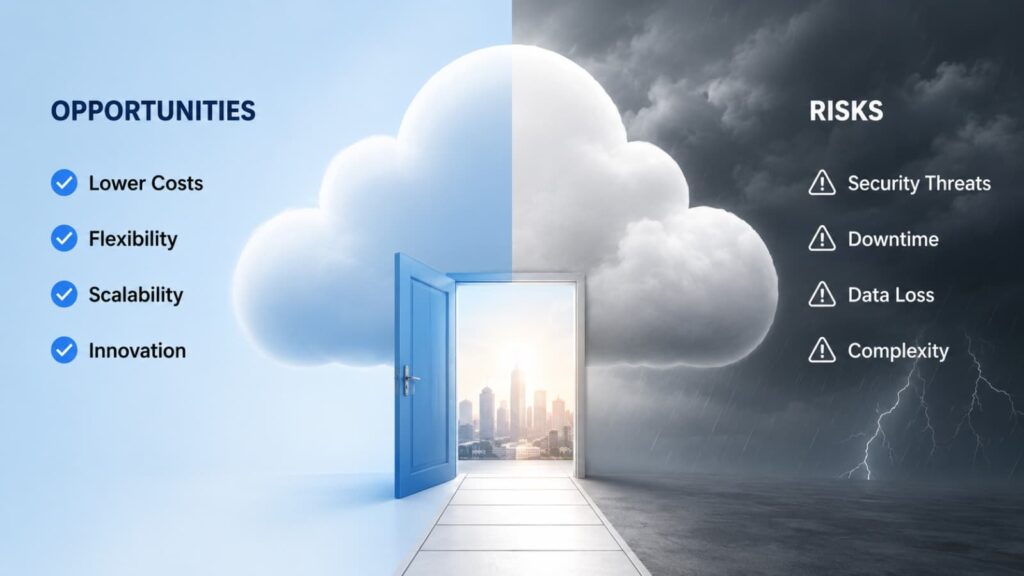
Despite its many benefits, cloud computing is not without challenges. Understanding these limitations is essential for making smart cloud computing decisions.
Downtime and Service Outages Even the most reliable cloud Thinking services experience downtime. When a major provider like AWS or Azure goes down, millions of businesses are affected simultaneously. Organizations that depend entirely on cloud without backup plans face serious operational risks during outages.
Data Security and Privacy Concerns Storing sensitive data with a third-party cloud provider raises legitimate security and privacy concerns. Businesses in regulated industries healthcare, finance, legal must ensure their cloud services comply with data protection laws like GDPR, HIPAA, or India’s DPDP Act. Cloud is explained from a risk perspective always includes the need for strong data governance.
Vendor Lock-In When an organization deeply integrates with one cloud provider’s tools and services, switching becomes expensive and complex. This vendor lock-in is a significant long-term risk, which is why multi-cloud strategies have become so popular in cloud news coverage this year.
Unpredictable Costs While cloud computing can reduce costs, it can also lead to overspending if resources are not managed carefully. Unused virtual machines, forgotten storage buckets, and unoptimized cloud services can silently drain budgets. Cloud cost management has become a discipline in its own right.
Internet Dependency Cloud computing requires a reliable, fast internet connection. In regions with limited connectivity including parts of rural India and developing countries cloud services may be inconsistent or inaccessible, creating digital inequality.
Compliance and Data Sovereignty Many countries require that certain types of data particularly citizen data be stored within national borders. Navigating data sovereignty requirements while using global cloud services can be complex and costly for multinational organizations.
Migration Complexity Moving existing systems to the cloud is rarely simple. Legacy applications, complex databases, and custom infrastructure can make cloud migration a lengthy, expensive, and technically demanding project.
Top Cloud Computing Services in 2026
Choosing the right platform is central to any cloud computing strategy. Here are the leading cloud computing services shaping the industry in 2026.
1. Amazon Web Services (AWS) AWS remains the global leader in cloud computing services, holding the largest market share. AWS offers over 200 fully featured cloud services, covering computing, storage, databases, AI, machine learning, IoT, and more. It is the go-to platform for enterprises needing depth, scale, and global reach in their cloud strategy.
2. Microsoft Azure Azure is the second-largest cloud computing provider and the preferred choice for organizations already using Microsoft products. Azure’s deep integration with Microsoft 365, Windows Server, and enterprise applications makes it the natural cloud home for most corporate IT environments. Azure also leads in hybrid cloud, bridging on-premise and cloud infrastructure seamlessly.
3. Google Cloud Platform (GCP) Google Cloud is the fastest-growing of the major cloud computing providers. Its strengths lie in data analytics, AI, and machine learning built on the same infrastructure that powers Google Search and YouTube. For organizations focused on data-driven applications, GCP is a compelling cloud choice.
4. IBM Cloud IBM Cloud specializes in enterprise cloud computing for regulated industries including finance, healthcare, and government. IBM’s cloud services emphasize security, compliance, and hybrid cloud capabilities, making it a trusted choice for organizations with strict regulatory requirements.
5. Oracle Cloud Infrastructure (OCI) Oracle Cloud is a strong computing choice for businesses running Oracle databases and enterprise applications like ERP and CRM. OCI has dramatically improved its performance and pricing in 2026, becoming a serious competitor in the cloud market.
6. Salesforce (SaaS Cloud Computing) Salesforce is the world’s leading Software as a Service cloud platform. Its ecosystem of CRM, marketing, analytics, and AI tools serves millions of businesses globally, representing the most widely used form of SaaS cloud computing.
7. Cloudflare Cloudflare is emerging as a critical player in edge cloud computing. By distributing computation across its global network, Cloudflare’s cloud services reduce latency and improve performance for applications that need to be close to end users.
8. Alibaba Cloud For businesses operating in Asia particularly in India, Southeast Asia, and China Alibaba Cloud is one of the most relevant cloud services available. It offers competitive pricing and strong regional data center coverage, making it a key player in computing news across Asian markets.

Comparison: Choosing Between Cloud Computing Services
When comparing cloud services, no single provider is best for every situation. The right choice depends on your specific needs, existing technology stack, and business goals.
AWS is unmatched in breadth of cloud services and global infrastructure. It is the best choice for organizations that need access to the widest range of tools and the most mature cloud ecosystem. However, its complexity can be overwhelming for smaller teams.
Azure wins for Microsoft-centric organizations. If your business runs on Windows, Office 365, or SQL Server, Azure provides the smoothest cloud integration. Its hybrid cloud capabilities are the strongest in the market.
Google Cloud stands out for data and AI workloads. If cloud explained as a data platform is what you need for big data analytics, machine learning pipelines, or AI application development GCP is the strongest technical choice.
IBM Cloud and Oracle Cloud serve specific enterprise niches. IBM for regulated industries, Oracle for businesses already running Oracle software. For everyone else, AWS, Azure, or GCP will cover most cloud computing needs effectively.
For SaaS cloud needs CRM, email, HR software platforms like Salesforce, Workday, or Microsoft 365 deliver fully managed cloud services that require no infrastructure management at all.
How to Choose the Right Cloud Computing Service
Selecting the right cloud computing platform requires a structured approach. Here is a practical guide.
Define Your Workloads Start by mapping your workloads and identifying what cloud services each one requires. Database-heavy applications, AI workloads, and high-traffic web applications all have different cloud needs. Cloud explained for IT leaders always starts with a workload inventory.
Assess Security and Compliance Requirements If your business handles sensitive data, ensure your chosen computing provider meets all relevant compliance standards. Ask providers about their certifications, data residency options, and security controls before committing.
Evaluate Total Cost of Ownership Compare not just the headline pricing of computing services but the total cost including data transfer fees, support costs, and migration expenses. Use each provider’s pricing calculator to estimate real-world computing costs for your workloads.
Consider Existing Technology Investments Your existing software and systems should influence your cloud choice. If you are deeply invested in Microsoft tools, Azure cloud is the natural fit. If you use Google Workspace, GCP cloud integrates more smoothly.
Plan for the Future Choose a cloud provider that can grow with your business. Look for cloud services that offer strong AI and machine learning capabilities, as these will be critical for competitive advantage in the coming years.
Start Small and Expand If you are new to cloud, do not try to migrate everything at once. Start with low-risk workloads, learn the cloud environment, build internal expertise, and expand gradually. This reduces risk and allows your team to develop cloud skills at a manageable pace.
Best Practices for Cloud Computing in 2026
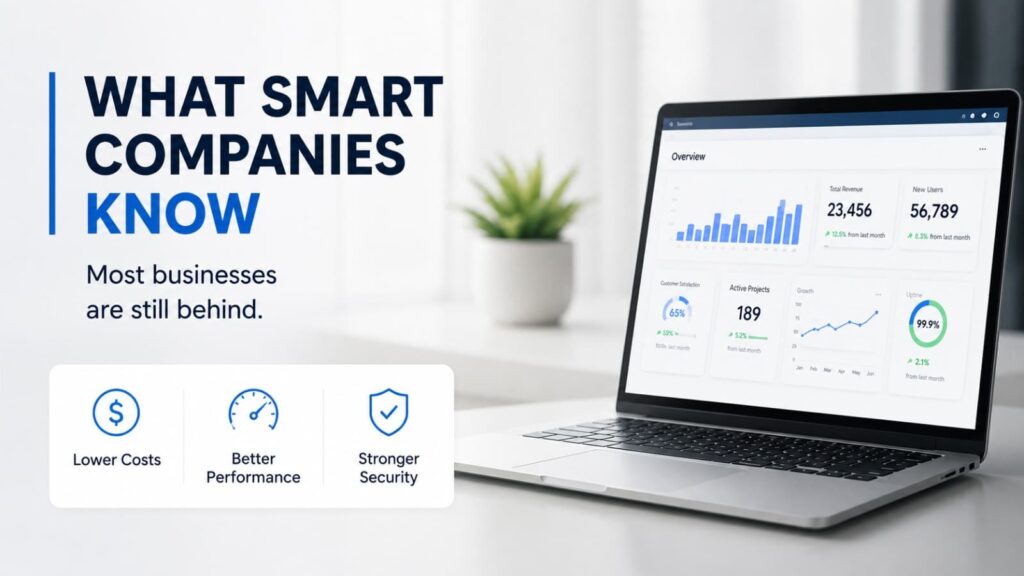
To get the most from cloud computing, follow these proven best practices.
Adopt a cloud-first mindset but not a cloud-only approach. Not every workload belongs in the cloud. Evaluate each application individually and use cloud where it genuinely adds value. Embrace multi-cloud strategies to avoid vendor lock-in and improve resilience. Invest in cloud cost management tools to monitor spending and eliminate waste. Train your team on cloud continuously the technology evolves fast, and staying current with cloud news ensures your team uses the latest and most efficient approaches. Always build with security in mind, using encryption, identity management, and access controls as standard components of every cloud deployment.
Final Verdict
Cloud computing in 2026 is not the future it is the present. Organizations that have embraced cloud services are moving faster, spending smarter, and innovating more effectively than those still relying on traditional infrastructure. The latest cloud news confirms that AI, edge computing, and multi-cloud strategies are driving the next wave of transformation.
What is cloud computing worth to your organization? Potentially everything. Lower costs, greater agility, global reach, and enterprise-grade security are all within reach through cloud services. But success requires more than just signing up with a provider. It requires strategy, governance, ongoing learning, and a genuine commitment to cloud as a long-term business capability.
Whether you are exploring cloud computing explained guides for the first time or refining a mature cloud strategy, the message is clear: the cloud is where business gets done in 2026. Get on it, stay on it, and make the most of it.
Frequently Asked Questions (FAQs)
Q1. What is cloud computing in simple terms? Cloud computing is the delivery of computing services storage, servers, software, databases, and more over the internet. Instead of owning physical hardware, you access these cloud resources on demand and pay only for what you use.
Q2. What are the main types of cloud computing services? The three main types of cloud computing services are Infrastructure as a Service (IaaS), Platform as a Service (PaaS), and Software as a Service (SaaS). Each type of cloud offers a different level of control, flexibility, and management.
Q3. What is the latest cloud computing news in 2026? Key cloud computing news in 2026 includes the deep integration of AI into all major cloud platforms, the rapid growth of edge computing, widespread adoption of multi-cloud strategies, and a strong industry focus on sustainable cloud practices.
Q4. Which cloud computing service is best for small businesses? For small businesses, the best cloud computing services are typically AWS, Microsoft Azure, or Google Cloud for infrastructure needs, and SaaS platforms like Microsoft 365 or Google Workspace for everyday productivity tools. Cloud explained for small businesses always emphasizes starting with managed SaaS cloud services to minimize technical complexity.
Q5. Is cloud computing secure? Yes, when properly configured, cloud computing is highly secure. Major cloud providers invest billions in security. However, cloud security is a shared responsibility providers secure the infrastructure, but customers must secure their own data, applications, and access controls.
Q6. How much does cloud computing cost? Cloud computing costs vary widely depending on the provider, services used, and scale of usage. Most cloud services use pay-as-you-go pricing, making cloud accessible to businesses of all sizes. Effective cost management is essential to keeping cloud expenses under control.
Q7. What is the difference between public, private, and hybrid cloud computing? Public cloud computing means services are shared across multiple customers on the provider’s infrastructure. Private cloud means dedicated infrastructure for a single organization. Hybrid cloud combines both, allowing data and applications to move between public and private environments a model that dominates enterprise cloud in 2026.
Follows Us on social media

Mohammed Viqar Ali is a Digital Marketer, UI/UX Designer, and content creator passionate about AI, technology, SEO, and digital growth. As the UI/UX Designer of aiblogmind, he focuses on creating user-friendly digital experiences while sharing practical insights on artificial intelligence, marketing trends, productivity tools, and online business growth. Through his content, he helps readers discover innovative solutions, stay updated with emerging technologies, and make informed decisions in the digital world.