


- AI business, marketing and money making
- AI Productivity and Automation
- AI Writing and content creation
- Content
Advertising & Marketing Guide to Grow Business
Advertising & marketing in a world overflowing with content, noise, and competition, advertising and marketing remain the twin engines of sustainable business growth. Whether you are a solo entrepreneur launching a product or a Fortune 500 brand defending market share, your ability to reach, persuade, and retain customers depends on how well you master advertising and marketing.
This guide is built on years of real-world practice, industry research, and platform data. Every strategy here has been tested by professionals – from seasoned advertising agency veterans to in-house performance teams – and refined to work across industries and budgets. You will not find vague advice here. You will find a structured, actionable blueprint for using advertising and marketing to grow your business, backed by clear reasoning and grounded in what actually works.
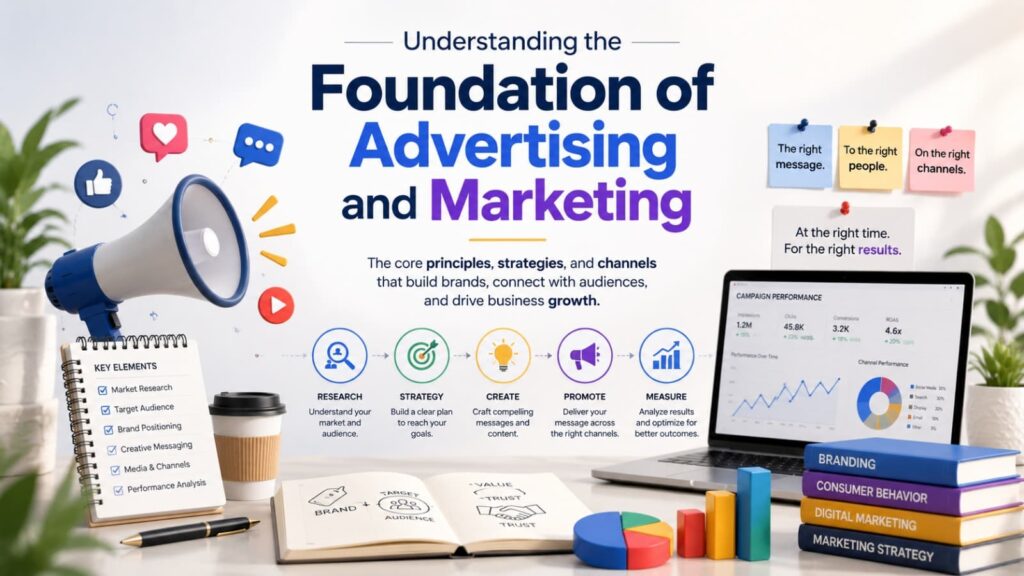
Understanding the Foundation of Advertising and Marketing
What Is Advertising and Marketing?
Advertising and marketing are often used interchangeably, but they serve distinct purposes within a unified growth strategy.
- Marketing is the broader discipline – it encompasses research, positioning, branding, pricing, product development, and the customer journey from awareness to loyalty.
- Advertising is a subset of marketing – it refers specifically to paid communication designed to inform, persuade, or remind a target audience about a product, service, or brand.
Together, advertising and marketing form the backbone of every successful business communication strategy. Without marketing, your product has no story. Without advertising, your story reaches no one.
The Modern Advertising & Marketing Landscape
The advertising and marketing ecosystem has transformed dramatically over the past decade. Digital channels have democratized access – small businesses can now compete with large corporations for the same audience segments. At the same time, the rise of mobile advertising, programmatic buying, and AI-powered targeting has made campaigns more precise and measurable than ever before.
Key pillars of the modern advertising and marketing landscape include:
- Search advertising (Google, Bing)
- Social media advertising (Meta, LinkedIn, TikTok, X)
- Mobile advertising (in-app, SMS, push notifications)
- Display and programmatic advertising
- Content marketing and SEO
- Influencer and creator marketing
- Out-of-home (OOH) and connected TV (CTV)
Each of these channels has its own mechanics, audience behaviour, and ROI profile. A mature advertising and marketing strategy doesn’t pick one – it orchestrates them.
Building Your Advertising and Marketing Strategy
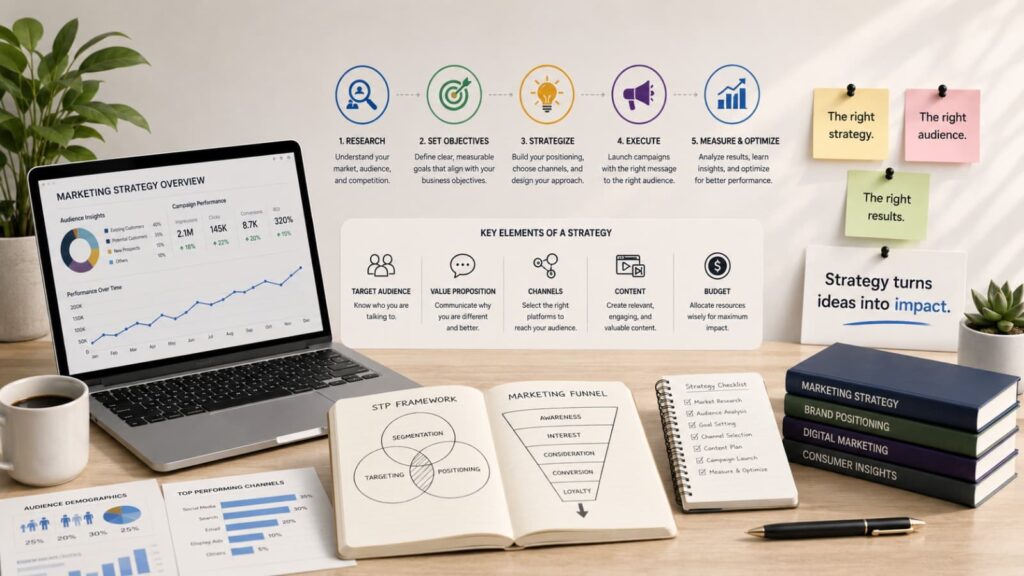
Step 1 – Define Your Business Goals
Every advertising and marketing effort must begin with clear business goals. Are you trying to generate leads? Drive e-commerce sales? Build brand recognition? Retain existing customers?
Goals determine everything: budget allocation, channel selection, messaging, and measurement. When goals are vague, advertising and marketing budgets disappear into campaigns that look busy but achieve nothing.
Use the SMART framework – Specific, Measurable, Achievable, Relevant, Time-bound – to define what success looks like before you spend a single rupee or dollar.
Step 2 – Know Your Audience at Depth
The most expensive mistake in advertising and marketing is targeting the wrong people. Audience research is not optional – it is the single highest-leverage activity in your entire strategy.
Build detailed audience personas that include:
- Demographics (age, gender, location, income)
- Psychographics (values, aspirations, frustrations)
- Behavioural data (purchase history, browsing habits, platform use)
- Language and content preferences
The best advertising and marketing campaigns speak to a real human being, not a demographic bucket. When your audience feels understood, your conversion rates reflect it.
Step 3 – Choose the Right Channels
Channel selection in advertising & marketing should follow your audience, not trends. Ask yourself: where does my ideal customer spend their time, and where are they most receptive to my message?
For B2C brands targeting young consumers, mobile advertising is non-negotiable — over 70% of digital media consumption now happens on smartphones. For B2B companies targeting decision-makers, LinkedIn advertising and content marketing tend to outperform.
An experienced advertising agency or ad agency partner can help map your audience to the right channel mix, especially when you are entering new markets or scaling aggressively.
Follow Us on linkedin
Step 4 – Craft Messaging That Converts
Great advertising and marketing messaging is not clever for the sake of being clever. It solves a problem, addresses a fear, or fulfils a desire that your audience al ready has.
The anatomy of a strong advertising and marketing message includes:
- A headline that stops the scroll – your first line must earn the second
- A value proposition that is instantly clear – what do you offer, and why does it matter?
- Proof that builds confidence – data, testimonials, case studies, certifications
- A call to action that removes friction – make it obvious what to do next
Authentic proof is particularly powerful in today’s environment. Audiences have grown sophisticated – they can spot manufactured enthusiasm instantly. Real customer stories, verifiable results, and transparent communication build the kind of trust that converts browsers into buyers and buyers into advocates.
Step 5 – Allocate Budget Strategically
Advertising and marketing budget allocation is part science, part experience. A common starting framework for growing businesses is to allocate:
- 40–50% to performance channels (search, social, mobile advertising) for measurable ROI
- 20–30% to brand channels (display, video, CTV) for long-term equity
- 15–20% to content and SEO for compounding organic growth
- 10–15% to testing – new channels, new creatives, new audiences
Review allocation quarterly based on performance data. The best advertising and marketing teams are ruthless about cutting what doesn’t work and reinvesting in what does.
The Role of an Advertising Agency in Business Growth
Why Work With an Ad Agency?
For many businesses, partnering with a professional advertising agency or ad agency is the most efficient path to advertising and marketing results. Here is why:
Expertise at scale. A quality advertising agency has specialists in strategy, creative, media buying, analytics, and technology – disciplines that are expensive and time-consuming to build in-house.
Objectivity. An external ad agency brings a perspective unclouded by internal politics or assumptions. They challenge briefs, question assumptions, and push for campaigns that actually work.
Access to tools and platforms. Leading advertising agency partners have direct relationships with media platforms, access to proprietary data, and enterprise-level tools that smaller in-house teams cannot afford independently.
Speed to market. An established ad agency can launch campaigns faster because they have built processes, creative frameworks, and media relationships that reduce lead time.
What to Look For in an Advertising Agency
Not all advertising agency partnerships are created equal. When evaluating an ad agency, look for:
- A portfolio with proven results in your industry or adjacent ones
- Transparent reporting – you should own your data, always
- Strategic thinking, not just execution
- Clear communication and accountability structures
- A pricing model that aligns with your growth stage
The relationship between a brand and its advertising agency works best when both parties see each other as partners, not vendor and client. The best ad agency relationships are built on shared accountability for outcomes.
Mobile Advertising – The Growth Frontier
Why Mobile Advertising Dominates Modern Campaigns
Mobile advertising is no longer a supplementary channel – it is the primary channel for the majority of consumers globally. In India, for example, over 600 million smartphone users consume content, shop, and communicate almost entirely on mobile devices. Any advertising and marketing strategy that does not prioritise mobile advertising is leaving a substantial share of its potential audience unreached.
Types of Mobile Advertising
Mobile advertising encompasses several formats, each suited to different objectives:
- In-app advertising – banner, interstitial, rewarded video ads served within mobile applications
- SMS and push notification campaigns – direct, permission-based messaging with high open rates
- Mobile search ads – search engine ads optimised for mobile intent and screen size
- Social media mobile ads – format-native ads on Instagram, TikTok, Snapchat, and Meta
- Location-based advertising – geo-targeted ads triggered by proximity to a physical location
Best Practices for Mobile Advertising
Effective mobile advertising requires a mobile-first design philosophy:
- Keep creative concise – mobile users decide in under 3 seconds
- Optimise landing pages for speed and mobile UX
- Use vertical video formats for social placements
- Leverage location data responsibly for hyper-relevant targeting
- Test across device types and operating systems
When mobile advertising is integrated with your broader advertising and marketing strategy, it creates a seamless customer experience across touchpoints – from awareness to conversion.
Measuring Advertising & Marketing Performance
Key Metrics That Matter
Effective advertising and marketing is inseparable from rigorous measurement. The metrics you track should tie directly to your business goals:
| Objective | Key Metric |
| Brand awareness | Reach, impressions, brand lift |
| Lead generation | Cost per lead (CPL), lead quality score |
| Sales | Return on ad spend (ROAS), cost per acquisition (CPA) |
| Retention | Customer lifetime value (CLV), churn rate |
| Engagement | Click-through rate (CTR), time on site, video completion rate |
Attribution in Advertising and Marketing
One of the most debated topics in advertising & marketing is attribution – how do you correctly assign credit for a conversion across multiple touchpoints? A customer might see a display ad, click a search ad, read a blog post, and then convert via a direct visit. Which channel gets credit?
Modern advertising and marketing teams use multi-touch attribution models – linear, time decay, or data-driven – to distribute credit more accurately. This leads to smarter budget decisions and better overall performance.
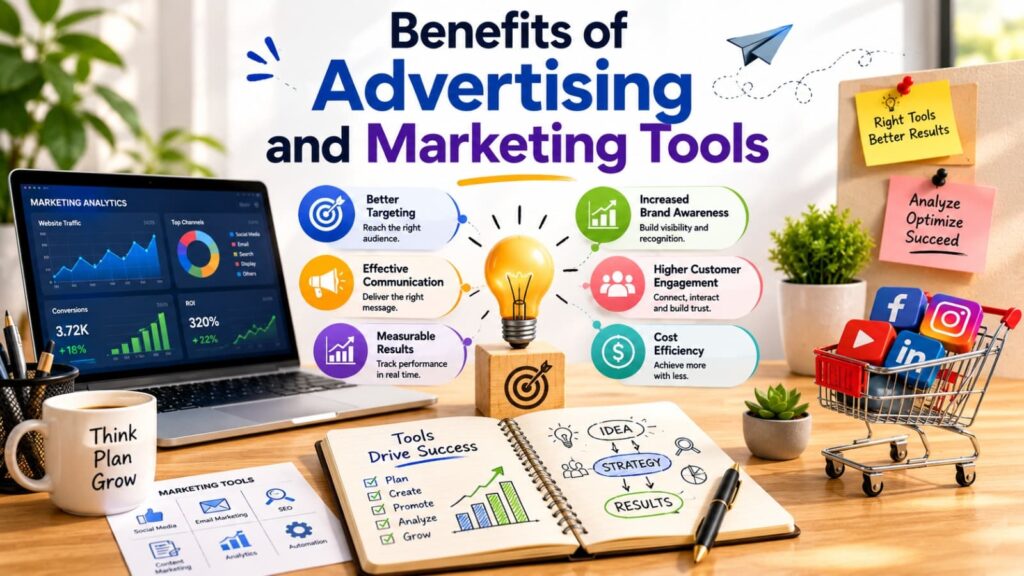
Benefits of Advertising and Marketing Tools
Modern advertising and marketing platforms and tools offer businesses capabilities that were once reserved for large agencies and enterprise brands. Here are the key benefits:
Benefits
- Precise Audience Targeting – Advanced advertising & marketing tools allow you to target audiences by age, interest, behaviour, location, device type, and even lookalike profiles. This precision ensures your budget reaches people most likely to convert, dramatically improving ROI.
- Real-Time Performance Data – Unlike traditional media, digital advertising & marketing platforms provide live data. You can see which creatives are working, pause underperformers, and scale winners – all within hours of launching a campaign.
- Cost Efficiency and Budget Control – Advertising and marketing platforms offer flexible budget models (CPC, CPM, CPA) that let businesses of any size participate competitively. You can start with a modest daily budget and scale as results justify it.
- Automation and AI Optimisation – Modern tools use machine learning to automatically optimise bids, creative rotation, and audience targeting. This reduces manual workload and often outperforms human-managed campaigns over time.
- Cross-Channel Integration – Leading advertising and marketing platforms connect data across channels – search, social, email, mobile advertising, display – giving a unified view of the customer journey and enabling coordinated campaign strategies.
- Scalability – A campaign that works at ₹50,000/month can often be scaled to ₹5,00,000/month with relatively minimal structural changes. This scalability makes advertising and marketing tools uniquely suited to growth-stage businesses.
- Creative Testing at Speed – A/B and multivariate testing capabilities let marketers experiment with headlines, images, CTAs, and landing pages rapidly, accelerating the discovery of winning combinations.
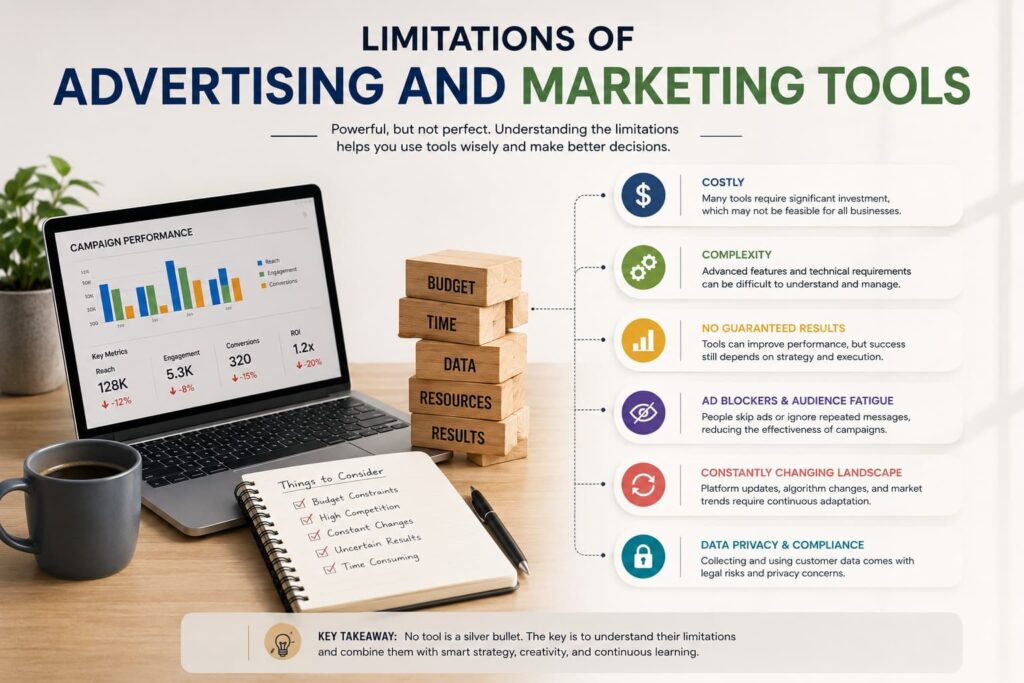
Limitations
- Learning Curve and Complexity – Many advertising and marketing platforms have steep learning curves. Without proper training, budgets can be wasted quickly on poorly configured campaigns.
- Ad Fatigue – Audiences exposed to the same creative repeatedly become desensitised. Advertising and marketing teams must refresh creative assets regularly, which demands ongoing investment in content production.
- Data Privacy Restrictions – With growing regulations (GDPR, India’s DPDP Act) and platform-level privacy changes (cookie deprecation, iOS tracking restrictions), advertising & marketing targeting capabilities are becoming more constrained.
- Increasing Competition and Cost – As more businesses invest in digital advertising and marketing, auction-based platforms become more competitive, driving up costs per click and impression in many categories.
- Attribution Complexity – Accurately measuring the contribution of each advertising & marketing channel remains challenging. Poor attribution leads to misallocation of budget and suboptimal strategy decisions.
- Dependence on Platform Algorithms – Businesses that rely heavily on a single platform are vulnerable to algorithm changes. A shift in Meta’s or Google’s algorithm can significantly impact campaign performance overnight.
Advertising & Marketing Tool Features – A Detailed Study
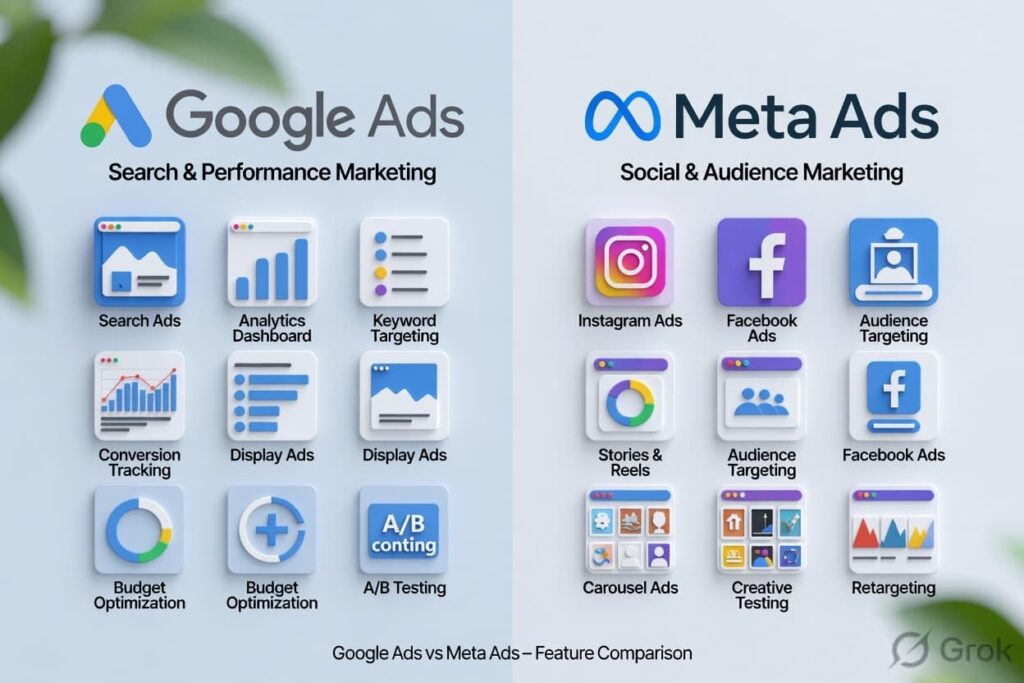
Google Ads
Google Ads is the dominant search advertising platform globally and a cornerstone of most advertising and marketing strategies.
- Search campaigns target users based on keyword intent – capturing demand at the moment it exists
- Performance Max campaigns use AI to serve ads across Search, Display, YouTube, Gmail, and Maps from a single campaign
- Smart Bidding automatically adjusts bids based on conversion likelihood
- Audience Manager enables remarketing, customer match, and in-market audience targeting
- Google Analytics integration provides end-to-end conversion tracking
Meta Ads
Meta’s advertising platform remains one of the most powerful tools for audience-based advertising and marketing.
- Detailed targeting by interest, behaviour, demographics, and life events
- Lookalike audiences expand reach to users similar to your best customers
- Dynamic ads automatically personalise creative based on user behaviour
- Instagram and Reels placements are critical for mobile advertising reach among younger demographics
- Conversion API helps maintain tracking accuracy despite browser-level restrictions
LinkedIn Campaign Manager
For B2B advertising & marketing, LinkedIn offers unmatched professional targeting.
- Job title, seniority, company size, and industry targeting make it precise for B2B campaigns
- Thought leadership ads promote executive content to relevant professional audiences
- Lead gen forms capture information directly within the platform, reducing friction
HubSpot Marketing Hub
HubSpot is a comprehensive inbound advertising and marketing platform.
- CRM integration connects marketing activity to sales outcomes
- Email marketing automation nurtures leads through personalised workflows
- SEO and content tools support organic advertising and marketing efforts
- Campaign analytics provide attribution reporting across channels
Programmatic DSPs (DV360, The Trade Desk)
Demand-side platforms power automated advertising and marketing at scale.
- Real-time bidding (RTB) across thousands of publisher sites and apps
- Data management platform (DMP) integration for first and third-party audience targeting
- Brand safety controls prevent ads from appearing in inappropriate environments
- Cross-device targeting enables consistent messaging across desktop, mobile, and CTV
Conclusion: Advertising & Marketing as a Competitive Advantage
Advertising & marketing is not a cost centre – it is an investment in the future of your business. Done with strategy, creativity, and rigour, advertising and marketing compounds over time: brand equity accumulates, audiences grow, and customer acquisition costs decline as reputation does the work that paid media once had to.
Whether you manage your advertising and marketing in-house, through an advertising agency, or through a hybrid model, the principles remain constant: know your audience deeply, speak to them honestly, meet them where they are (increasingly, on mobile advertising channels), and measure relentlessly.
The businesses that treat advertising and marketing as a core competency – not an afterthought – are the ones that build durable, scalable growth. That is the only guide you truly need.
5 Frequently Asked Questions (FAQs)
Q1. What is the difference between advertising & marketing, and why does it matter for my business?
Marketing is the complete process of identifying your target audience, understanding their needs, developing your product or service positioning, and building a strategy to reach and retain customers. Advertising is a specific tactic within marketing – the paid placement of messages across channels to reach your audience at scale. Understanding this distinction matters because businesses that conflate the two often over-invest in paid advertising & marketing placements while neglecting foundational strategy. The result is campaigns that generate clicks but fail to convert, because the underlying messaging, positioning, or offer hasn’t been properly developed. A mature advertising & marketing approach aligns both disciplines from the start.
Q2. How do I know if I should hire an advertising agency or manage advertising & marketing in-house?
The right choice depends on your business stage, budget, and internal capabilities. Early-stage businesses often benefit from working with a specialist advertising agency or ad agency because it gives them access to expertise and tools they cannot yet afford to build internally. As companies grow, many build hybrid models – keeping brand strategy and data in-house while working with an ad agency for creative production or media buying in specific channels. The key question is: do you have the internal talent to execute advertising & marketing at the level your growth goals require? If the honest answer is no, an experienced advertising agency is almost always the faster and more cost-effective path.
Q3. What budget should a small business set aside for advertising and marketing?
Industry benchmarks suggest that businesses should allocate between 7–15% of gross revenue to advertising & marketing, with the higher end appropriate for growth-stage companies in competitive markets. For businesses with revenues under ₹1 crore (approximately $120,000), it is more practical to focus budget on two or three channels rather than spreading thin across many. Mobile advertising and search advertising typically offer the most measurable returns for small businesses because they capture intent and allow precise budget control. Start with what you can measure, prove what works, and scale from there.
Q4. How important is mobile advertising in a modern advertising & marketing strategy?
Mobile advertising is not just important – for most consumer-facing businesses, it is the primary channel. With smartphone penetration exceeding 80% in urban India and users spending an average of 4–5 hours daily on mobile devices, a significant portion of any target audience is most reachable on mobile. Mobile advertising formats – in-app ads, mobile search, social media placements, and push notifications – allow brands to engage users at moments of high intent and receptivity. Any advertising and marketing strategy that does not optimise specifically for mobile is already at a structural disadvantage against competitors who do.
Q5. How do I measure whether my advertising and marketing campaigns are actually working?
Measurement in advertising & marketing requires two things: the right metrics for your goals, and the right tracking infrastructure. Start by defining what success looks like for your specific objective – is it leads, sales, brand awareness, or retention? Then ensure your tracking is correctly set up: conversion pixels, UTM parameters, CRM integration, and attribution modelling. The most important principle in advertising & marketing measurement is to look beyond vanity metrics (impressions, likes, followers) and focus on business outcomes (revenue, profit, customer lifetime value). Review performance weekly for tactical adjustments and monthly for strategic decisions. Over time, your historical data becomes one of your most valuable advertising and marketing assets – use it to benchmark future campaigns and continuously improve.
Know more About Us

Hi, I’m Rufqha, the SEO Manager at AIBlogMind. I focus on building content strategies that help websites improve visibility, attract the right audience, and create sustainable organic growth. My expertise includes on-page SEO, keyword research, content optimization, and aligning SEO with user experience and business goals.