




Cybersecurity: Simple Guide to Stay Safe Online
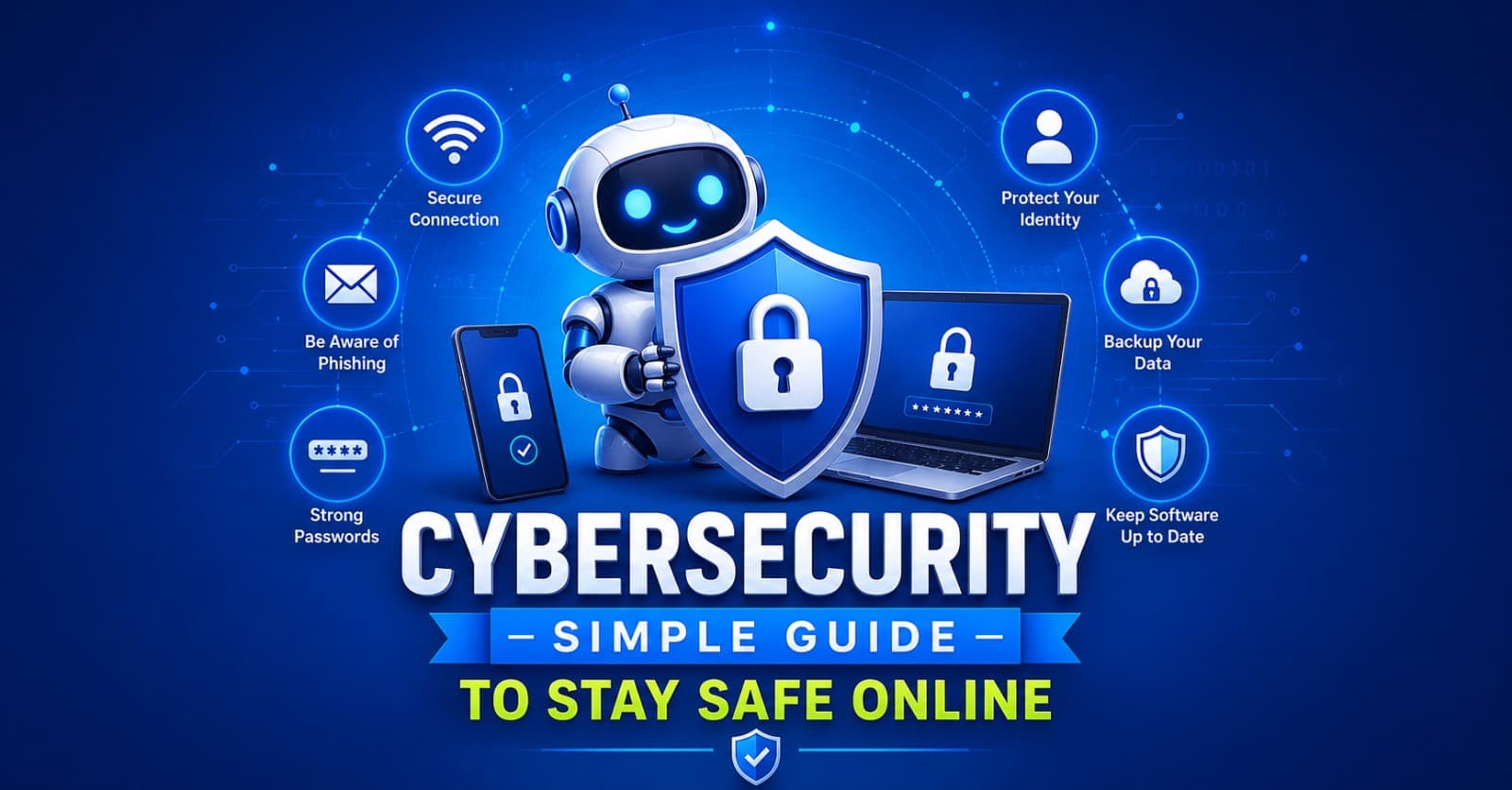
Every time you log into your email, make an online purchase, scroll through social media, or connect to a public Wi-Fi network, you are operating in a digital environment that carries real risk. Data is stolen, accounts are hijacked, businesses are held to ransom, and personal identities are compromised every single day across the globe. The shield that stands between you and all of that is cybersecurity.
It is the practice of protecting computers, networks, programs, and data from unauthorized access, damage, theft, and disruption. It is a discipline that spans technology, human behavior, organizational policy, and legal frameworks. It is not just a concern for governments and large corporations. It is something every individual, small business owner, student, and professional needs to understand and practice in the modern world.
This guide is designed to make it’s a simple, practical, and actionable. Whether you are completely new to the topic or looking to strengthen your existing knowledge, this article will walk you through everything you need to know about cybersecurity, from the basics to the advanced tools professionals use to keep digital environments safe.
What Is Cybersecurity?
Cybersecurity is a broad field that encompasses the technologies, processes, and practices designed to protect digital systems and the information they contain. At its most fundamental level, It is about ensuring that only the right people have access to the right information, and that digital systems continue to function as intended even under attack.
Cyber operates across three main dimensions:
- Confidentiality – ensuring that information is accessible only to those authorized to see it
- Integrity – ensuring that data is accurate and has not been tampered with
- Availability – ensuring that systems and data are accessible when needed by authorized users
These three principles, often called the CIA triad, are the foundation of every cybersecurity strategy, from a personal password manager to an enterprise-level security operation center.
It is relevant across every sector of the modern economy. Healthcare cybersecurity protects patient records. Financial cybersecurity safeguards transactions and banking systems. Government cybersecurity defends national infrastructure. And personal cybersecurity keeps individuals safe from scams, identity theft, and account compromise.
Why Cybersecurity Matters More Than Ever
The digital world is growing at an extraordinary pace. More devices are connected to the internet than ever before. More personal and financial data is stored digitally. More business operations depend on networked systems. And with this expansion comes a corresponding increase in risk.
Cyber threats have grown in both volume and sophistication. In 2024 alone, data breaches exposed billions of records globally. Ransomware attacks shut down hospitals, schools, and critical infrastructure. Phishing campaigns tricked millions of users into surrendering their credentials. The financial cost of cybercrime globally runs into trillions of dollars annually.
For individuals, poor Information security can mean losing access to bank accounts, having personal photos stolen, or having identities fraudulently used to take out loans. For businesses, a cybersecurity failure can mean regulatory fines, reputational damage, legal liability, and in extreme cases, complete operational shutdown.
It is not optional. It is essential infrastructure for the digital age, and understanding it is the first step toward practicing it effectively.
Understanding Cyber Threats
To practice good cybersecurity, you first need to understand what you are defending against. Cyber threats are the risks and dangers that cybersecurity professionals work to prevent, detect, and respond to.
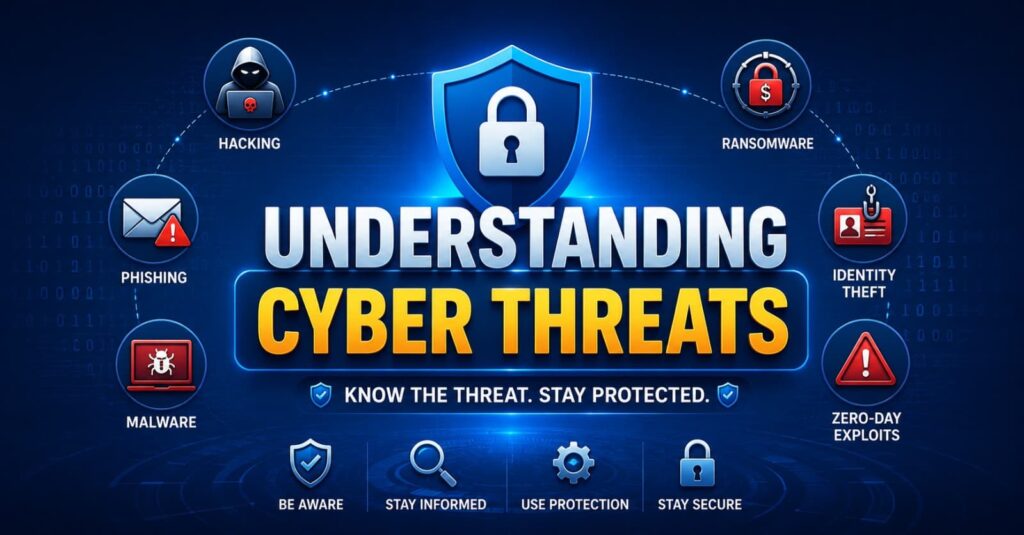
Cyber threats come in many forms, and they evolve constantly as attackers find new ways to exploit vulnerabilities. The most common cyber threats that cybersecurity practitioners deal with include:
Phishing:– One of the most widespread cyber threats, phishing involves deceptive emails, messages, or websites that trick users into revealing sensitive information like passwords or credit card numbers. Phishing is responsible for a significant proportion of all cybersecurity incidents globally.
Malware:– Malicious software designed to disrupt, damage, or gain unauthorized access to systems. Malware encompasses viruses, worms, trojans, spyware, and ransomware. Defending against malware is a core responsibility of any cyber threads strategy.
Ransomware:– A particularly damaging category of malware where attackers encrypt a victim’s data and demand payment for the decryption key. Ransomware attacks have targeted hospitals, schools, municipalities, and major corporations, making them one of the most severe cyber threats in the cybersecurity landscape.
Social Engineering:– Cyber threats that exploit human psychology rather than technical vulnerabilities. Attackers manipulate people into making cybersecurity mistakes, such as revealing passwords or granting system access.
Denial of Service (DoS) Attacks:– Cyber threats that overwhelm a system with traffic, making it unavailable to legitimate users. Large-scale distributed denial of service attacks are a major concern in enterprise cyber security.
Insider Threats:– Cyber threats that originate from within an organization, whether through malicious intent or accidental error. Insider threats are among the most difficult cybersecurity challenges to detect and prevent.
Zero-Day Exploits:– Cyber threats that take advantage of previously unknown software vulnerabilities before developers have had a chance to patch them. Zero-day exploits are highly prized in the cybercrime ecosystem and represent a significant cyber security challenge.
Understanding these cyber threats is the starting point for building any meaningful cyber security posture, whether personal or organizational.
Core Principles of Cybersecurity
Effective cybersecurity is built on a set of principles that guide how individuals and organizations approach digital protection.
Defense in Depth:– Rather than relying on a single cyber threats control, defense in depth layers multiple protections so that if one fails, others remain in place. This is the cornerstone of enterprise cyber security architecture.
Least Privilege:– Users and systems should only have access to the resources they need to perform their specific functions. Limiting access reduces the potential damage of a cybersecurity breach.
Zero Trust:– A modern cybersecurity framework built on the principle of never trust, always verify. Zero trust cybersecurity assumes that threats exist both inside and outside the network, and requires continuous verification of every user and device.
Security by Design:– It should be built into systems from the beginning, not added as an afterthought. Products and platforms that are designed with cybersecurity in mind are inherently more resilient.
Incident Response:– No cybersecurity system is perfect. Having a clear plan for how to detect, contain, and recover from cybersecurity incidents is just as important as prevention.
The Security Operation Center: The Command Hub of Cybersecurity
One of the most important structures in enterprise cybersecurity is the security operation center. A security operation center, commonly referred to as a SOC, is a centralized unit of cybersecurity professionals, processes, and technologies that monitor, detect, analyze, and respond to cybersecurity threats around the clock.
The security operation center is the nerve center of an organization’s cybersecurity function. It brings together threat intelligence feeds, security information and event management systems, endpoint detection tools, and skilled analysts who work together to keep digital environments secure.
In a typical security operation center, cyber security analysts monitor alerts and logs from across the organization’s digital infrastructure in real time. When a potential cyber security incident is detected, the security operation center team investigates, determines whether it represents a genuine threat, and coordinates the response. This might involve isolating an affected system, blocking malicious IP addresses, notifying affected users, or escalating to senior cybersecurity leadership.
The security operation center model has evolved significantly in recent years. Traditional security operation centers were on-premises facilities staffed entirely by in-house cybersecurity teams. Today, many organizations use managed security operation center services, where a third party cybersecurity provider operates the SOC function on their behalf. This model makes enterprise-grade cybersecurity accessible to mid-sized businesses that could not otherwise afford a full in-house security operation center.
The maturity of a security operation center reflects the maturity of an organization’s overall cybersecurity posture. Organizations with well-developed security operation center capabilities detect cyber threats breaches significantly faster, contain damage more effectively, and recover more quickly than those without.
Personal Cybersecurity: Practical Steps Everyone Should Take
It does not have to be complicated. For individuals, a handful of consistent habits dramatically reduce cybersecurity risk.
Use Strong, Unique Passwords:- One of the most basic but important cybersecurity practices is using a different, complex password for every account. A password manager makes this manageable and significantly strengthens personal cybersecurity.
Enable Two-Factor Authentication:- Two-factor authentication adds a second layer of cyber security verification beyond your password. Even if a password is stolen, attackers cannot access your account without the second factor.
Keep Software Updated:- Many of this breaches exploit vulnerabilities in outdated software. Keeping your operating system, apps, and browsers updated is a simple but powerful cyber security measure.
Be Skeptical of Unsolicited Messages:- Phishing is one of the most common cyber threats. Cybersecurity awareness means questioning unexpected emails, messages, or calls that ask for personal information or urge immediate action.
Use Secure Networks:- Public Wi-Fi is a common vector for cyber security attacks. Using a virtual private network (VPN) encrypts your internet traffic and strengthens your cybersecurity on unsecured networks.
Back Up Your Data:- Regular backups are a fundamental cyber security practice. If ransomware strikes or a device is lost, backups allow you to recover without paying attackers or losing critical information.
Review App Permissions:- Many apps request access to far more data than they need. Good personal cyber security involves regularly reviewing and limiting app permissions on your devices.
Cybersecurity in the Workplace
Organizations face cybersecurity challenges that are far more complex than those faced by individuals. Enterprise cyber security involves protecting large networks, managing access for hundreds or thousands of users, securing cloud environments, complying with regulatory requirements, and defending against sophisticated, targeted cyber threats.
Workplace cyber threats starts with policy. Every organization should have a clear cybersecurity policy that defines acceptable use of systems, password requirements, data handling procedures, and incident reporting protocols.
Training is equally critical. Human error remains one of the leading causes of cyber security incidents. Regular cyber security awareness training helps employees recognize cyber threats like phishing, practice good cyber security hygiene, and understand their role in protecting organizational data.
Technical controls in workplace cyber security include firewalls, endpoint protection platforms, email security gateways, identity and access management systems, data loss prevention tools, and the monitoring capabilities of the security operation center.
Regulatory compliance is also a major driver of enterprise cyber security investment. Frameworks like GDPR, HIPAA, ISO 27001, and NIST provide structured approaches to cyber security that help organizations demonstrate due diligence and protect themselves legally.
Cybersecurity Careers: A Growing Field
The demand for cybersecurity professionals has never been higher. There are millions of unfilled cyber security positions globally, and the gap between supply and demand continues to widen as cyber threats grow more sophisticated and pervasive.
Cybersecurity careers span a wide spectrum of roles and specializations. Cyber threats analysts monitor systems and investigate incidents. Penetration testers simulate attacks to find vulnerabilities before real attackers do. Cyber security architects design secure systems and networks. Security operation center managers lead teams of analysts. Chief Information Security Officers provide executive leadership for organizational cyber strategy.
Entry into the cyber security field typically begins with foundational certifications like CompTIA Security+, followed by more advanced credentials like Certified Information Systems Security Professional (CISSP) or Certified Ethical Hacker (CEH). Many cyber threats professionals also come from backgrounds in networking, software development, or systems administration.
The cybersecurity field is also notable for its strong commitment to knowledge sharing. Online communities, conferences like DEF CON and Black Hat, and an abundance of free learning resources make cyber threats one of the most accessible technical disciplines to self-study.
Benefits of Cybersecurity
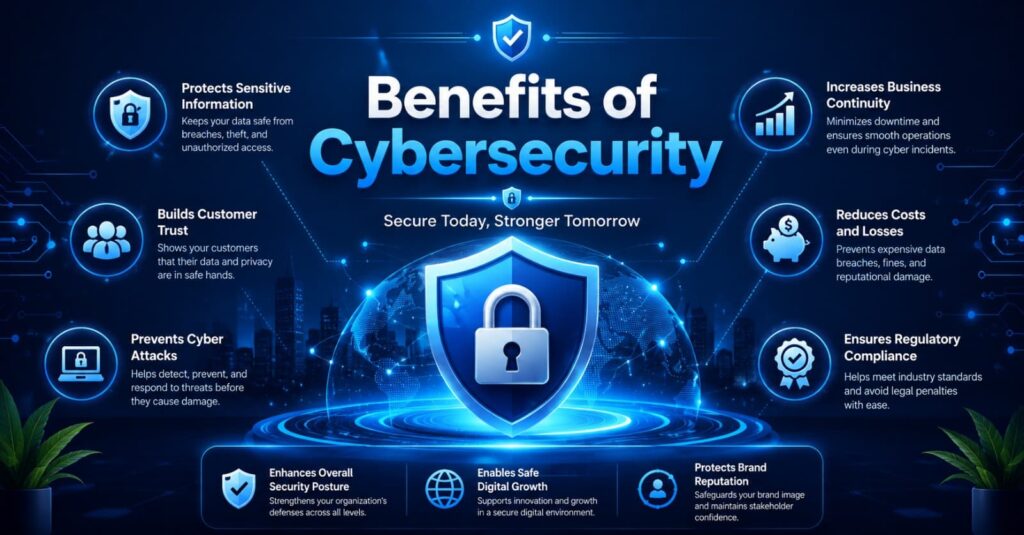
Investing in cybersecurity delivers substantial benefits across personal, organizational, and societal levels.
1. Protection of Sensitive Data:- Cybersecurity keeps personal, financial, and confidential business information out of the hands of unauthorized parties. For individuals and organizations alike, data protection is the most direct benefit of strong cybersecurity.
2. Business Continuity:- Cyber security protects organizations from disruptions caused by cyber threats. A robust cybersecurity posture ensures that operations continue uninterrupted even when attacks occur.
3. Financial Loss Prevention:- Cyber threats cost businesses and individuals enormous sums. Effective cybersecurity reduces the likelihood of financial loss from fraud, theft, ransomware, and regulatory fines.
4. Reputation Protection:- A cybersecurity breach can permanently damage an organization’s reputation. Strong cyber threats demonstrates to customers, partners, and stakeholders that their data is taken seriously.
5. Regulatory Compliance:- Many industries require compliance with cyber security standards. Meeting these requirements protects organizations from legal liability and demonstrates commitment to responsible data stewardship.
6. Customer Trust:- In a world where data breaches make headlines regularly, organizations with strong cybersecurity build greater customer confidence and loyalty.
7. National Security:- At the macro level, cyber security protects critical national infrastructure, government systems, and defense capabilities from state-sponsored cyber threats and hostile actors.
Follow Us on LinkedIn
Limitations of Cybersecurity
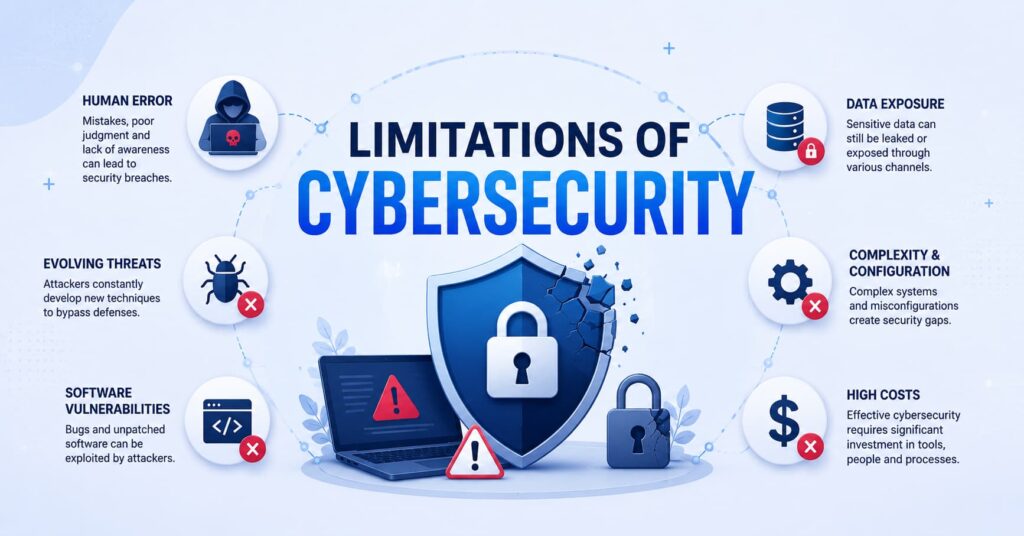
Cybersecurity is powerful, but it is not without limitations that users and organizations must understand.
1. No System Is Completely Secure:- The most fundamental limitation of cybersecurity is that no protection is absolute. Determined, sophisticated attackers with sufficient resources can eventually find ways through even the strongest cyber security defenses.
2. Human Error Remains a Constant Risk:- Technology can only go so far. Cyber threats is undermined when people fall for phishing attacks, use weak passwords, or mishandle sensitive data. The human element is the hardest cybersecurity challenge to fully solve.
3. Rapidly Evolving Threat Landscape:- Cyber threats evolve faster than cyber threats defenses can always keep pace. New attack techniques, zero-day vulnerabilities, and emerging technologies constantly create new cybersecurity challenges.
4. High Cost of Implementation:- Enterprise-grade cybersecurity, including a fully staffed security operation center, is expensive. Many small and mid-sized businesses struggle to afford the cybersecurity resources that their risk profile demands.
5. Complexity and Alert Fatigue:- Large cybersecurity systems generate enormous volumes of alerts. Security operation center analysts can suffer from alert fatigue, where the sheer volume of notifications makes it harder to identify genuine threats.
6. Privacy Tensions:- Some cyber security monitoring practices, particularly in workplace environments, raise legitimate privacy concerns. Balancing effective cyber threads monitoring with employee privacy is an ongoing tension.
7. Dependency on Vendor Trust:- Much of modern cyber threats relies on trusting third-party vendors. It is a supply chain attacks, where attackers compromise trusted vendors to gain access to their customers, represent a growing and difficult-to-manage risk.
Detailed Cybersecurity Tool Features Study
The cybersecurity ecosystem includes a rich array of tools designed to prevent, detect, and respond to cyber threats. Here is a detailed look at the key categories and their features:
Firewalls:- The foundational perimeter cyber threats control. Next-generation firewalls include deep packet inspection, application-layer filtering, intrusion prevention, and VPN support. They are deployed at network boundaries to filter malicious traffic before it reaches internal systems.
Endpoint Detection and Response (EDR):- EDR tools monitor devices in real time for signs of compromise. Features include behavioral analysis, threat hunting capabilities, automated response actions, and integration with security operation center platforms. EDR is now considered essential cyber security for any organization managing a fleet of devices.
Security Information and Event Management (SIEM):- SIEM platforms are the analytical backbone of the security operation center. They aggregate log data from across the IT environment, correlate events to identify patterns indicative of cyber threats, and generate alerts for analyst review. Features include real-time monitoring, historical search, compliance reporting, and threat intelligence integration.
Identity and Access Management (IAM):- IAM tools enforce cyber policies around who can access what resources. Features include multi-factor authentication, single sign-on, privileged access management, and access certification reviews. IAM is central to zero trust cybersecurity architectures.
Vulnerability Management Platforms:- Tools like Tenable Nessus and Qualys scan systems for known cyber security vulnerabilities and prioritize remediation. Features include continuous scanning, risk scoring, patch management integration, and compliance reporting.
Penetration Testing Tools:- Platforms like Metasploit and Burp Suite are used by cyber security professionals to simulate attacks and find weaknesses before real attackers do. Features include exploit frameworks, web application testing, network scanning, and detailed reporting.
Email Security Gateways:- Given that phishing is one of the most prevalent cyber threats, email security is a critical cybe rsecurity layer. Features include spam filtering, malicious link detection, attachment sandboxing, and impersonation protection.
VPNs and Zero Trust Network Access:- VPNs encrypt network traffic to protect cybersecurity on unsecured connections. Zero Trust Network Access platforms go further, verifying identity and device posture before granting access to specific applications rather than the entire network.
Frequently Asked Questions (FAQs)
Q1. What is cybersecurity and why do I need it?
It is the practice of protecting your digital devices, accounts, networks, and data from unauthorized access and cyber threats. You need this because the digital world carries real risks including identity theft, financial fraud, account compromise, and data loss. Good cybe rsecurity habits protect your personal information and give you control over your digital life.
Q2. What are the most common cyber threats I should know about?
The most common cyber threats include phishing emails that trick you into revealing passwords, malware that infects your devices, ransomware that locks your files, and social engineering attacks that manipulate your behavior. Understanding these cyber threats is the first step to defending against them with good cybersecurity practices.
Q3. What is a security operation center and what does it do?
A security operation center is a dedicated team and facility within an organization that monitors, detects, and responds to cyber threats around the clock. The security operation center uses advanced tools to watch for signs of attack across the organization’s digital environment and coordinates the cyber security response when incidents occur. It is the command hub of enterprise cybersecurity.
Q4. How can I improve my personal cybersecurity without being a tech expert?
You do not need to be a technical expert to practice good cybersecurity. Start by using strong, unique passwords with a password manager, enabling two-factor authentication on all accounts, keeping your devices and apps updated, being skeptical of unsolicited messages, and avoiding public Wi-Fi without a VPN. These simple cyber threats habits dramatically reduce your risk from the most common cyber threats.
Q5. Is cybersecurity a good career choice?
It is one of the strongest career paths available today. There are millions of unfilled cybersecurity roles globally across specializations including security operation center analysis, penetration testing, cybersecurity architecture, and executive leadership. The field offers strong salaries, remote work opportunities, continuous learning, and the satisfaction of doing work that genuinely matters. Anyone with an interest in problem-solving, technology, and digital safety should seriously consider cyber security as a career.
Conclusion
Cybersecurity is not a product you buy or a box you check. It is an ongoing practice, a mindset, and a shared responsibility that belongs to everyone who participates in the digital world. From individual users protecting their personal accounts to security operation center teams defending critical infrastructure from sophisticated cyber threats, cyber is the work that keeps the digital age functioning safely.
The good news is that cyber security is not beyond anyone’s reach. With the right knowledge, the right tools, and consistent habits, every person and every organization can meaningfully improve their cybersecurity posture. Cyber threats will continue to evolve, but so will the cyber community’s ability to understand, anticipate, and counter them.
Stay informed, stay vigilant, and stay safe. That is the simple, enduring message at the heart of cybersecurity.
Know more About Us

Mohammed Viqar Ali is a Digital Marketer, UI/UX Designer, and content creator passionate about AI, technology, SEO, and digital growth. As the UI/UX Designer of aiblogmind, he focuses on creating user-friendly digital experiences while sharing practical insights on artificial intelligence, marketing trends, productivity tools, and online business growth. Through his content, he helps readers discover innovative solutions, stay updated with emerging technologies, and make informed decisions in the digital world.