



Smart Devices: Transforming Modern Living with Intelligent Technology
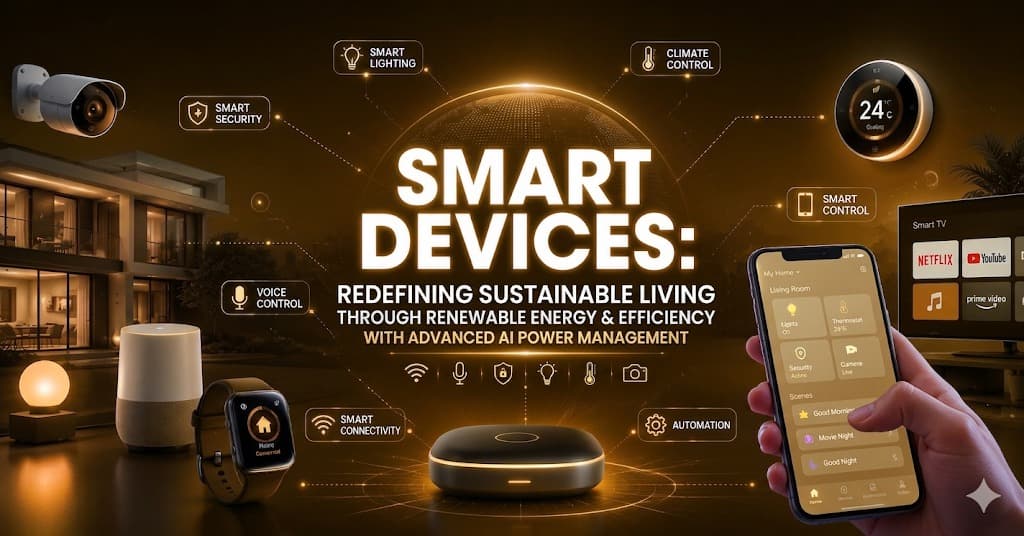
We are living in a pivotal era, one where the boundaries between the physical and digital worlds dissolve with every passing year. At the center of this transformation are smart devices, a class of connected, AI-powered tools that are fundamentally reshaping how we live, work, and interact with our environments. From adjusting room temperature without leaving your couch to receiving grocery reminders from your refrigerator, smart devices have moved far beyond novelty status. They are now the cornerstone of modern, efficient, and sustainable living.
This article is based on verified technical research, real-world usage patterns, and curated expertise from leading voices in consumer technology and IoT (Internet of Things) ecosystems. Whether you are a homeowner considering your first purchase or a technology professional evaluating enterprise-level deployments, this guide will provide you with a thorough, authoritative understanding of what smart device are, how they work, and why they matter.
What Are Smart Devices?
A smart device is any electronic gadget that can connect to a network (typically Wi-Fi, Bluetooth, Zigbee, or Z-Wave), communicate with other devices, and respond intelligently to user commands or environmental data. Unlike traditional electronics that perform fixed functions, smart device learn, adapt, and optimize based on user behavior and real-time data inputs.
The term “smart device” encompasses a vast range of products:
- Smart speakers (e.g., Amazon Echo, Google Nest Audio)
- Smart plugs that remotely control any appliance
- Voice assistants like the Google Mini
- Smart thermostats, lights, locks, cameras, and doorbells
- Wearables such as smartwatches and fitness trackers
- Smart TVs, refrigerators, washing machines, and air purifiers
These products collectively form the backbone of the modern smart home – an interconnected ecosystem where every device communicates seamlessly to create personalized, automated living experiences.
The Explosive Growth of Smart Devices Globally
The Explosive Growth of Smart Devices Globally
The global smart device ecosystem has experienced remarkable growth over the past decade, transforming the way people interact with technology in their homes, workplaces, and everyday lives. According to industry analytics from 2025, the global smart home market is projected to surpass $250 billion by 2030, fueled by increasing consumer demand for convenience, automation, energy efficiency, and enhanced security. Today, billions of connected smart devices including smart speakers, security cameras, lighting systems, thermostats, appliances, wearables, and voice assistants are actively deployed across residential and commercial environments worldwide. As artificial intelligence and Internet of Things (IoT) technologies continue to evolve, smart devices are becoming more intelligent, responsive, and integrated into daily routines.
In India, the adoption of smart devices has accelerated significantly, growing by more than 40% year-on-year. Several factors are driving this rapid expansion, including widespread internet connectivity, affordable smartphones, decreasing device costs, and increasing awareness of smart technologies among consumers. The introduction of regional-language voice assistants and AI-powered applications has further enhanced accessibility, allowing users from diverse linguistic backgrounds to interact with technology more naturally. Additionally, government initiatives supporting digital transformation and the growing popularity of smart living solutions among urban households have contributed to the market’s upward trajectory.
Globally, countries such as the United States, Germany, South Korea, Japan, and Australia remain at the forefront of smart device adoption due to their advanced digital infrastructure, high consumer spending power, and strong technology ecosystems. However, emerging markets across Southeast Asia, the Middle East, Africa, and Latin America are rapidly narrowing the gap. Improved internet access, expanding e-commerce platforms, and increasing investments in smart city initiatives are enabling millions of new users to embrace connected technologies. As manufacturers continue to innovate and competition drives prices downward, smart devices are becoming more affordable and accessible than ever before.
What was once considered a luxury reserved for high-end homes has now evolved into a mainstream consumer trend. The democratization of smart technology has enabled middle-income households worldwide to enjoy the benefits of automation, remote control, energy management, and intelligent assistance. As connectivity becomes increasingly seamless and AI capabilities continue to advance, smart devices are expected to play an even greater role in shaping the future of modern living, making homes, businesses, and cities smarter, safer, and more efficient.
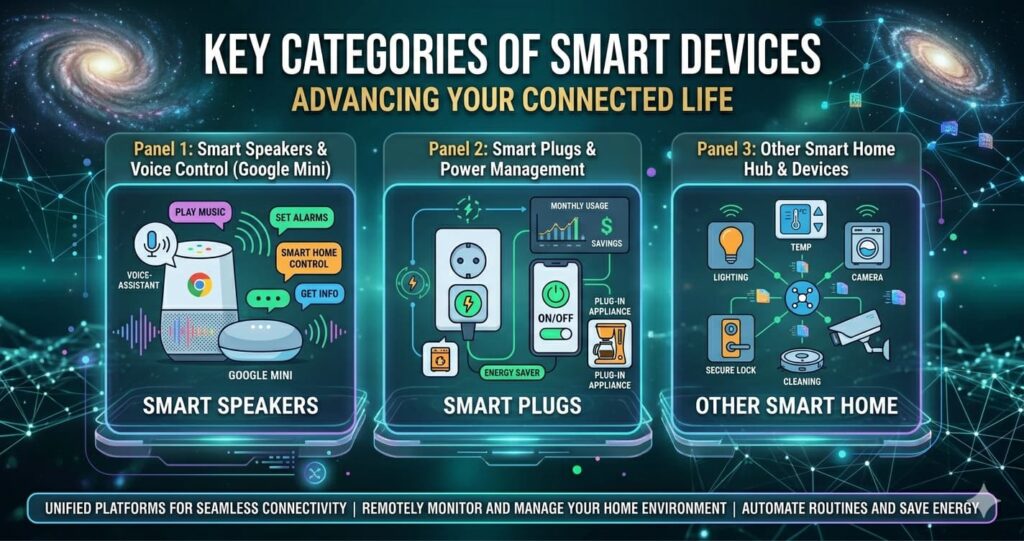
Key Categories of Smart Devices
1. Smart Speakers
Smart speakers represent one of the most widely adopted categories of smart device in the world. Products such as the Amazon Echo, Apple HomePod, and Google Nest Audio combine high-quality audio playback with always-on voice assistant capabilities. These devices act as the central hub of the smart home capable of controlling other smart devices, answering questions, setting reminders, playing music, reading news, and managing calendars, all through natural voice commands.
Smart speakers use natural language processing (NLP) engines to understand context, intent, and even accents. The latest generation of smart speakers can distinguish between multiple users in a household, offering personalized responses to each member.
2. Google Mini
The Google Mini (now evolved into the Google Nest Mini) is one of the most compact and affordable entry points into the world of smart device. Despite its small footprint, the Google Mini is powered by Google Assistant, one of the most capable AI voice platforms available. It can answer complex questions, control compatible smart devices, stream music, manage routines, and even translate languages in real time.
The Google Mini integrates deeply with Google’s ecosystem including Google Calendar, Gmail, Google Maps, and YouTube making it especially valuable for users already embedded in Google’s services. For apartments, small rooms, or secondary spaces in a home, the Google Mini provides an ideal, cost-effective smart device experience.
3. Smart Plugs
A smart plug is perhaps the simplest yet most versatile of all smart devices. At its core, a smart plug is an adapter that fits between a standard wall outlet and any electrical device, instantly transforming ordinary appliances into internet-connected, remotely controllable ones.
With a smart plug, you can:
- Turn appliances on or off from anywhere using a smartphone app
- Set schedules and timers for devices
- Monitor real-time energy consumption
- Integrate with voice assistants to control via voice
- Create automation routines (e.g., turn off all lights when you leave home)
Smart plugs are compatible with virtually every appliance from lamps, fans, and coffee makers to heaters and air conditioners. They are an excellent starting point for anyone new to smart devices, requiring no rewiring, no professional installation, and minimal technical knowledge.
How Smart Devices Work: The Technical Foundation
Understanding the mechanics of smart devices helps users make better purchasing and deployment decisions.
Smart devices operate through a combination of:
- Connectivity Protocols:- Wi-Fi offers broad bandwidth; Bluetooth enables local, low-energy control; Zigbee and Z-Wave are mesh protocols suited to large smart home deployments; Matter is the newest universal standard enabling cross-platform compatibility.
- Cloud Processing:- Most smart devices send data to cloud servers where AI models process requests and return instructions. This enables sophisticated voice recognition, machine learning-based personalization, and remote access from anywhere in the world.
- Edge Computing:- Premium smart devices perform some processing locally (on-device), reducing latency and improving privacy. Smart cameras, for instance, can detect motion and identify faces without uploading footage to the cloud.
- Mobile Applications:- Every smart device is managed through a companion app — either the manufacturer’s proprietary app or a unified platform like Google Home, Amazon Alexa, or Apple HomeKit.
- APIs and Interoperability:- Modern smart devices expose APIs that enable third-party integrations and automation platforms like IFTTT, Home Assistant, and SmartThings to build complex, multi-device workflows.
Smart Devices in Everyday Life: Real-World Use Cases
The transformative power of smart devices becomes clearest when examined through real-world scenarios:
Morning Routines:- A scheduled smart device routine can gradually brighten bedroom lights, start the coffee maker, read the day’s news headlines through a smart speaker, and adjust the thermostat – all automatically, before you leave bed.
Energy Management:- Smart plugs and smart thermostats track energy usage patterns and automatically optimize consumption. Households using smart devices for energy management report savings of 15–30% on monthly electricity bills.
Remote Monitoring:- Parents can use smart devices particularly smart cameras and doorbells to monitor children, deliveries, and home security from anywhere in the world.
Accessibility:- For elderly individuals and people with disabilities, smart devices provide significant independence. Voice-controlled smart devices eliminate the need to physically operate switches, locks, or appliances.
Hospitality and Business:- Hotels, co-working spaces, and offices use smart devices to automate lighting, HVAC, access control, and guest personalization at scale.
Detailed Tool Features Study: Smart Devices at a Glance
Below is a detailed breakdown of features across the three key smart device categories discussed:
Smart Plug – Feature Study
| Feature | Details |
| Connectivity | Wi-Fi (2.4 GHz), some support 5 GHz and Bluetooth |
| Compatibility | Amazon Alexa, Google Assistant, Apple HomeKit |
| Energy Monitoring | Real-time wattage and kWh tracking |
| Scheduling | Daily, weekly, and custom timer schedules |
| Remote Control | Full on/off control via smartphone from any location |
| Automation | Supports IFTTT, routines, and third-party integrations |
| Max Load | Typically 10–15 amps (varies by model) |
| Installation | Plug-and-play; no electrician required |
| App Support | Manufacturer app + Google Home / Alexa app |
| Safety Features | Surge protection, overload cutoff, child lock |
Google Mini – Feature Study
| Feature | Details |
| Voice Assistant | Google Assistant (NLP-powered, contextual) |
| Audio Output | 360-degree sound, enhanced bass for its size |
| Connectivity | Wi-Fi (2.4/5 GHz), Bluetooth 5.0 |
| Smart Home Control | Controls 50,000+ compatible smart devices |
| Multi-User Support | Voice Match for up to 6 users |
| Ecosystem Integration | Google Calendar, Maps, Gmail, YouTube, Nest |
| Languages Supported | 30+ languages including Hindi and regional dialects |
| Privacy Controls | Physical mute button, activity controls via Google account |
| Power | Plugged-in (15W adapter included) |
| Dimensions | 98mm diameter; ultra-compact form factor |
Smart Speakers – Feature Study
| Feature | Details |
| Audio Quality | Woofer + tweeter arrays; spatial audio on premium models |
| Voice Recognition | Far-field microphone arrays (4–8 mics) |
| Smart Home Hub | Zigbee/Matter hub built into premium models |
| Multi-Room Audio | Synchronize audio across multiple smart speakers |
| Streaming Services | Spotify, Apple Music, Amazon Music, YouTube Music |
| Intercom Function | Drop-in calling and room-to-room announcements |
| Routine Automation | Time/trigger-based multi-device routines |
| Display Variants | Smart displays (e.g., Echo Show, Nest Hub) with screens |
| Privacy | Hardware mic mute button; no local audio storage |
| Price Range | ₹2,000 – ₹30,000 depending on model and features |
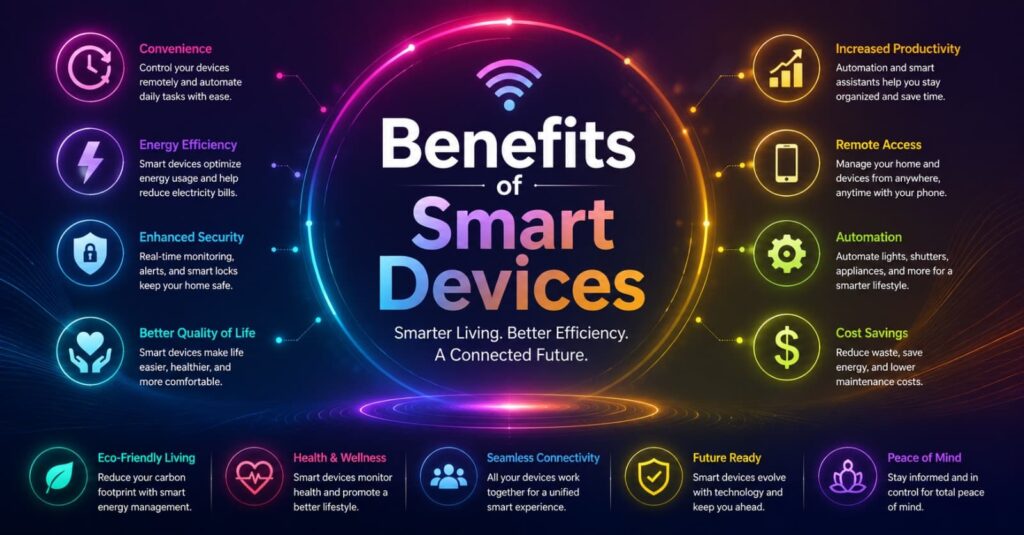
Benefits of Smart Devices
1. Unmatched Convenience
Smart devices eliminate friction from daily tasks. Automating repetitive actions turning off lights, locking doors, running the dishwasher frees up mental bandwidth for more meaningful activities.
2. Energy Efficiency and Cost Savings
Smart devices such as smart thermostats and smart plugs monitor and optimize energy use in real time, reducing waste. Over a year, a connected household can save significantly on utility costs.
3. Enhanced Home Security
Smart cameras, doorbells, and sensor-based smart devices provide 24/7 monitoring, real-time alerts, and cloud-recorded footage dramatically improving home security without expensive professional monitoring fees.
4. Accessibility and Inclusivity
Voice-activated smart devices empower users with mobility impairments, visual challenges, or age-related limitations to live more independently and safely.
5. Remote Access and Control
Whether traveling across the city or across the world, smart devices put complete home control at your fingertips via smartphone apps and cloud connectivity.
6. Scalability
Start with a single smart plug or Google Mini and expand to a fully automated smart home over time. Smart devices are modular; each addition enhances the overall ecosystem.
7. Data-Driven Personalization
Smart devices learn from user behavior over time, creating personalized routines and preferences that make the experience increasingly seamless and intuitive.
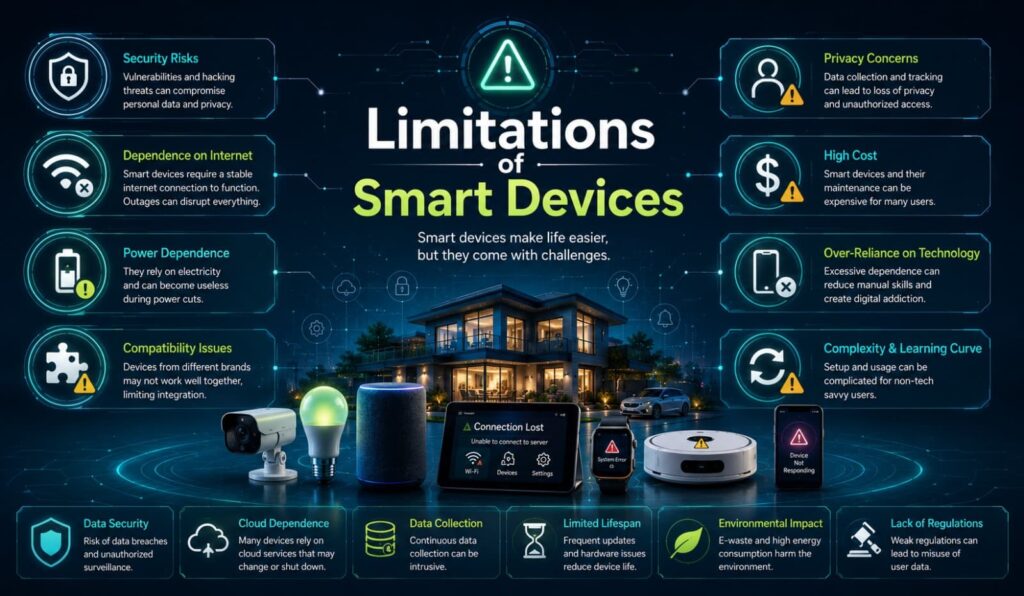
Limitations of Smart Devices
1. Privacy and Data Security Concerns
Smart devices collect significant amounts of behavioral data. Insufficiently secured devices can be entry points for cyberattacks, and cloud-based data storage raises privacy concerns for many users.
2. Internet Dependency
Most smart devices require a stable internet connection to function fully. During outages or when connectivity is poor, remote control and cloud features may become unavailable.
3. Interoperability Challenges
Despite the emergence of the Matter standard, not all smart devices work seamlessly together especially older models across different ecosystems (Amazon, Google, Apple).
4. Initial Cost Investment
While individual smart devices like the Google Mini or smart plug are affordable, building a comprehensive smart home ecosystem requires meaningful upfront investment.
5. Technical Complexity for Non-Tech Users
Setup, configuration, and troubleshooting of smart devices can be challenging for non-technical users, particularly older generations less familiar with apps and cloud services.
6. Environmental and E-Waste Concerns
It have relatively short product cycles. Rapid obsolescence can contribute to electronic waste if older devices are discarded rather than repurposed.
7. Over-Reliance and Vulnerability
Dependence on smart devices for critical functions (locks, alarms, thermostats) can create vulnerability if devices malfunction, batteries die, or manufacturer cloud servers go offline.
Follow Us on LinkedIn
The Future of Smart Devices
The next generation of smart devices will be defined by deeper AI integration, ambient computing, and radical miniaturization. Generative AI engines embedded in smart devices will enable truly conversational, context-aware assistants that anticipate needs rather than merely responding to commands.
Matter the new universal connectivity standard backed by Apple, Google, Amazon, and Samsung is already transforming smart device interoperability, allowing devices from different manufacturers to work together effortlessly. The integration of smart devices with renewable energy systems, health monitoring platforms, and urban infrastructure will extend their impact far beyond the home.
5G networks and Wi-Fi 7 will eliminate latency concerns for smart devices, while edge AI chips will make processing faster and more private. Expect smart devices to become invisible embedded into walls, furniture, clothing, and city infrastructure, creating ambient intelligent environments that respond to human presence and preference without explicit commands.
Conclusion
Smart devices are not a passing trend, they are the foundational infrastructure of modern life in the 21st century. From the humble smart plug that empowers your old appliances with new intelligence, to the Google Mini that brings a world of knowledge and control into your living room, to the rich audio and automation capabilities of smart speakers, these technologies are democratizing convenience, efficiency, and security for millions of people worldwide.
The question is no longer whether to adopt smart devices, but how to adopt them thoughtfully balancing the extraordinary benefits with a clear-eyed understanding of privacy, security, and sustainability considerations. As AI becomes more embedded, connectivity becomes more universal, and ecosystems become more interoperable, The devices will only grow more capable, more affordable, and more essential.
The smart home of tomorrow is being built by the smart devices of today. And that future, increasingly, belongs to everyone.
5 Frequently Asked Questions (FAQs)
Q1. What is the best starting smart device for a beginner?
A smart plug is universally recommended as the best entry point for beginners. It requires zero technical expertise, no wiring, and instantly adds remote and scheduled control to any existing appliance. Paired with a Google Mini or smart speaker for voice control, it creates a simple but powerful smart home foundation.
Q2. Are smart devices safe from hackers?
Smart devices can be vulnerable if not properly secured. Best practices include using strong, unique Wi-Fi passwords, regularly updating device firmware, enabling two-factor authentication on associated accounts, and purchasing devices from reputable manufacturers with active security support. The Matter standard is also improving baseline security across the industry.
Q3. Do smart devices work without the internet?
Most smart devices require an internet connection for remote access, voice commands processed in the cloud, and software updates. However, some functions like local Bluetooth control, preset schedules, and on-device automation may continue working during internet outages depending on the device and platform.
Q4. Can I use the Google Mini with non-Google smart devices?
Yes. The Google Mini works with thousands of smart devices from hundreds of brands through Google Assistant compatibility. This includes smart plugs, smart speakers, lights, thermostats, locks, and cameras from brands like Philips Hue, TP-Link, Honeywell, and many more. The new Matter standard is further expanding cross-brand compatibility.
Q5. How much can smart devices reduce my electricity bill?
Studies and real-world user reports suggest that actively managed smart devices particularly smart thermostats, smart plugs with energy monitoring, and automated lighting can reduce household energy consumption by 15% to 30% annually. Savings vary by household size, climate, existing energy habits, and the number and type of smart devices deployed.
Know more About Us

Mohammed Viqar Ali is a Digital Marketer, UI/UX Designer, and content creator passionate about AI, technology, SEO, and digital growth. As the UI/UX Designer of aiblogmind, he focuses on creating user-friendly digital experiences while sharing practical insights on artificial intelligence, marketing trends, productivity tools, and online business growth. Through his content, he helps readers discover innovative solutions, stay updated with emerging technologies, and make informed decisions in the digital world.