


7 Powerful Generative AI vs Traditional AI Examples in 2026
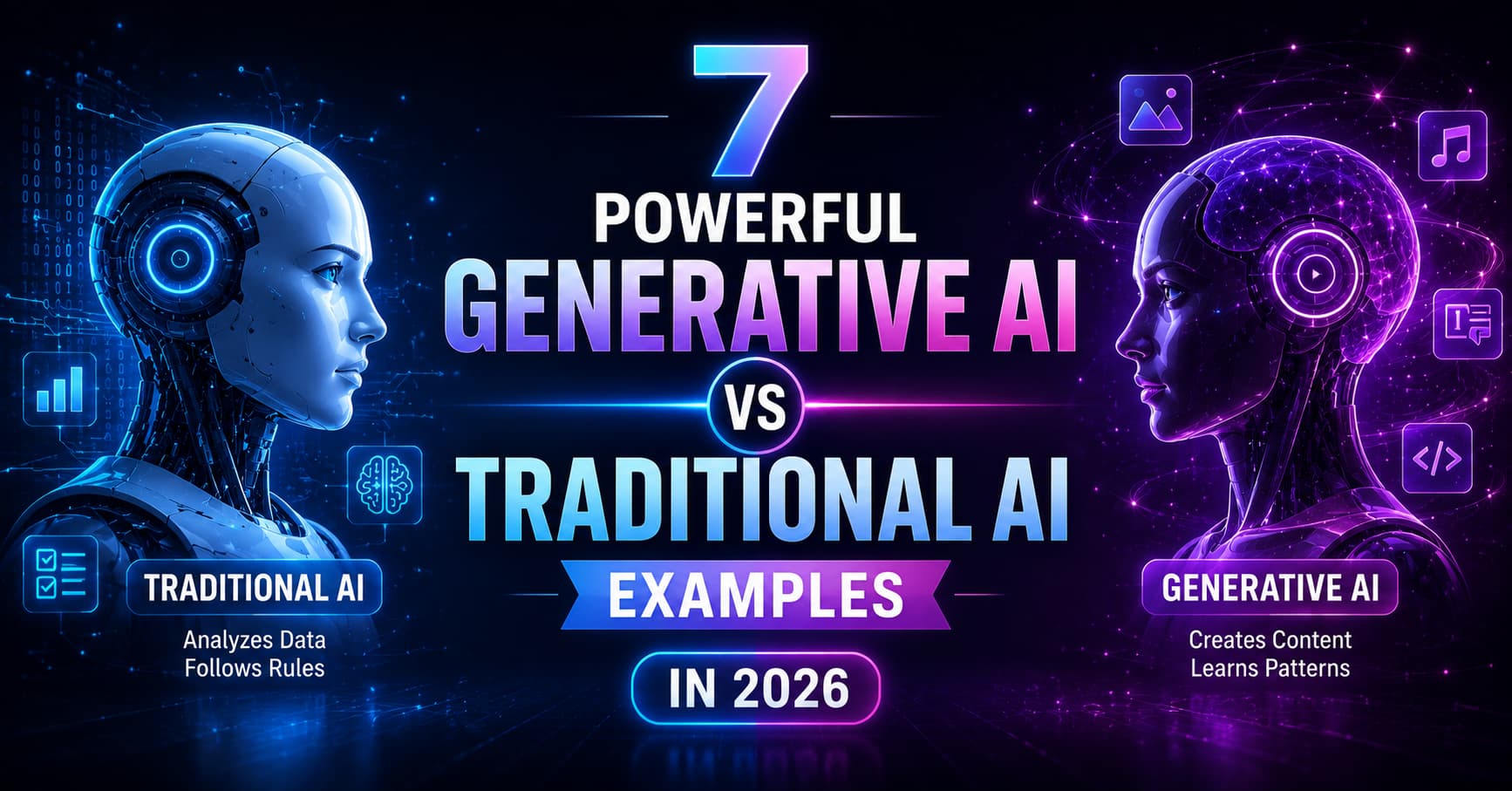
Artificial intelligence has evolved faster in the last three years than most technologies evolve in decades. Businesses, developers, and even students are now using AI tools daily without realizing how different AI systems actually work behind the scenes. Some systems generate completely new content like text, images, videos, and code, while others focus only on prediction, classification, or automation. That is where the debate around Generative AI vs Traditional AIagents becomes incredibly important in 2026.
Many people think all AI systems are the same, but the reality is very different. Generative AI can create original outputs from prompts, while traditional AI relies on predefined rules, structured data, and predictive models to solve tasks. Understanding this difference is critical for businesses involved in AI app development, automation, customer service, healthcare, finance, and marketing. Companies choosing the wrong AI approach often waste time, money, and technical resources.
According to recent market reports, the global generative AI market is expected to surpass $136 billion by 2030, while enterprise adoption of AI-powered automation tools has increased dramatically across industries. Businesses are now integrating both generative AI and traditional AI together instead of treating them as competing technologies. This hybrid approach is shaping the future of intelligent software systems.
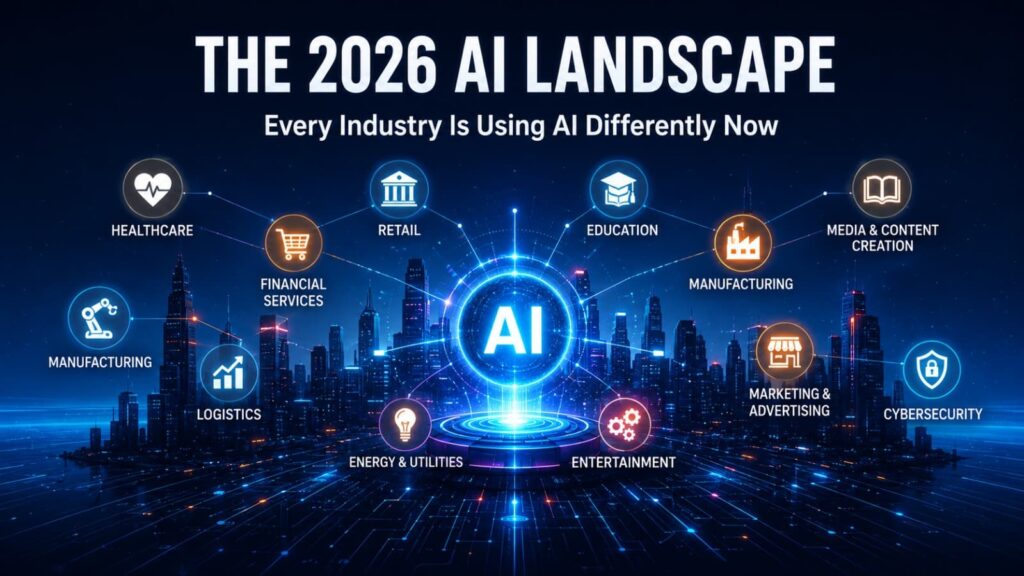
What Is Generative AI?
How Generative AI Works
To understand the debate around Generative AI vs Traditional AIagents, you first need to understand what generative AI actually is. Generative AI refers to systems capable of creating original outputs such as text, images, videos, music, audio, and even software code. Unlike older AI systems that only classify or analyze information, generative systems produce completely new content based on patterns learned from massive datasets.
Think of generative AI like a digital artist or writer. Instead of simply identifying objects or sorting information, it creates something new every time you interact with it. Modern AI models can write articles, generate realistic voices, build applications, create marketing campaigns, and even design graphics within seconds. This capability has transformed industries involved in AI app development, digital marketing, entertainment, and software engineering.
Large Language Models (LLMs) are the backbone of many generative systems. These models are trained using billions of words, images, and datasets to understand patterns and relationships. When users provide prompts, the AI predicts and generates the most contextually relevant output. The result often feels surprisingly human. That is why generative AI examples such as AI chatbots, image generators, and coding assistants have exploded in popularity across businesses worldwide.
Why Generative AI Became Popular
The rapid rise of generative AI happened because it dramatically reduces the time required to create digital content. Tasks that once took hours can now be completed in minutes. Marketers use AI for blog writing. Developers use AI coding assistants. Designers create visuals instantly. Even students rely on AI tools for learning and productivity.
Another major reason behind its popularity is accessibility. You no longer need advanced programming skills to use AI systems. Modern platforms provide simple interfaces where users can generate outputs through natural language prompts. This democratization of AI has accelerated innovation in startups and enterprise environments alike.
Businesses also love generative AI because it boosts scalability. A single AI system can produce thousands of customer responses, marketing copies, or design variations without additional labor costs. In sectors like AI app development, generative systems are helping developers prototype software faster than ever before.
What Is Traditional AI?
Rule-Based Intelligence
Before generative models dominated headlines, traditional AI powered most intelligent systems worldwide. Traditional AI focuses primarily on automation, decision-making, classification, and prediction rather than content creation.
Imagine a factory robot sorting products on a conveyor belt. It follows predefined rules and algorithms to complete repetitive tasks efficiently. That is traditional AI in action. These systems excel in environments where rules are clear, data is structured, and consistency matters more than creativity.
Examples include:
- Recommendation engines
- Spam filters
- Fraud detection systems
- Navigation software
- Industrial automation systems
Unlike generative systems, traditional AI usually does not create original content. Instead, it analyzes patterns and predicts outcomes using historical data. Businesses have relied on these systems for decades because they are reliable, efficient, and easier to control.
Predictive and Analytical Systems
Traditional AI became the foundation of modern automation because predictive systems are incredibly useful in business operations. Banks use AI to detect fraudulent transactions. Hospitals use machine learning to identify diseases from scans. E-commerce platforms predict customer preferences based on browsing history.
This form of AI depends heavily on structured datasets and predefined objectives. If the system is trained to recognize fraudulent activity, it will continuously analyze patterns to identify suspicious behavior. However, it cannot suddenly generate a marketing campaign or create an image unless specifically programmed with generative capabilities.
That distinction is central to understanding Generative AI vs Traditional AIagents. One system creates. The other predicts and automates.
Generative AI vs Traditional AIagents: Key Differences
Creativity vs Prediction
The biggest difference between generative AI and traditional AI is creativity. Generative systems create entirely new outputs, while traditional systems analyze data to make predictions or automate tasks.
Think of traditional AI as a calculator. It processes information logically and provides accurate results based on existing data. Generative AI, however, behaves more like an artist or storyteller capable of producing original ideas.
This distinction changes how businesses use AI technologies. A fraud detection system needs precision and consistency, which makes traditional AI ideal. A content marketing team, on the other hand, benefits more from generative AI because creativity matters.
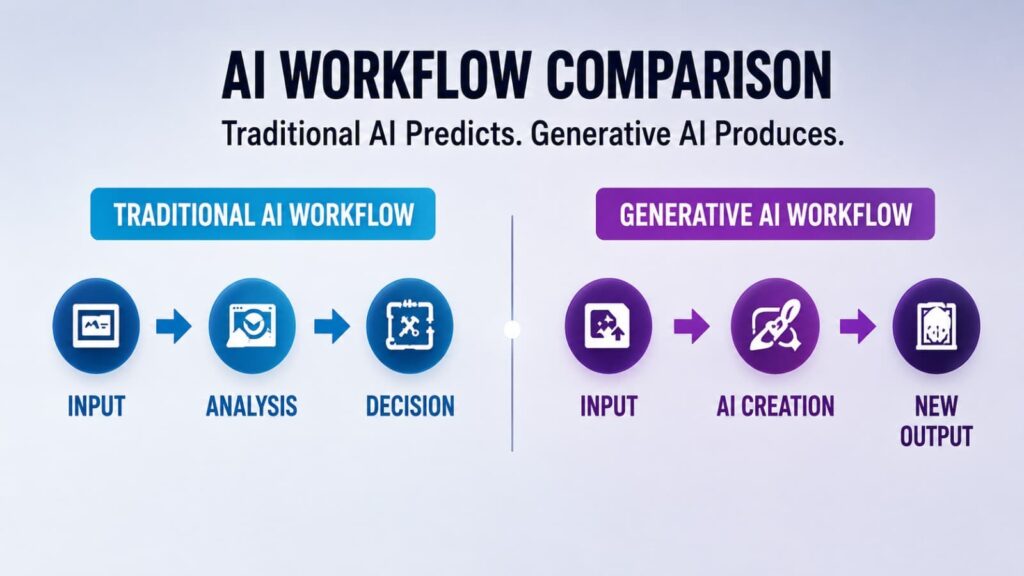
| Feature | Generative AI | Traditional AI |
|---|---|---|
| Main Function | Creates new content | Analyzes and predicts |
| Data Usage | Learns patterns for generation | Uses structured training data |
| Flexibility | Highly adaptive | Task-specific |
| Creativity | High | Low |
| Examples | ChatGPT, Midjourney | Spam filters, fraud detection |
Data Usage and Learning Methods
Another key difference in Generative AI vs Traditional AIagents is how they learn from data. Generative models consume massive datasets including text, audio, images, and videos to understand relationships between concepts. This allows them to generate highly dynamic outputs.
Traditional AI systems usually train on smaller, task-specific datasets. Their primary goal is accuracy rather than creativity. Because of this, traditional systems are often easier to audit and explain compared to generative models.
Businesses in AI app development increasingly combine both approaches. For example, an app may use traditional AI for analytics while using generative AI for customer interactions.
Example 1 – AI Chatbots and Virtual Assistants
AI chatbots are one of the clearest generative AI examples in 2026. Older customer service bots relied heavily on rule-based systems. They followed strict scripts and struggled with unexpected questions.
Modern generative AI assistants are completely different. They understand conversational context, generate natural responses, and adapt dynamically during conversations. Instead of responding with robotic answers, they communicate more like humans.
Traditional AI chatbots still exist because they are reliable for structured workflows. Airlines, banks, and telecom companies often use traditional AI for simple tasks like balance inquiries or ticket booking. Generative systems, however, are taking customer support to another level by handling complex conversations naturally.
The comparison between Generative AI vs Traditional AIagents becomes obvious here:
- Traditional chatbots follow predefined rules.
- Generative AI assistants create contextual conversations in real time.
This shift is reshaping customer support and digital communication worldwide.
Example 2 – AI in Content Creation
Content creation is perhaps the most explosive area for generative AI in 2026. Writers, marketers, designers, and video editors now use AI tools daily to accelerate production.
Generative systems can:
- Write blog articles
- Create ad copy
- Generate social media posts
- Produce videos
- Design graphics
- Compose music
Traditional AI still supports content systems behind the scenes through recommendation algorithms, SEO analysis, and audience targeting. However, it cannot generate original creative outputs independently.
This transformation has deeply impacted AI app development because modern applications increasingly integrate generative content capabilities directly into user experiences.
For example:
- AI writing tools assist bloggers
- AI video editors automate production
- AI image generators create marketing visuals
These are powerful generative AI examples demonstrating how creativity and automation are merging together.
Example 3 – AI in Healthcare
Healthcare provides one of the most fascinating comparisons in Generative AI vs Traditional AIagents.
Traditional AI systems have long been used for:
- Medical image analysis
- Disease prediction
- Patient monitoring
- Drug discovery analytics
These systems analyze structured data to help doctors make decisions more accurately.
Generative AI, however, is introducing entirely new possibilities. AI systems can now generate medical documentation, summarize patient histories, and simulate drug compounds during pharmaceutical research.
Imagine a doctor spending hours writing clinical notes after appointments. Generative AI can automate that process instantly, saving enormous time. Meanwhile, traditional AI continues analyzing patient data for diagnostic accuracy.
This hybrid combination is making healthcare faster, smarter, and more efficient.
Example 4 – AI in Finance and Fraud Detection
Finance still relies heavily on traditional AI because accuracy and compliance are critical. Fraud detection systems analyze transaction patterns to identify suspicious behavior. These systems excel because they follow strict predictive models.
Generative AI is now entering finance in different ways:
- Financial report generation
- AI-powered investment assistants
- Automated customer communication
- Personalized financial advice
Banks use both systems together because each solves different problems. Traditional AI ensures stability and risk management, while generative systems improve customer engagement and operational efficiency.
The comparison between Generative AI vs Traditional AIagents in finance highlights why businesses should not view these technologies as competitors. They complement each other.
Example 5 – AI in E-Commerce
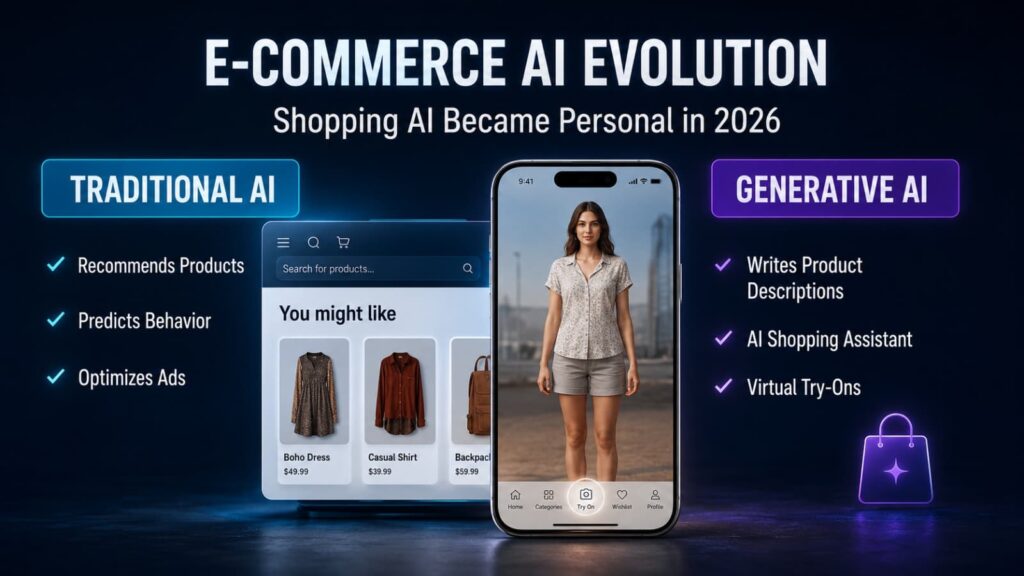
E-commerce platforms use AI everywhere. Traditional systems recommend products based on customer behavior and purchasing history. These predictive engines increase sales by understanding user preferences.
Generative AI adds another layer of personalization. Online stores now generate:
- Product descriptions
- Personalized recommendations
- AI shopping assistants
- Marketing campaigns
- Customer support conversations
This combination creates more engaging shopping experiences. Customers receive personalized interactions while businesses automate large portions of their operations.
Modern e-commerce brands investing in AI app development increasingly rely on both traditional and generative AI together to improve customer satisfaction and conversion rates.
Example 6 – AI in Software and AI App Development
The software industry has transformed dramatically because of generative AI coding assistants. Developers can now generate code snippets, debug applications, and automate repetitive programming tasks within seconds.
Generative AI tools help developers:
- Write code
- Generate APIs
- Create UI layouts
- Debug errors
- Automate testing
Traditional AI still plays a critical role in backend analytics, cybersecurity, and performance optimization. Systems monitoring application stability usually depend on predictive AI rather than generative models.
This area represents one of the fastest-growing sectors in AI app development because developers now build intelligent applications much faster than before.
The future of software engineering will likely involve collaborative AI systems where generative models handle creative coding while traditional AI manages infrastructure and security.
Example 7 – AI in Gaming and Entertainment
Gaming and entertainment industries are embracing both AI approaches aggressively. Traditional AI has powered NPC behavior, game balancing, and recommendation systems for years.
Generative AI is now transforming entertainment by creating:
- AI-generated game environments
- Dynamic storylines
- Realistic character dialogue
- AI-generated music
- Personalized gaming experiences
Imagine playing a game where characters respond uniquely every time instead of repeating scripted dialogue. That is the future enabled by generative systems.
Streaming platforms also combine traditional recommendation algorithms with generative personalization to improve engagement.
This evolution demonstrates how Generative AI vs Traditional AIagents are shaping immersive digital experiences.
To know more about AI, do follow our page
Benefits of Combining Generative AI and Traditional AI
Businesses are increasingly realizing that the best approach is not choosing one technology over another. The real power comes from combining both systems.
Benefits include:
- Better automation
- Improved creativity
- Faster workflows
- Enhanced customer experiences
- Smarter analytics
- Personalized interactions
For example, an e-commerce app may use traditional AI for inventory forecasting while using generative AI for customer communication and marketing.
This hybrid approach is becoming the standard in modern AI app development strategies.
How Businesses Choose Between Generative AI and Traditional AI
Choosing between Generative AI vs Traditional AIagents depends completely on the business goal. Companies focused on automation, prediction, and operational efficiency usually rely more on traditional AI because it delivers highly structured and reliable results. Industries like banking, manufacturing, logistics, and cybersecurity still depend heavily on predictive machine learning systems. These environments require precision, stability, and rule-based automation instead of creativity. For example, fraud detection systems in banks cannot afford random or imaginative outputs because accuracy directly affects financial security. That is why traditional AI remains a critical part of enterprise infrastructure even as generative technologies continue growing rapidly.
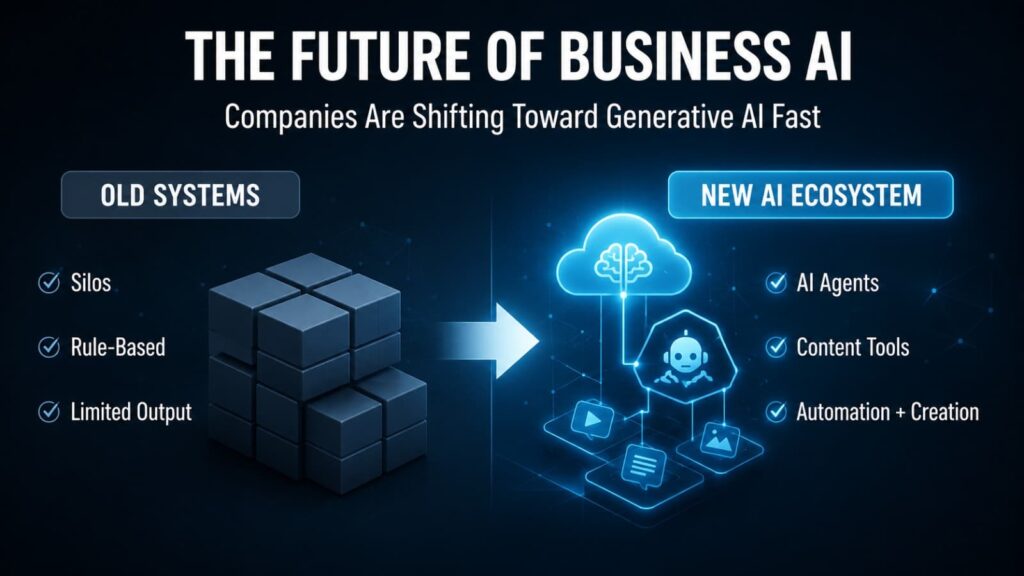
Businesses that prioritize creativity, personalization, and customer engagement are investing heavily in generative AI solutions. Marketing agencies use AI-generated content for campaigns, while e-commerce brands create personalized product recommendations and customer interactions using conversational systems. The entertainment industry also benefits massively from generative AI examples like AI-generated visuals, scripts, voiceovers, and game environments. This shift is pushing companies to rethink how they approach digital experiences. Instead of static interactions, businesses now want adaptive and intelligent systems capable of responding dynamically to user behavior. The result is a new generation of highly interactive products powered by AI.
The future of AI app development will likely revolve around hybrid AI ecosystems where both technologies operate together seamlessly. Traditional AI will continue managing analytics, prediction, and operational automation, while generative systems handle creativity, conversation, and content generation. This combination creates smarter applications capable of both reasoning and creating. Imagine an AI-powered business dashboard that predicts customer churn using traditional AI while simultaneously generating personalized retention campaigns using generative AI. That type of integration represents the next major evolution of intelligent software systems. Companies that successfully combine both technologies will gain faster workflows, stronger customer experiences, and a major competitive advantage in the AI-driven economy of 2026 and beyond.
Challenges and Risks in 2026
Despite rapid progress, AI systems still face significant challenges.
Generative AI risks include:
- Hallucinations
- Copyright concerns
- Bias in generated outputs
- Deepfake misuse
- Security vulnerabilities
Traditional AI challenges include:
- Limited adaptability
- Dependence on structured data
- Difficulty handling ambiguous situations
Businesses implementing AI must carefully balance innovation with ethical responsibility.
Future of AI Technologies
The future of AI will likely revolve around hybrid intelligence systems where generative and traditional AI work together seamlessly.
Experts predict future systems will:
- Understand human emotions better
- Automate complex workflows
- Generate personalized experiences
- Operate autonomously across industries
The debate around Generative AI vs Traditional AIagents will eventually shift from comparison to collaboration because both technologies solve fundamentally different problems.
Conclusion
The rise of AI in 2026 has completely transformed how businesses operate, communicate, and innovate. Understanding the difference between Generative AI vs Traditional AIagents is essential for anyone involved in technology, automation, or digital business strategies.
Generative AI excels at creativity, content generation, and dynamic interactions, while traditional AI remains unmatched in prediction, structured analysis, and operational automation. The most successful companies are not choosing between them. They are combining both technologies strategically.
From healthcare and finance to gaming and AI app development, these systems are reshaping industries at incredible speed. Businesses that understand how to use both approaches effectively will gain a major competitive advantage in the years ahead.
FAQs
What is the main difference between generative AI and traditional AI?
Generative AI creates original content, while traditional AI focuses on prediction, classification, and automation.
What are some popular generative AI examples?
Examples include AI chatbots, image generators, coding assistants, AI writing tools, and video generation platforms.
Is traditional AI still important in 2026?
Yes. Traditional AI remains essential for fraud detection, analytics, automation, recommendation systems, and industrial operations.
How does AI app development use both AI types?
Modern AI app development combines traditional AI for analytics and prediction with generative AI for content creation and conversational experiences.
Which industries benefit most from generative AI?
Healthcare, marketing, software development, entertainment, customer service, and e-commerce are among the biggest beneficiaries of generative AI technologies.

Syed Abubakkar is a content and SEO specialist responsible for article publishing, on-page SEO, keyword optimization, and AI-powered image generation. He is passionate about digital marketing and helping websites grow their online presence.