


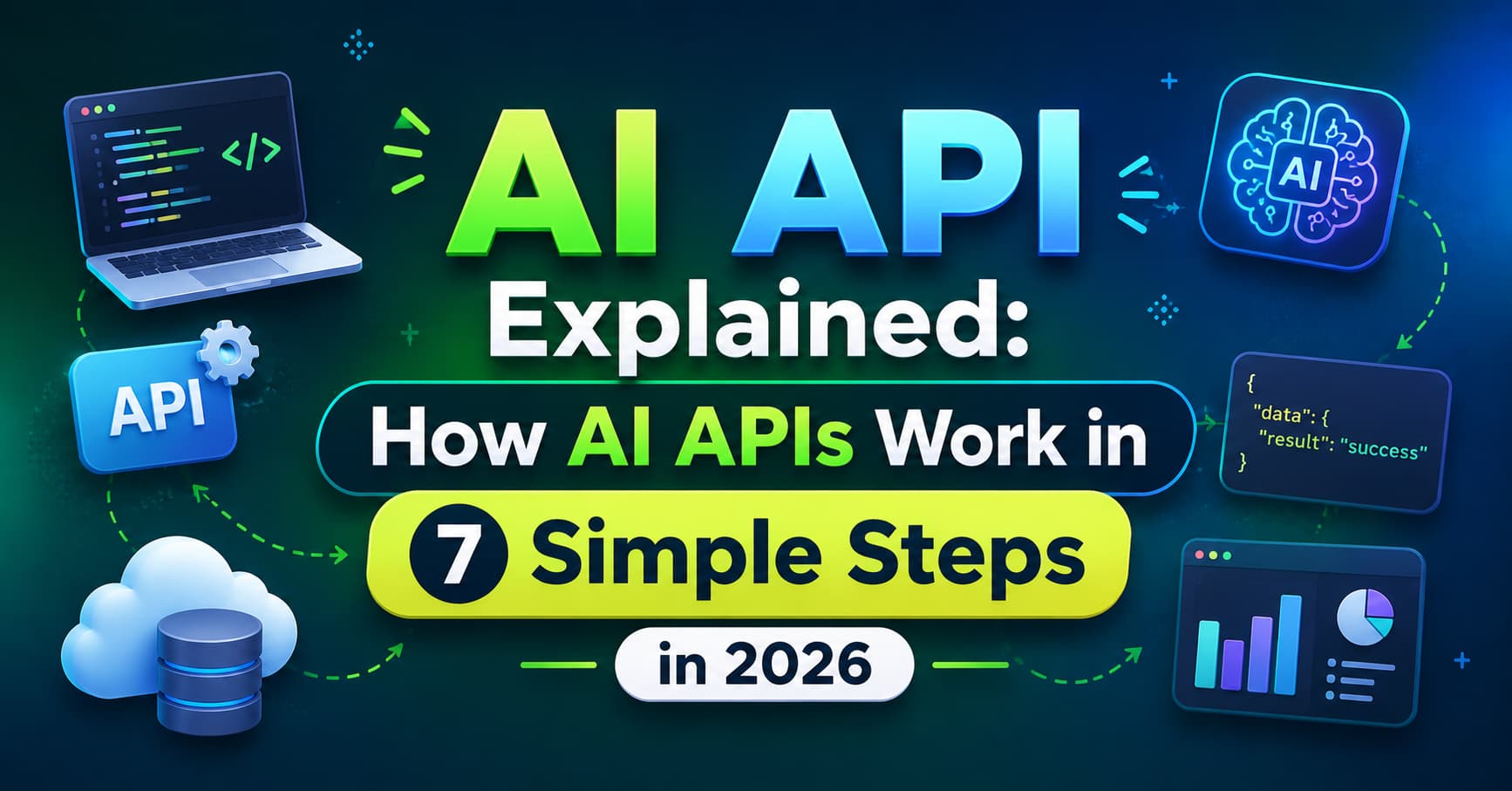
AI API Explained: How AI APIs Work in 7 Simple Steps in 2026
Artificial intelligence is no longer something hidden inside research labs or giant tech companies. In 2026, almost every modern app, website, chatbot, and digital service uses some kind of AI API to deliver smarter experiences. Whether you are using a virtual assistant, generating images, writing content, translating languages, or automating customer support, there is a strong chance an AI API is working behind the scenes. Businesses are adopting these technologies rapidly because users now expect intelligent and personalized experiences everywhere they go online.
Think about how people interact with technology today. Instead of clicking through endless menus, users simply ask questions in natural language and expect instant answers. That shift is exactly why AI API systems have become so important. Developers no longer need to build complex machine learning models from scratch. They can connect powerful AI services directly into apps using simple API requests. This saves time, reduces costs, and makes advanced AI available even to small businesses and solo developers.
The biggest advantage of modern AI API integration is accessibility. A few years ago, creating AI-powered software required huge budgets and specialized teams. Now, developers can connect tools like the ChatGPT API, speech recognition systems, recommendation engines, and image generation models with only a few lines of code. This change has completely transformed the software industry. From eCommerce stores to healthcare platforms, AI is becoming the engine that powers modern digital experiences.
This guide will explain AI APIs explained in the easiest way possible. You will learn what an AI API actually is, why it matters, and exactly how it works in seven simple steps. You will also discover the most popular AI categories, the role of AI developer tools, common challenges developers face, and why businesses are investing heavily in AI-powered applications in 2026.

What Is an AI API?
An AI API is a bridge that allows applications to communicate with artificial intelligence systems. The word API stands for Application Programming Interface. In simple terms, it acts like a waiter inside a restaurant. You place an order, the waiter carries it to the kitchen, and then returns with your food. Similarly, an AI API takes a request from an app, sends it to an AI model, and then returns the response back to the user.
The reason AI APIs explained have become such a hot topic is because they simplify AI adoption. Instead of building large machine learning infrastructures from the ground up, developers can connect directly to existing AI services. For example, a chatbot application can use the ChatGPT API to generate intelligent responses instantly. An image editing app can use an AI image API to remove backgrounds automatically. A voice assistant can use speech recognition APIs to convert spoken words into text within seconds.
Another reason the AI API market is booming is flexibility. APIs allow developers to add AI features to almost any software product. This means businesses can create personalized recommendations, automate customer support, analyze data, detect fraud, and generate content without becoming AI experts themselves. It is similar to plugging a smart brain into an existing application.
In 2026, companies are competing based on how intelligent and efficient their applications are. Users now expect apps to understand their needs instantly. Because of that expectation, AI API integration is no longer optional for many businesses. It has become a major part of modern digital transformation strategies across industries worldwide.
Understanding APIs in Simple Words
To understand an AI API, you first need to understand what a normal API does. Imagine two people speaking different languages. They need a translator to communicate effectively. APIs work in a similar way. They help two software systems exchange information smoothly without needing to understand each other’s internal code structure.
For example, when you log into a website using your Google account, APIs are involved. The website sends a request to Google asking for authentication. Google verifies your login details and sends the approval back through the API. The same process happens with AI systems, except the request may involve text generation, voice recognition, or data analysis instead of login verification.
The rise of AI developer tools has made APIs even more important. Developers now use APIs to connect advanced machine learning models into websites, mobile apps, and cloud systems. Instead of spending months building AI algorithms, they can simply call an API endpoint and receive intelligent results immediately.
One major advantage of an AI API is scalability. If an application suddenly gets thousands of users, cloud-based APIs can handle those requests efficiently. This is why startups and enterprises both rely heavily on API-based AI services in 2026. APIs reduce technical complexity while delivering powerful AI capabilities that previously required massive infrastructure investments.
Why AI APIs Are Growing Fast in 2026
The growth of the AI API industry is happening at an incredible speed because businesses now prioritize automation and personalization. Customers expect instant support, smarter recommendations, and faster services. AI helps companies meet those expectations without hiring massive teams.
One of the biggest drivers of this growth is content generation. Businesses use tools powered by the ChatGPT API to create blog posts, product descriptions, emails, and customer responses at scale. Marketing teams save countless hours while maintaining consistent communication across platforms. This is why AI-generated content has become a major trend in digital marketing.
Another major reason for rapid growth is affordability. Building AI models internally requires expensive hardware, data scientists, and ongoing maintenance. APIs eliminate most of these barriers. Companies only pay for what they use. This makes AI API integration attractive for startups and small businesses that want enterprise-level technology without enterprise-level costs.
The expansion of cloud computing has also accelerated adoption. Cloud providers now offer reliable AI infrastructure globally, allowing applications to process requests within seconds. Combined with improved AI developer tools, APIs have become easier to integrate than ever before. Developers can now launch intelligent features quickly without deep machine learning expertise.
Why Businesses Are Using AI API Solutions
Businesses are using AI API platforms because modern consumers value convenience and speed above everything else. Companies that fail to provide intelligent digital experiences often lose customers to competitors offering smarter alternatives.
Customer support is one of the biggest examples. AI-powered chatbots can answer thousands of questions simultaneously using APIs connected to language models. Instead of waiting on hold for human agents, customers receive instant responses 24/7. This improves customer satisfaction while reducing operational costs dramatically.
Data analysis is another important area. Businesses collect enormous amounts of information daily, but analyzing that data manually is nearly impossible. AI APIs can process customer behavior, sales patterns, and market trends in real time. This helps companies make faster and smarter business decisions.
The popularity of AI APIs explained also comes from productivity improvements. Developers can automate repetitive coding tasks using AI coding assistants. Marketing teams can generate content ideas quickly. Designers can create AI-generated visuals instantly. The result is faster workflows and improved efficiency across departments.
As competition increases in every industry, businesses are realizing that AI is no longer just a futuristic concept. It has become a practical necessity. Companies that adopt AI API integration early often gain a significant competitive advantage over slower-moving competitors.
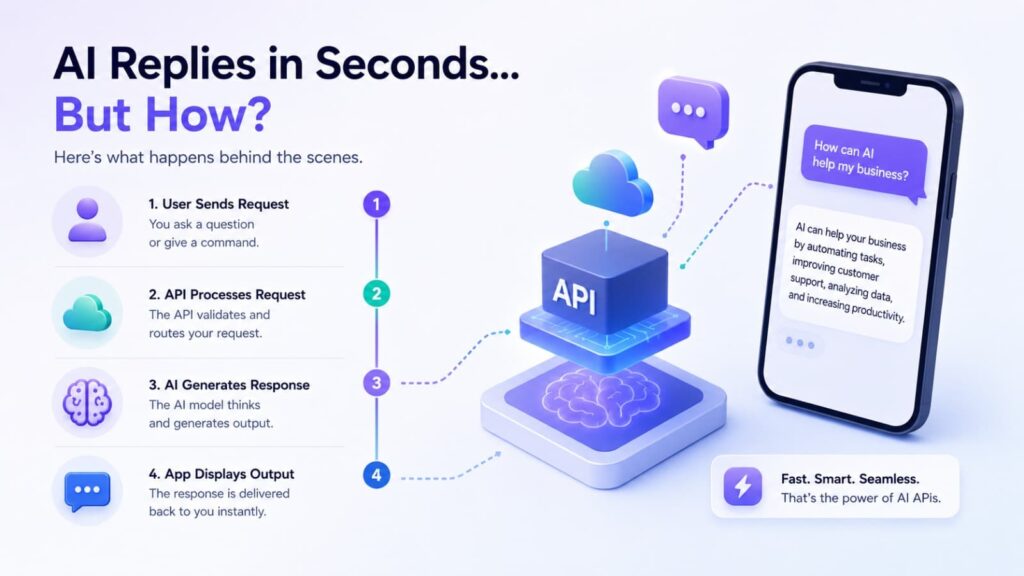
How AI APIs Work in 7 Simple Steps
Step 1 – User Sends a Request
Every AI API process starts with a user request. This request could be a question typed into a chatbot, an uploaded image, a voice command, or any other form of input. The application collects this information and prepares it for the AI system.
For example, if someone asks a chatbot, “Write me a product description,” the app packages that request into a structured format. Usually, this format is JSON data sent through HTTP requests. The API acts like a messenger carrying the user’s request to the AI model.
This step may sound simple, but it is critical. The quality of the request often affects the quality of the response. Developers spend a lot of time optimizing prompts and input formatting because better prompts usually produce better AI outputs.
Modern AI developer tools now include prompt management systems that help businesses improve AI accuracy. This is especially important for companies using large-scale AI API integration across multiple applications.
Step 2 – Authentication and API Keys
Before processing any request, the system checks authentication credentials. This is where API keys come into play. An API key acts like a digital password proving that the application has permission to access the AI service.
Security is extremely important in the world of AI API systems because APIs handle sensitive data daily. Without authentication, anyone could misuse AI services or overload servers with fake requests. API keys help providers monitor usage, control access, and prevent abuse.
For example, when developers use the ChatGPT API, they receive unique credentials from the provider. Every request includes these credentials so the server can verify legitimacy. If the credentials are invalid, the request gets rejected immediately.
This authentication process also helps companies track billing. Many APIs operate on usage-based pricing models where businesses pay based on tokens, requests, or processing power consumed. Accurate authentication ensures fair usage tracking for all customers.
Step 3 – Data rocessing Begins
Once authentication succeeds, the AI API begins processing the incoming data. The system cleans, organizes, and prepares the information for the AI model. This preparation stage is extremely important because AI models require structured input to generate accurate results.
For text-based systems, processing may involve tokenization, where sentences are broken into smaller units the model can understand. For image APIs, preprocessing might involve resizing images or enhancing quality before analysis begins.
This stage is similar to preparing ingredients before cooking a meal. Even the best chef cannot create great food with messy ingredients. Similarly, AI systems perform better when the input data is properly prepared and optimized.Advanced AI developer tools now automate much of this process. Developers no longer need deep expertise in machine learning preprocessing techniques because modern APIs handle most technical complexities automatically behind the scenes.
Step 4 – AI Model Analyzes the Input
After preprocessing, the actual AI model begins analyzing the information. This is the brain of the entire AI API system. The model uses machine learning algorithms trained on enormous datasets to understand patterns and relationships within the input.
For example, a language model analyzes grammar, context, intent, and meaning before generating responses. Image recognition models examine shapes, textures, and colors to identify objects. Voice recognition systems analyze sound frequencies and speech patterns.
The power of modern AI models in 2026 is astonishing. Some systems can process billions of parameters simultaneously, allowing them to generate highly human-like responses. This is why APIs powered by advanced AI models feel increasingly natural during interactions.
One reason AI APIs explained attract so much attention today is because these models continue improving rapidly. Newer systems understand context better, reduce errors, and deliver more personalized results compared to earlier AI generations.
Step 5 – Machine Learning Generates Output
Once analysis is complete, the AI generates a response. This output could be text, images, recommendations, translations, summaries, or predictions depending on the API type being used.
For example, the ChatGPT API may generate a conversational answer, while an AI image API creates artwork based on text prompts. Recommendation APIs may suggest products based on customer preferences and browsing history.
This stage often feels magical to users because results appear almost instantly. Behind the scenes, however, incredibly complex machine learning computations are happening within milliseconds. AI models evaluate probabilities and predict the most likely outputs based on training data patterns.
Businesses love this capability because it creates scalable automation. A single AI API can handle thousands of simultaneous requests, allowing companies to deliver intelligent services efficiently without needing massive human teams.
Step 6 – API Sends Response Back
After generating the result, the API packages the output and sends it back to the application. The response usually arrives in a structured format like JSON, making it easy for software systems to understand and display.
For example, a chatbot app receives the generated response text and displays it in the chat window. An image generation app receives image URLs or encoded image data. Translation apps receive translated sentences ready for display.
The speed of this communication is one reason users enjoy AI-powered experiences. Modern APIs often respond within seconds or even milliseconds. Faster response times create smoother and more engaging digital interactions.
Reliable infrastructure is crucial here. Large AI providers use distributed cloud networks to ensure stable performance even during heavy traffic periods. This scalability is a major reason businesses prefer API-based AI solutions instead of building their own infrastructure.
Step 7 – Application Displays Final Result
The final step happens when the application presents the AI-generated result to the user. At this point, the entire process feels seamless. Users simply see answers, recommendations, or generated content without realizing how many technical systems worked together behind the scenes.
Good user interface design plays a major role here. Even the best AI API becomes ineffective if results are displayed poorly. Developers focus heavily on making AI interactions feel natural, intuitive, and visually appealing.
This final step also includes feedback collection in many systems. Some applications allow users to rate AI responses or provide corrections. That feedback helps companies improve performance over time.
The complete process from request to response often takes only a few seconds, yet it involves authentication, preprocessing, machine learning analysis, output generation, and data delivery. This is what makes modern AI API integration such a powerful technological breakthrough in 2026.
Popular Types of AI APIs in 2026
| API Type | Main Use Case | Example Applications |
|---|---|---|
| Text Generation APIs | Content creation and chatbots | Blog writing, virtual assistants |
| Image Generation APIs | AI-created visuals | Graphic design, marketing |
| Speech Recognition APIs | Voice-to-text conversion | Voice assistants, subtitles |
| Recommendation APIs | Personalized suggestions | Netflix-style recommendations |
| Translation APIs | Language conversion | Global communication tools |
| Vision APIs | Object and face recognition | Security systems, retail apps |
Text generation APIs remain among the most popular categories because businesses constantly need written content. APIs connected to advanced language models can generate articles, product descriptions, emails, and customer replies quickly.
Image and video APIs are also exploding in popularity. Marketing agencies now create ad creatives using AI-powered image tools. eCommerce businesses generate product visuals instantly. Social media creators use AI-generated graphics daily to speed up content production.
Voice AI is another rapidly growing area. Smart assistants, call center automation, and speech-to-text systems rely heavily on advanced APIs. Improved speech accuracy has made voice interaction more reliable than ever before.
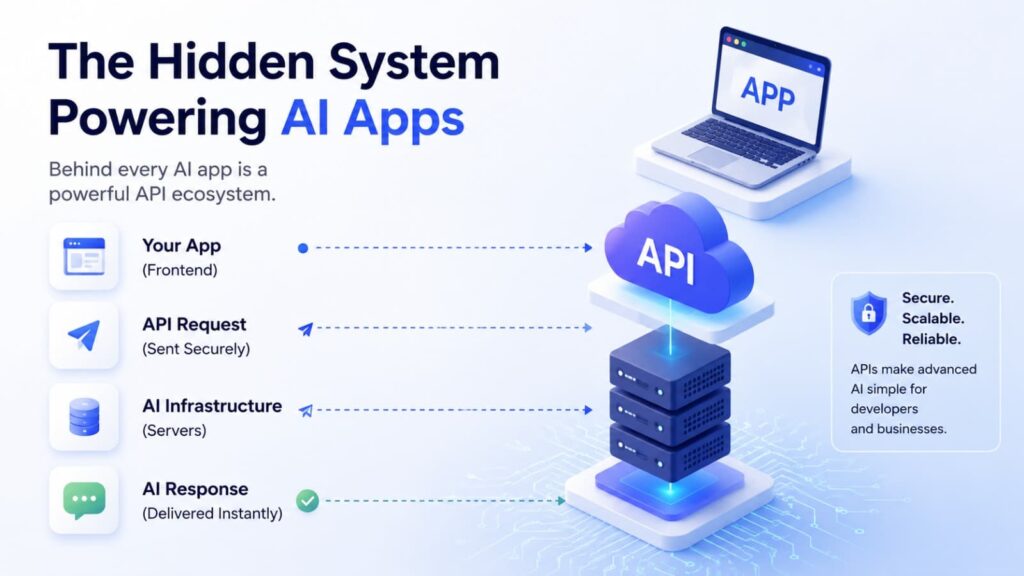
Benefits of AI API Integration
The biggest benefit of AI API integration is speed. Companies can launch intelligent features quickly without spending years building machine learning systems internally. This dramatically shortens development cycles and reduces technical barriers.
Cost savings are another huge advantage. Instead of maintaining expensive AI infrastructure, businesses simply pay for API usage. This flexible pricing model makes AI adoption accessible for startups, freelancers, and smaller companies.
Scalability is equally important. APIs allow businesses to handle sudden traffic spikes efficiently. Whether an application serves hundreds or millions of users, cloud-based AI services can scale dynamically based on demand.
Modern AI developer tools also improve productivity significantly. Developers now spend less time writing repetitive code and more time focusing on innovation. Teams can experiment with new features rapidly, leading to faster product improvements and better customer experiences.
Challenges Developers Face With AI APIs
Despite their advantages, AI API systems still come with challenges. Security and privacy remain major concerns because APIs often process sensitive user data. Companies must ensure encryption, secure authentication, and compliance with privacy regulations.
Cost management can also become difficult at scale. Heavy API usage may lead to unexpectedly high expenses, especially for applications processing large amounts of data daily. Developers need efficient optimization strategies to control operational costs.
Another challenge is dependency. Businesses relying heavily on external APIs become dependent on third-party providers. If pricing changes or outages occur, applications may experience disruptions. This is why many companies build backup systems and multi-provider strategies.
AI accuracy is another ongoing issue. Even advanced models sometimes produce incorrect or biased outputs. Developers must test systems carefully and implement monitoring tools to maintain quality standards consistently.
Final Verdict
The rise of the AI API industry is reshaping how software is built and how users interact with technology. APIs have made artificial intelligence accessible to businesses of all sizes, allowing developers to integrate advanced machine learning capabilities without building everything from scratch.
From the ChatGPT API to image generation systems and voice assistants, AI-powered APIs are becoming the foundation of modern applications. They improve automation, increase productivity, personalize customer experiences, and help companies compete in a rapidly evolving digital world.
Understanding AI APIs explained is no longer optional for developers and business owners. AI is becoming deeply integrated into daily digital experiences, and APIs are the invisible bridges making those intelligent interactions possible.
As AI technology continues advancing through 2026 and beyond, the importance of AI API integration and modern AI developer tools will only grow stronger. Businesses that adopt these technologies early are likely to lead the next wave of digital innovation.
FAQs
1. What is an AI API in simple words?
An AI API is a tool that allows applications to communicate with artificial intelligence systems. It sends requests to AI models and returns intelligent responses back to the app.
2. Why are AI APIs important in 2026?
AI APIs are important because they help businesses automate tasks, improve customer experiences, and build intelligent applications faster without creating AI models from scratch.
3. What is the role of the ChatGPT API?
The ChatGPT API allows developers to integrate conversational AI into apps, websites, customer support systems, and productivity tools.
4. What are AI developer tools?
AI developer tools are platforms, frameworks, and services that help developers build, test, deploy, and manage AI-powered applications efficiently.
5. What are the biggest challenges of AI API integration?
The biggest challenges include security risks, privacy concerns, API costs, dependency on providers, and maintaining consistent AI accuracy.
To know more about AI, stay connected with us! Thank you!

Syed Abubakkar is a content and SEO specialist responsible for article publishing, on-page SEO, keyword optimization, and AI-powered image generation. He is passionate about digital marketing and helping websites grow their online presence.