



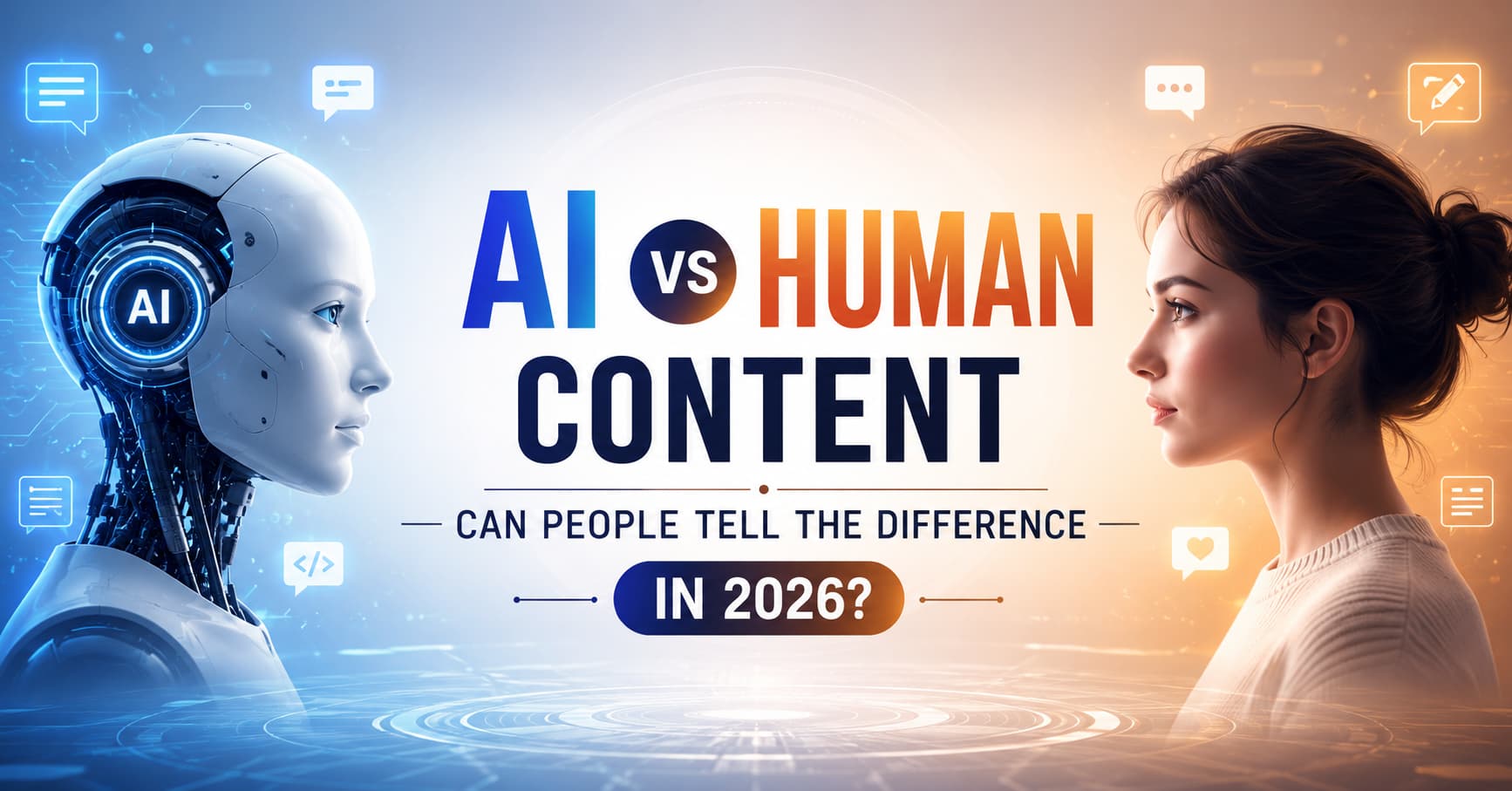
AI vs Human Content: Can People Tell the Difference in 2026?
Introduction
Imagine reading a blog post, a product description, or even a news article — and having absolutely no idea whether a human being wrote it or a machine did. That is not a futuristic scenario anymore. In 2026, this is everyday reality. The debate around AI vs human content has exploded across every industry, from marketing and journalism to education and e-commerce.
The problem is real and growing. Businesses are pushing out thousands of words of AI generated content every single day. Readers are consuming it without question. Search engines are indexing it. And somewhere in the middle, the lines between authentic human written content and machine output have blurred almost completely.
So here is the big question: Can people actually tell the difference between AI vs human content anymore? And if they cannot, does it even matter?
This article breaks it all down. We will look at where AI writing tools excel, where they fall short, how AI content detection works (and fails), and what it all means for writers, brands, and everyday readers trying to navigate the content landscape in 2026.
Why the AI vs Human Content Debate Matters More Than Ever
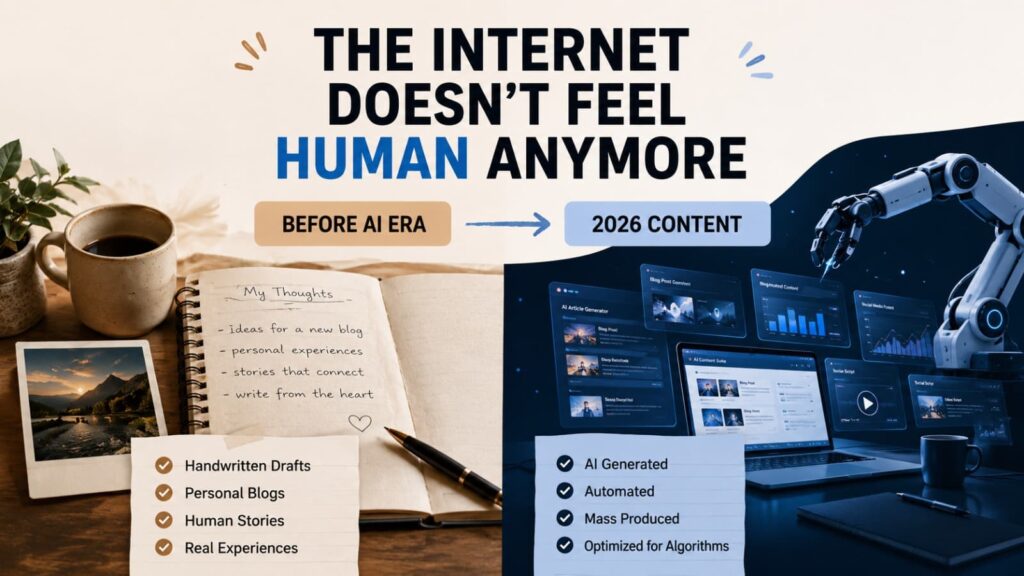
A few years ago, AI generated content was easy to spot. Robotic phrasing. Repetitive sentence structures. A strange flatness that felt like no human had ever touched the words. Today, that is no longer the case.
The latest generation of AI writing tools produces content that mirrors human tone, adapts to different styles, uses nuance, and even mimics emotional depth. The gap between AI vs human content has narrowed so much that professional editors, experienced marketers, and even researchers struggle to reliably identify which is which in blind tests.
Studies conducted in early 2026 show that readers correctly identify AI vs human content only slightly better than chance when reading well-edited AI output. That is a dramatic shift from just two years ago, when detection accuracy was much higher.
This matters for several reasons. Trust is at stake. Authenticity drives purchasing decisions. Google and other search engines are actively working to prioritize human written content that demonstrates real experience and expertise. And audiences, when they find out they have been reading AI generated content without being told, often feel misled.
Understanding the AI vs human content divide is not just a technical exercise. It is a business decision, an ethical conversation, and a creative challenge all at once.
The Benefits of AI Writing Tools
Let us be fair. AI writing tools have brought genuine advantages to content creation, and ignoring those benefits would be dishonest.
Speed and Scale
The most obvious benefit of AI vs human content production is speed. A skilled human writer might produce 1,000 to 2,000 words per hour on a good day. An AI writing tool can generate the same volume in under a minute. For businesses that need product descriptions, FAQs, social media captions, and email sequences at scale, this is a legitimate game-changer.
Cost Efficiency
Human written content from experienced writers commands a premium, and rightfully so. But not every piece of content requires deep expertise or creative flair. For templated, repetitive, or data-driven content, AI generated content dramatically reduces production costs without sacrificing basic quality.
Consistency
AI writing tools maintain a consistent voice, tone, and structure across hundreds of pieces without fatigue. Human writers have off days. AI does not. When brand consistency is a top priority, AI generated content can actually outperform fragmented human writing from multiple contributors.
Research Assistance and Drafting
Even writers who would never fully outsource their work to AI use these tools for brainstorming, outlining, and first drafts. In the AI vs human content workflow, many professionals now operate in a hybrid mode — using AI to do the heavy lifting on structure and using human judgment to refine, fact-check, and add genuine experience.
Multilingual Capability
AI writing tools can produce content in dozens of languages instantly, which opens up global content strategies that would have been cost-prohibitive with purely human written content.
Also, checkout Articles on latest Ai tools
The Limitations of AI Writing Tools
Despite the impressive progress, AI vs human content comparisons still reveal meaningful gaps. Understanding these limitations is essential for anyone relying on AI generated content for serious purposes.
Lack of Real Experience
This is the biggest limitation in the AI vs human content debate. AI has no lived experience. It cannot tell you what it felt like to test a product, speak to a customer, or navigate a complex industry challenge. Human written content carries genuine perspective. AI generated content, even when well-crafted, tends to sound authoritative without actually being grounded in real-world knowledge.
Google’s EEAT framework — which stands for Experience, Expertise, Authoritativeness, and Trustworthiness — specifically rewards content that demonstrates first-hand experience. AI generated content structurally struggles here, because it is drawing from patterns in existing data, not from anything it has actually done or observed.
Factual Errors and Hallucination
AI writing tools can confidently state things that are simply wrong. This is known as hallucination, and in 2026 it remains a serious problem. When producing AI generated content at scale, errors can slip through unnoticed, especially if human review is minimal. Human written content, backed by a real person’s knowledge and accountability, is generally more reliable on factual accuracy.
Thin Originality
AI generated content is, at its core, a sophisticated remix of what already exists. It does not generate new ideas, conduct original research, or break new ground. In the AI vs human content comparison, human writing still wins decisively when genuine originality and creative voice are required.
AI Content Detection Challenges
Ironically, the better AI writing tools become, the harder AI content detection becomes. Businesses and platforms trying to enforce human written content policies are in a constant arms race with AI tools that are specifically designed to mimic human style. Current AI content detection tools have meaningful false positive rates, sometimes flagging authentic human written content as machine-generated.
Context and Tone Sensitivity
AI writing tools can struggle with nuanced tone — satire, cultural references, grief, irony. The human written content advantage is clearest in emotionally complex pieces where getting the tone wrong can cause real damage.
Top AI Writing Tools in 2026: How They Shape the AI vs Human Content Landscape
The AI writing tools market has matured significantly. Here are the leading platforms shaping the AI vs human content conversation this year.
ChatGPT (OpenAI)
Still the most widely used AI writing tool globally, ChatGPT powers everything from quick email drafts to long-form AI generated content. Its latest model produces highly natural prose that scores well in AI vs human content blind tests. It is versatile, accessible, and deeply integrated into many business workflows.
Claude (Anthropic)
Claude is known for producing AI generated content that feels particularly thoughtful and structured. It handles nuance better than many competitors, making it a preferred tool for longer, more complex content. In AI vs human content comparisons, Claude’s output often requires careful reading to distinguish from polished human written content.
Gemini (Google)
Google’s own AI writing tool is deeply integrated with search data, which gives it an edge for SEO-focused AI generated content. For marketers specifically working on AI vs human content strategy, Gemini’s awareness of search intent is a notable advantage.
Jasper AI
Jasper remains a favourite among marketing teams for brand-consistent AI generated content. It offers templates, tone customization, and integrations that make it practical for high-volume content teams navigating AI vs human content decisions at scale.
Copy.ai
Copy.ai focuses on short-form AI generated content — ads, product descriptions, social copy. It is user-friendly and fast, making it popular with small businesses that need AI writing tools without a steep learning curve.
AI vs Human Content: A Direct Comparison
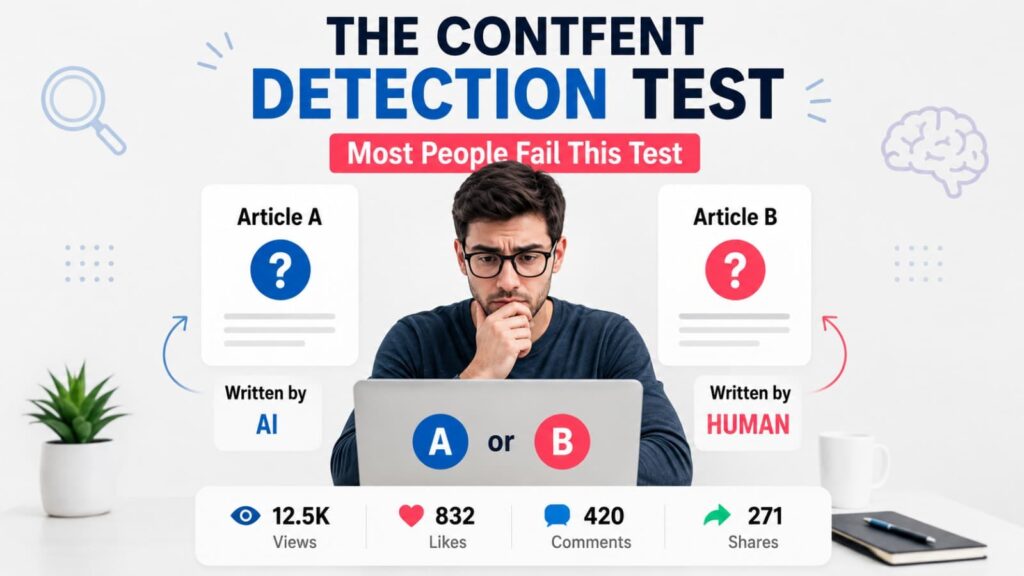
Let us put the AI vs human content question into direct comparison across the dimensions that matter most.
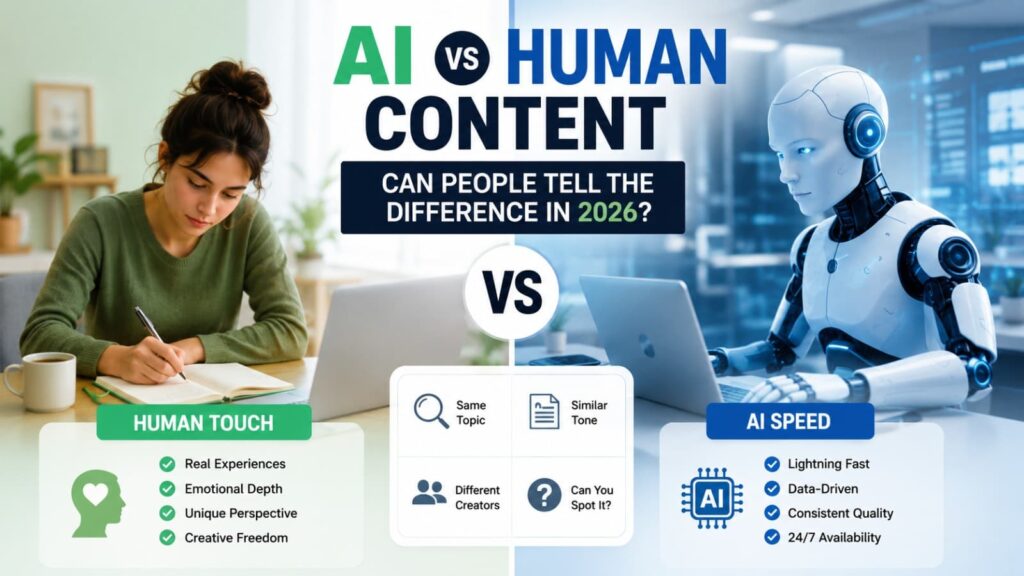
Quality: Human written content still leads when depth, originality, and emotional resonance matter. AI generated content leads on volume and speed.
SEO Performance: In 2026, both AI generated content and human written content can rank well — but content that demonstrates genuine expertise and experience consistently outperforms thin AI output in competitive search results.
Reader Trust: Surveys show readers still prefer knowing content is human written. Transparency about AI generated content helps, but the preference for human written content is real and persistent.
Cost: AI writing tools win on cost efficiency for standard content. Human written content costs more but delivers more value in high-stakes contexts.
Accuracy: Human written content holds an edge in factual reliability, particularly in technical, legal, medical, and financial domains.
Detection: AI content detection tools in 2026 are improving but remain imperfect. Watermarking and metadata-based detection are emerging as more reliable methods than linguistic pattern analysis.
The honest answer in the AI vs human content debate is that neither is universally better. Context determines which approach wins.
How to Choose the Right Approach: AI vs Human Content
Choosing between AI generated content and human written content is not a binary decision. Most successful content strategies in 2026 blend both.
Use AI writing tools for:
High-volume, templated content where speed matters more than depth. Think product descriptions, FAQ pages, email subject lines, and social media calendars. AI generated content handles these efficiently without compromising quality in meaningful ways.
Use human written content for:
Thought leadership, original research, emotionally sensitive topics, and any content where genuine experience is a ranking or trust factor. Human written content is irreplaceable when your audience needs to trust not just the information but the person behind it.
Invest in editing regardless:
Whether you start with AI generated content or human written content, professional editing is what separates forgettable content from content that actually builds authority. AI content detection by readers is not just about linguistic patterns — it is about whether the content feels real, grounded, and useful.
Be transparent:
As AI generated content becomes more prevalent, audiences increasingly appreciate honesty. Disclosing when content is AI-assisted, rather than hiding it, builds the kind of trust that human written content historically earned organically.
Test your AI content detection vulnerability:
If you are using AI writing tools, run your output through multiple AI content detection platforms. Not because detection is perfect, but because it gives you a sense of how obviously machine-like your content sounds — and where human editing needs to add warmth and specificity.
A recent viral example came from the publishing industry, where several online blogs used AI-generated articles for technology and finance news without informing readers. At first, the content looked polished and professional, but readers soon noticed repeated phrases, robotic transitions, and shallow explanations. Human-written articles on the same topics included personal experiences, unique opinions, and emotional storytelling that kept users engaged longer. This situation proved that in 2026, AI can create fast and informative content, but experienced readers can still identify the lack of human creativity and real-world insight in many AI-written pieces.
Another strong example is social media marketing campaigns. Many brands started using AI tools to generate Instagram captions, product descriptions, and LinkedIn posts. While the AI content improved posting speed, audiences often reacted better to posts written by real people. Human-written content usually included humor, cultural references, and authentic emotions that connected with readers naturally. In comparison, AI-generated posts sometimes sounded too perfect or repetitive. Companies that combined AI efficiency with human editing achieved higher engagement rates and stronger audience trust.
The education sector also became a major example in the AI vs human content debate. Schools and universities reported that students increasingly used AI tools for essays and assignments. Teachers noticed that AI-generated work often lacked critical thinking, personal opinions, and deep analysis. Human-written assignments contained unique perspectives, real-life examples, and emotional understanding that AI struggled to replicate completely. As a result, many institutions introduced AI detection tools and encouraged students to use AI only for research and brainstorming instead of full content creation.
Final Verdict
Can people tell the difference between AI vs human content in 2026? Sometimes. But not reliably, and not always.
The best AI writing tools have genuinely closed the gap. AI generated content, when produced with the right tools and reviewed by skilled humans, can be indistinguishable from human written content to most readers. AI content detection has not kept pace with AI generation capabilities, creating a significant grey zone.
But here is what has not changed: quality content — the kind that ranks, converts, builds trust, and actually helps people — still requires human judgment somewhere in the process. AI writing tools are exactly that: tools. They amplify human capability, but they do not replace the experience, accountability, and genuine perspective that human written content carries at its best.
The smartest approach to AI vs human content is not to pick a side. It is to use AI writing tools where they genuinely help, invest in human written content where it genuinely matters, and be honest with your audience about how your content is made.
In a world drowning in AI generated content, authentic human written content is not going extinct. It is becoming more valuable.
Frequently Asked Questions (FAQs)
Q1: Can readers tell the difference between AI vs human content in 2026?
In most cases, readers cannot reliably distinguish AI vs human content when the AI generated content has been well-edited. Blind tests consistently show that people identify AI generated content at only slightly above chance levels when reading polished output from advanced AI writing tools.
Q2: Is AI generated content bad for SEO?
Not inherently. Google’s official position is that AI generated content is acceptable as long as it is helpful, accurate, and not produced purely to manipulate rankings. Human written content that demonstrates genuine EEAT still tends to outperform thin AI generated content in competitive searches.
Q3: How does AI content detection work?
AI content detection tools analyze linguistic patterns, sentence structure, perplexity scores, and burstiness — how varied a text’s sentence lengths are — to estimate whether content is AI generated or human written. However, these tools have notable inaccuracy rates in 2026, and no AI content detection method is fully reliable on its own.
Q4: Should I disclose when I use AI writing tools?
Transparency is increasingly recommended, especially in journalism, academic writing, and professional publishing. Disclosing the use of AI writing tools builds audience trust and protects you from credibility damage if AI generated content is discovered without disclosure.
Q5: What is the best AI writing tool for long-form content?
Claude and ChatGPT are consistently rated highest for long-form AI generated content in 2026, based on naturalness, coherence, and the ability to maintain tone and argument across extended pieces. Both require human review to ensure the final output meets the standards of quality human written content.
Q6: Will AI replace human writers?
The AI vs human content debate is not heading toward full replacement. AI writing tools are displacing certain types of low-complexity writing work, but demand for skilled human written content in strategy, storytelling, analysis, and expertise-driven content continues to grow. Human writers who learn to work with AI writing tools are better positioned than those who ignore them entirely.
For more such AI-related content, follow us on Instagram. Thank You!

Syed Abubakkar is a content and SEO specialist responsible for article publishing, on-page SEO, keyword optimization, and AI-powered image generation. He is passionate about digital marketing and helping websites grow their online presence.