


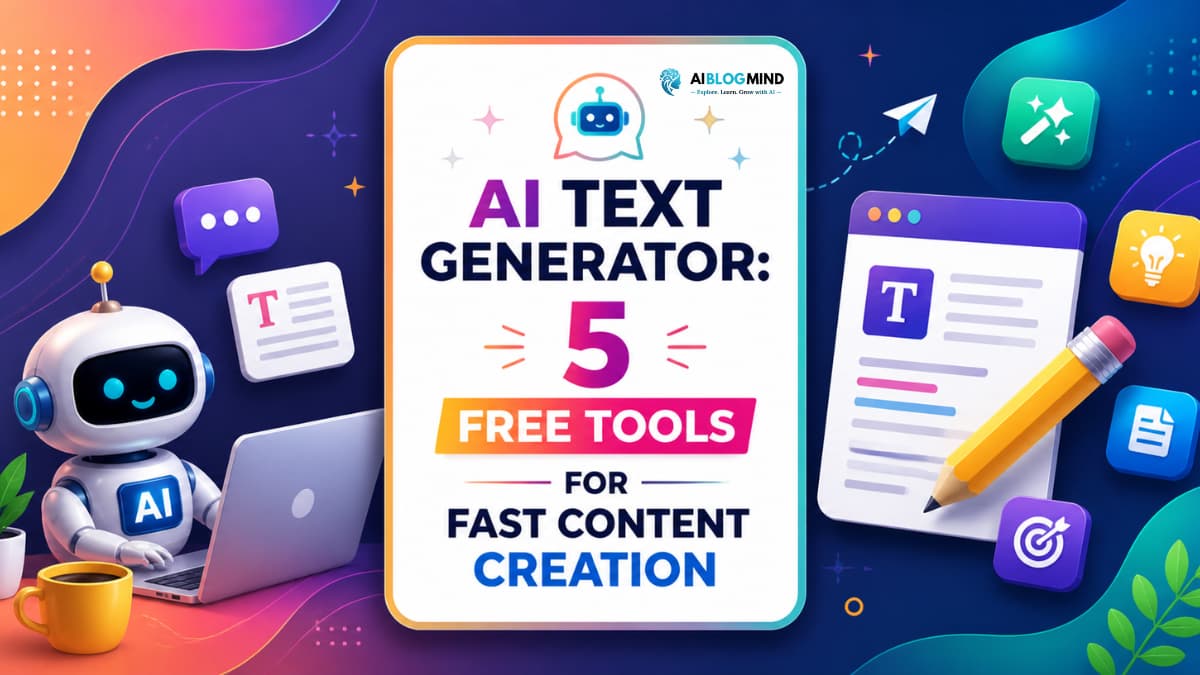
AI Text Generator: 5 Free Tools for Fast Content Creation
The digital content landscape has changed dramatically. Whether you’re a solo blogger, a startup founder, or a seasoned marketing professional, the pressure to produce high-quality content quickly has increased significantly. Enter the AI text generator: a technology that is transforming how we create, optimize, and distribute written content at scale.
Introduction: Why AI Text Generators Matter for Marketers Today
An AI text generator is a software tool powered by large language models (LLMs) that can produce human-like text based on prompts, outlines, or keywords. From blog posts and product descriptions to social media captions and email sequences, an AI text generator can handle many of these tasks in seconds.
But not every AI text generator is built the same way. Some are free. Some are deeply specialized.
In this guide, we break down the 5 best free AI text generators available today, explain how each supports fast content creation, and show you how to use AI writing principles to produce content that ranks, resonates, and earns trust.
What Is an AI Text Generator And Why Does It Matter in 2025?
An AI text generator uses machine learning models trained on vast datasets of human text to predict and produce coherent, contextually relevant content. The best AI text generator tools don’t just string sentences together — they understand tone intent, structure, and even SEO signals.
In 2025, the role of an AI text generator has expanded beyond simple content drafting. Modern AI writing tools are now expected to:
- Produce content that satisfies E-E-A-T (demonstrating first-hand experience, deep subject knowledge, authority, and trustworthiness)
- Be optimized for AEO — structuring answers in a way that satisfies voice search queries and AI-driven answer boxes
- Align with GEO — formatting content so it gets picked up and cited by generative AI systems like ChatGPT, Gemini, and Perplexity
Understanding these three pillars will help you choose and use any AI text generator more effectively.
E-E-A-T, AEO, and GEO: The New Content Quality Trinity
Before diving into the tools, it’s essential to understand the framework that should guide every piece of AI writing you produce.
E-E-A-T: The Foundation of Trustworthy Content
Google’s E-E-A-T (Experience, Expertise, Authoritativeness, Trustworthiness) framework is the quality benchmark by which content is evaluated. An AI text generator can produce high-volume content, but without E-E-A-T signals, that content may struggle to rank.
When using an AI text generator, always layer in:
- Experience: Real-world examples, case studies, and first-hand insights
- Expertise: Accurate data, citations, and subject-matter depth
- Authoritativeness: Author bios, backlinks, and brand credibility signals
- Trustworthiness: Transparent sourcing, factual accuracy, and honest claims
The best AI writing workflow uses an AI text generator to create the structure and draft, then adds human expertise on top to meet E-E-A-T standards.
AEO: Optimizing for Answer Engines
Answer Engine Optimization (AEO) is the practice of structuring content to be directly surfaced as answers in voice assistants, featured snippets, and AI-powered search results. An AI text generator that produces FAQ-style formats, concise definitions, and structured data is inherently AEO-friendly.
When using an AI text generator for AEO, focus on:
- Clear question-answer pairs
- Concise introductory definitions (40–60 words)
- Bullet lists and numbered steps
- Schema markup compatibility
GEO: Optimizing for Generative AI Systems
Generative Engine Optimization (GEO) is an emerging discipline focused on making your content citable by AI systems. As tools like Perplexity, ChatGPT Browse, and Google’s AI Overviews pull from web content, GEO ensures your AI writing gets referenced, not ignored.
GEO best practices when using an AI text generator include:
- Using precise, factual statements that are easy to quote
- Structuring content with clear headings and semantic HTML
- Including statistics, studies, and original data
- Writing in a neutral, informative tone that mirrors how AI systems respond
Now, let’s look at the 5 free AI text generators that best support this framework.
1. ChatGPT (Free Tier) The Most Versatile AI Text Generator
Best for: General content creation, brainstorming, drafts
Free Plan: GPT-3.5 with limited GPT-4o access
AI Writing Strength: Breadth and conversational quality
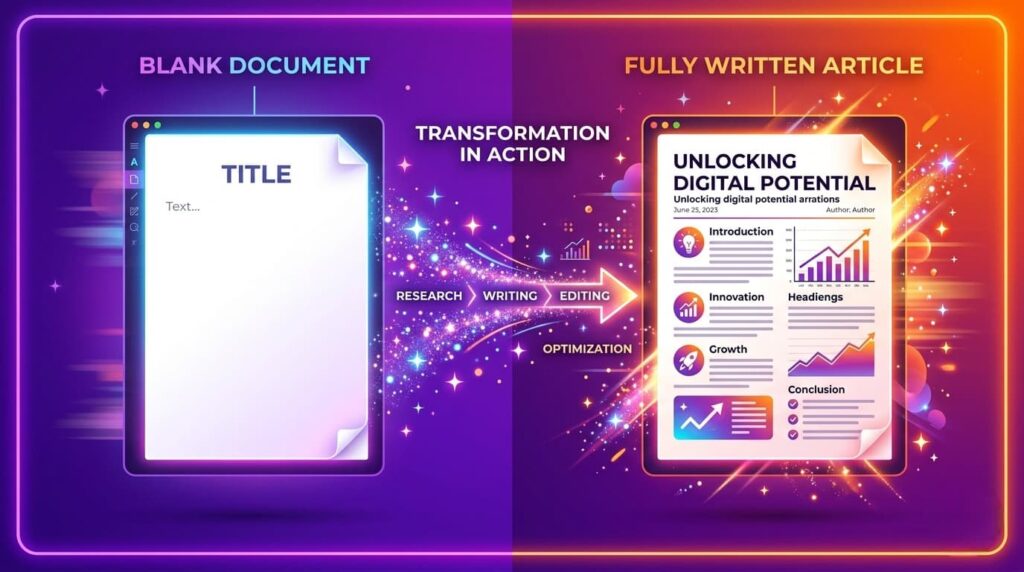
follow us for more
ChatGPT remains the most widely used AI text generator in the world. Its free tier gives users access to GPT-3.5, which is more than capable of producing blog posts, product descriptions, email templates, and social media content.
Why it works for E-E-A-T, AEO, and GEO: ChatGPT’s AI writing output is easy to shape with precise prompting. Ask it to write in an expert tone, cite statistics, or format content as FAQ blocks — and it delivers. For GEO, ChatGPT itself is one of the engines you’re optimizing for, making understanding its output style a strategic advantage.
Best use case: Feed ChatGPT a detailed outline and keyword list, then use the AI text generator to produce a structured first draft. Layer in E-E-A-T elements manually for maximum impact.
Limitations: Free users face usage caps and lack access to the latest model capabilities like web browsing.
2. Google Gemini (Free) The AI Text Generator Built for Search
Best for: SEO-focused content, search-intent alignment
Free Plan: Gemini 1.5 Flash via gemini.google.com
AI Writing Strength: Search integration and factual grounding
Google’s own AI text generator, Gemini, is uniquely positioned for content creators who care about SEO. Since it’s built by the same company that runs Google Search, its AI writing output tends to align naturally with search intent signals.
Why it works for E-E-A-T, AEO, and GEO: Gemini’s responses are grounded in Google Search data, which means the AI text generator can pull in current information and cite sources directly supporting E-E-A-T principles. Its output also tends to follow a structured format well-suited for AEO.
Best use case: Use Gemini as your AI text generator when researching content for YMYL (Your Money, Your Life) topics where E-E-A-T compliance is critical, such as health, finance, or legal content.
Limitations: The free plan has limited advanced reasoning compared to the Gemini Advanced tier.
3. Claude (Free Tier by Anthropic) The Long-Form AI Text Generator
Best for: Long-form articles, nuanced writing, tone consistency
Free Plan: Claude Sonnet access via claude.ai
AI Writing Strength: Nuance, depth, and contextual awareness
Anthropic’s Claude is quickly gaining a reputation as the most nuanced AI text generator for long-form AI writing. Claude excels at maintaining a consistent voice across extended pieces, understanding complex prompts, and producing content that reads naturally not robotically..
Why it works for E-E-A-T, AEO, and GEO: Claude is particularly effective for E-E-A-T because it can be prompted to write with expert-level depth and avoid overconfident claims a key trust signal. For GEO, Claude’s structured, precise output is highly citable by other AI systems.
Best use case: Use Claude as your AI text generator for comprehensive pillar articles, white papers, and thought-leadership content where tone, nuance, and depth matter as much as keyword density.
Limitations: The free tier has daily message limits and no built-in web access.
4. Rytr (Free Plan) The AI Text Generator for Marketers
Best for: Short-form copy, marketing content, templates
Free Plan: 10,000 characters/month
AI Writing Strength: Template variety and use-case specificity
Rytr offers a focused AI text generator experience built around marketing use cases. With dozens of pre-built templates from AIDA frameworks to product descriptions to interview questions Rytr makes AI writing accessible even for non-technical users.
Why it works for E-E-A-T, AEO, and GEO: Rytr’s structured templates naturally produce AEO-friendly content. Its AIDA and PAS (Problem-Agitate-Solution) frameworks create clear, answer-forward structures that AI systems can easily parse and cite, supporting GEO goals.
Best use case: Use Rytr as your AI text generator for landing page copy, email subject lines, social media posts, and product listings where template structure adds speed and consistency.
Limitations: The free plan’s 10,000-character limit is restrictive for long-form AI writing. Upgrading unlocks significantly more output.
5. Writesonic (Free Trial) The AI Text Generator for SEO Articles
Best for: SEO blog posts, SERP-optimized content
Free Plan: Limited free credits monthly
AI Writing Strength: SEO integration and SERP analysis
Writesonic is one of the most SEO-aware AI text generator tools on the market. Its Article Writer feature pulls in real-time data from search results, analyzes top-ranking pages, and uses that insight to inform the AI writing output.
Why it works for E-E-A-T, AEO, and GEO: Writesonic explicitly supports E-E-A-T by helping users structure content around authoritative sources and statistics. Its AI text generator also produces schema-friendly output that aligns with AEO requirements. For GEO, the real-time data integration ensures content reflects current information a major credibility signal for AI systems.
Best use case: Use Writesonic as your AI text generator when you need a blog post that is immediately competitive in search one that references current data, mirrors top-ranking structures, and satisfies both human readers and AI answer engines.
Limitations: Free credits run out quickly, making it better suited as a trial or supplementary tool rather than a primary AI text generator.

How to Use an AI Text Generator Responsibly: A Best-Practice Workflow
Using an AI text generator responsibly means understanding its role in your content process as a collaborator, not a replacement for human insight. Here’s a workflow that ensures your AI writing meets E-E-A-T, AEO, and GEO standards:
Step 1 — Define Your Intent
Before prompting any AI text generator, know your audience, primary keyword, and search intent. An AI text generator performs best when given clear, specific instructions.
Step 2 — Generate and Structure
Use your chosen AI text generator to create an outline and first draft. Focus on structure: clear H2s and H3s, bullet points for AEO, and concise intro paragraphs for featured snippet eligibility.
Step 3 — Add Human Expertise
This is where E-E-A-T happens. Layer in personal experience, original data, expert quotes, or case studies. No AI text generator can replicate genuine first-hand knowledge that is your unique value-add.
Step 4 — Optimize for GEO
Review your content through a GEO lens. Are your factual claims precise and citable? Do your headings mirror the questions people ask AI tools? Is your content structured so a generative engine could quote it confidently?
Step 5 — Edit, Fact-Check, and Publish
Every piece of AI writing needs a human editorial pass. Verify facts, check for tone consistency, and ensure the content genuinely serves the reader not just the algorithm.
Choosing the Right AI Text Generator for Your Needs
| Tool | Best For | Free Limit | E-E-A-T Fit | AEO Fit | GEO Fit |
| ChatGPT | General drafts | Daily cap | Medium | High | High |
| Gemini | SEO + facts | Unlimited | High | High | High |
| Claude | Long-form nuance | Daily cap | High | Medium | High |
| Rytr | Marketing copy | 10K chars/mo | Low | Medium | Medium |
| Writesonic | SEO articles | Limited credits | High | High | High |
No single AI text generator wins in every category. The smartest AI writing workflows use multiple tools leveraging each one’s strengths at different stages of the content process.
Choosing the best and easiest AI text generator isn’t about picking the most powerful tool it’s about finding the one that matches your workflow, skill level, and content goals. Tools like ChatGPT, Google Gemini, and Claude are known for their advanced capabilities, but they can feel overwhelming if you’re just starting out. On the other hand, platforms like Rytr and Writesonic are designed with simplicity in mind, offering templates and guided workflows. The key is to decide whether you need flexibility or structure. If you want full creative control and conversational interaction, go for a tool like ChatGPT or Claude. If you prefer a plug-and-play experience, Rytr or Writesonic might be a better fit.
Ease of use should be your top priority, especially if your goal is fast content creation. A good AI tool should have a clean interface, minimal learning curve, and ready-to-use templates. For example, Writesonic and Rytr provide pre-built formats for blog posts, ads, and social media captions, which can save you significant time. Meanwhile, Gemini integrates well with other Google services, making it convenient if you already use Google Workspace. Claude is often praised for its natural writing style and clarity, which makes it ideal for long-form content. ChatGPT stands out as a balanced option it’s beginner-friendly yet powerful enough for advanced users, making it a strong all-rounder.
Another important factor is output quality and customization. Some tools generate quick drafts but may require heavy editing, while others produce more polished content from the start. Claude and ChatGPT are generally better for high-quality, human-like writing, especially for blogs and detailed articles. Gemini excels in research-backed responses and factual content, while Rytr and Writesonic are optimized for speed and marketing-focused outputs. If your priority is SEO-friendly content or copywriting, Writesonic can be particularly useful. But if you want deeper control over tone, structure, and creativity, ChatGPT or Claude will give you more flexibility.
Ultimately, the “best” AI tool depends on how you plan to use it. If you’re a beginner looking for something simple and fast, start with Rytr or Writesonic. If you want a mix of ease and power, ChatGPT is a safe choice. For more refined, thoughtful writing, Claude is a strong contender, while Gemini is ideal for those already embedded in the Google ecosystem. Instead of chasing the most popular tool, focus on what helps you create content faster and more comfortably. The right tool is the one that reduces your effort, improves your consistency, and fits naturally into your content creation routine.
Final Thoughts: The Future of the AI Text Generator
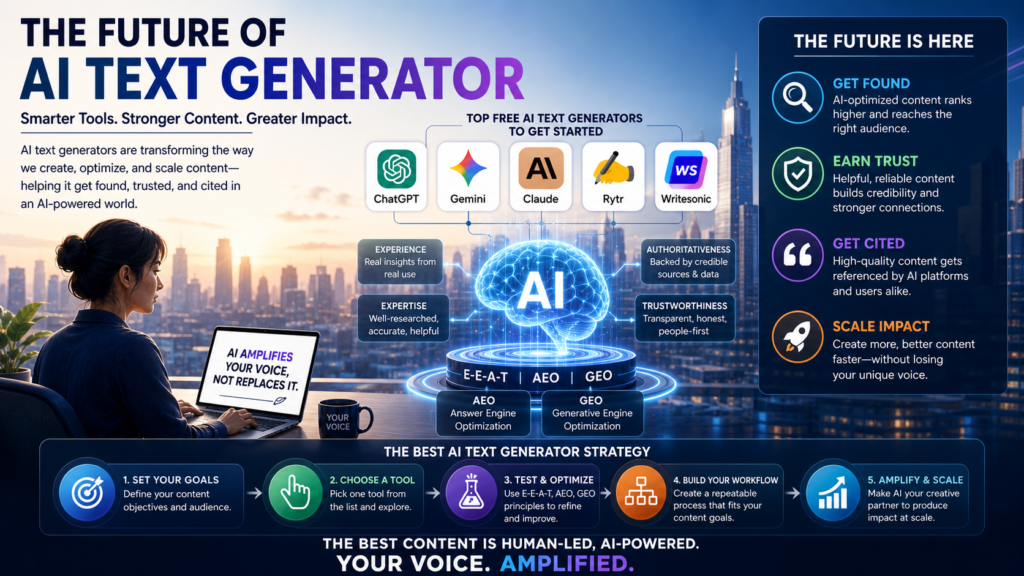
follow us for more
The AI text generator is no longer a novelty it’s a necessity. As content volume demands rise and search engines evolve to prioritize trustworthy, expert, and verifiably accurate content, the gap between those who use an AI text generator strategically and those who use it carelessly will only widen.
The tools featured here ChatGPT, Gemini, Claude, Rytr, and Writesonic represent the best free entry points into the world of AI writing. Each one, when used with E-E-A-T, AEO, and GEO principles in mind, can help you produce content that doesn’t just get published it gets found, trusted, and cited.
The best AI text generator strategy isn’t about replacing your voice. It’s about amplifying it faster, smarter, and at scale. Start with one tool from this list today, test it against your content goals, and build a workflow that makes the AI text generator your most productive creative partner.
To take this a step further, the future of AI writing will increasingly revolve around integration and personalization. Tools like ChatGPT, Google Gemini, and Claude are already evolving beyond simple text generation into full creative ecosystems helping with research, editing, summarization, and even content strategy. As these platforms continue to improve, the real advantage will lie in how well you can connect them with your existing workflow, whether that’s blogging, marketing, or social media management.
Another key shift will be the growing importance of human oversight. While AI can generate content quickly, it still depends on your direction, judgment, and expertise to ensure accuracy and originality. Search engines are becoming smarter at identifying shallow or repetitive content, which means simply generating large volumes of AI text won’t be enough. Instead, creators who fact-check, refine, and add unique insights will stand out. This is where tools like Rytr and Writesonic can support efficiency, but your input will define the final quality.
Looking ahead, AI text generators will also become more context-aware and audience-focused. They will better understand tone, intent, and user behavior, allowing you to create highly targeted content that resonates with specific audiences. This means your role will shift from “writer” to “content strategist,” where you guide the AI with clear goals, audience insights, and brand voice. The better your prompts and direction, the better your results will be.
Ultimately, success with AI content creation will come down to balance. Rely too much on automation, and your content risks becoming generic. Ignore AI altogether, and you may fall behind in speed and scalability. The winning approach is to combine AI efficiency with human creativity and strategic thinking. As the landscape continues to evolve, those who adapt early and use these tools thoughtfully will not only keep up they’ll lead.
Frequently Asked Questions (FAQs)
1. What is an AI text generator?
An AI text generator is a tool that uses machine learning to create written content automatically. Platforms like ChatGPT and Google Gemini can generate blogs, emails, and social media posts in seconds.
2. Are there truly free AI text generators available?
Yes, many tools offer free access with limitations. For example, Claude provides a free tier, while Rytr offers a free plan with monthly usage limits.
3. Which free AI tool is best for beginners?
Beginners often find ChatGPT and Rytr easy to use due to their simple interfaces and ready-made templates.
4. Can free AI writing tools create long-form content?
Yes, but with some restrictions. Tools like Writesonic allow long-form content generation, though free plans may limit word count or features.
5. Is content generated by AI tools unique?
Most AI tools aim to produce original content. However, it’s always recommended to review and edit the output to ensure uniqueness and accuracy.
Read more informative blogs about such amazing tools here

Hi, I’m Rufqha, the SEO Manager at AIBlogMind. I focus on building content strategies that help websites improve visibility, attract the right audience, and create sustainable organic growth. My expertise includes on-page SEO, keyword research, content optimization, and aligning SEO with user experience and business goals.