

What Are the Best SEO Tools to Boost Your Rankings?
Search engine optimization has changed more in the last two years than in the previous decade combined. Rankings no longer depend only on keywords and backlinks they depend on how well a brand demonstrates real experience, genuine expertise, credible authority, and consistent trustworthiness across every page it publishes. On top of that, search itself has split into three different battlegrounds: traditional blue-link results, AI-generated answer boxes that respond directly to a user’s question, and generative chat assistants that summarize the web and cite sources instead of sending clicks. If you want to compete in all three arenas at once, you need the best SEO tools working together, not a single dashboard that only tracks rankings.
This guide walks through the best SEO tools available today, why they matter more than ever, and how to use them to build a website that search engines, and increasingly, AI systems trust enough to recommend. Whether you’re comparing paid platforms or hunting for reliable free options, understanding what separates the best SEO tools from the rest will save you time and budget. Along the way, we’ll cover free options, paid platforms, backlink analysis, and a full features breakdown so you can decide which tools deserve a spot in your workflow.
Why the Best SEO Tools Matter More Than Ever
A decade ago, SEO success was mostly a numbers game: more keywords, more backlinks, more pages. Today, search engines evaluate a much richer signal set. They look at whether the person or organization behind the content has actually done the thing they’re writing about, whether they have credentials or hands-on knowledge, whether other reputable sites vouch for them, and whether users can rely on the information without getting misled. This shift means the best SEO tools now need to help you prove credibility, not just chase rankings.
At the same time, a growing share of searches never produce a traditional list of blue links at all. Instead, users get a direct, conversational answer pulled from a handful of sources. Ranking well in this format means structuring your content so a machine can lift out a clear, self-contained answer, short paragraphs, direct definitions, well-organized lists, and clear headings that map to real questions people ask. The best SEO tools that survive this shift are the ones that help you audit your content for exactly this kind of clarity.
There’s a second, newer layer too: AI chat assistants and generative answer engines are now summarizing entire topics and citing a small set of sources as they do it. Getting cited in these AI-generated summaries requires a different kind of visibility, one built on being mentioned across multiple credible sites, having consistent facts about your brand repeated in places the AI trusts, and publishing content that reads as authoritative even when a human never clicks through to your page. The best SEO tools are starting to build features specifically for this kind of visibility, tracking not just where you rank in search results but whether you’re being referenced inside AI-generated answers at all.
The Best SEO Tools to Boost Your Rankings in 2026
Below is a rundown of the best SEO tools worth using this year, spanning all-in-one platforms, free utilities, and specialized backlink checkers.
1. Semrush
Semrush remains one of the best SEO tools for competitive research, keyword tracking, and site audits. Its Semrush backlink checker is one of the most widely used tools in the industry, letting you see referring domains, anchor text distribution, toxic link scores, and historical link growth for any domain — including your competitors’. Because backlinks remain one of the strongest trust signals search engines use, having a reliable Semrush backlink checker in your toolkit is close to non-negotiable if you’re serious about link building.
Beyond backlinks, Semrush offers keyword research, position tracking, technical SEO audits, content optimization scoring, and PPC competitive intelligence. It’s a paid platform, but the depth of data makes it one of the best SEO tools for agencies and in-house teams managing multiple sites.
2. Ahrefs
Ahrefs is often mentioned in the same breath as Semrush, and for good reason. Its link index is enormous, and its Site Explorer gives detailed insight into referring domains, top pages, and organic traffic estimates. Many SEOs run Ahrefs alongside a Semrush backlink checker to cross-verify link data, since no single index captures every backlink on the web. Ahrefs also has strong content gap analysis features, helping you find topics competitors rank for that you don’t.
3. Google Search Console
Google Search Console is free, official, and arguably the single most important tool on this list because the data comes directly from Google itself. It shows impressions, clicks, average position, and indexing issues for your actual site not estimates. Among free SEO optimization tools, this is the one every website owner should set up before anything else. It also flags mobile usability issues, security problems, and manual actions that could be hurting your rankings.
4. Google Analytics
Rankings mean little if they don’t translate into engaged visitors. GA4 tracks user behavior after the click: bounce rate, session duration, conversion paths, and traffic sources. Pairing GA4 with Search Console gives you a fuller picture of whether your best SEO tools strategy is actually driving business results, not just vanity ranking positions.
5. Ubersuggest
Ubersuggest is one of the more accessible seo tools free options for beginners and small businesses. It offers keyword suggestions, basic backlink data, content ideas, and site audit reports. While its data isn’t as deep as Semrush or Ahrefs, it’s a solid entry point if you’re not ready to invest in a paid subscription yet, and it consistently ranks among the more popular seo tools free options for new site owners.
6. Screaming Frog SEO Spider
Screaming Frog crawls your website the way a search engine bot would, surfacing broken links, duplicate title tags, missing meta descriptions, redirect chains, and thin content pages. The free version covers up to 500 URLs, making it one of the most practical free seo optimization tools for small to mid-sized sites that need a technical audit without a monthly fee.
7. Yoast SEO / Rank Math
For WordPress users, Yoast SEO and Rank Math are plugins that guide on-page optimization in real time checking keyword placement, readability, meta tag length, and internal linking as you write. Both have generous free tiers, making them staples among seo tools free for content creators who publish regularly.
8. AnswerThePublic
AnswerThePublic visualizes the actual questions people type into search engines around a topic. This is especially valuable for structuring content that can be pulled directly into short, conversational answer boxes, since it shows you the exact phrasing real users search for.
9. Surfer SEO
Surfer SEO analyzes top-ranking pages for a target keyword and gives you a content structure word count, heading count, keyword density to match or beat them. It’s particularly useful for teams trying to systematize content briefs across many writers.
10. Moz Pro
Moz Pro rounds out the list of the best SEO tools with its Domain Authority metric, keyword explorer, and on-page grader. While Domain Authority isn’t an official Google ranking factor, it’s widely used as a shorthand for a site’s overall link profile strength.
Benefits of Using the Best SEO Tools
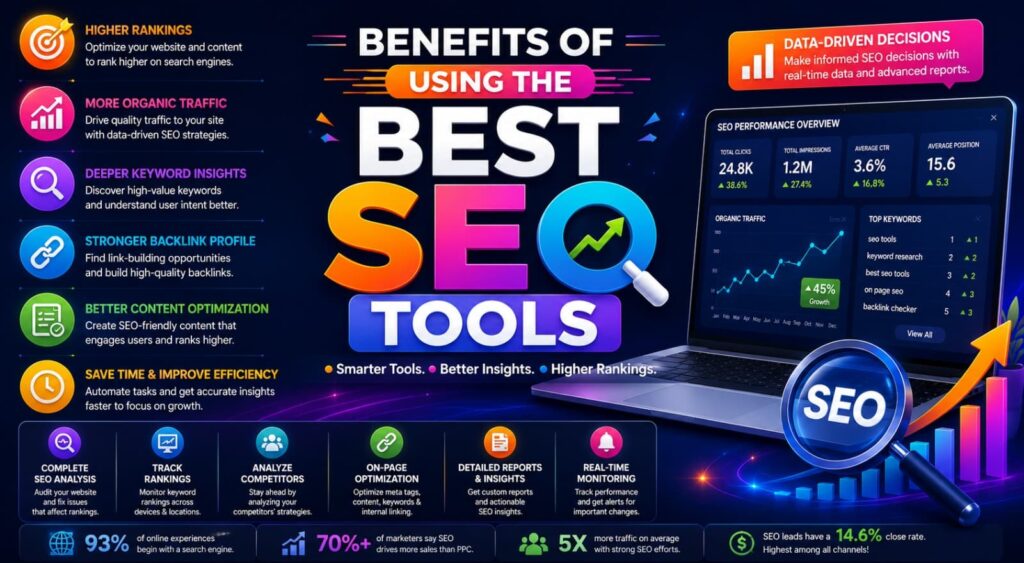
- Faster, data-backed decisions. Instead of guessing which keywords to target, the best SEO tools show you real search volume, difficulty, and competitor rankings so you can prioritize effort where it will pay off.
- Stronger backlink strategy. A dedicated Semrush backlink checker or similar tool reveals which sites already link to you, which links are toxic, and which competitor backlinks you could realistically earn yourself.
- Technical issue detection. Crawlers like Screaming Frog catch broken links, duplicate content, and indexing problems before they quietly erode rankings.
- Content that answers real questions. Tools like AnswerThePublic and Surfer SEO help you structure pages around the exact language searchers use, improving your odds of being pulled into direct-answer results.
- Budget flexibility. Between free SEO optimization tools like Google Search Console and Screaming Frog, and paid platforms like Semrush, there’s an entry point for every budget size.
- Competitive visibility. You can see exactly what’s working for competitors, their top pages, their backlink sources, their keyword gaps and adapt your strategy accordingly.
- Long-term trust building. Consistent use of the best SEO tools helps you catch inconsistent business information, thin content, and weak authorship signals, all things that undermine how credible your site appears to both users and search engines.
Follow Us on LinkedIn
Limitations of the Best SEO Tools
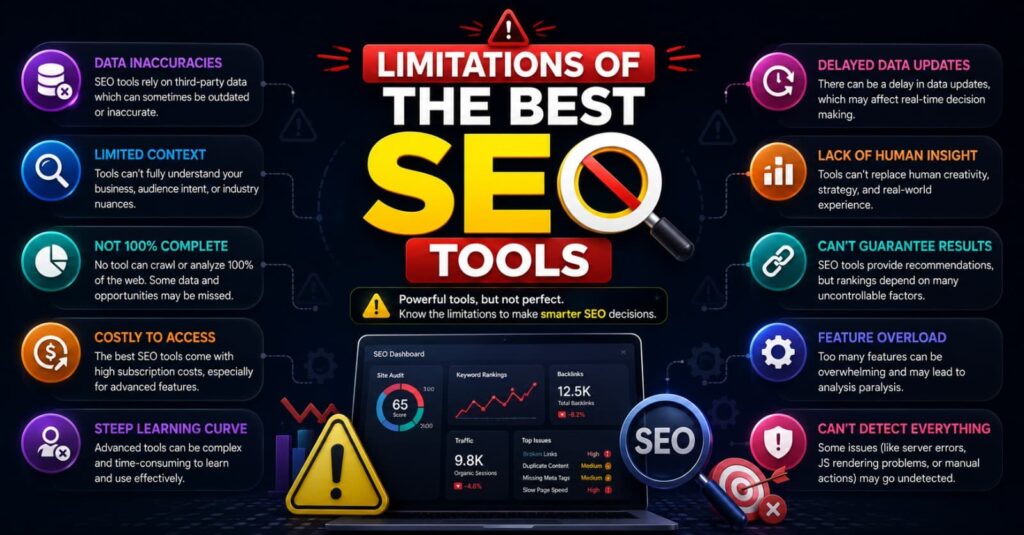
- Data isn’t always exact. Traffic and keyword volume figures from third-party tools are estimates, not confirmed numbers, since only search engines have the real data.
- Learning curve. Platforms like Semrush and Ahrefs are powerful but dense, with dashboards that can overwhelm beginners.
- Cost adds up. Running several paid subscriptions at once a keyword tool, a backlink checker, a content optimizer can get expensive quickly for small businesses.
- No tool can replace judgment. Even the best SEO tools can’t tell you whether content is genuinely useful, accurate, or written by someone with real expertise; that still requires human review.
- Backlink indexes differ. No single Semrush backlink checker or competing tool captures 100% of the links pointing at a domain, so cross-checking multiple sources is often necessary.
- Free tiers are limited. Most free SEO optimization tools cap the number of URLs, keywords, or reports you can pull per month, which can slow down larger projects.
- Rapid algorithm changes. Search engines update ranking systems frequently, and tool recommendations or scores can lag behind the latest changes.
A Detailed Features Study of the Best SEO Tools
| Tool | Core Focus | Backlink Data | Free Tier | Best For |
| Semrush | All-in-one SEO suite | Full-featured Semrush backlink checker with toxic score, anchor text, referring domains | Limited trial | Agencies, competitive research |
| Ahrefs | Link analysis & content gaps | Large independent link index | Very limited | Backlink-heavy strategies |
| Google Search Console | First-party performance data | None (indexing only) | Fully free | Every website owner |
| Google Analytics 4 | On-site behavior tracking | None | Fully free | Conversion tracking |
| Ubersuggest | Beginner keyword research | Basic | Generous free tier | Small businesses, beginners |
| Screaming Frog | Technical site crawling | None | Free up to 500 URLs | Technical audits |
| Yoast / Rank Math | On-page content guidance | None | Generous free tier | WordPress content creators |
| AnswerThePublic | Question & intent discovery | None | Limited free searches | Content ideation |
| Surfer SEO | Content structure optimization | None | Trial only | Content briefs at scale |
| Moz Pro | Domain authority & keyword explorer | Moderate | Limited free tools | Authority tracking |
When you line these tools up side by side, a pattern emerges: no single platform covers everything. The best SEO tools strategy usually combines a first-party analytics source (Search Console and GA4), a competitive research platform (Semrush or Ahrefs), a technical crawler (Screaming Frog), and a content-structuring tool (Surfer SEO or AnswerThePublic). Layering these together gives you visibility into rankings, technical health, backlink quality, and content clarity all at once which is exactly what modern search systems, and the AI models increasingly summarizing search results, reward.
How to Choose the Right Mix of SEO Tools
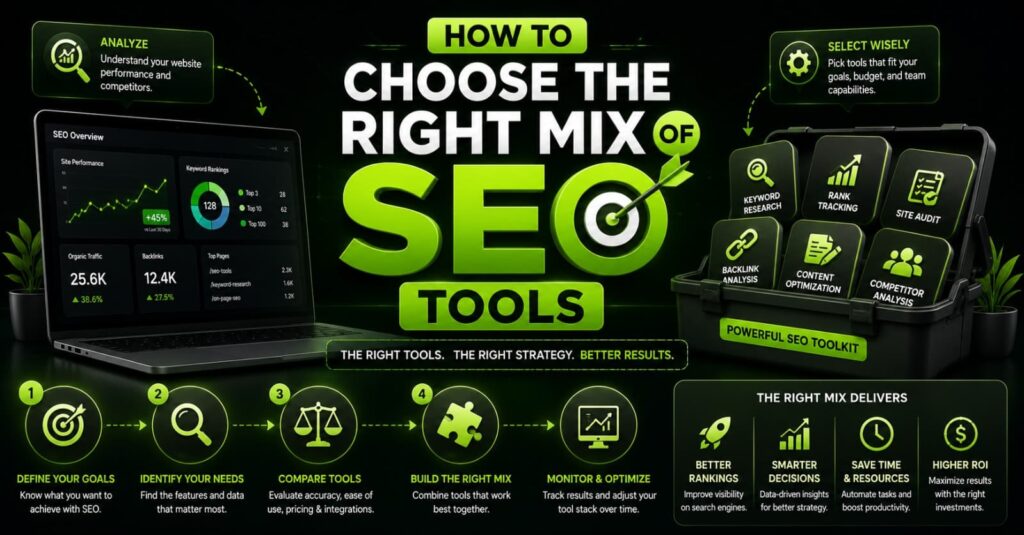
Choosing among the best SEO tools depends on three things: your budget, your site’s size, and your primary goal. If budget is your main constraint, searching for seo tools free is a reasonable first move, since several of the best SEO tools on this list have no-cost tiers that cover most beginner needs.
If you’re a solo blogger or small business just getting started, lean on free SEO optimization tools first, Google Search Console, Google Analytics 4, Screaming Frog’s free crawl limit, and a WordPress plugin like Yoast or Rank Math. These cover the fundamentals: indexing health, on-page structure, and basic performance tracking, without any monthly cost.
If you’re running a growing content operation or managing SEO for multiple clients, it becomes worth investing in a platform like Semrush. A reliable Semrush backlink checker alone can justify the subscription cost by revealing link-building opportunities and toxic links that would otherwise go unnoticed. Pair it with Surfer SEO or a similar content optimizer once you’re publishing at volume and need consistent content briefs across writers.
Larger enterprises with complex sites often need the full stack of the best SEO tools on the market: Ahrefs or Semrush for competitive intelligence, Screaming Frog (or its paid tier) for large-scale technical crawls, and a rank tracking tool that monitors positions daily across many markets and devices.
Whatever combination you land on, remember that tools surface data they don’t create trust on their own. The sites that perform best over time are the ones that pair the best SEO tools with genuinely well-researched content, clear authorship, transparent sourcing, and consistent business information repeated accurately across the web. That combination is what earns both a spot in traditional rankings and a mention when an AI-driven answer summarizes a topic for a user who never even clicks through.
Bringing It All Together
The best SEO tools available today do far more than track keyword positions. They help you build a site that’s technically sound, backed by credible links, structured around real user questions, and consistent enough in its facts and authorship to be trusted by both search engines and the AI systems now summarizing the web. A strong toolkit typically blends free SEO optimization tools for the fundamentals with paid platforms like Semrush for deeper competitive and backlink intelligence.
There’s no single “best” tool for every situation; the best SEO tools are the ones that match your budget, your site’s size, and the specific gaps in your current strategy. Start with the free layer, add a dedicated Semrush backlink checker or equivalent once link building becomes a priority, and round things out with a technical crawler and a content structuring tool as your site scales. Used together, these tools give you the clearest possible picture of where you stand and what it will take to move up.
Frequently Asked Questions
1. What are the best SEO tools for beginners?
For beginners, the best SEO tools are usually free ones: Google Search Console and Google Analytics 4 for performance data, Screaming Frog for a basic technical audit, and Yoast or Rank Math if you’re on WordPress. These cover the essentials without any cost, and they’re a natural starting point before investing in a paid platform.
2. Is Semrush worth it compared to free SEO optimization tools?
Semrush offers far deeper data than most free SEO optimization tools, especially through its Semrush backlink checker, keyword gap analysis, and competitor tracking. It’s worth the investment once you’re managing multiple sites or clients and need data that free tools simply don’t provide at the same depth.
3. What is the most accurate Semrush backlink checker alternative?
Ahrefs is generally considered the closest alternative to a Semrush backlink checker, since both maintain large, independently crawled link indexes. Many SEOs use both together, since no single backlink index captures every link on the web.
4. Can I do effective SEO using only free SEO optimization tools?
Yes, especially for smaller sites. A combination of Google Search Console, Google Analytics 4, Screaming Frog’s free crawl, and Ubersuggest can cover keyword research, technical audits, and performance tracking without a paid subscription. As your site grows, though, paid tools become more valuable for competitive and backlink insights.
5. How often should I use SEO tools to check my rankings and backlinks?
Most SEOs check rank tracking weekly and run a full backlink and technical audit monthly, using tools like a Semrush backlink checker and Screaming Frog. Frequent small checks help you catch issues early, while a deeper monthly review ensures your overall best SEO tools strategy is still aligned with your goals.
Know more About Us

Hi, I’m Rufqha, the SEO Manager at AIBlogMind. I focus on building content strategies that help websites improve visibility, attract the right audience, and create sustainable organic growth. My expertise includes on-page SEO, keyword research, content optimization, and aligning SEO with user experience and business goals.