



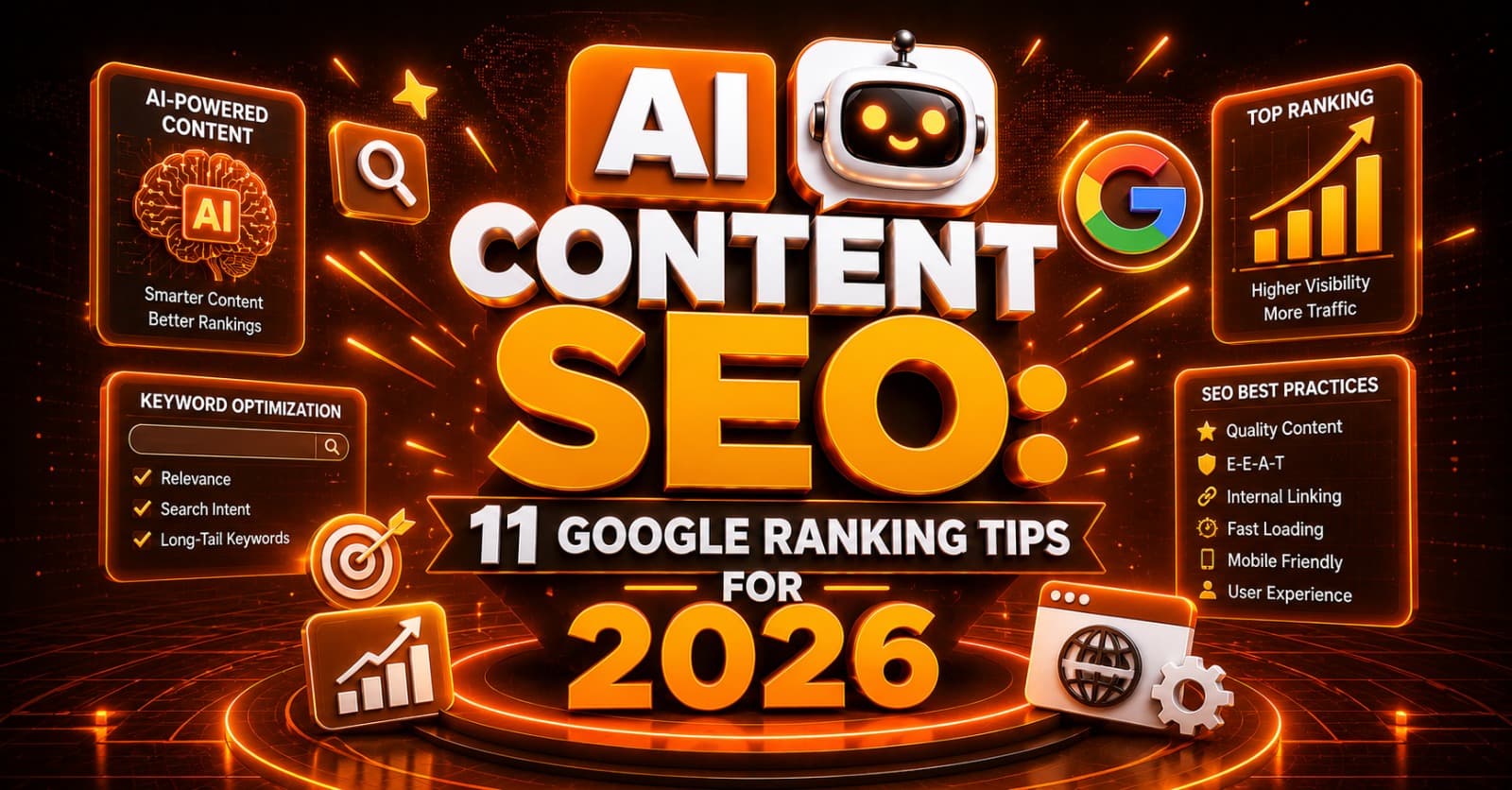
AI Content SEO: 11 Google Ranking Tips for 2026
You spent hours writing that AI-assisted blog post. You published it. Crickets.
No traffic. No rankings. Maybe a trickle from your social share, and then nothing.
This is the reality for most people using AI to create content right now. The problem is not the AI itself. The problem is that most people treat content SEO as an afterthought they generate the article, paste it in, hit publish, and hope Google figures it out.
Google will not figure it out. Not in 2026.
The algorithm is smarter, faster, and more skeptical of generic content than it has ever been. But here is what most guides won’t tell you: AI-generated content can rank. Very well, actually. The difference between AI content that climbs to page one and the stuff that sits in content purgatory comes down to how you handle content SEO from the very beginning — before, during, and after you write.
This article gives you 11 practical, tested tips for content SEO in 2026. Each one is built around what Google actually rewards: experience, expertise, authority, and trust. If you work on AI SEO or rely on AI generated content SEO to build your brand, these tips will change how you think about publishing.
What Is Content SEO in 2026?
Content SEO is the practice of creating, structuring, and optimizing written content so that search engines can understand it, trust it, and show it to the right people.
That definition has not changed much. What has changed is how Google evaluates content SEO signals. In 2026, the algorithm rewards specificity, first-hand value, and topical depth. It penalizes thin coverage, keyword stuffing, and anything that reads like it was assembled from fragments of other articles — which, unfortunately, describes most AI output without proper human editing.
This is why SEO for AI content is its own discipline now. You cannot treat AI articles the same way you would treat a manually written piece. The optimization layer has to be intentional and thorough.

Benefits of Using AI for Content SEO
Before the tips, it is worth being honest about what AI actually does well here.
AI tools can produce a solid structural draft fast. If you are doing content SEO at scale — targeting dozens of long-tail keywords, building out topical clusters, filling gaps in your content strategy — AI cuts the time it takes to go from outline to draft. That part is genuinely useful.
AI SEO tools also help with keyword research, content gap analysis, and competitor comparisons. Tools like Surfer SEO, Frase, and Clearscope can analyze top-ranking pages and tell you exactly what topics, questions, and entities your content needs to cover. That used to take hours of manual research. Now it takes minutes.
For AI generated content SEO specifically, the speed advantage means you can test more angles, iterate faster, and cover your niche more completely than most human-only teams can.
For more AI tools, Checkout our AI based Articles
Limitations You Need to Know
AI tools have a reliability problem that directly affects content SEO performance.
They hallucinate facts. They repeat common knowledge instead of adding new insight. They write in a way that sounds confident but lacks the kind of specific, experience-based detail that Google’s Quality Raters are trained to notice. When you rank AI articles without adding human expertise, you are publishing content that is technically competent but experientially empty.
Google’s EEAT guidelines specifically look for first-hand experience. “I tested this” outperforms “according to studies” almost every time in competitive niches. That kind of content cannot come from an AI alone.
The other limitation is that AI content often lacks a clear topical focus. It tries to cover everything broadly rather than going deep on one thing. For content SEO, depth wins. Shallow coverage, even at length, rarely ranks for anything competitive.
11 Google Ranking Tips for Content SEO in 2026
Tip 1: Start with Topical Authority, Not Just a Keyword
Most people do content SEO backwards. They pick a keyword, write one article, and move on.
Google has shifted to evaluating topical authority — how well your site covers an entire subject area, not just one query. To rank AI articles in 2026, you need a content cluster strategy. One pillar page supported by multiple related subtopics. Internal links connecting them. Consistent entity mentions across the cluster.
Before you write anything, map out the topic. What are the main subtopics? What questions do readers have at each stage? Your content SEO will improve across the entire cluster when Google can see that your site genuinely covers the subject.
Tip 2: Add Genuine First-Hand Perspective
This is the most important tip in this entire guide for SEO for AI content.
An AI can summarize information. It cannot test a tool, share a failure, or give an opinion rooted in actual use. When you add your own experience to an AI draft — even a paragraph or two — you change the EEAT profile of the content entirely.
A line like “I ran this on a 3,000-word article and the results were worse than I expected” is worth more for content SEO than three paragraphs of neutral explanation. Be specific. Be honest. Include the failures, not just the wins.
Tip 3: Answer the Core Question in the First 200 Words
AEO (Answer Engine Optimization) is now critical for content SEO because Google features direct answers in its search results. If your article does not clearly answer the main question early, you are leaving featured snippet opportunities on the table.
Write a clear, direct answer in the first paragraph or two. Not a buildup to an answer — the actual answer. Save the depth and context for what follows.
For AI SEO content especially, this matters because AI tends to pad introductions. Cut it. Get to the point.
Tip 4: Structure for Generative AI, Not Just Traditional Search
GEO (Generative Engine Optimization) has become a real part of content SEO strategy in 2026. AI-powered search features — Google’s AI Overviews, ChatGPT search, Perplexity — pull structured, clearly written content to include in generated answers.
To get cited in these contexts, your content needs clear headings, concise paragraphs, and direct statements. No meandering. No three-sentence windup to a simple point. Think about how a question would be answered in a sentence, write that sentence, then expand.
AI generated content SEO that is already structured well for human readers tends to perform better in AI-powered search features too.
Tip 5: Use Semantic Keywords, Not Just Exact Match
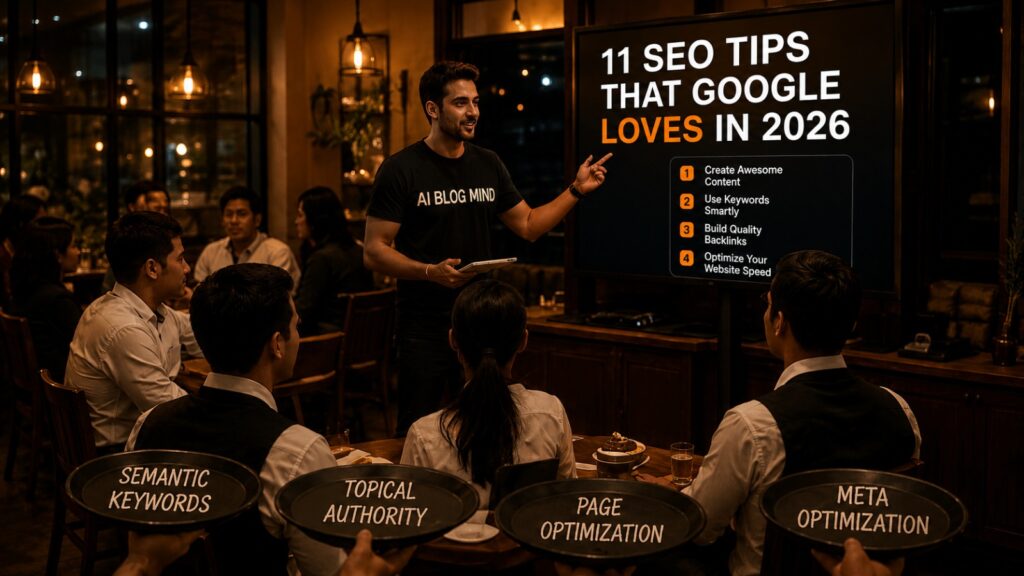
Repeating your primary keyword over and over does not help your content SEO in 2026. Google uses semantic understanding to identify what a page is about, which means related terms, entities, and concepts matter as much as the exact keyword.
When you are optimizing AI content, add terms that belong in the topic space. For a piece on AI SEO, that means terms like natural language processing, search intent, crawl budget, schema markup, and E-E-A-T. These signal that your content is genuinely covering the subject, not just keyword-stuffed to hit a count.
Tip 6: Fix AI’s Structural Weaknesses Before Publishing
AI drafts tend to have the same structural problems. Long introductions. Repeated points dressed up with different words. Weak transitions. Conclusions that summarize without adding anything new.
Good content SEO requires you to edit these out. Cut anything that a reader would skip. Make every heading genuinely useful — not “Introduction to X” but “How X Works When Y Happens.” Use subheadings that address real questions.
The editing step is where you close the gap between an average AI draft and content that can actually rank AI articles competitively.
Tip 7: Build Internal Links With Intent
Internal linking is one of the most underused content SEO tactics. Most people add a few links and move on. The sites that rank well use internal links to tell Google which pages are most important, how topics connect, and where to direct crawl attention.
When you publish AI content, always link it into your existing content structure. Link from your highest-authority pages when it makes sense. Link from the new piece to your pillar pages and related subtopics. Use descriptive anchor text — not “click here,” but the actual topic the linked page covers.
For AI SEO workflows running at scale, build a linking standard so your team applies it consistently.
Tip 8: Optimize Meta Titles and Descriptions by Hand
AI-generated meta titles are usually either too generic or too long. They miss the actual intent behind the search.
Write these yourself. Your title should include the primary keyword, signal the content’s unique value, and stay under 60 characters. Your meta description should expand on the title with a clear reason to click. It is not directly a ranking factor, but a strong description improves click-through rate, which does affect your content SEO performance over time.
Tip 9: Improve Page Experience Signals
Content SEO does not end at the words on the page. Google measures how people interact with your content. Do they stay and read? Do they bounce immediately? Do they scroll past the fold?
These behavioral signals feed back into rankings. A page that people leave in five seconds tells Google the content did not satisfy the query, even if it was technically well-optimized. AI generated content SEO often fails here because the content is too generic — it does not give readers a reason to stay.
Add things that create engagement: specific examples, data points, genuinely useful explanations, and formatting that makes the content easy to scan. Break up walls of text. Use short paragraphs.
Tip 10: Update AI Content Regularly
One pattern you see with AI SEO content is that it gets published and forgotten. The articles sit there, getting stale, while competitors publish fresher, more detailed versions.
Google notices freshness. For competitive content SEO topics, a page that was last updated 18 months ago is at a disadvantage against pages that have been revised and improved over time. Set a schedule to review and update your top AI-generated content. Add new data. Revise outdated recommendations. Expand sections that are too thin.
The article that gets maintained consistently tends to rank better than the one that was slightly better at launch but has been ignored ever since.
Tip 11: Build Authority Off the Page Too
Content SEO is not just on-page work. Off-page signals — backlinks, brand mentions, social engagement — still drive a significant portion of ranking performance.
When you rank AI articles, the content itself earns you traffic. But to sustain that traffic and climb further, you need other sites to cite you, link to you, and treat your content as a reference. This means creating content worth linking to: original data, unique perspectives, comprehensive guides.
AI tools can help you draft the content. The authority has to be earned.
Top AI Tools for Content SEO in 2026
These tools are worth knowing if you are serious about AI SEO at scale.
Surfer SEO is strong for on-page content SEO analysis. It shows you what top-ranking pages are doing in terms of word count, keyword usage, and structure, and gives you a real-time score as you write or edit.
Frase is better for the research side — building content briefs, analyzing SERPs, and identifying the questions your content needs to answer.
Jasper and Claude (Anthropic) are both solid for draft generation, with Claude performing better on longer, structured pieces that need factual accuracy.
Clearscope handles semantic keyword analysis well. If you want to ensure your AI generated content SEO covers the right topic signals, it is worth the cost.
MarketMuse is useful for topical authority planning — showing you where your content cluster has gaps and what to build next.
None of these tools replace the human editing and expertise layer. They make the production process faster and more informed. The quality still depends on what you bring to the content after the AI finishes its part.
Comparison: AI-Assisted vs. Fully Manual Content SEO
Fully manual content takes longer but tends to have stronger EEAT signals out of the gate. The writer’s experience and voice come through naturally. The weakness is scale — one good writer can only produce so much.
AI-assisted content SEO is faster and easier to scale. The weakness is quality control. Without a human editing layer, AI content tends to be generic, slightly off-topic, and thin on the kind of specific detail that earns rankings and trust.
In practice, the best content SEO strategies in 2026 combine both. AI handles structure and first draft. A human with real expertise handles editing, adding first-hand insight, and final review. The output is faster than fully manual and more trustworthy than fully automated.
How to Choose the Right Approach
If you are publishing one or two articles per month on a personal site, fully manual content SEO is probably fine. You have the time to do it well.
If you are building a content operation — covering a niche thoroughly, filling out topical clusters, targeting dozens of keywords — AI-assisted content SEO is worth learning properly. Start with a quality AI tool for drafting, layer in a strong editing workflow, and build in a regular review and update cycle.
The right AI SEO setup depends on your volume, your niche’s competitiveness, and your team’s ability to add genuine expertise to the content after it is drafted.

Final Verdict
Content SEO in 2026 rewards depth, trust, and specificity. AI tools give you speed and scale. The combination works — but only if you are doing the work that AI cannot do: adding real expertise, editing rigorously, and building authority over time.
The 11 tips in this guide are not complicated. Most of them come down to treating your readers like people who deserve genuinely useful content, rather than treating Google like an algorithm to be gamed.
When you do that well, the rankings follow.
FAQs
Does Google penalize AI-generated content?
No, not automatically. Google penalizes low-quality content regardless of how it was created. AI generated content SEO that is well-edited, accurate, and genuinely useful can rank well. Content that is thin, generic, or inaccurate will not — whether a human or an AI wrote it.
How many times should I use my target keyword?
For content SEO in 2026, focus on natural usage and semantic coverage rather than a specific count. Keyword density rules are outdated. A density of around 1–2% is reasonable, but semantic coverage of the topic matters more than hitting a number.
Can AI content rank on page one?
Yes. AI-assisted content ranks on page one regularly when it is properly optimized, edited by a human expert, and backed by topical authority. The AI draft is the starting point, not the finished product.
What is the biggest mistake people make with AI SEO content?
Publishing without editing. AI drafts need human review to catch factual errors, remove generic filler, and add the specific detail and experience that Google rewards under its EEAT framework.
How often should I update AI-generated articles?
For competitive content SEO topics, review your top-performing articles every six to twelve months. Add new data, revise outdated information, and expand thin sections. Regular updates signal to Google that your content is maintained and current.
What is GEO and why does it matter for content SEO?
GEO stands for Generative Engine Optimization. It is the practice of structuring and writing content so it can be cited by AI-powered search features like Google’s AI Overviews. As AI-driven search grows, GEO is becoming an important part of any serious content SEO strategy.
Follow us to stay updated for related information

Syed Abubakkar is a content and SEO specialist responsible for article publishing, on-page SEO, keyword optimization, and AI-powered image generation. He is passionate about digital marketing and helping websites grow their online presence.