

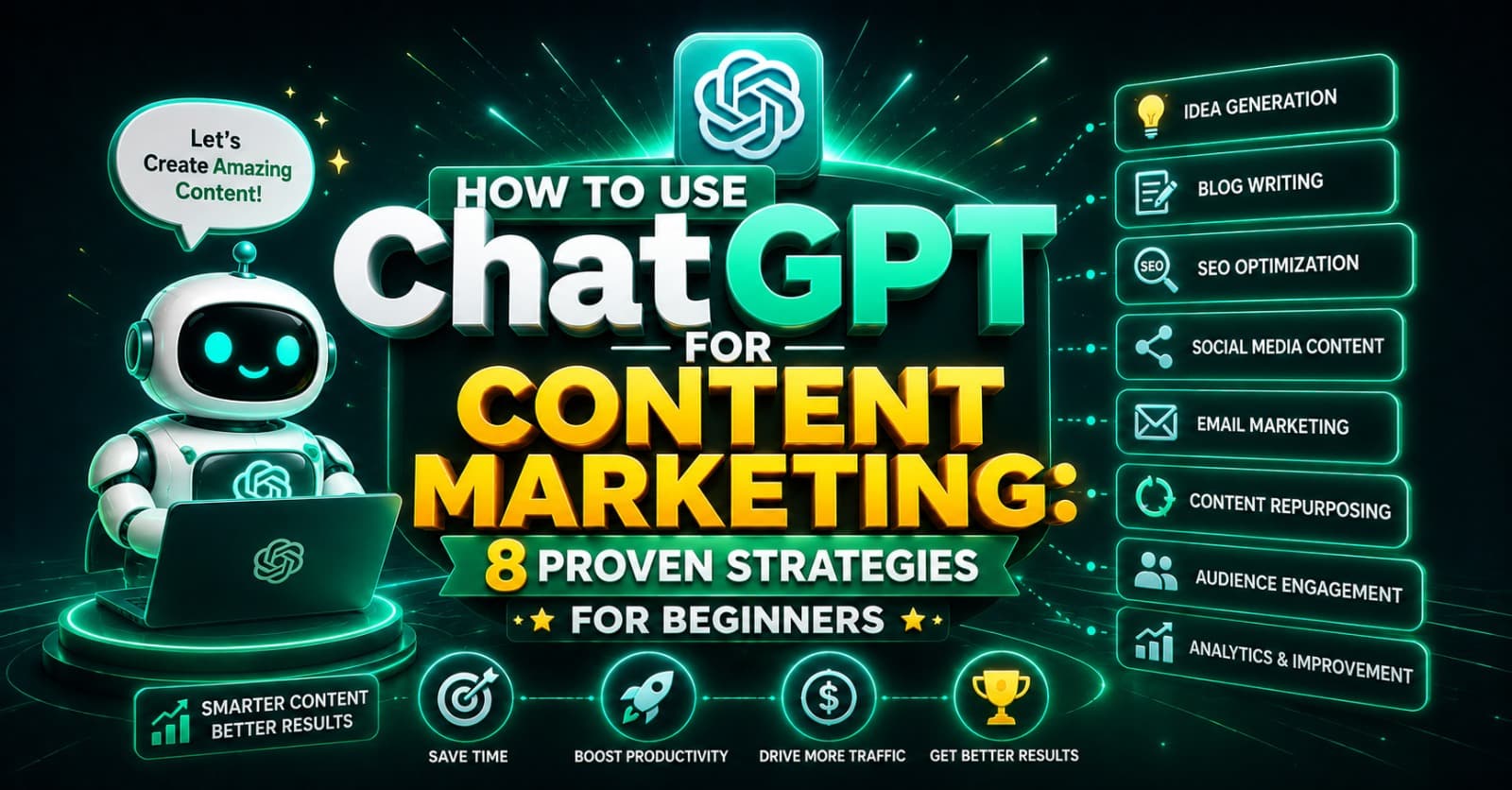
How to Use ChatGPT for Content Marketing: 8 Proven Strategies for Beginners
Introduction
Imagine spending hours every week writing blog posts, crafting social media captions, brainstorming email subject lines, and still feeling like you are falling behind your competitors. If that sounds familiar, you are not alone. Content marketing is one of the most powerful ways to grow a business online, but it is also one of the most time-consuming. That is exactly why so many marketers, bloggers, and small business owners are turning to ChatGPT for content marketing to get more done in less time without sacrificing quality.
ChatGPT for content marketing is not just a trend. It is a practical shift in how modern businesses create and distribute content. Whether you run a solo blog, manage a brand’s social media, or own a small business trying to stand out online, using ChatGPT for content marketing gives you a real competitive edge. It helps you generate ideas faster, write better drafts, and stay consistent with your publishing schedule.
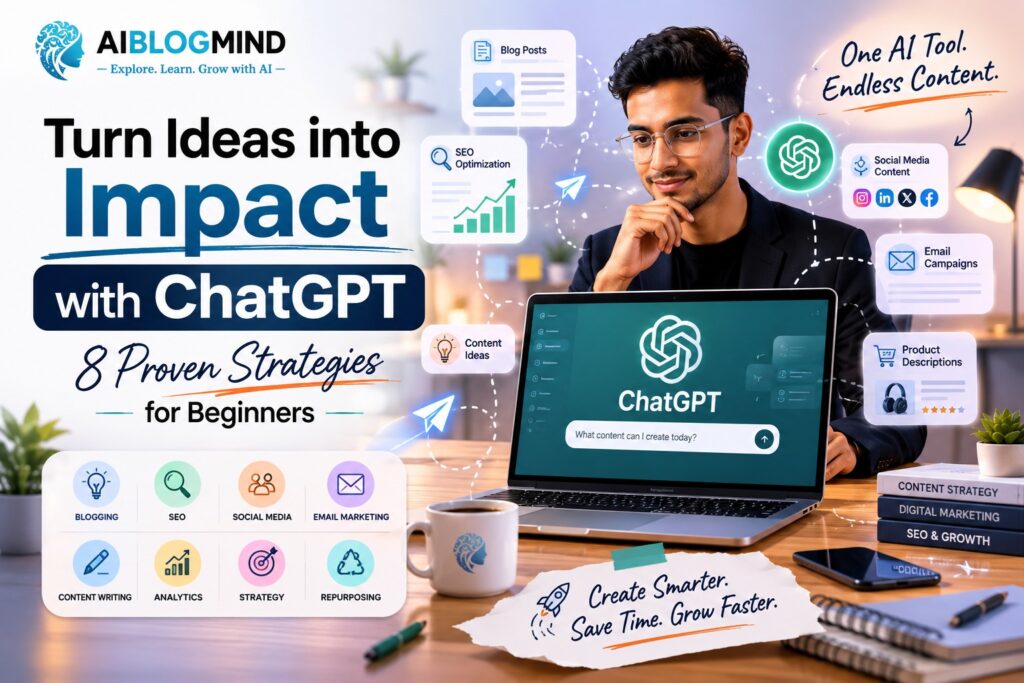
In this article, you will discover 8 proven strategies for using ChatGPT for content marketing as a beginner. You will also learn about its benefits, limitations, how it compares to other AI tools, and how to choose the right tool for your specific goals. By the end, you will have everything you need to start using ChatGPT for content marketing with confidence.
What Is ChatGPT for Content Marketing?
ChatGPT is a large language model developed by OpenAI. It can read text prompts and generate human-like written responses in seconds. When applied to content marketing, ChatGPT becomes a powerful assistant that can help with blog writing, social media posts, email campaigns, product descriptions, SEO content, and much more.
Using ChatGPT for content marketing means feeding it specific prompts and instructions, then editing and refining the output to match your brand voice. It is not about replacing your creativity — it is about amplifying it. ChatGPT for content marketing works best when you treat it as a collaborator, not a ghostwriter you never speak to.
Benefits of Using AI Tools Like ChatGPT for Content Marketing
Before diving into the strategies, it is important to understand why so many marketers are embracing AI-powered tools.
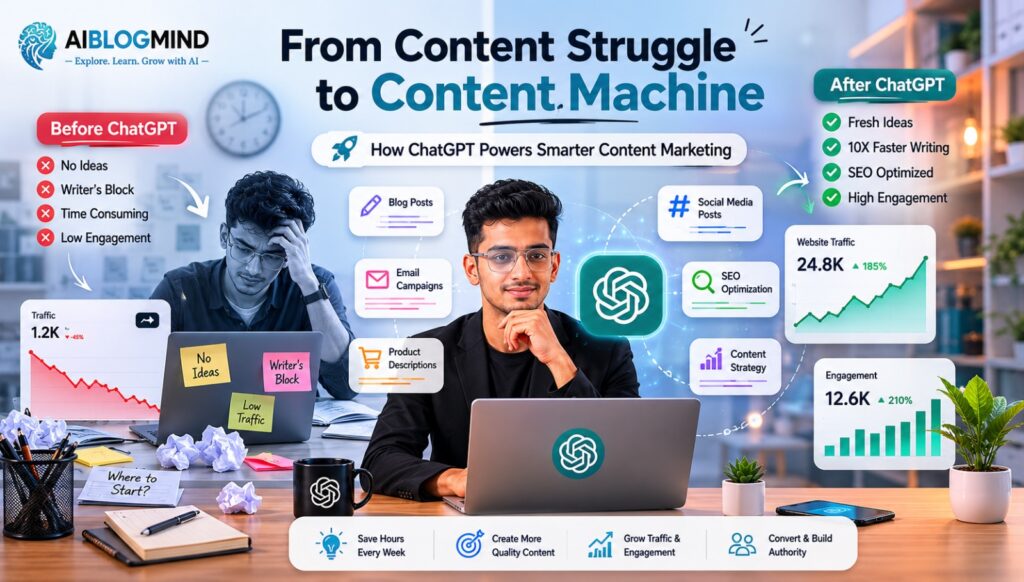
Speed and Efficiency The biggest benefit of using ChatGPT for content marketing is speed. What used to take a copywriter several hours can now be drafted in minutes. This means you can produce more content at a higher frequency without burning out.
Cost Savings for Small Businesses ChatGPT for small business is a game-changer when it comes to budget. Hiring a full-time content writer or a content agency is expensive. With ChatGPT for small business, even a one-person operation can produce professional-quality blog posts, product pages, and email newsletters without spending a fortune.
Consistency and Scalability One of the hardest parts of content marketing is staying consistent. ChatGPT for content marketing makes it easier to maintain a regular publishing schedule. You can use it to batch-produce content for an entire month in just a few focused sessions.
Brainstorming and Overcoming Writer’s Block Sometimes the hardest part is just getting started. ChatGPT marketing prompts can generate dozens of content ideas in seconds, helping you break through creative blocks and keep your editorial calendar full.
Multilingual and Versatile ChatGPT for content marketing can write in multiple languages and adapt to different tones — professional, casual, humorous, or authoritative. This versatility makes it useful for a wide range of industries and audiences.
Limitations of AI Tools in Content Marketing
While ChatGPT for content marketing is powerful, it is not without its limitations. Being aware of these will help you use it more effectively.
Lack of Real-Time Information ChatGPT’s knowledge has a training cutoff, which means it may not have the latest news, statistics, or industry developments. Always fact-check claims and update any outdated data before publishing.
No Personal Experience One of the key pillars of EEAT (Experience, Expertise, Authoritativeness, Trustworthiness) is genuine human experience. ChatGPT cannot share personal stories, client case studies, or first-hand expertise. You need to layer that in yourself.
Potential for Generic Output Without strong, specific prompts, ChatGPT for content marketing can produce bland or generic text. The quality of what you get is directly tied to the quality of your ChatGPT marketing prompts.
Requires Editing and Oversight AI-generated content should never be published without human review. Errors, inaccuracies, and awkward phrasing can slip through. Always treat ChatGPT output as a first draft, not a finished product.
Risk of Over-Reliance Becoming too dependent on AI can dull your own creative instincts over time. The best approach is to use ChatGPT for content marketing as a tool that supports your thinking, not one that replaces it entirely.
Top AI Tools for Content Marketing
There are several AI writing and content tools available today. Here is a quick look at some of the most popular options, with a focus on why ChatGPT for content marketing remains a top choice.
ChatGPT (OpenAI) ChatGPT for content marketing is the most widely used AI writing assistant in the world. It is versatile, easy to use, and capable of handling everything from long-form blog articles to short social media captions. With the right ChatGPT marketing prompts, you can get impressive results quickly.
Jasper AI Jasper is a dedicated marketing copywriting tool built on top of large language models. It comes with pre-built templates for ads, emails, and blog posts. However, it is more expensive than ChatGPT for small business users who are just getting started.
Copy.ai Copy.ai is another AI writing tool focused on marketing copy. It is beginner-friendly and has a free tier, making it accessible for small businesses. That said, ChatGPT for content marketing offers more flexibility and depth for long-form content.
Writesonic Writesonic focuses on SEO-optimized content and article generation. It integrates with tools like Surfer SEO, which makes it appealing for bloggers. Still, many content marketers prefer ChatGPT for content marketing because of its conversational interface and ability to handle nuanced instructions.
Google Gemini Google’s AI assistant is increasingly being used for content drafting and ideation. Its main advantage is access to real-time search results. However, ChatGPT for content marketing remains the go-to for most bloggers and marketers due to its established user base and consistent output quality.
Comparison: ChatGPT vs. Other AI Content Tools
When comparing ChatGPT for content marketing against other tools, a few key differences stand out.
ChatGPT for content marketing offers the most flexible conversational interface. You can have back-and-forth dialogue, refine outputs, and ask follow-up questions — all within the same session. This makes it feel less like using software and more like working with a skilled assistant.
Jasper and Copy.ai are better suited for teams that need structured templates and role-based workflows. They work well for marketing departments producing high volumes of short-form content like ad copy or email sequences.
Writesonic and similar tools offer strong SEO integration, which is useful if you are building an organic search strategy. However, for pure versatility and depth, ChatGPT for content marketing is hard to beat — especially for beginners who need a single tool that can handle many tasks at once.
For ChatGPT for small business owners who are budget-conscious, the free version of ChatGPT is a solid starting point. The paid version (ChatGPT Plus) offers access to more advanced models and faster response times, making it well worth the investment as your content needs grow.
Also, go through our other Articles related to Ai tools
8 Proven Strategies for Using ChatGPT for Content Marketing
Now let’s get into the practical part. Here are eight strategies that beginners can start using today.
Strategy 1: Use ChatGPT for Blogging to Generate Topic Ideas
Use ChatGPT for blogging by asking it to generate a list of blog post ideas based on your niche, target audience, and primary keyword. A good ChatGPT marketing prompt might look like this: “Give me 20 blog post ideas for a small business owner in the health and wellness space targeting beginners.” You will get a diverse, ready-to-use list in seconds.
Strategy 2: Create Full Blog Post Outlines
Before writing a single word, use ChatGPT for content marketing to build a detailed outline. Ask it to structure a post with an introduction, subheadings, key points, and a conclusion. This gives you a clear roadmap and saves enormous time during the writing phase.
Strategy 3: Draft Long-Form Blog Content Section by Section
Use ChatGPT for blogging to write one section at a time rather than asking for a full article in one shot. This gives you more control over tone, accuracy, and structure. Paste in each section, edit it, and move on. ChatGPT for content marketing works best when you guide it step by step.
Strategy 4: Write Social Media Captions and Posts
ChatGPT marketing prompts work brilliantly for social media. Ask ChatGPT for content marketing to write five Instagram captions, three LinkedIn posts, or a week’s worth of Twitter threads on a given topic. Specify the tone, character count, and any hashtags you want included.
Strategy 5: Craft Email Marketing Sequences
Email marketing is one of the highest-ROI channels available to small businesses. Use ChatGPT for small business by asking it to write a 5-email welcome sequence, a re-engagement campaign, or a promotional email for a product launch. Always personalize the output with specific brand details before sending.
Strategy 6: Repurpose Existing Content
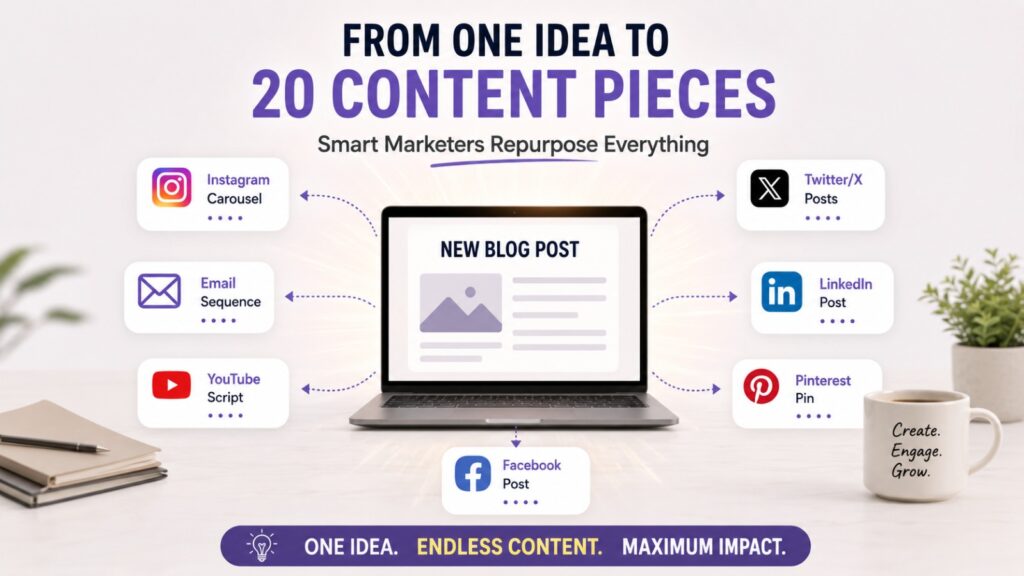
One of the smartest ways to use ChatGPT for content marketing is content repurposing. Take a blog post you have already written and ask ChatGPT to turn it into a LinkedIn article, a Twitter thread, a YouTube script, and three Facebook posts. This multiplies your content output without requiring you to create anything new from scratch.
Strategy 7: Optimize Content for SEO
Use ChatGPT marketing prompts to help with on-page SEO. Ask it to suggest meta descriptions, title tags, internal linking anchor text, and FAQ sections based on your primary keyword. ChatGPT for content marketing can also help you identify related keywords and phrases to naturally include in your content.
Strategy 8: Use ChatGPT for Small Business Product Descriptions and Website Copy
For e-commerce brands and service-based businesses, ChatGPT for small business is incredibly useful for writing product descriptions, landing page copy, and about-us pages. Provide it with key features, benefits, and your target customer, and it will generate compelling copy that you can refine to match your voice.
How to Choose the Right AI Tool for Content Marketing
Choosing the right tool depends on your goals, budget, and content volume. Here is a simple framework to guide your decision.
If you are a beginner with a limited budget, start with ChatGPT for content marketing using the free tier. It covers the widest range of content tasks and has an intuitive interface that does not require any technical knowledge.
If you use ChatGPT for blogging as your primary content format, consider upgrading to ChatGPT Plus for access to advanced models and plugins that can help with research, SEO, and web browsing.
If you are a ChatGPT for small business user who needs help with email campaigns and ad copy, the free version of ChatGPT combined with a dedicated email platform like Mailchimp is often all you need to get started.
If you are managing content for a larger team or multiple clients, explore dedicated platforms like Jasper or Writesonic that offer team features, brand voice settings, and workflow integrations.
The most important thing is to start somewhere. Overanalyzing tools is the number one reason marketers delay getting started. ChatGPT for content marketing is free, accessible, and powerful enough to transform your content strategy from day one.
Do followus for latest Ai tools updates
Final Verdict
ChatGPT for content marketing is one of the most accessible and impactful tools available to marketers today — regardless of budget, experience level, or industry. Whether you want to use ChatGPT for blogging, social media, email marketing, or SEO, it offers a practical solution to the biggest challenge in content marketing: producing high-quality content at scale.
The key to success with ChatGPT for content marketing lies in how you use it. Master your ChatGPT marketing prompts, always edit and personalize the output, and layer in your own expertise and experience to meet EEAT standards. When used strategically, ChatGPT for small business owners and beginners can level the playing field against larger competitors with bigger teams and budgets.
Start with one strategy, get comfortable with the tool, and then expand your use of ChatGPT for content marketing as your confidence grows. The marketers who thrive in the coming years will not be those who resist AI — they will be those who learn to use it wisely.
Frequently Asked Questions (FAQs)
Is ChatGPT for content marketing free to use? Yes, ChatGPT offers a free tier that gives you access to its core features. This is more than enough for beginners using ChatGPT for content marketing on a budget. A paid plan (ChatGPT Plus) unlocks more advanced capabilities.
Can I use ChatGPT for blogging without any writing experience? Absolutely. Using ChatGPT for blogging is one of the easiest entry points for beginners. You provide a topic and a few details, and ChatGPT helps you structure and draft the content. You still need to review and personalize the output, but you do not need to be an experienced writer to get started.
What are the best ChatGPT marketing prompts for beginners? Some of the most effective ChatGPT marketing prompts for beginners include: “Write a 1000-word blog post introduction on [topic],” “Give me 10 social media post ideas for [niche],” and “Write a welcome email sequence for a [type of business].” The more specific your prompt, the better your results.
Is ChatGPT good for small business content marketing? Yes. ChatGPT for small business is especially valuable because it reduces the cost and time associated with content creation. Small business owners can use it to write website copy, blog posts, email campaigns, and social media content without hiring a full content team.
Does Google penalize AI-generated content? Google’s guidelines focus on helpful, accurate, and original content — not on how it was written. As long as you edit, personalize, and add real value to your ChatGPT for content marketing output, it can rank well in search engines. Avoid publishing raw, unedited AI content without adding your own expertise.
How often should I use ChatGPT for content marketing? You can use ChatGPT for content marketing as often as your workflow requires. Many marketers use it daily for ideation and drafting, then spend time editing and publishing. The more you use it and refine your ChatGPT marketing prompts, the more efficient and effective your content process becomes.

Syed Abubakkar is a content and SEO specialist responsible for article publishing, on-page SEO, keyword optimization, and AI-powered image generation. He is passionate about digital marketing and helping websites grow their online presence.