



Content Generator: What Makes It Powerful or Dangerous?
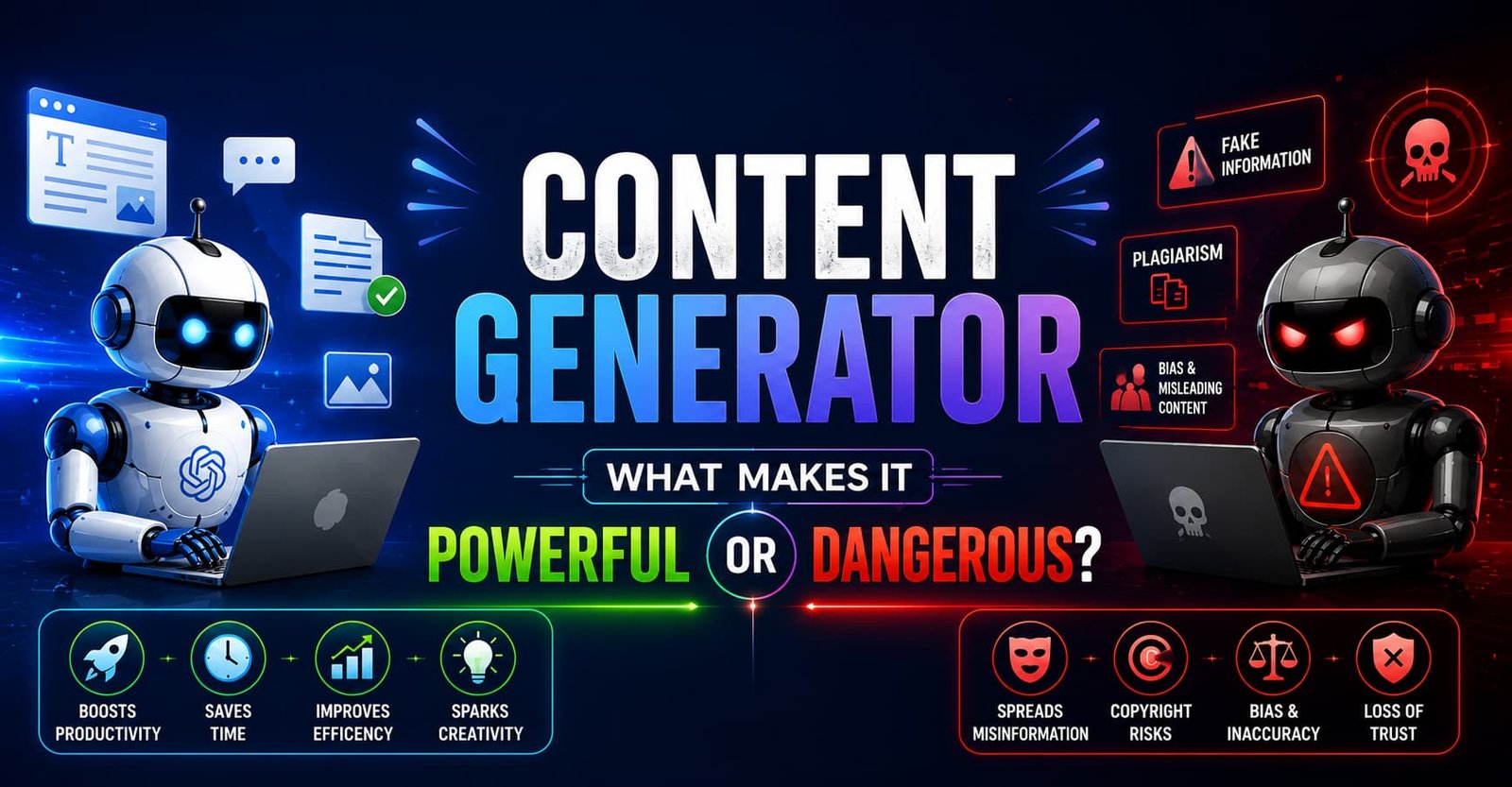
A content generator is a software tool, usually powered by AI, that creates written, visual, or audio material automatically based on a prompt or set of instructions. Modern versions are typically an ai content generator, meaning they use large language models trained on huge amounts of data to produce text that reads like it was written by a person. A good content generator can save massive amounts of time, but it also comes with real risks around accuracy, originality, and overreliance that are worth understanding before you start using one.
This article breaks down exactly what a content generator is, how it works, where it shines, where it falls short, and how to get started using one safely and effectively.
Why Content Generators Are Everywhere Right Now
A few years ago, a content generator was a niche tool used mostly by marketers testing product descriptions. Today, nearly every industry uses some form of content generator from social media captions to full blog posts to email campaigns to video scripts. This explosion happened because modern ai writing tool technology got dramatically better at producing natural, coherent, human-sounding text almost instantly.
This shift is exciting because it removes a lot of the friction that used to slow down content creation. But it’s also risky, because a content generate can just as easily produce polished-sounding misinformation, generic filler, or content that quietly copies existing ideas too closely. Understanding both sides is the whole point of this guide.
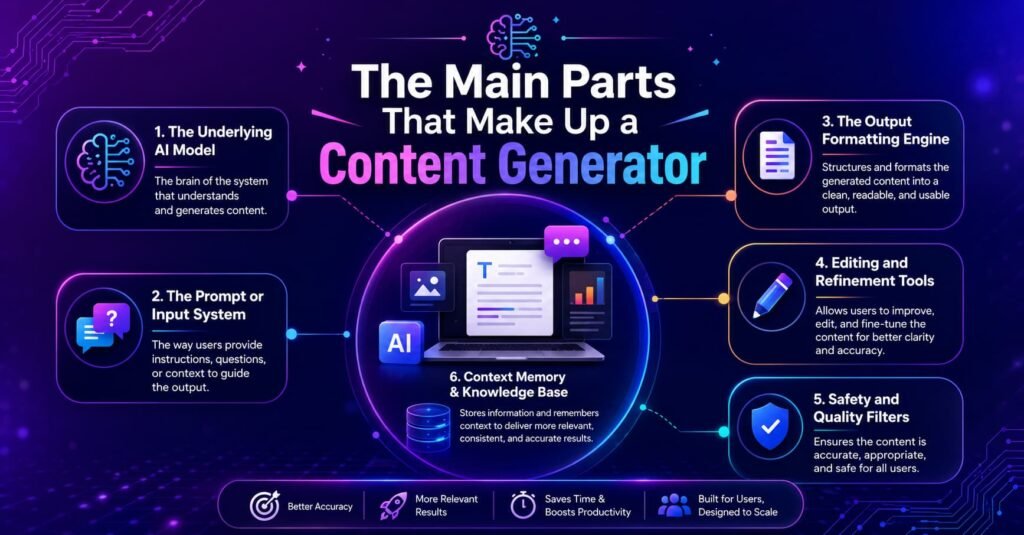
The Main Parts That Make Up a Content Generator
Follow Us on LinkedIn
Every content generator, no matter how simple or advanced, is built from a handful of core components working together. Understanding these parts helps you see why some tools produce much better results than others.
1. The Underlying AI Model
This is the “brain” of the content generator usually a large language model (LLM) trained on massive datasets of text, code, or images. The quality of this model heavily determines how coherent, accurate, and useful the output will be.
Checklist Is the model solid?
- Trained on a large, diverse dataset
- Regularly updated with newer information
- Capable of following detailed instructions
- Produces coherent, grammatically correct output
- Can adjust tone and style based on prompts
2. The Prompt or Input System
This is how you tell the content generator what you actually want. Some tools use a simple text box; others use structured forms with fields like topic, tone, keywords, and length.
Checklist Is the input system useful?
- Accepts free-form text prompts
- Allows tone and style customization
- Supports length or format controls
- Lets you upload reference material or examples
- Saves or reuses previous prompts
3. The Output Formatting Engine
Once content is generated, it needs to be formatted properly headings, bullet points, paragraph breaks, and sometimes even SEO elements like meta descriptions. A strong content generator handles this automatically.
Checklist Is the formatting solid?
- Produces clean, readable structure
- Supports headings, lists, and bold text
- Can export to common formats (Word, HTML, etc.)
- Maintains consistent formatting across long outputs
4. Editing and Refinement Tools
Good content generator platforms let you revise, regenerate, or fine-tune specific sections instead of starting over completely. This turns a one-shot output into a genuinely collaborative writing process.
Checklist Are the editing tools useful?
- Allows regenerating just one section
- Supports tone or length adjustments after the fact
- Offers an ai to human text rewriting or “humanizing” option
- Tracks version history so you can compare drafts
5. Safety and Quality Filters
Responsible tools include filters that catch factual errors, biased language, or inappropriate content before it reaches the user. This part of a content generator is often invisible but incredibly important.
Checklist Are safety filters present?
- Flags potentially false or unverifiable claims
- Filters offensive or harmful language
- Warns about potential plagiarism or overly similar phrasing
- Includes some form of human review recommendation
6 Types & Use-Cases of Content Generators
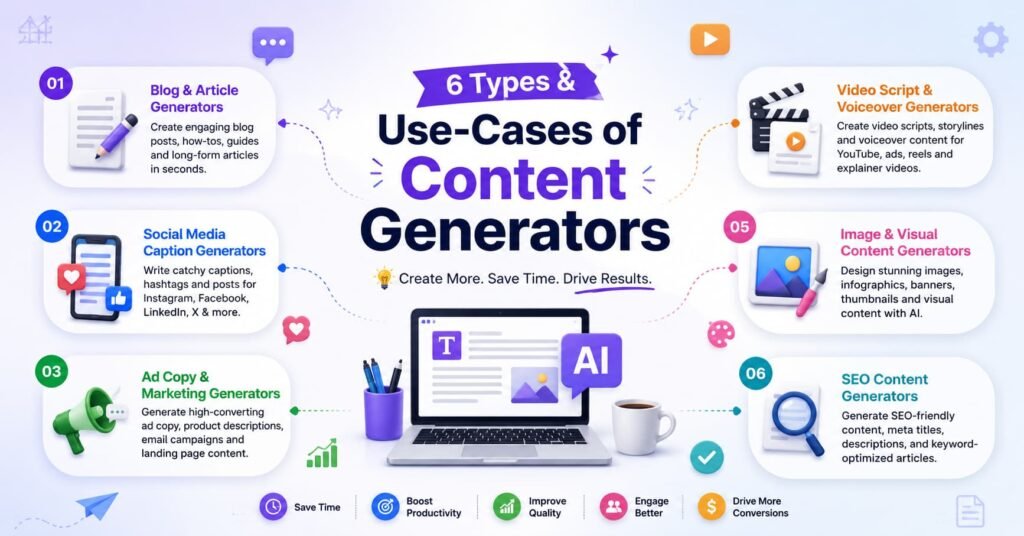
A content generator isn’t just one type of tool it covers a wide range of formats and industries. Here are the most common types people search for.
Blog & Article Generators
These tools produce long-form written content, often including headings, intros, and conclusions based on a topic or outline. This is one of the most popular uses of an ai content generate, especially for marketing teams that need to publish content consistently.
Social Media Caption Generators
These specialize in short, catchy text for platforms like Instagram, LinkedIn, and Twitter/X, often including hashtag suggestions. A social-focused content generator usually optimizes for brevity and engagement rather than depth.
Ad Copy & Marketing Generators
These are built specifically to produce persuasive, conversion-focused text for ads, product descriptions, and email campaigns. This type of content generator typically includes A/B testing variations to compare different messaging angles.
Video Script & Voiceover Generators
These tools generate scripts for YouTube videos, podcasts, or explainer content, sometimes paired with AI voice generation to create a full audio track. This use-case blends an ai writing tool with text-to-speech technology.
Image & Visual Content Generators
While text is the most common use, many platforms now generate accompanying images, thumbnails, or infographics alongside written content, creating a more complete content package from a single content generator.
SEO Content Generators
These focus specifically on producing search-optimized content, often built around target keywords, competitor analysis, and readability scoring. This is one of the fastest-growing categories of content generate tools used by businesses trying to rank higher on search engines.
How a Content Generator Actually Works, Step by Step
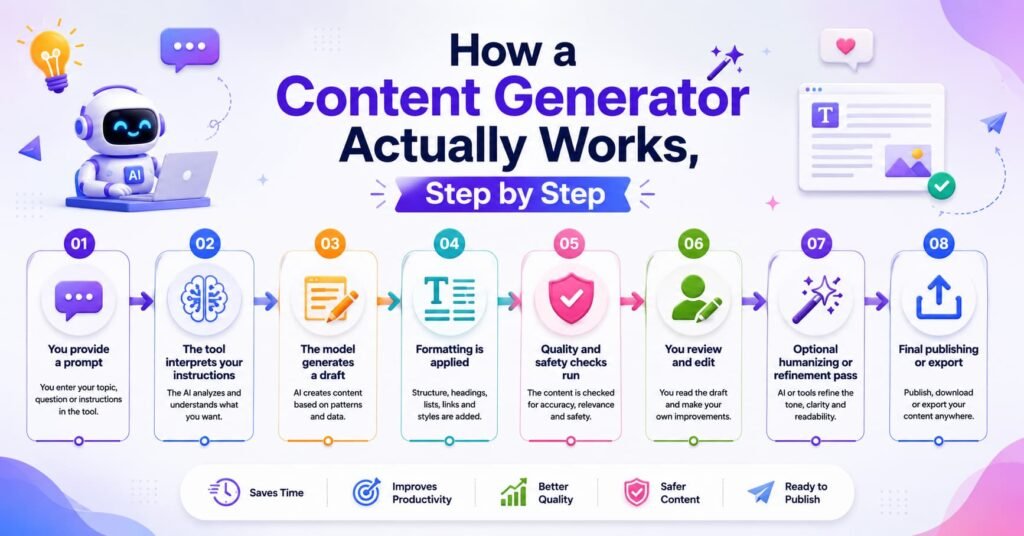
Understanding the process behind a content generator makes it much easier to use one effectively and to spot when something might be going wrong.
- You provide a prompt – This includes your topic, desired tone, target audience, and any specific requirements like length or keywords.
- The tool interprets your instructions – The underlying AI model analyzes your prompt to understand what kind of content you’re asking for.
- The model generates a draft – Using patterns learned from its training data, the content generate predicts and assembles text word by word (or sentence by sentence) to form a coherent response.
- Formatting is applied – Headings, bullet points, and paragraph structure are added automatically based on the content type you requested.
- Quality and safety checks run – Some tools scan the output for factual red flags, biased language, or overly generic phrasing before displaying it to you.
- You review and edit – This step is critical. Even the best content generate should be treated as a first draft, not a final product, especially for anything published publicly.
- Optional humanizing or refinement pass – Many people run the draft through an ai to human text tool or manually revise it to add personal voice, real examples, and nuance that AI alone often misses.
- Final publishing or export – The finished content is exported, scheduled, or published directly through integrations with blogs, social media, or email platforms.
Pros and Cons of Using a Content Generator (With Real Numbers)
Being honest about both sides matters here. A content generator can be genuinely brilliant, but it’s not without real drawbacks.
Pros
- Massive time savings – Many marketers report that using an ai writing tool cuts first-draft writing time by 50% or more compared to writing entirely from scratch.
- Consistent output volume – Businesses using a content generator can realistically produce daily social posts or weekly blog content without needing a large writing team.
- Lower cost per piece – Some studies estimate AI-assisted content creation can reduce content production costs by 30-50% compared to fully outsourced freelance writing.
- Great for brainstorming – Even when the final output isn’t used directly, a content generator is excellent at quickly producing multiple angles, headlines, or outlines to spark ideas.
- Multilingual capability – Many tools can generate content in dozens of languages, making it easier for small teams to reach global audiences without hiring translators.
- Scalability – A single person can now manage the content output that previously required an entire small team, which is a major shift for small businesses and solo creators.
Cons
- Accuracy issues – AI models can produce confident-sounding but factually incorrect information, often called “hallucination,” which makes fact-checking essential.
- Generic-sounding output – Without careful prompting and editing, content from a content generator can sound bland, repetitive, or interchangeable with content from competitors using the same tool.
- SEO and detection risk – Search engines have gotten better at identifying low-quality, mass-produced AI content, and some platforms penalize content that appears entirely unedited from an ai content generate.
- Originality and copyright concerns – Because models learn from existing text, outputs can sometimes closely resemble existing content, raising both ethical and legal questions.
- Overreliance risk – Teams that lean too heavily on a content generator without editing or fact-checking can gradually erode their own brand voice and credibility.
- Detection and trust concerns – Readers are increasingly able to spot unedited AI writing, and some audiences respond negatively when they feel content wasn’t genuinely written by a human.
Weighing these pros and cons honestly is the smartest way to decide how much to rely on a content generator in your own workflow, rather than treating it as either a magic solution or something to avoid entirely.
How a Content Generator Differs From Similar Topics People Confuse It With
There’s a lot of overlap in terminology here, so it helps to separate a content generator from related tools and concepts.
- Content Generator vs. Grammar Checker – A grammar checker like Grammarly fixes and improves existing text you’ve already written. A content generator creates brand-new content from a prompt, often before any writing exists at all.
- Content Generator vs. Content Management System (CMS) – A CMS like WordPress is where you store, organize, and publish content. A content generate is what actually creates the content in the first place; the two are often used together but serve completely different purposes.
- AI Writing Tool vs. Content Generator – These terms are often used interchangeably, but “ai writing tool” can also include editing assistants, outline builders, and research tools, while “content generator” usually refers specifically to tools that produce full, ready-to-use drafts.
- Content Generator vs. Chatbot – A general chatbot is designed for back-and-forth conversation and answering questions. A content generate is optimized specifically for producing polished, publishable content in a specific format, even though many chatbots can also function as content generates.
- AI to Human Text vs. Content Generator – An ai to human text tool specifically focuses on rewriting AI-sounding text to feel more natural, personal, or undetectable as AI-written. A content generator is the tool that creates the original draft; the two are often used together in sequence.
- Content Generator vs. Content Strategy – A content strategy is the overall plan for what to create and why, based on business goals and audience needs. A content generates is simply the execution tool; it can’t replace the strategic thinking behind good content.
The Biggest Challenges Facing Content Generator Tools Today
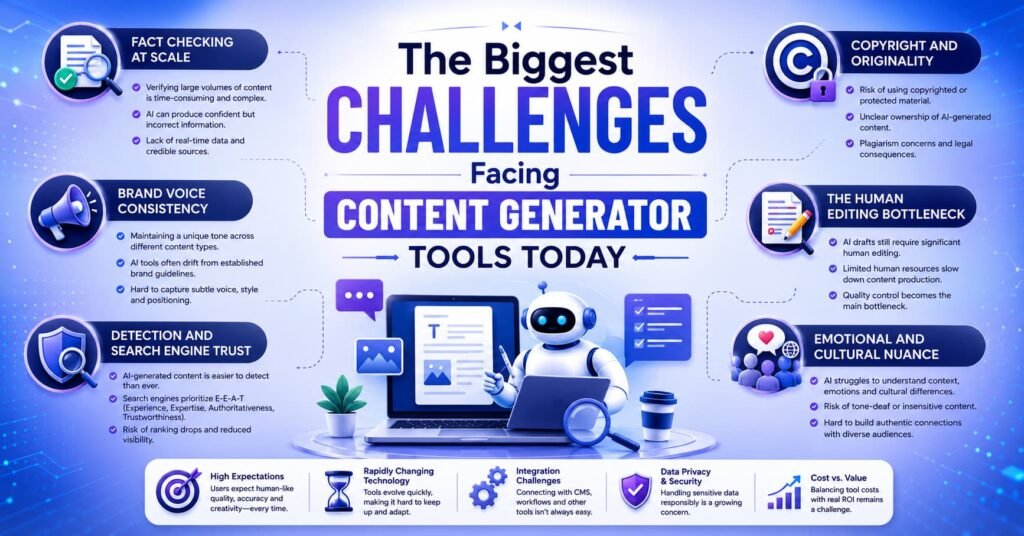
Beyond the general pros and cons, there are specific, ongoing challenges that shape how useful and trustworthy a content generates really is in practice.
Fact-Checking at Scale
As businesses use a content generator to produce dozens or hundreds of pieces per month, manually fact-checking every claim becomes harder to keep up with. This creates real pressure to build faster verification workflows, since publishing inaccurate information at scale can damage credibility quickly.
Brand Voice Consistency
A generic content generator output often doesn’t match a specific brand’s tone, personality, or values right out of the box. Companies increasingly need to invest time training or fine-tuning tools with style guides and examples so the ai content generates output actually sounds like them instead of sounding like everyone else using the same tool.
Detection and Search Engine Trust
As more websites publish AI-assisted content, search engines and readers are getting better at recognizing generic, unedited output. This has raised the bar for what counts as “good enough” – a content generator draft that isn’t edited or fact-checked is increasingly likely to underperform compared to genuinely refined content.
Copyright and Originality
Because AI models learn patterns from existing text, there’s an ongoing legal and ethical debate about how closely generated content can resemble existing copyrighted material. This is one of the more unresolved risks tied to any ai writing tool, and it’s still being worked out in courts and industry guidelines.
The Human Editing Bottleneck
Ironically, one of the biggest challenges with a content generator isn’t generating content it’s finding enough time to properly edit, fact-check, and personalize everything it produces. Teams that skip this step often end up with content that technically exists but doesn’t actually perform well or build trust.
Emotional and Cultural Nuance
A content generates can struggle with subtle humor, regional slang, or deeply culturally specific references, since it’s working from statistical patterns rather than lived experience. This is one reason human review remains important, especially for content aimed at niche or culturally specific audiences.
Common Myths vs. Facts About Content Generators
Misunderstandings are common with a fast-moving tool like this. Here are some myths worth clearing up about the modern content generator.
Myth: A content generator can fully replace a professional writer. Fact: Most content generator tools produce strong first drafts, but professional writers still add strategic thinking, original insight, and editorial judgment that current AI tools can’t fully replicate.
Myth: All content generator output sounds robotic. Fact: With detailed prompts, style examples, and light editing, output from a good ai content generator can sound remarkably natural the quality depends heavily on how it’s prompted and refined, not just the tool itself.
Myth: Using a content generator is always considered cheating or dishonest. Fact: Most audiences and platforms don’t consider using an ai writing tool dishonest, as long as the content is accurate, valuable, and not deceptively presented as something it isn’t (like a fake personal testimonial).
Myth: Bigger, more expensive content generator tools are always better. Fact: The best tool often depends on your specific use-case; a simple, well-prompted content generator can outperform an expensive one used poorly, since prompt quality and editing matter more than raw tool cost.
Myth: Content generator output is always plagiarized. Fact: Most modern tools generate new combinations of language rather than copying text directly, though occasional close similarity to source material can happen, which is why originality checks are still a smart precaution.
Best Practices for Getting Better Results from a Content Generator
Getting genuinely useful output from a content generator usually comes down to how you use it, not just which tool you pick.
- Be specific in your prompts – Include audience, tone, format, and goal instead of vague topic requests; this alone dramatically improves the quality of an ai content generator’s output.
- Provide examples – Pasting in a sample of your preferred writing style helps the tool match your voice more closely.
- Break big tasks into smaller prompts – Generating an outline first, then expanding section by section, often produces more coherent results than asking for an entire article in one shot.
- Always fact-check specific claims – Names, statistics, dates, and technical details should be independently verified before publishing anything from a content generator.
- Edit for voice, not just grammar – Add personal anecdotes, opinions, and specific examples that make the content feel genuinely yours rather than generic.
- Use it for brainstorming, not just final drafts – Even when you don’t use the exact output, a content generator is excellent for quickly generating headline ideas, outlines, and alternative angles.
- Combine tools when needed – Pairing a content generator with a separate ai to human text or editing tool often produces better final results than relying on a single tool alone.
How Different Industries Use Content Generators
The way a content generator gets used varies a lot depending on the industry, since each field has different priorities around accuracy, tone, and volume.
Marketing & E-commerce
Marketing teams rely heavily on a content generator for product descriptions, email campaigns, and ad variations, since these tasks require high volume and quick turnaround. E-commerce brands in particular use an ai content generator to write hundreds of product listings that would take a human team weeks to produce manually.
Journalism & Media
News organizations use content generation tools cautiously, mostly for drafting routine reports like earnings summaries or sports recaps, while keeping human journalists responsible for investigative and sensitive reporting. This is an area where the risks of a content generator producing inaccurate information carry especially high stakes.
Education
Teachers and course creators use a content generator to draft lesson plans, quiz questions, and study guides, which can save significant prep time. Some schools have policies around student use of an ai writing tool for assignments, since it raises separate questions about academic integrity.
Small Business & Freelancing
Solo entrepreneurs and freelancers often rely on a content generator to handle marketing tasks they don’t have time or budget to outsource, from social captions to website copy. This is one of the areas where the tool provides the clearest value, since it lets small teams compete with larger, better-resourced competitors.
Legal & Financial Services
These industries use content generation carefully and typically with heavy human review, since even small factual errors can carry serious consequences. An ai content generator might be used to draft a first version of a client email or explainer article, but compliance review remains essential before anything goes out.
Entertainment & Publishing
Some publishers experiment with a content generator for outlining stories, generating character ideas, or drafting marketing copy for books and shows, while keeping core creative writing human-led. This reflects a broader pattern where the tool works best as a support system rather than a full creative replacement.
What the Future Holds for Content Generator Technology
Looking ahead, several trends are likely to shape how a content generator evolves over the next few years.
- Better fact-checking built in – Future tools are expected to include stronger built-in verification, cross-referencing claims against reliable sources automatically before displaying output.
- More personalized brand voice training – Instead of generic output, tools will likely get better at learning and consistently replicating a specific company’s or individual’s unique voice.
- Tighter integration with publishing platforms – Expect a content generator to increasingly connect directly with CMS platforms, social schedulers, and analytics tools for a more seamless workflow.
- Improved transparency features – More tools may include built-in disclosure options or watermarking to make it easier to identify AI-assisted content when needed.
- Multimodal content packages – Rather than just text, future tools will likely generate matching images, video clips, and audio alongside written content in a single workflow.
- Stronger detection and originality safeguards – As concerns about duplicate or low-quality content grow, more ai writing tool platforms are expected to build in originality scoring by default.
A Simple Real-World Example of Using a Content Generator
To make this more concrete, imagine a small bakery owner who wants to start posting weekly blog content but has no time to write. She opens an ai content generator, types in a prompt describing her bakery’s style, target audience, and a topic like “5 tips for storing fresh sourdough bread.”
Within seconds, the content generator produces a structured draft with a title, intro, five clearly organized tips, and a friendly closing line. She reads through it, corrects one factual detail about refrigeration that wasn’t quite right, adds a sentence about her own bakery’s specific process, and swaps in a more personal, casual tone in a couple of spots.
The final result took about ten minutes total instead of an hour or more of writing from scratch. This small example captures both sides of the content generator conversation well it saved real time and produced a solid structural draft, but it still needed a human eye to catch an error and add authentic personal detail that made it genuinely hers.
Signs You’re Using a Content Generator Well (vs. Poorly)
Not all use of a content generator looks the same, and the difference between a good and bad approach is usually pretty visible in the final result.
Signs of good use:
- Content includes specific, accurate details relevant to your actual business or topic
- The tone feels consistent with your usual voice, not generic or interchangeable
- Claims and statistics have been verified before publishing
- The draft was edited, not just copy-pasted directly from the content generator
Signs of poor use:
- Content feels vague, repetitive, or could apply to literally any business
- Specific facts, numbers, or claims were never checked for accuracy
- The same generic structure appears across every single piece of content
- Readers or clients have noticed the content doesn’t sound authentic
Q&A: Common Questions About Content Generators
1. Is content from a content generator good enough to publish as-is?
Usually not without editing. Most experts recommend treating output from a content generator as a strong first draft that still needs fact-checking, personal voice, and refinement before publishing, especially for anything representing a brand or business. Publishing raw, unedited output is one of the most common mistakes new users make, and it’s usually easy for readers to spot.
2. Can search engines detect and penalize AI-generated content?
Search engines generally don’t penalize content simply for being AI-assisted, but they do penalize low-quality, unhelpful content regardless of how it was created. A well-edited content generator draft with real value, original insight, and accurate information can perform just as well as fully human-written content in search rankings.
3. Will a content generator replace human writers?
Most experts believe a content generator is more likely to change how writers work rather than fully replace them, shifting the role toward editing, strategy, fact-checking, and adding unique perspective rather than typing every word from scratch. Writers who learn to work alongside these tools effectively tend to become more productive rather than less needed.
4. How accurate is an ai content generator?
Accuracy varies significantly by tool and topic. Well-known factual topics tend to be handled reasonably well, but niche, recent, or highly technical information should always be independently verified before publishing, since even the best models can occasionally state incorrect information with complete confidence.
5. What’s the difference between free and paid content generators?
Free tools often have shorter output limits, fewer customization options, and sometimes older or less capable underlying models. Paid tools typically offer longer outputs, better tone control, access to more advanced models, and additional features like SEO optimization or team collaboration.
6. Is it ethical to use a content generator for my business?
Most experts consider it ethical as long as you’re transparent when required, fact-check the output, and add genuine value rather than publishing unedited, low-quality mass content purely for search engine manipulation. The ethics largely come down to how the tool is used, not whether it’s used at all.
7. How do I make content generator output sound more human?
Adding personal anecdotes, specific examples, a consistent voice, and editing out repetitive phrasing all help significantly. Many people also run drafts through a dedicated ai to human text tool as an additional refinement step, which can smooth out awkward phrasing that still sounds distinctly machine-generated.
8. Can a content generator help with SEO?
Yes, many tools include built-in keyword optimization, readability scoring, and meta description generation, making a content generator genuinely useful for SEO-focused content when paired with real keyword research and a clear understanding of what your audience is actually searching for.
9. How much does a good content generator typically cost?
Pricing varies widely, from free basic plans to $20-$100+ per month for professional tools with advanced features. Enterprise-level content generator platforms with team collaboration and custom brand training can cost significantly more, depending on usage volume and features needed.
Helpful Tools & Resources for Content Generators
- Popular AI Writing Platforms – Tools like Jasper, Copy.ai, and Writesonic are widely used dedicated content generator platforms built for marketing teams.
- General-Purpose Assistants – Tools like Claude, ChatGPT, and Gemini can function as a flexible ai content generator for blogs, emails, and scripts.
- Grammar & Style Tools – Grammarly and Hemingway Editor help refine and humanize AI-generated drafts after the initial content is produced.
- SEO Tools – Platforms like Surfer SEO and Clearscope help ensure content generator output is optimized for search performance, not just readability.
- Plagiarism & AI Detection Checkers – Tools like Copyscape and Originality.ai help verify uniqueness and transparency before publishing.
- Communities & Learning – Marketing and content creator communities on Reddit, LinkedIn, and YouTube regularly share tips on getting better results from an ai writing tool.
How to Get Started: Simple Checklist
- Choose a content generator that fits your specific use-case (blog, social, ads, video scripts)
- Start with a clear, detailed prompt including tone, audience, and length
- Generate a first draft and treat it as a starting point, not a final product
- Fact-check any specific claims, statistics, or technical details
- Edit for your own voice and add real examples or personal insight
- Run the draft through an ai to human text tool if it still sounds robotic
- Check for originality using a plagiarism checker before publishing
- Track performance over time to see what content actually resonates with your audience
Final Thoughts
A content generator can be genuinely brilliant, saving time, sparking ideas, and helping small teams produce far more content than they could otherwise. But it’s also risky when used carelessly, since accuracy issues, generic output, and overreliance can quietly damage trust and quality over time. The smartest approach is to treat any ai content generator as a powerful assistant rather than a replacement for human judgment, always editing, fact-checking, and adding your own voice before anything goes out into the world.
know more About Us

Hi, I’m Rufqha, the SEO Manager at AIBlogMind. I focus on building content strategies that help websites improve visibility, attract the right audience, and create sustainable organic growth. My expertise includes on-page SEO, keyword research, content optimization, and aligning SEO with user experience and business goals.