



SEO Tools Ranking: How to Compare and Improve Results?
SEO tools ranking refers to how different SEO software platforms stack up against each other in terms of features, accuracy, and value, and also how well your own website ranks when tracked by these tools. In short, it’s both a comparison exercise (which tool is best) and a measurement exercise (where does my site currently stand). Understanding SEO tools ranking properly helps you pick the right platform and correctly interpret the data it gives you.
If you’re new to this, don’t worry, this guide breaks it all down in plain language: what makes up a good comparison, the different types of tools you’ll run into, how the whole process works step by step, and honest pros and cons. By the end, you’ll be able to make sense of SEO tools ranking comparisons instead of feeling overwhelmed by conflicting reviews.
What Exactly Is SEO Tools Ranking?
At its core, SEO tools ranking has two related meanings that people often blend together. First, it can mean comparing SEO software platforms against each other accuracy, pricing, features to figure out which is genuinely worth using. Second, it can mean the actual ranking position your website holds in search results, as measured by a website ranking checker inside one of these tools.
Both meanings matter because the quality of your SEO tools ranking data directly affects how well you can track and improve your site’s real-world search position. A tool with inaccurate data can make you think you’re doing better (or worse) than you actually are, which leads to wasted effort chasing the wrong fixes.
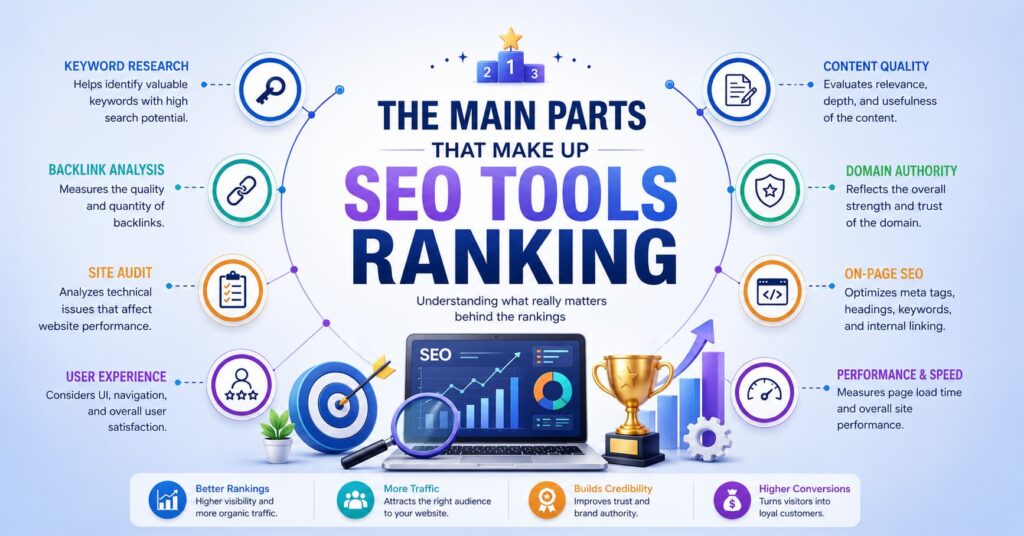
The Main Parts That Make Up SEO Tools Ranking
Follow Us Instagram
Comparing and using SEO tools involves several distinct building blocks. Below is each core piece, with a simple checklist so you know what to evaluate. Most discussions of SEO tools ranking revolve around these categories.
1. Accuracy of Ranking Data
This is how closely a tool’s reported position matches what a real searcher actually sees. Since search results are personalized, no website ranking checker is ever 100% exact, but the best ones get very close by simulating neutral, logged-out searches.
Accuracy is arguably the single most important factor in any SEO tools ranking comparison, because inaccurate data leads to wasted effort. If a tool tells you a page ranks #3 when it actually sits at #9, you might wrongly conclude your strategy is working when it isn’t, or worse, abandon a page that’s actually close to breaking into page one.
Checklist:
- Tool clearly states which country/location it’s simulating
- Tool distinguishes between desktop and mobile rankings
- Tool updates data at least weekly, ideally daily for competitive keywords
- Tool shows historical ranking trends, not just today’s snapshot
- Tool lets you spot-check specific keywords against a manual search
2. Feature Completeness
This covers how many core SEO functions a platform actually includes, key word research, technical audits, backlink tracking, and rank monitoring.
A platform that only offers rank tracking without keyword research forces you to juggle multiple subscriptions, which adds cost and complexity. Most top-rated entries in any SEO tools ranking list bundle several of these functions together so you’re not stitching together data from five different sources.
Checklist:
- Includes keyword research with volume and difficulty data
- Includes a technical site audit feature
- Includes backlink analysis
- Includes competitor comparison features
- Includes at least basic content optimization scoring
3. Ease of Use
A tool packed with features is useless if nobody on your team can figure out how to use it. This is a major factor in most SEO tools ranking comparisons and reviews.
Some platforms cram so much data onto a single dashboard that beginners feel paralyzed rather than empowered. When comparing tools, pay close attention to how quickly you can find the specific number or report you actually need, since that day-to-day usability matters more long-term than any single flashy feature.
Checklist:
- Dashboard is organized logically, not cluttered
- Tool offers onboarding tutorials or guided setup
- Reports can be exported or shared easily
- Customer support is responsive when issues come up
- Mobile app or mobile-friendly dashboard is available
4. Pricing and Value
This is simply what you get relative to what you pay, which varies enormously across the SEO tools ranking landscape.
It’s tempting to assume the most expensive platform must be the best, but that’s not always true. Smaller sites tracking a handful of keywords often get more genuine value from a modestly priced tool than from an enterprise platform loaded with features they’ll never touch.
Checklist:
- Free trial or free tier is available to test before committing
- Pricing scales reasonably as your site grows
- No hidden limits on keyword tracking or crawl volume
- Cancellation policy is clear and straightforward
- Annual billing discount is available if you plan to commit long-term
5. Historical Context (Google PageRank)
Understanding older concepts like google pagerank helps explain why modern tools measure authority the way they do today.
Back when google pagerank was publicly visible, site owners could check a simple 0-10 score for any page directly in their browser toolbar. Google discontinued this public score years ago, partly because it was being gamed and misused, which is exactly why every modern platform now calculates its own proprietary authority metric instead.
Checklist:
- You understand that public google pagerank scores were discontinued years ago
- You know modern tools use their own proprietary authority scores instead
- You don’t rely on outdated PageRank browser toolbars or plugins
- You understand authority scores are estimates, not official Google metrics
- You compare authority scores within the same tool, not across different platforms
6 Types of Tools You’ll Compare in SEO Tools Ranking Discussions
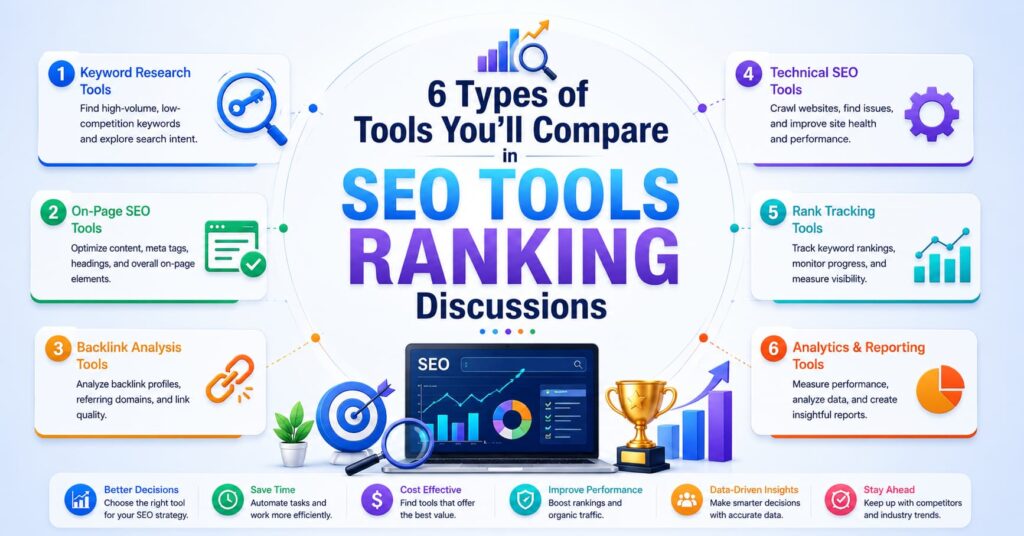
Not every tool serves the same purpose, so here’s a quick rundown of the main categories that come up in SEO tools ranking comparisons.
1. All-in-One SEO Platforms:- These bundle keyword research, audits, rank tracking, and backlink analysis into one dashboard. They typically top most SEO tools ranking lists because of their sheer breadth of features.
2. Dedicated Website Ranking Checkers:- These focus purely on tracking search positions. A simple website ranking checker is often the first tool beginners try since it answers the most immediate question: “where do I actually rank?”
3. Keyword Research Tools:- These specialize in key word research showing search volume, competition, and related terms so you know what to target before writing content.
4. Technical Audit Crawlers:- These focus on crawling your site for broken links, slow pages, and indexing issues, rather than tracking rankings directly.
5. Backlink & Authority Checkers:- These estimate a site’s authority using proprietary scoring systems that effectively replaced the old public google pagerank metric.
6. Free Beginner Tools:- These are simple, often single-purpose tools ideal for someone who just wants a quick website ranking checker without committing to a paid subscription.
How to Choose Based on Your Site’s Needs
Not every site needs the same depth of SEO tools ranking data. Here’s a quick guide to matching tools to your actual situation.
If you’re just starting out:- A free website ranking checker paired with Google Search Console is genuinely enough. You don’t need advanced SEO tools ranking features until you’re tracking dozens of keywords.
If you’re a growing blog or small business:- This is usually where investing in proper key word research tools starts paying off, since guessing which topics to write about becomes riskier as competition increases.
If you’re an established business:- At this stage, comprehensive SEO tools ranking platforms with automated reporting save significant time compared to manually checking positions one by one.
If you’re an agency managing multiple clients:- Enterprise-level platforms become necessary here, offering white-label reporting and the ability to track website ranking checker data across dozens of sites from one dashboard.
A Real-World Example
Imagine a small online pet store trying to figure out which SEO tool to invest in. They start by testing three different platforms’ free trials, using each one’s website ranking checker to check their ranking for “organic dog treats” a keyword they believe they rank well for.
One tool reports position 4, another reports position 11, and a manual, logged-out search shows position 7. Rather than assuming any one tool is “wrong,” they recognize this is a normal side effect of differing methodologies within the broader SEO tools ranking landscape, and they settle on the tool whose number was closest to their manual check.
They also run some basic key word research and discover “grain-free dog treats” has similar search volume but notably lower competition. Six months later, using consistent tracking from their chosen platform, they see steady upward movement on both terms a realistic result of using SEO tools ranking data consistently rather than chasing the “perfect” tool.
How SEO Tools Ranking Comparisons Actually Work, Step by Step
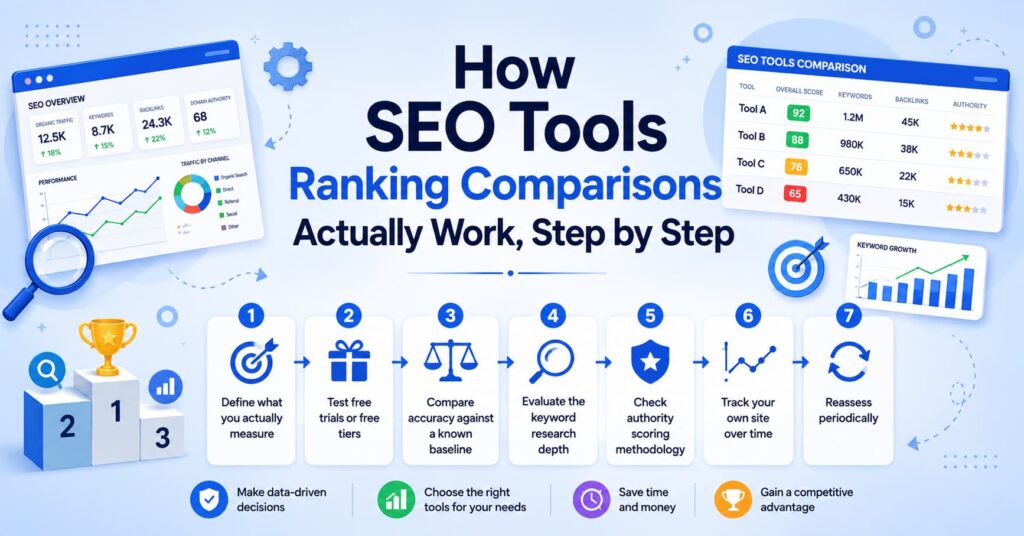
Here’s the practical process people follow when evaluating and using tools based on SEO tools ranking data.
Step 1: Define what you actually need Before comparing platforms, decide whether you need deep key word research, technical audits, or simply a basic website ranking checker. This narrows the field considerably.
Step 2: Test free trials or free tiers Most reputable platforms in the SEO tools ranking space offer free trials. Use this window to check accuracy against your known rankings before paying anything.
Step 3: Compare accuracy against a known baseline Search a keyword manually (logged out, incognito) and compare it to what the tool reports. Consistent, close matches are a good sign of reliable SEO tools ranking data.
Step 4: Evaluate the keyword research depth Look at how thorough the key word research features are, search volume, difficulty scores, and related term suggestions all matter here.
Step 5: Check authority scoring methodology Since google pagerank is no longer public, see how the tool calculates its own authority score and whether it explains its methodology transparently.
Step 6: Track your own site over time Once you’ve chosen a tool, use its website ranking checker consistentl, weekly or monthly, to build a reliable trend line rather than one-off snapshots.
Step 7: Reassess periodically Revisit your SEO tools ranking choice every 6-12 months, since platforms update features and pricing regularly, and a better fit may emerge as your site grows.
Pros and Cons of Relying on SEO Tools Ranking Data
Let’s be honest even the best website ranking checker has limitations. Here’s a balanced look at both sides.
Pros
- Removes guesswork:- Instead of manually searching every keyword, a website ranking checker automates tracking across hundreds of terms at once, saving hours of repetitive manual searching every week.
- Reveals trends over time:- A single ranking snapshot means little, but tracked over months, SEO tools ranking data reveals whether your strategy is genuinely working or needs adjustment.
- Supports better keyword research:- Solid keyword research data helps you avoid wasting months writing content for terms nobody searches, directing your time toward topics with real demand.
- Higher organic traffic potential:- Sites that consistently apply data-backed SEO strategies see, on average, 20-30% year-over-year organic traffic growth according to multiple industry benchmarks.
- Competitor visibility:- Most tools let you compare your SEO tools ranking data directly against competitors, showing gaps you can realistically target rather than guessing where you stand.
Cons
- Personalization skews accuracy:- Since Google personalizes results based on location and search history, no website ranking checker perfectly matches every individual searcher’s experience, which can make numbers feel inconsistent.
- Cost adds up:- Premium platforms with full SEO tools ranking features often run $99-$399/month, which is steep for small budgets, particularly for solo site owners just starting out.
- Data can conflict between tools:- Two different platforms might report different keyword difficulty or ranking positions for the same term, which can confuse beginners comparing sources side by side.
- No official google pagerank equivalent exists:- Modern authority scores are estimates, not verified Google metrics, so they should be treated as directional rather than exact.
- Results are slow:- SEO improvements typically take 3-6 months to show meaningful movement in ranking checkers, testing the patience of anyone expecting fast, immediate results.
How SEO Tools Ranking Differs From Similar (Often Confused) Topics
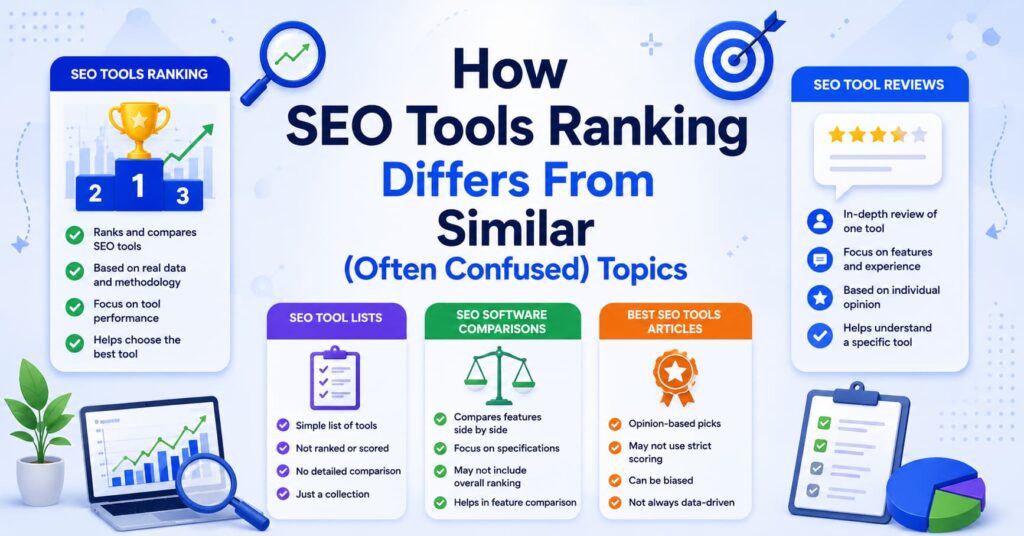
People frequently mix up SEO ranking concepts with other related ideas. Here’s the difference, in plain terms.
SEO tools ranking vs. Google PageRank Google pagerank was a specific, publicly visible score Google once displayed for every page; it was discontinued as a public metric years ago. Modern SEO tools ranking platforms use their own proprietary authority scores that only approximate the old concept.
Website ranking checker vs. web analytics tools A website ranking checker tells you your position in search results for specific keywords. Analytics tools, like Google Analytics, tell you what happens after someone clicks traffic, bounce rate, conversions.
Key word research vs. content writing tools Key word research tells you what to write about and which terms to target. Content writing tools help you draft the actual words the two work together but aren’t the same category.
SEO tools ranking vs. domain authority scores Domain authority is just one input into a broader SEO tools ranking comparison, which also weighs accuracy, features, pricing, and ease of use.
Paid rank trackers vs. free website ranking checkers A free website ranking checker is fine for occasional spot checks, but it typically lacks the historical trend data and automated reporting that paid tools provide.
Common Mistakes People Make When Comparing SEO Tools
Even with a solid understanding of SEO tools ranking, it’s easy to fall into a few avoidable traps.
Mistake 1: Trusting a single tool’s number as absolute truth No website ranking checker is perfectly accurate. Treat reported positions as close estimates, not exact facts, especially when comparing across different platforms.
Mistake 2: Skipping key word research entirely Some site owners jump straight to tracking rankings for keywords they assumed were good targets, without ever doing proper key word research to confirm real search volume exists.
Mistake 3: Chasing outdated google pagerank concepts A surprising number of people still search for browser plugins claiming to show google pagerank scores. These are outdated at best and potentially unsafe at worst, since Google stopped publishing this metric years ago.
Mistake 4: Switching tools too frequently Jumping between platforms every few months makes it hard to build a reliable historical trend line. Pick a reasonably accurate tool and stick with its website ranking checker consistently.
Mistake 5: Ignoring competitor comparisons Many people track their own SEO tools ranking data in isolation, without ever checking how competitors are performing for the same keywords which is often where the most useful insights come from.
Pricing Snapshot: What SEO Tools Ranking Platforms Typically Cost
Budget is often the deciding factor when comparing platforms, so here’s a rough breakdown of what to expect.
- Free tools: $0/month – Google Search Console and basic website ranking checker tools fall here.
- Entry-level paid tools: $15-$50/month – good for solo bloggers tracking a small set of keywords.
- Mid-tier all-in-one platforms: $99-$199/month – suited for small businesses needing fuller key word research and reporting features.
- Enterprise/agency platforms: $200-$399+/month – built for agencies managing SEO tools ranking data across multiple client sites at once.
Most beginners can comfortably start free and only upgrade once they’ve genuinely outgrown the basics.
Q&A: Common Questions People Search For
Q: What is the most accurate website ranking checker?
A: No tool is perfectly accurate due to search personalization, but tools that let you specify location and device type tend to be closer to what real users see. It’s worth testing a few against manual, logged-out searches before committing.
Q: Is google pagerank still a real metric I should check?
A: No Google discontinued the public PageRank toolbar score years ago. Modern platforms use their own proprietary authority scores instead, which serve a similar purpose but aren’t official Google numbers.
Q: How do I do proper key word research for my niche?
A: Start by brainstorming topics your audience cares about, then use a keyword research tool to check search volume and competition for each idea. Prioritize terms with decent volume and manageable difficulty for your site’s current authority level.
Q: How often should I check my SEO tools ranking data?
A: Weekly or monthly is a reasonable baseline for most small sites. Checking daily often leads to overreacting to normal, temporary fluctuations that resolve on their own.
Q: Are free website ranking checkers good enough for small sites?
A: Often, yes especially for sites tracking a small number of keywords. As your keyword list grows, a paid tool with automated tracking usually becomes worth the investment.
Q: What’s a realistic ranking improvement timeline?
A: Most sites see initial movement in 3-6 months, with more significant gains around the 6-12 month mark, depending on competition and consistency.
Q: Can SEO tools ranking data guarantee a #1 position?
A: No. No legitimate tool can guarantee rankings, since search engines control their own algorithms and weigh hundreds of signals that no external tool can fully replicate.
Q: Why do two different tools show different rankings for the same keyword?
A: Differences usually come down to methodology different simulated locations, different data refresh rates, or different ways of handling personalized results. This is completely normal and not a sign that one tool is broken.
Q: Should I trust a tool’s proprietary authority score the same way people once trusted google pagerank?
A: Treat it as a helpful directional signal rather than an exact measurement. Since these scores are proprietary estimates rather than official Google data, they’re most useful for comparing pages within the same tool rather than across different platforms.
Q: What’s the difference between a website ranking checker and full SEO tools ranking software?
A: A website ranking checker typically does one thing, tracks positions. Full SEO tools ranking platforms bundle that alongside keyword research, audits, and backlink tracking, offering a more complete picture of your site’s overall SEO health.
How to Know If Your SEO Tools Ranking Strategy Is Working
It’s easy to install a website ranking checker and never actually check whether it’s leading to real improvement. Here’s how to measure success properly.
Look at trend lines, not single-day snapshots. A single day’s position can shift due to normal search volatility. What matters is whether your SEO tools ranking data trends upward over 3-6 month windows.
Track movement even below page one. Moving from position 45 to position 18 for a target keyword is real, measurable progress, even though it’s not yet visible on page one. This kind of gradual climb is exactly what a good website ranking checker is built to reveal.
Cross-reference with Search Console impressions. If your SEO tools ranking data shows improvement but actual clicks aren’t increasing, the issue may be your title and meta description rather than your position itself.
Revisit your key word research periodically. Search trends shift, and new opportunities emerge. Refreshing your key word research every few months ensures you’re not missing rising terms in your niche.
Set realistic benchmarks. A brand-new site might realistically aim for steady, gradual keyword movement within 3-6 months, while an established site might target a 20-30% year-over-year traffic increase. Comparing your actual results against a benchmark makes your SEO tools ranking data far more meaningful than staring at raw numbers alone.
Helpful Tools & Resources
Here’s a starter list worth exploring as you compare platforms in the SEO tools ranking space. Each one serves a slightly different purpose, so pick based on what you actually need rather than trying to use all of them at once.
- Google Search Console – free, shows your actual average position data straight from Google, making it the most authoritative free source available
- Google Analytics – free, tracks traffic and user behavior once visitors land on your site
- Google Keyword Planner – free, solid starting point for basic key word research, originally built for ad campaigns but useful for organic planning too
- Ahrefs – paid, strong for backlink analysis and detailed rank tracking, often favored by larger sites and agencies
- SEMrush – paid, all-in-one platform with audits, tracking, and research bundled together
- Moz Pro – paid, known for its proprietary authority score that replaced old-style google pagerank thinking
- Ubersuggest – freemium, beginner-friendly website ranking checker and keyword tool with a simpler learning curve
- Screaming Frog – free (limited)/paid, technical site crawler for deeper audits
- PageSpeed Insights – free, checks site speed and Core Web Vitals in seconds
How to Get Started: A Simple Checklist
- Set up Google Search Console and Google Analytics (free)
- Pick a basic website ranking checker to track your top 5-10 keywords
- Do initial key word research to confirm you’re targeting realistic terms
- Compare 2-3 tools using their free trials before committing to a paid plan
- Manually verify a few rankings against what the tool reports
- Set a monthly reminder to review your SEO tools ranking data and adjust
- Avoid relying on outdated google pagerank browser plugins or toolbars
- Reassess your chosen tool every 6-12 months as your site grows
Comparing and using SEO tools ranking data isn’t about finding a perfect, flawless tool, it’s about finding one accurate and clear enough to guide steady, consistent improvement over time. Whether you start with a free website ranking checker or invest in a full platform, the goal is the same: reliable data, applied consistently, over months rather than days. Pair that with genuine key word research and a healthy skepticism toward outdated ideas like public google pagerank scores, and you’ll be well ahead of most site owners still relying on guesswork.
Know more About Us

Hi, I’m Rufqha, the SEO Manager at AIBlogMind. I focus on building content strategies that help websites improve visibility, attract the right audience, and create sustainable organic growth. My expertise includes on-page SEO, keyword research, content optimization, and aligning SEO with user experience and business goals.