



What Is an AI Content Generator and How Does It Improve Content Creation?
An AI content generator has quickly become one of the most talked-about tools in modern content creation, and for good reason. Whether you’re a solo blogger trying to publish more consistently, a marketing team managing dozens of campaigns, or a business owner who simply doesn’t have time to write everything from scratch, an AI content generator promises to speed things up without sacrificing quality. But what exactly is it, how does it work, and is it actually worth using? This article breaks down everything you need to know, including a detailed features study, the benefits and limitations, and answers to the most common questions people ask.
There’s genuinely no one-size-fits-all answer to how much any single AI content generator can do for your workflow, since the right fit always depends on your goals, your team size, and the type of content you produce most often. That’s exactly why this guide walks through the landscape feature by feature rather than pointing you toward one generic pick.
What Is an AI Content Generator?
An AI content generator is a software tool that uses machine learning models, typically large language models, to produce written content based on prompts or instructions you provide. Instead of staring at a blank page, you give the tool a topic, some keywords, and a desired tone, and it drafts blog posts, product descriptions, social captions, emails, and more within seconds.
Modern platforms go well beyond simple text prediction. Today’s AI content generator tools can research a topic, structure an outline, match a specific brand voice, and even suggest headlines optimized for search visibility. Some are standalone platforms, while others integrate directly into existing tools like Google Docs, WordPress, or content management systems, functioning as an ai writer built right into your existing workflow.
How Does an AI Content Generator Actually Work?
At the core of every AI content generator is a language model trained on massive amounts of text data, allowing it to understand grammar, context, tone, and structure well enough to generate coherent, human-sounding writing. When you type a prompt, the model predicts the most likely and relevant sequence of words to follow, essentially completing your request piece by piece until it forms a full response.
The best platforms don’t just generate text blindly. They pull in supporting signals competitor content, trending topics, keyword data, and sometimes real-time web results so the output reflects what’s currently relevant rather than outdated or generic information. This is part of why a modern ai blog writer can feel far more capable than the clunky auto-generated text tools of a few years ago.
Importantly, well-designed generators are built to help content read as genuinely useful and credible rather than robotic or repetitive. That means encouraging specific examples, clear explanations, and content structured so a reader or a search engine trying to summarize the page can quickly find a direct, accurate answer near the top of a section. As more searches are answered directly within AI-generated summaries and voice assistant responses, content that’s organized this way has a far better chance of being the source those systems reference and cite.
Why Businesses and Creators Are Turning to AI Content Generators
The appeal of an AI content generator isn’t just speed though that’s a huge factor. It’s the combination of speed, consistency, and scalability that makes these tools valuable:
- Speed. What might take a writer several hours can be drafted in minutes.
- Consistency. Brand voice and formatting stay uniform across large volumes of content.
- Scalability. Teams can produce far more content without proportionally increasing headcount.
- Idea generation. Even when a human does the final writing, an AI content generator is useful for brainstorming angles, headlines, and outlines.
- Cost efficiency. Smaller teams and solo creators can produce professional-quality content without hiring a full writing staff.
Top Categories of AI Writing Tools Compared
Not every AI content generator is built the same way. Here’s a breakdown of the major categories you’ll encounter when researching ai writing tools.
1. General-Purpose AI Writers
These are broad platforms capable of handling nearly any writing task, blog posts, emails, social captions, product descriptions, and more. They act as an all-in-one ai writer, making them a popular starting point for beginners who don’t want to juggle multiple subscriptions.
Standout features:
- Flexible templates for dozens of content types
- Tone and style customization
- Multi-language support
- Built-in plagiarism and originality checks
2. Dedicated Blog and Long-Form Writers
These platforms specialize in long-form content, positioning themselves as a focused ai blog writer rather than a general tool. They tend to include research assistance, outline generation, and SEO scoring baked directly into the writing process.
Standout features:
- Automated outline and heading generation
- Keyword and search-intent integration
- Content scoring against top-ranking competitor pages
- Internal linking suggestions
3. SEO-Focused Writing Assistants
Some ai writing tools are built specifically around search visibility, analyzing top-ranking pages before generating a draft so the output already reflects what search engines tend to reward.
Standout features:
- Real-time content scoring
- Competitor content gap analysis
- Meta title and description generation
- Schema markup suggestions
4. Short-Form and Social Content Generators
These tools focus on captions, ad copy, and short marketing snippets rather than full articles, making them a lightweight complement to a full AI content generator subscription.
Standout features:
- Platform-specific formatting (character limits, hashtags)
- A/B variant generation
- Tone presets for different campaigns
- Batch generation for multiple posts at once
Detailed Tool Features Study
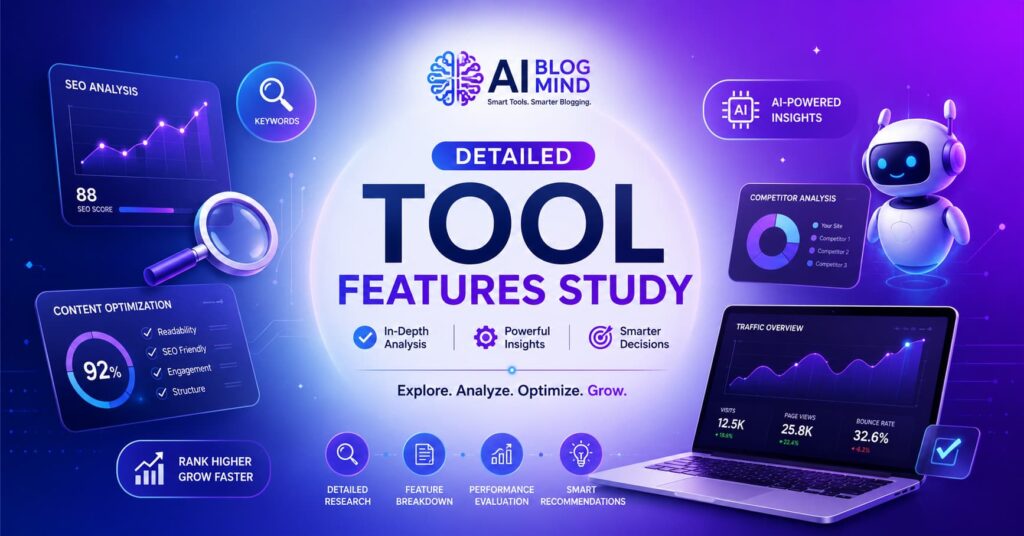
To understand what separates an excellent AI content generator from a mediocre one, it helps to look closely at the individual feature categories that matter most.
Prompt Understanding and Context Handling The strongest platforms interpret nuanced prompts accurately, remembering context across a longer document rather than losing track after a few paragraphs. This matters enormously for long-form content, where an ai blog writer needs to maintain a consistent argument and tone from introduction to conclusion.
Research and Fact Integration Some tools pull in real-time information from the web, reducing the risk of outdated or inaccurate claims. Others rely purely on their training data, which can lead to gaps or inaccuracies on fast-moving topics. Platforms with stronger research integration tend to produce content that reads as more credible and well-supported, since claims are backed by identifiable, current information rather than vague generalities.
Tone and Brand Voice Customization A quality AI content generator allows you to define a specific voice formal, conversational, technical, playful and apply it consistently across every piece of content. This is especially important for businesses that need every blog post, email, and social caption to sound like it came from the same brand.
SEO and Structural Guidance Many modern ai writing tools now analyze top-ranking competitor content before drafting, suggesting headings, word count targets, and related subtopics to cover. This overlaps closely with structuring content so it directly and clearly answers the reader’s core question early in each section a habit that also makes the content easier for search engines to lift accurately into summaries, snippets, and voice responses.
Originality and Plagiarism Detection Because so much AI-generated content is now published online, the better platforms run built-in originality checks to ensure output isn’t too similar to existing published material, protecting both search rankings and brand reputation.
Editing and Human-in-the-Loop Features The most reliable AI content generator platforms don’t treat their output as a finished product. They include easy editing interfaces, suggestion highlighting, and version history, encouraging a human reviewer to refine facts, add personal insight, and inject firsthand experience the model can’t generate on its own, details like specific results, screenshots, or lessons learned that make content feel authentically written by someone who has actually done the work.
Collaboration and Workflow Integration For teams, integration with content calendars, CMS platforms, and approval workflows turns an AI content generator from a novelty into an actual part of the publishing pipeline.
Benefits of Using an AI Content Generator
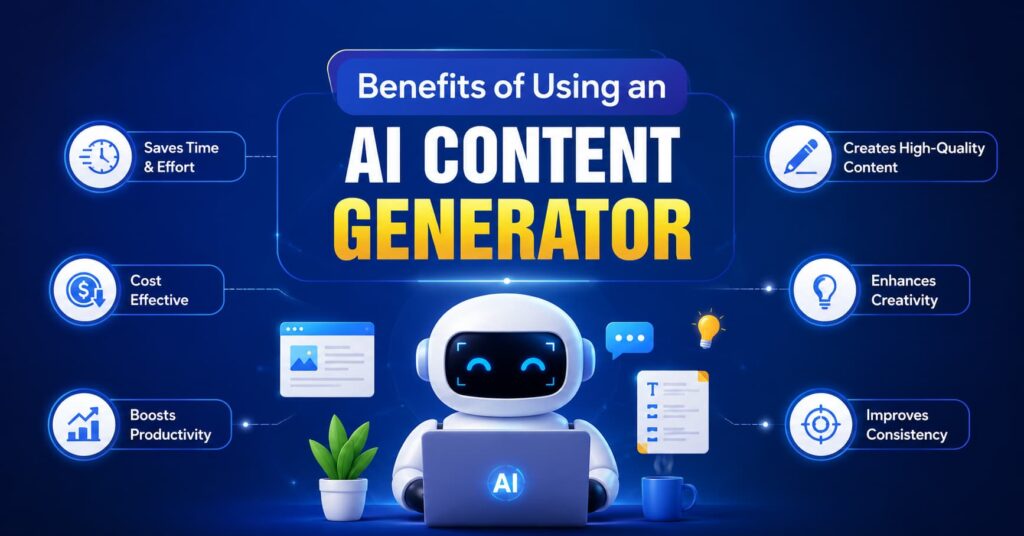
- Massive time savings:- Drafting content that once took hours can now take minutes, freeing up time for strategy and editing.
- Reduced writer’s block:- Even experienced writers benefit from having a starting draft to react to and improve.
- Improved consistency at scale:- Large content libraries maintain a uniform tone and structure more easily.
- Better keyword and structure alignment:- Many tools automatically suggest formatting that helps content perform well in search results.
- Accessible to non-writers:- Small business owners and non-native speakers can produce polished, professional content without a dedicated writing background.
- Faster iteration:- Multiple headline or angle variations can be generated instantly for testing.
- Support for answer-ready content:- Because well-designed tools encourage clear, direct answers early in a section, content is more likely to be accurately picked up by AI-generated search summaries and voice assistants.
Limitations to Keep in Mind
Follow Us on Instagram
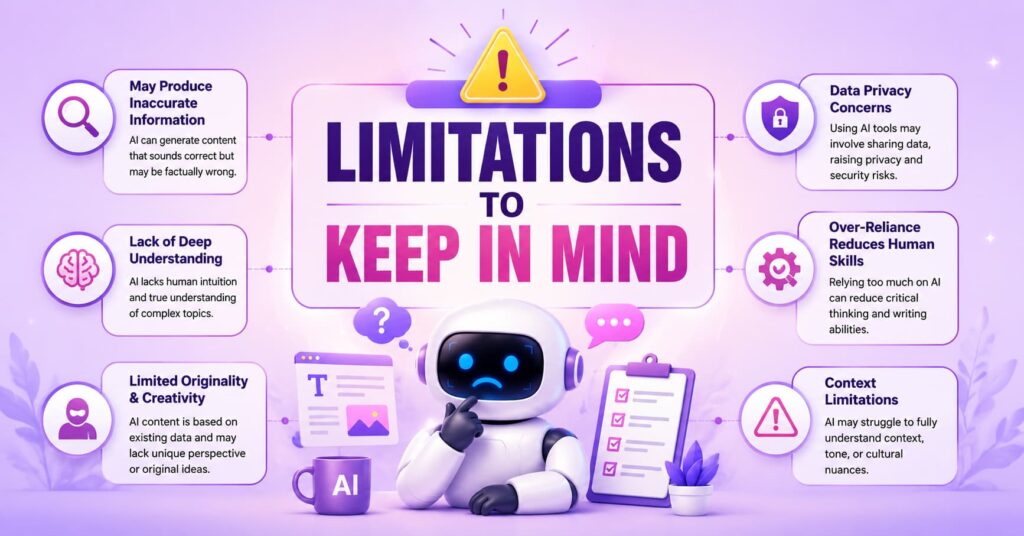
- Risk of generic output:- Without careful prompting and editing, content can sound bland or interchangeable with countless other AI-generated pages.
- Accuracy isn’t guaranteed:- An AI content generator can occasionally produce confident-sounding but incorrect information, especially on niche or rapidly evolving topics.
- Lack of genuine firsthand experience:- No matter how advanced the model, it can’t replace a human’s actual lived experience, opinions, or original research these still need to be added manually for content to feel authentic and trustworthy.
- SEO risk if overused carelessly:- Publishing large volumes of unedited AI content can trigger quality concerns, since search engines are increasingly good at detecting low-effort, unedited output.
- Learning curve for advanced features:- Getting the best results from an AI writer often requires learning how to prompt effectively, which takes some practice.
- Ongoing subscription costs:- Many of the more capable ai writing tools operate on tiered pricing, and the most useful features are often reserved for higher-cost plans.
- Editing is still required:- Treating an AI content generator as a fully autonomous replacement for editorial oversight tends to produce weaker, less trustworthy content than using it as a drafting assistant.
How to Choose the Right AI Content Generator
- If you need an all-purpose solution, a general ai writer with flexible templates will likely cover the widest range of use cases.
- If your priority is blogging or long-form content, look for a dedicated ai blog writer with strong outline and research features.
- If SEO visibility is your main goal, prioritize tools with competitor content analysis and keyword integration built in.
- If you manage a team, workflow integration and brand voice consistency should weigh heavily in your decision.
- If budget is tight, start with a free trial or lower-tier plan before committing to the more expensive ai writing tools on the market.
No matter which direction you lean, always pair any AI content generator with a human editing pass. The tool should accelerate your process, not replace the judgment, expertise, and firsthand knowledge that make content genuinely valuable to readers.
Common Mistakes to Avoid When Using an AI Content Generator
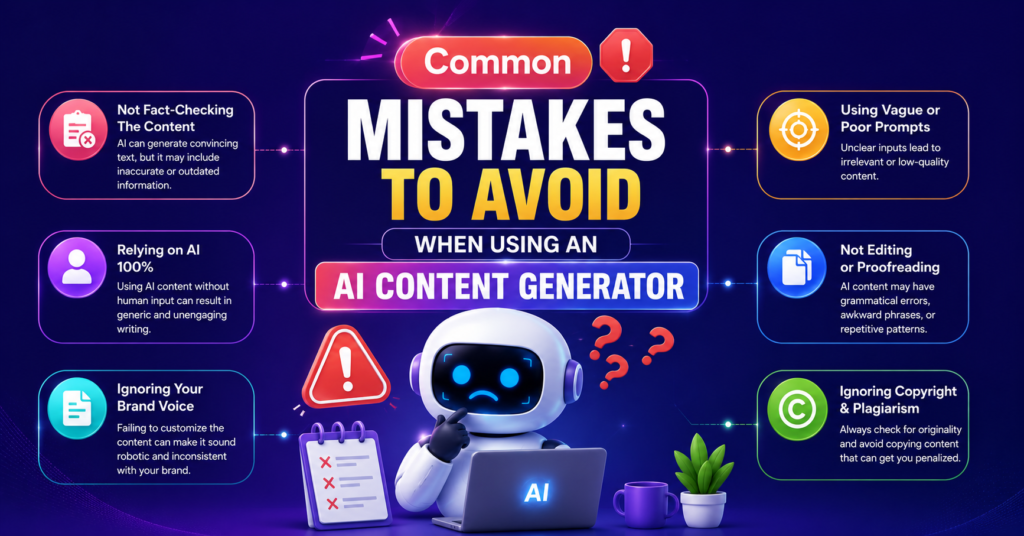
- Publishing without editing. Raw, unedited output from an AI content generator often lacks the specificity and polish that build reader trust.
- Ignoring factual verification. Always double-check statistics, dates, and claims before publishing, since even a strong ai writer can occasionally generate inaccurate details.
- Overusing generic prompts. Vague instructions tend to produce vague content; detailed prompts with clear context produce far stronger drafts.
- Skipping brand voice setup. Failing to customize tone settings results in content that feels disconnected from the rest of your website.
- Relying solely on automation. The most successful teams use an AI content generator as a first draft engine, then layer in original insight, data, and examples that only a human contributor can provide.
Comparing Pricing Tiers Across AI Content Generators
Cost is often the deciding factor when narrowing down which AI content generator to commit to long-term. While exact pricing shifts over time, it helps to understand the general tiers you’ll typically encounter:
- Free tiers usually cap word counts per month and limit access to advanced features like SEO scoring or long-form templates, but they’re a great way to test whether an AI writer’s tone and output quality match your needs.
- Entry-level plans (roughly $15–$40/month) typically unlock unlimited or high-volume word generation, more templates, and basic tone customization, a solid starting point for solo creators and freelancers.
- Mid-tier plans (roughly $60–$150/month) often add SEO integration, competitor content analysis, and team collaboration features, making them popular among small marketing teams relying on a dedicated ai blog writer.
- Enterprise plans (often $300+/month) include multiple user seats, brand voice training across large content libraries, API access, and priority support, necessary for larger organizations publishing at scale.
It’s worth testing the free trial of two or three platforms before committing to an annual subscription, since the quality and personality of the output can vary more between tools than the feature list alone suggests. Some ai writing tools genuinely shine at long-form blog content but feel clunky for short social captions, while others are the reverse, so matching the tool to your primary content type matters more than chasing the platform with the longest feature list.
Content Signals That Influence How AI-Generated Content Performs
Beyond raw drafting speed, the way content is structured and supported has a real impact on how well it performs both with human readers and with the automated systems that summarize search results. A few signals worth building into your process when using an AI content generator:
- Author credibility. Clear bylines and visible expertise behind a piece help readers and algorithms trust the content.
- Original insight. Data, screenshots, and specific examples that no other page has make a piece stand out from other AI-generated content covering the same topic.
- Clear sourcing. Linking to credible references signals that claims are backed by something beyond the model’s internal training data.
- Direct, scannable answers. Structuring each section so it answers the reader’s question clearly near the top makes content easier to summarize accurately in search snippets and AI-generated overviews.
Building these habits into every draft whether it comes from a general AI writer or a specialized AI blog writer is what separates content that ranks and gets cited from content that blends into the flood of generic AI output already online.
Final Thoughts
An AI content generator has changed how individuals and teams approach content creation, offering speed, consistency, and scale that simply weren’t possible a few years ago. But the tools that produce the best results are the ones used thoughtfully as a drafting partner rather than a replacement for human judgment. Whether you’re using a general-purpose ai writer, a specialized ai blog writer, or exploring different ai writing tools to find the right fit, the winning formula stays the same: let the AI handle the heavy lifting of structure and speed, then layer in the firsthand expertise, accuracy, and original insight that make content genuinely worth reading.
Frequently Asked Questions
1. Is content from an AI content generator good for SEO?
It can be, provided the output is edited for accuracy, structured clearly, and enhanced with original insight. Search engines don’t penalize content simply for being AI-assisted, but they do reward content that’s genuinely useful, well-organized, and trustworthy qualities that require human review on top of any automated draft.
2. What’s the difference between an AI writer and an AI blog writer?
An ai writer is typically a broad tool capable of producing many content types emails, captions, product descriptions, and articles. An ai blog writer is more specialized, focused specifically on long-form content with features like outline generation, research assistance, and SEO scoring built around blog-length articles.
3. Can an AI content generator replace human writers entirely?
Not effectively, at least not yet. While an AI content generator can handle drafting and structure extremely well, it still lacks genuine firsthand experience, nuanced judgment, and the ability to verify facts independently all things a human editor or writer needs to contribute for the content to feel authentic and reliable.
4. Are free AI writing tools worth trying before paying for a subscription?
Yes. Many platforms offer free tiers or trials that are more than capable of handling short content, social captions, or quick drafts. They’re a good way to test whether a particular AI content generator’s tone and style match your needs before committing to a paid plan.
5. How do I make AI-generated content sound more human and trustworthy?
Add specific examples, personal insight, and firsthand detail that the model can’t generate on its own. Editing for tone, verifying facts, and structuring the piece around a clear, direct answer to the reader’s question all help the final content feel genuinely written by someone with real expertise, rather than generic machine output.
Know more About Us.

Hi, I’m Rufqha, the SEO Manager at AIBlogMind. I focus on building content strategies that help websites improve visibility, attract the right audience, and create sustainable organic growth. My expertise includes on-page SEO, keyword research, content optimization, and aligning SEO with user experience and business goals.