




Print Media Explained: Simple Guide for Beginners
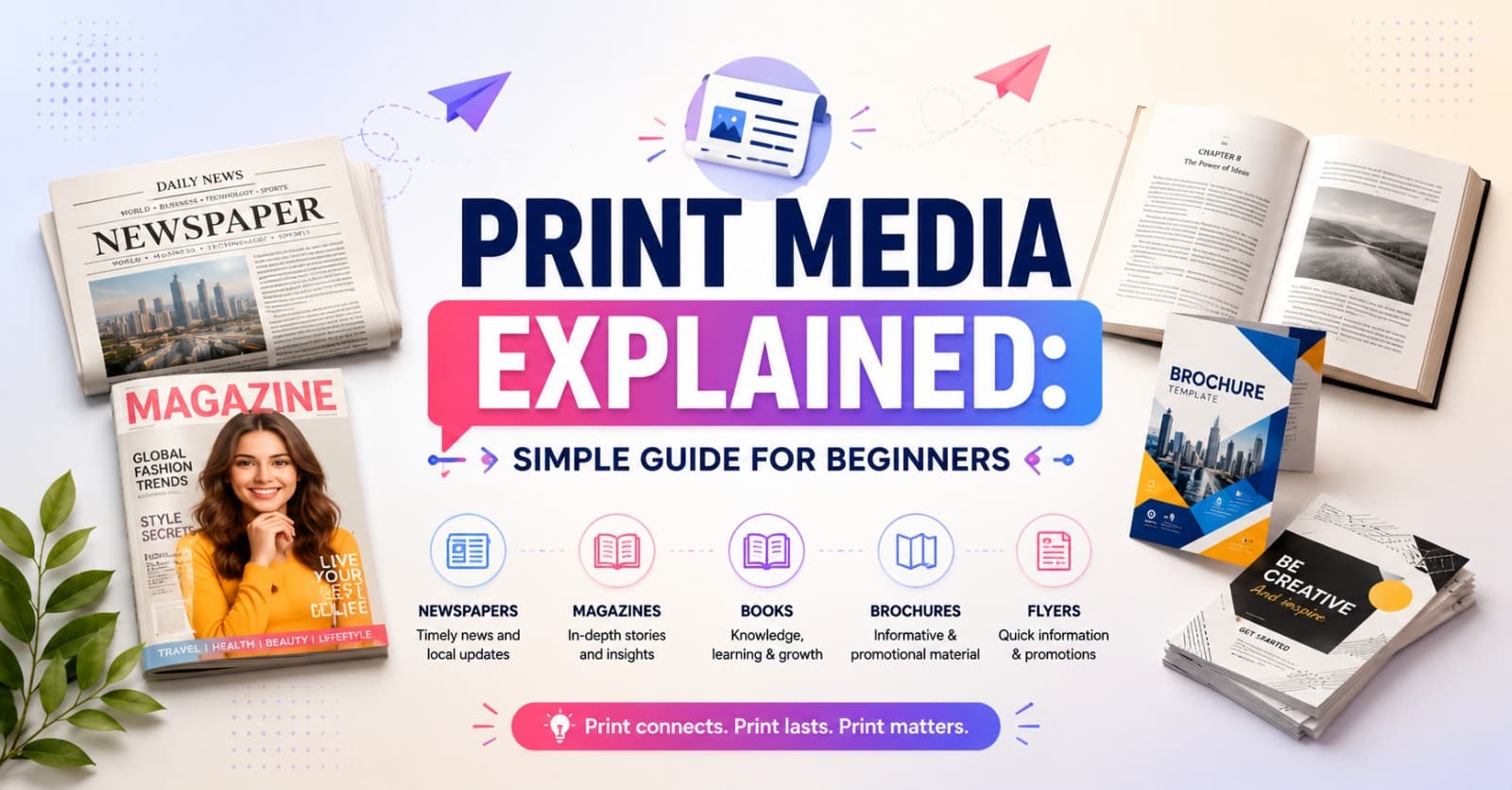
Whether you’ve flipped through a morning newspaper, glanced at a billboard on your commute, or leafed through a glossy magazine in a waiting room, you’ve already interacted with print media. But what exactly is print media, and why does it still matter in an age dominated by smartphones and social feeds? This beginner’s guide breaks down everything you need to know about print media – from its definition and history to the different types of printed media and how it continues to serve audiences, businesses, and communities around the world.
It refers to any form of communication that is physically produced by printing text, images, or graphics onto a surface – most commonly paper. It is one of the oldest and most trusted forms of mass communication, predating television, radio, and the internet by centuries. Even today, print media remains a cornerstone of journalism, advertising, education, and creative expression.
In this guide, we will walk you through the foundations of printed media in a way that is clear, accurate, and useful – whether you are a student, a small business owner, a marketer, or simply someone curious about how information has traveled through the ages.
What Is Print Media?
Print media is any form of communication where content is reproduced on a physical surface using a printing process. This includes text, photographs, illustrations, charts, and other visual elements. The term print media encompasses a broad range of publications and materials – from daily newspapers and monthly magazines to brochures, flyers, posters, books, and catalogs.
The core distinguishing feature of print media is its tangibility. Unlike digital content, print media can be held in your hands, saved, annotated, and shared physically. This physical quality gives print media a sense of permanence and credibility that digital channels often struggle to replicate.
A Brief History of Print Media
The story of print media begins with Johannes Gutenberg’s invention of the movable-type printing press around 1440. Before this revolutionary technology, books and manuscripts were copied by hand – a slow, expensive, and error-prone process. Gutenberg’s press made it possible to produce print media at scale, enabling the mass distribution of information for the first time in human history.
The printing press democratized knowledge. Within decades of its invention, newspapers and pamphlets began circulating across Europe, spreading news, ideas, and debate. Over the centuries, print media evolved through technological advances, from steam-powered presses to offset lithography – becoming faster, cheaper, and more sophisticated with each era.
By the 19th century, it had become the dominant form of mass communication. Newspapers reached millions daily, magazines shaped culture and fashion, and books preserved human knowledge across generations. Even as radio, television, and later the internet emerged, print media adapted and retained its place as a credible, reliable medium.
Different Types of Print Media
Understanding the different types of print media helps you appreciate how varied and versatile this form of communication truly is. Each type serves a unique purpose and targets a specific audience. Let’s explore the major categories:
1. Newspapers
Print media in the form of newspapers is the most recognizable format in daily life. Published daily, weekly, or on a special-edition basis, newspapers cover local, national, and international news. They include editorial pieces, opinion columns, classifieds, and advertisements. Newspapers are trusted by readers for timely, fact-checked information – making them one of the most credible forms of print media.
2. Magazines
Magazines are a widely consumed type of printed media that target specific interest groups. Whether focused on lifestyle, fashion, science, technology, sports, or business, magazines offer in-depth articles, high-quality imagery, and curated advertising. Their longer editorial shelf-life – typically weekly or monthly – gives it’s magazines a deeper, more detailed voice than newspapers.
3. Books
Books represent one of the most enduring forms of print media. From textbooks and reference manuals to novels and poetry collections, books transmit knowledge, culture, and stories across generations. The book publishing industry remains one of the largest segments of the printed media market worldwide.
4. Brochures and Pamphlets
Businesses and organizations frequently use brochures and pamphlets as targeted print media materials. These are cost-effective, easily distributable, and highly visual. A well-designed brochure can convey a brand’s message, products, or services at a glance – making it a popular choice in event marketing, tourism, healthcare, and retail sectors.
5. Flyers and Leaflets
Flyers and leaflets are among the simplest and most affordable forms of it . Typically single-sided and produced in large quantities, they are ideal for announcing events, promotions, or services. Local businesses, political campaigns, and community organizations rely heavily on this format of printed media to reach their target audiences quickly.
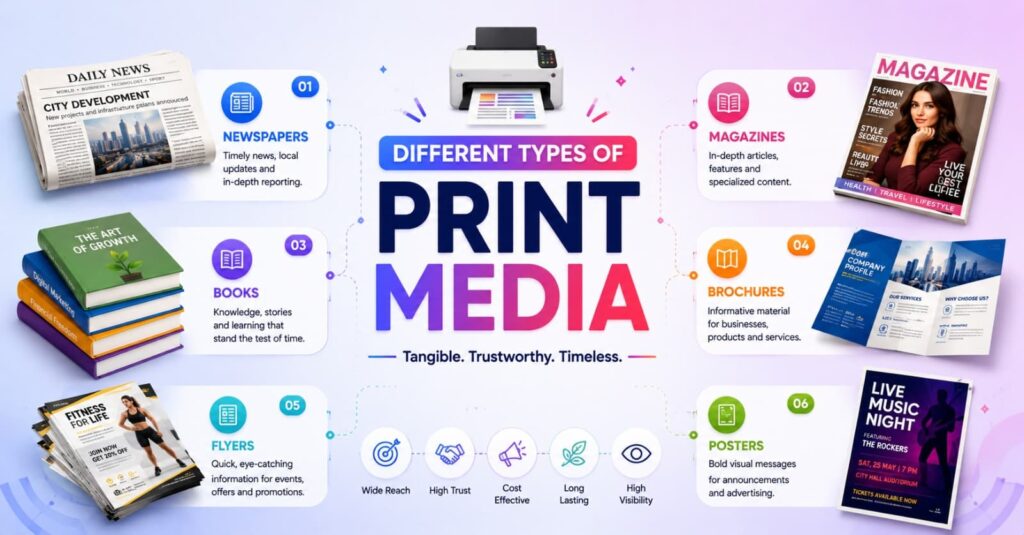
6. Posters and Banners
Posters and banners are large-format printed media designed for high visibility. They are placed in public spaces – bus stops, shopping malls, stadiums – to capture the attention of passersby. In advertising, this type of print media is known as out-of-home (OOH) advertising.
7. Catalogs
Retail brands and B2B companies use catalogs as detailed printed media tools to showcase their product ranges. A well-produced catalog guides the reader through offerings, specifications, and pricing in a convenient printed format. Many consumers still prefer the tactile experience of browsing a physical catalog over scrolling through a website.
8. Newsletters
Newsletters – whether produced by schools, nonprofits, or businesses – are a community-focused form of print media. Distributed on a regular basis, they keep readers informed about updates, events, and news within a specific group or organization.
Creative Print Media: Where Art Meets Communication
Beyond functional communication, creative print media represents the intersection of design, art, and messaging. This category includes beautifully designed coffee table books, limited-edition art prints, custom packaging, zines (self-published independent magazines), and artistic branding materials.
In the world of marketing, creative printed media is used strategically to create memorable brand experiences. Think of a luxury brand that mails clients a beautifully embossed invitation, or a startup that uses letterpress-printed business cards to make a tactile first impression. These examples show how creative printed media elevates the physical experience of receiving and reading material far beyond what a digital notification can offer.
Graphic designers, illustrators, and typographers have long regarded print media as a canvas for their finest work. The constraints of physical printing, paper weight, ink type, color reproduction – push creative professionals to think more deliberately about layout, hierarchy, and visual impact.
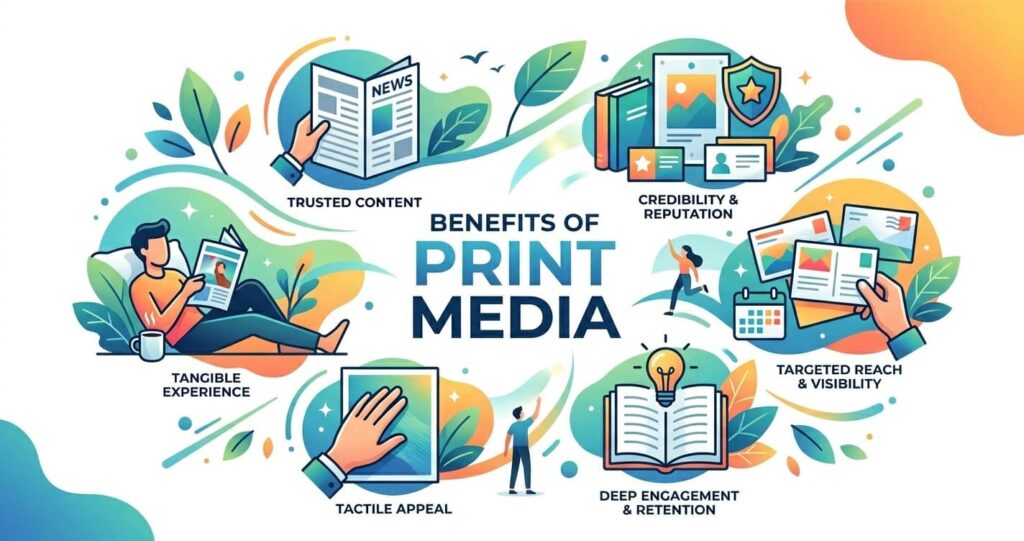
Benefits of Print Media
Understanding the advantages of print media helps explain why it has survived and thrived for centuries alongside newer technologies.
1. High Credibility and Trust
Multiple studies and industry surveys consistently show that consumers trust print media more than digital advertising. A printed advertisement or editorial piece carries a sense of legitimacy – it required physical investment to produce and distribute. This trust factor makes it especially valuable for brand reputation and serious journalism.
2. Tangibility and Longevity
Unlike a social media post that disappears in seconds from a user’s feed, it stays around. A magazine can sit on a coffee table for months. A brochure can live in a drawer for years. This extended exposure gives print media a much longer active lifespan than most digital content.
3. Targeted Reach
Many forms of print media particularly niche magazines and direct mail – allow advertisers to reach very specific demographics with precision. A publication about sustainable gardening, for example, delivers print media content to a ready, interested audience with minimal waste.
4. Reduced Digital Fatigue
As screen time increases globally, more people are actively seeking relief from digital devices. it offers a screen-free alternative that many readers find relaxing and cognitively refreshing. Studies have shown that people retain information better when reading from papers compared to screens.
5. No Algorithm Dependence
One of the most underrated strengths is that it operates independently of search algorithms, social media platforms, or internet connectivity. A printed newspaper delivers its content to every reader equally – no filtering, no personalization bias, and no risk of being de-ranked or suppressed by a platform’s algorithm.
6. Premium Perceived Value
High quality print media especially glossy magazines, luxury catalogs, and premium brochures – carries an inherent sense of value. The investment required to produce quality media signals to the reader that the brand or publisher takes their content seriously.
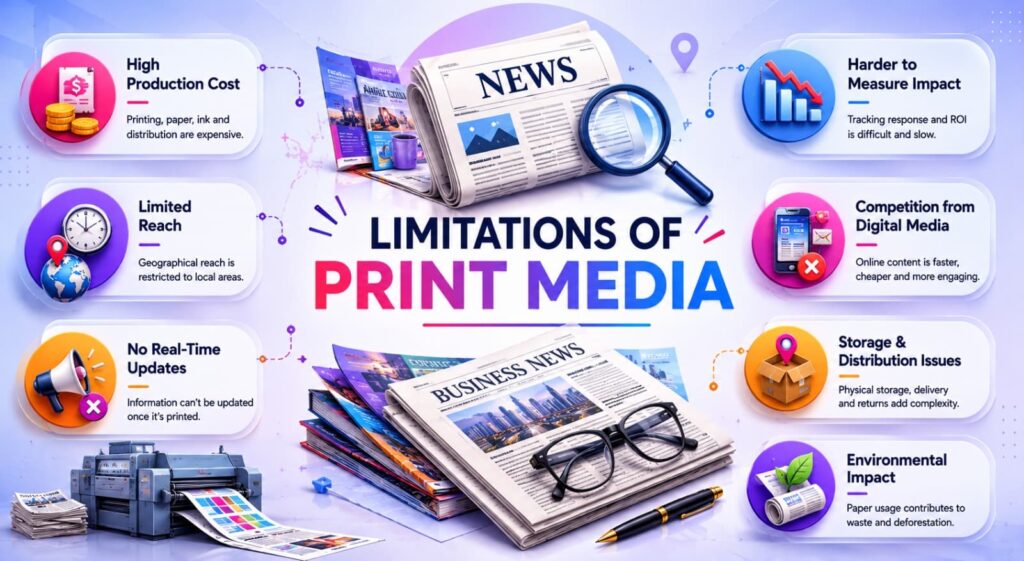
Limitations of Print Media
While print media has clear strengths, it also carries inherent limitations that businesses and publishers must carefully consider.
1. Higher Production Costs
Producing quality print media requires investment in design, printing, paper, and distribution. Compared to a digital post that can be published instantly at near-zero cost, print media production requires lead time and capital, making it less suitable for last-minute or frequent updates.
2. Limited Real-Time Updates
One of the biggest drawbacks is its inability to be updated after printing. Once a newspaper goes to press with an error, it cannot be corrected instantly like a webpage. This lack of agility makes it slower to respond to breaking news and rapidly changing situations.
3. Environmental Concerns
The production of print media involves paper, ink, and energy – all of which carry environmental costs. While the industry has made strides toward sustainable printing practices, it still faces scrutiny from environmentally conscious audiences and businesses.
4. Declining Readership in Some Segments
Younger demographics increasingly consume news and information through digital channels, which means certain forms of it, particularly daily newspapers have seen declining readership. Adapting it to remain relevant to all age groups is an ongoing challenge for publishers.
5. Difficult to Measure ROI
Unlike digital advertising where clicks, impressions, and conversions can be tracked in real time, measuring the return on investment (ROI) of print media campaigns is more complex. Marketers often rely on indirect indicators such as coupon redemptions, unique phone numbers, or surveys to gauge the effectiveness of print media advertising.
Detailed Feature Study: Key Tools and Techniques in Print Media Production
Modern print media production relies on a sophisticated set of tools and technologies. Whether you are a professional designer, a print buyer, or a marketer planning a print media campaign, understanding these features is essential.
1. Desktop Publishing (DTP) Software
Tools like Adobe InDesign, QuarkXPress, and Affinity Publisher are the backbone of professional print design. They allow designers to control typography, layout, image placement, and color with precision. These programs produce print-ready files in formats such as PDF/X, which are optimized for high-quality commercial printing.
2. Color Management Systems
Color accuracy is critical in print media production. The CMYK color model (Cyan, Magenta, Yellow, Key/Black) is the standard for print, as opposed to the RGB model used for screens. Color management tools ensure that what designers see on their monitors accurately translates to the final printed piece, preventing costly reprints.
3. Typography and Font Licensing Tools
Typography is arguably the most powerful design element in print media. Platforms like Adobe Fonts, Monotype, and Google Fonts provide access to thousands of typefaces. Proper font licensing ensures that it producers use fonts legally across print runs of any size.
4. Print-on-Demand Platforms
Services like Moo, Vistaprint, and Blurb have democratized print media by allowing individuals and small businesses to produce professional-grade printed materials in small quantities at affordable prices. This has lowered the barrier to entry for high-quality print media significantly.
5. Offset vs. Digital Printing
Understanding the difference between printing methods is vital for any print media project. Offset printing is ideal for large runs – the cost per unit decreases significantly with volume – and delivers superior color consistency. Digital printing is better for short runs and personalized content, offering flexibility that traditional offset print media printing cannot match.
6. Paper Stock and Finishing Options
The physical feel of print media matters enormously. Paper weight, texture, coatings (matte, gloss, satin), and finishing techniques (embossing, debossing, spot UV, die-cutting) all influence how a printed piece is perceived. Premium finishing elevates it from functional to memorable.
7. Proofing and Pre-Press Tools
Before any of it goes to press, it undergoes a proofing stage. Soft proofs (on-screen) and hard proofs (physical prints) allow designers and clients to review color, layout, and content accuracy. Pre-press checklists cover bleed settings, crop marks, image resolution (minimum 300 DPI for quality print media), and font embedding.
The Future of Print Media in a Digital World
Contrary to predictions of its demise, print media has proven remarkably resilient. Rather than disappearing, it has repositioned itself as a complement to digital channels. Savvy publishers and brands are now using it in integrated, multi-channel campaigns, pairing printed newsletters with email lists, or using QR codes in print media advertisements that direct readers to digital landing pages.
The rise of independent publishing, artisan zines, and boutique magazine culture shows that audiences continue to seek the depth and craftsmanship that it uniquely offers. In a world saturated with digital noise, a well-crafted printed piece can cut through the clutter in ways that a digital ad rarely achieves.
For businesses and communicators in 2024 and beyond, the question is not whether to use print media or digital media – it is how to use both intelligently. Understanding its strengths, its formats, and its production process is a skill that remains highly valuable across industries.
Conclusion
From the dawn of the Gutenberg press to the artisan zines of today, print media has proven its staying power time and time again. It is not merely a relic of the past – it is a living, evolving medium that continues to inform, inspire, and connect people around the world. Understanding its different types, its creative possibilities, and its production tools is the first step toward using it effectively, whether for education, business, or personal expression.
As you explore the world of print media, remember that the most powerful communication combines clarity, credibility, and craft. Whether you are designing your first flyer or planning a full-scale magazine launch, the principles of great print media remain timeless: know your audience, respect the medium, and deliver content that is genuinely worth reading.
Frequently Asked Questions (FAQs)
Q1. What is the primary definition of print media?
It refers to any form of mass communication that is produced by printing text and images onto a physical surface, typically paper. Common examples of print media include newspapers, magazines, books, brochures, flyers, and posters. It is one of the oldest and most trusted forms of human communication, dating back to Gutenberg’s invention of the movable-type press in the 15th century.
Q2. What are the different types of print media?
The main different types of print media include:
• Newspapers – for daily or weekly news coverage
• Magazines – for in-depth, topic-specific content
• Books – for long-form knowledge and storytelling
• Brochures and pamphlets – for business and marketing use
• Flyers and leaflets – for events and promotions
• Posters and banners – for large-format visibility
• Catalogs – for product showcases
• Newsletters – for community and organizational updates
Q3. Is print media still relevant today?
Absolutely. While digital media has grown significantly, paper media remains highly relevant. It continues to be trusted by consumers, valued by advertisers, and preferred by certain audiences – particularly for long-form reading, luxury brand communication, and local community news. Many businesses successfully use it alongside their digital strategies for maximum reach and impact.
Q4. What is creative print media and how is it used?
Creative print media refers to printed materials that combine strong design aesthetics with communication goals. It includes limited-edition art books, designer packaging, hand-crafted zines, and premium branded materials. Businesses and artists use creative media to create memorable, tactile experiences that leave lasting impressions on their audiences – something that digital formats often struggle to replicate.
Q5. What are the main advantages and disadvantages of print media?
The main advantages include high credibility and trust, tangibility and longevity, targeted reach, reduced digital fatigue, and independence from algorithms. The main disadvantages include higher production costs, inability to update content in real time, environmental considerations, and challenges in measuring campaign ROI. Despite these limitations, It remains a powerful and effective communication tool when used strategically.
know more About Us

Hi, I’m Rufqha, the SEO Manager at AIBlogMind. I focus on building content strategies that help websites improve visibility, attract the right audience, and create sustainable organic growth. My expertise includes on-page SEO, keyword research, content optimization, and aligning SEO with user experience and business goals.