



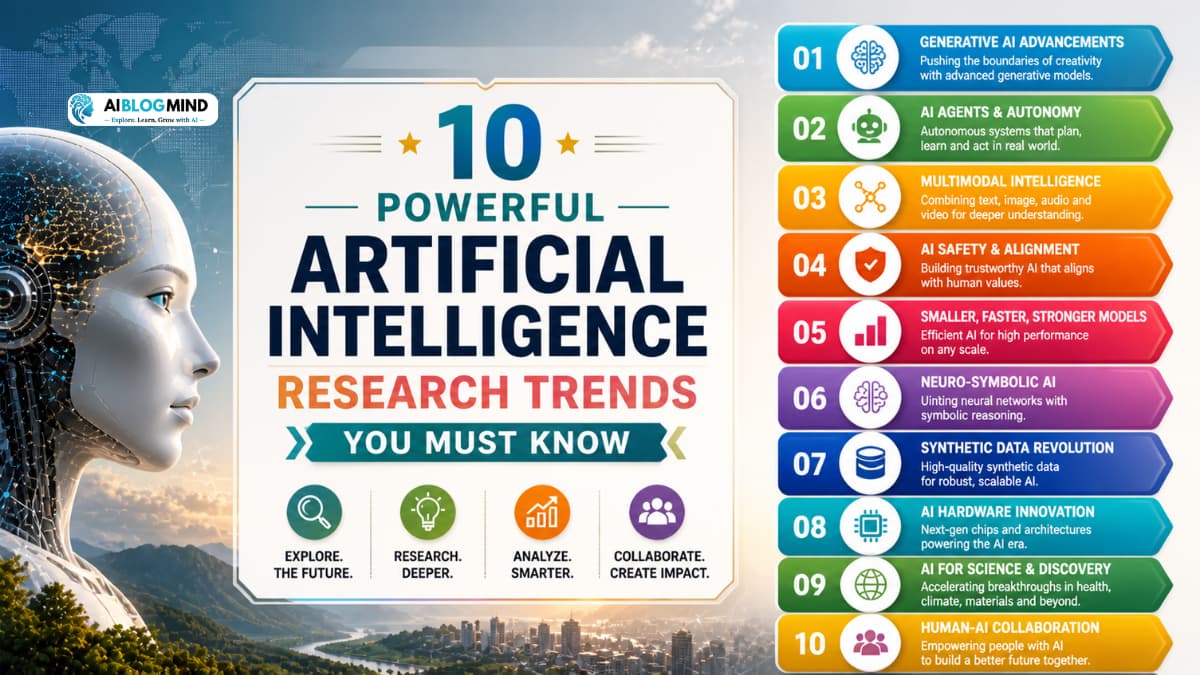
10 Powerful Artificial Intelligence Research Trends You Must Know
Did you know that the global artificial intelligence market is projected to exceed $1.8 trillion by 2030? That staggering number tells you everything about where the world is heading and why keeping up with AI research is no longer optional.
Every week, something new happens in artificial intelligence research. A new model breaks a benchmark. A startup launches AI tools that were science fiction just two years ago. Governments draft regulations. Researchers publish papers that make tech headlines worldwide. It can feel overwhelming even for professionals who work in tech every day.
For beginners, the confusion is even bigger. What is artificial intelligence research actually trying to solve? Which AI trends are hype and which ones will genuinely change the world? Which are the best artificial intelligence research tools available today, and how do you even start learning?
This article gets straight to the point. Here, you’ll get a clear, jargon-free overview of the 10 most important trends in artificial intelligence research right now what they mean, why they matter, and how they could affect your career, business, or everyday life.
Whether you are a curious beginner, a working professional, or a student exploring the field, this guide is written for you.
Benefits of Artificial Intelligence Research
Artificial intelligence research is not just for scientists in laboratories. Its benefits reach into hospitals, classrooms, small businesses, and living rooms. Understanding what AI research delivers helps you see why the field attracts billions of dollars in investment every year.
For businesses: Artificial intelligence research translates directly into smarter products, faster decisions, and lower costs. Companies use AI tools to automate customer service, predict supply chain disruptions, personalize marketing, and detect fraud in real time.
For students and researchers: the field offers some of the most exciting career opportunities of this generation. The demand for people who understand artificial intelligence research is growing far faster than universities can produce graduates. Fields like healthcare, climate science, finance, and education are all hungry for AI-literate talent.
For everyday people: for everyday people, artificial intelligence research makes technology more intuitive and personalised powering tools like smart spell-checkers, predictive navigation, and voice assistants. Access to the best AI research tools is now easier than ever, with platforms like Google Scholar and others enabling anyone to explore research, discover related work, and track ideas over time, helping democratise knowledge.
Quick answer: The biggest benefit of following artificial intelligence research is that it keeps you informed about tools and techniques that are actively reshaping industries often before they go mainstream.
Limitations of Artificial Intelligence Research
No field is without challenges, and artificial intelligence research is no exception. Understanding its limitations helps you approach the subject with realistic expectations.
Complexity and steep learning curves: Artificial Intelligence research can be difficult for beginners due to advanced math like algebra, calculus, and statistics. While modern AI tools make research easier to access, fully understanding it still takes time and effort.
High costs: Training frontier AI models requires enormous computing resources. Only well-funded companies and research institutions can afford to train the largest models. This creates an uneven playing field where a handful of organisations dominate the cutting edge of artificial intelligence research.
Ethical and social risks: Artificial intelligence research has produced systems that can be biased, opaque, and potentially manipulative. Research into fairness, accountability, and transparency in AI is growing fast, but so are the harms that poorly designed AI systems can cause.
Reproducibility problems: A surprising number of artificial intelligence research papers describe results that are difficult or impossible to reproduce. This is a growing concern in the scientific community, as it makes it hard to build reliably on previous work.
Keeping up is a full-time job: The volume of new papers published in artificial intelligence research is staggering thousands every month on platforms like arXiv alone. Even specialists struggle to keep pace. This is actually where AI tools come in handy: tools like Elicit and Semantic Scholar use AI itself to help researchers navigate this flood of information.
Artificial Intelligence Research Tools
Here are the ten trends that are defining the current direction of artificial intelligence research. Each one is reshaping industries, opening new possibilities, and attracting huge amounts of academic and commercial attention.
1. Generative AI and Large Language Models (LLMs)
Generative AI is arguably the most visible trend in artificial intelligence research today. Large language models like GPT-4, Claude, and Gemini can write, reason, code, summarise, and converse at near-human level. The underlying research transformer architectures, attention mechanisms, and reinforcement learning from human feedback (RLHF) has fundamentally changed what AI can do.

Real-world example: Writers use LLMs to draft content. Developers use them as coding assistants. Doctors use them to summarise patient records and research notes.
Why it matters: This trend has moved artificial intelligence research from an academic topic into everyday productivity. The best AI research tools themselves now use LLMs to help users find and interpret scientific literature.
Future potential: Researchers are working on making LLMs more accurate, less prone to hallucination, and capable of reasoning over very long documents. Multi-modal models that can process images, audio, and text together represent the next frontier.
2. AI Safety and Alignment Research
As AI systems grow more powerful, the question of how to ensure they behave safely and in accordance with human values has become one of the most critical areas of artificial intelligence research. AI alignment is the study of how to build AI that reliably does what its designers intend even as it becomes more capable.
Real-world example: Anthropic, OpenAI, and DeepMind all run dedicated safety teams. Their published research covers topics like interpretability (understanding what AI systems “think”), reward hacking, and scalable oversight.
Why it matters: A misaligned AI system could optimise for the wrong goal with devastating efficiency. Solving alignment is considered by many researchers to be one of the most important problems in human history.
Future potential: Advances in interpretability and formal verification of neural networks could make it possible to mathematically guarantee certain AI behaviours a breakthrough that would transform the entire field.
3. Multimodal AI Systems
Traditional AI systems specialised in one type of data text, images, or audio. Multimodal artificial intelligence research focuses on building systems that can process and reason across multiple types of information simultaneously. Think of it as giving AI the ability to see, read, hear, and think all at once.
Real-world example: Google’s Gemini and OpenAI’s GPT-4o can look at an image, read text about it, and answer questions that require understanding both.
Why it matters: Most real-world problems involve multiple types of data. Multimodal artificial intelligence research is bringing AI closer to the way humans actually understand the world.
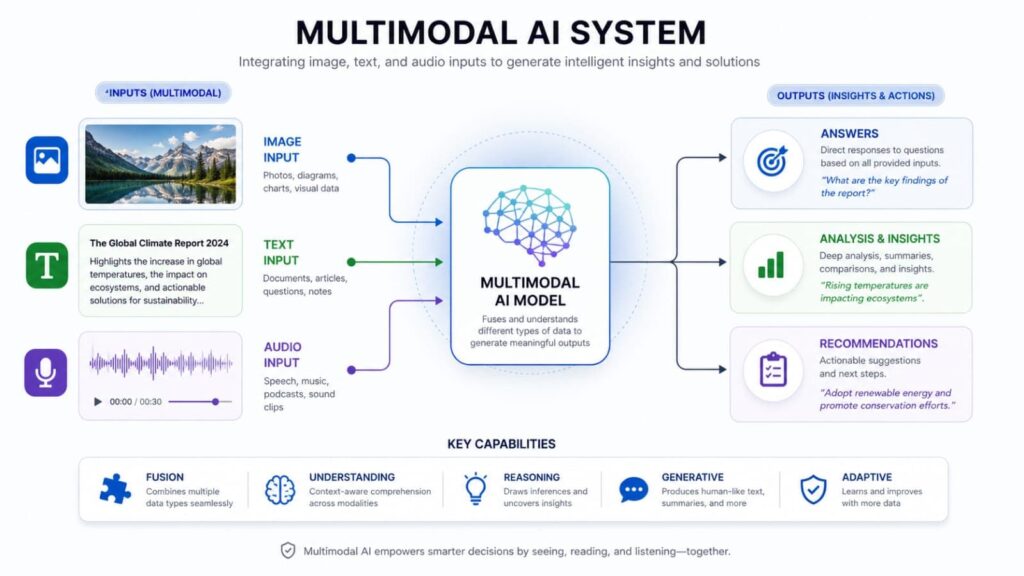
Future potential: Future multimodal systems will likely incorporate video, 3D data, and real-time sensor input enabling AI agents that can genuinely understand physical environments.
4. Agentic AI and Autonomous Systems
Agentic AI refers to systems that can plan, make decisions, use tools, and take actions over extended sequences without a human directing every step. This is one of the fastest-moving areas of artificial intelligence research, and it is already reshaping how businesses think about automation.
Real-world example: AI agents can browse the internet, write and execute code, send emails, and book meetings all in response to a single high-level instruction. Tools like Auto GPT and Devin (an AI software engineer) are early demonstrations of this direction.
Why it matters: Agentic AI could automate entire workflows, not just individual tasks. This changes the economics of knowledge work dramatically.
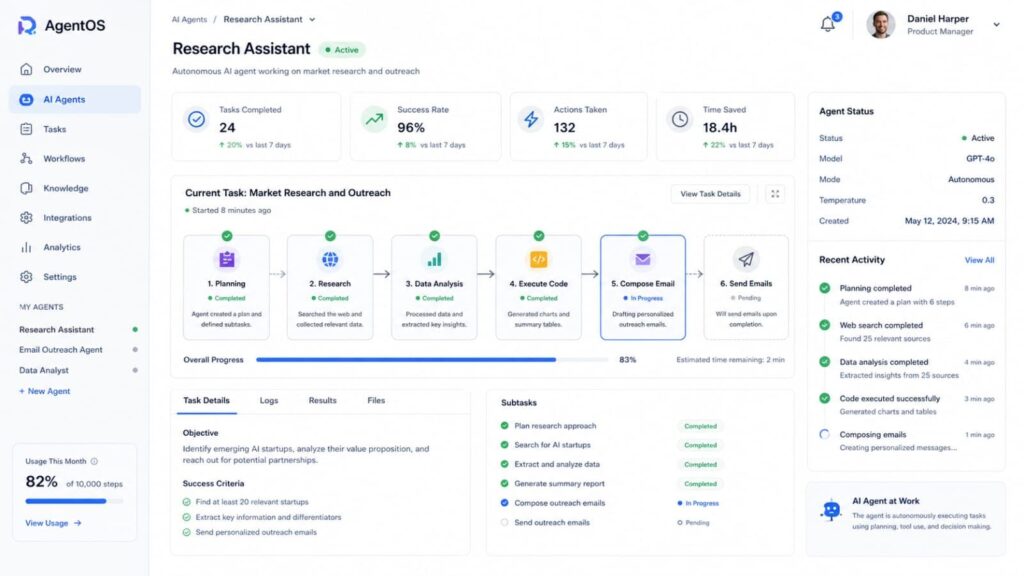
Future potential: As artificial intelligence research on planning, memory, and tool-use matures, agents will become capable of managing complex, multi-day projects with minimal human input.
5. AI for Scientific Discovery
Artificial intelligence research is accelerating the pace of scientific discovery across biology, chemistry, physics, and materials science. AI doesn’t just analyse data faster it identifies patterns and generates hypotheses that human researchers might never have considered.
Real-world example: DeepMind’s AlphaFold predicts protein structures with high accuracy, advancing drug discovery. In climate science, AI tools model complex systems more efficiently than traditional methods.
Why it matters: Diseases that take decades to research and treat may be understood in years. Materials for next-generation batteries, solar cells, and superconductors could be discovered at machine speed.

Future potential: AI may become an indispensable co-researcher in every scientific discipline, finding the signal in datasets too large and complex for unaided human analysis.
6. Edge AI and On-Device Intelligence
Most AI systems today run in the cloud your data travels to a data centre, gets processed, and a result comes back. Edge AI is the artificial intelligence research trend focused on running AI models directly on local devices: your smartphone, smartwatch, laptop, or industrial sensor.
Real-world example: Apple’s Neural Engine processes face recognition and voice commands on your iPhone without sending data to a server.
Why it matters: Edge AI means faster responses, better privacy, and AI capabilities in places with no reliable internet connection remote hospitals, farms, ships, and factories.
Future potential: As chips designed specifically for AI workloads become cheaper and more powerful, nearly every connected device will run meaningful AI locally. This will fundamentally change privacy and data ownership.
7. Explainable AI (XAI) and Interpretability
Modern AI models, particularly deep learning systems, are often described as “black boxes.” They produce answers, but it can be impossible to understand why. Explainable AI is the area of artificial intelligence research dedicated to making AI decisions understandable and auditable by humans.
Real-world example: When AI denies a loan or flags a medical image, regulators and users want an explanation. XAI methods like LIME and SHAP show which factors influenced the model’s decision, making it easier to understand.
Why it matters: Trust is foundational. Without the ability to explain AI decisions, it is impossible to catch systematic bias, ensure regulatory compliance, or hold systems accountable when they cause harm.
Future potential: As regulation tightens globally especially in the EU under the AI Act XAI will shift from a research interest to a legal requirement for many applications.
8. AI and Robotics: Physical World Intelligence
For decades, robotics and artificial intelligence research ran on largely parallel tracks. That is changing. Modern robotics research increasingly integrates deep learning, computer vision, and language understanding, creating robots that can adapt to unstructured environments in ways that rule-based systems never could.
Real-world example: Boston Dynamics robots use AI to navigate uneven terrain. Tesla’s Optimus humanoid robot uses vision-based AI to manipulate objects.
Why it matters: Robots that can reason and adapt could transform manufacturing, construction, elder care, and disaster response sectors that have long resisted automation because of their unpredictability.

Future potential: Foundation models trained on internet-scale data are now being adapted for robotic control, potentially giving future robots a broad base of world knowledge to draw from.
9. Federated Learning and Privacy-Preserving AI
Training AI models normally requires centralising large amounts of data which creates privacy risks and regulatory headaches. Federated learning is an artificial intelligence research approach that allows models to be trained across many devices or organisations without the raw data ever leaving its source.
Real-world example: Google uses federated learning to improve the next-word prediction on Android keyboards. Hospitals use similar techniques to train diagnostic AI across multiple institutions without sharing sensitive patient records.
Why it matters: Privacy-preserving AI makes it possible to train better models in sensitive domains healthcare, finance, law where data sharing is legally or ethically impossible.
Future potential: As data sovereignty laws proliferate worldwide, federated learning will become essential infrastructure for any organisation that wants to use AI responsibly.
10. AI in Education and Personalised Learning
One of the most human and hopeful areas of artificial intelligence research is education. AI systems can now adapt teaching content to the pace and style of individual learners, identify gaps in understanding, provide instant feedback, and give every student the kind of personalised attention that was once only possible with a private tutor.
Real-world example: Platforms like Khan Academy use AI to guide learners through personalised problem sets. Language learning apps like Duolingo use machine learning to predict which words you are about to forget and schedule review accordingly.
Why it matters: Education is the great equaliser. If AI can deliver high-quality, personalised instruction at scale, it could reduce educational inequality in ways that traditional systems have never managed to achieve.
Future potential: Future AI tutors will combine natural conversation, adaptive curriculum, and deep understanding of individual learning psychology. The best artificial intelligence research tools of the 2030s may well be ones designed to accelerate human learning itself.
Trend Comparison: Impact, Difficulty, and Use Cases
Not all artificial intelligence research trends are created equal. Some are already mature and accessible; others are cutting-edge and require deep technical expertise. Use this table to quickly understand where each trend sits.
| AI Research Trend | Impact Level | Difficulty | Best For | Timeframe |
|---|---|---|---|---|
| Generative AI / LLMs | Very High | Medium | Writers, developers, business | Now |
| AI Safety & Alignment | Critical | High | Researchers, policy makers | Now–Future |
| Multimodal AI | Very High | Medium–High | Healthcare, media, retail | Now |
| Agentic AI | Disruptive | High | Enterprises, developers | Emerging |
| AI for Science | Generational | High | Scientists, pharma, energy | Now–Future |
| Edge AI | High | Medium | Hardware, IoT, consumer tech | Now |
| Explainable AI (XAI) | High | Medium | Finance, law, compliance | Now |
| AI + Robotics | Very High | High | Manufacturing, logistics | Emerging |
| Federated Learning | High | Medium–High | Healthcare, government | Now |
| AI in Education | Societal | Low–Medium | Students, teachers, HR | Now |
Takeaway: If you are looking for immediate, practical impact, focus on Generative AI, Multimodal AI, and AI in Education. If you are interested in the deeper, long-term trajectory of artificial intelligence research, AI Safety and AI for Science are where the most consequential work is happening.
Final Verdict Where Should You Start?
After surveying the full landscape of artificial intelligence research, the key takeaway is this: the field is broad, moving fast, and genuinely exciting at every level. You don’t need to master all ten trends. You need to find the ones that connect with your goals.
For Beginners
- Start with Generative AI it’s the most accessible and immediately useful
- Explore AI in Education tools to accelerate your own learning
- Use AI tools like Elicit or Semantic Scholar to explore research papers at your own pace
- Follow AI Safety concepts early it gives you an ethical framework as you learn
For Professionals
- Agentic AI is the biggest near-term workflow disruptor start experimenting now
- Multimodal AI opens new product possibilities in almost every industry
- XAI is becoming a regulatory requirement make it part of your AI strategy
- Federated Learning is critical if your work involves sensitive data
The best AI research tools whether you’re using them to read papers, build products, or stay informed are increasingly powered by the very trends listed above. The field is genuinely self-referential in the most exciting way: artificial intelligence research is now one of the most powerful tools available to people studying AI research.
Frequently Asked Questions
What is artificial intelligence research?
Artificial intelligence research is the scientific study of creating systems that can perform tasks requiring human-like intelligence such as understanding language, recognising images, solving problems, and making decisions. It spans computer science, mathematics, neuroscience, and philosophy, and is conducted by universities, tech companies, and government labs worldwide.
Which are the best AI research tools available today?
Some of the best Artificial intelligence research tools include Elicit (for AI-assisted literature reviews), Semantic Scholar (for finding and exploring research papers), Connected Papers (for visualising how papers relate to one another), Research Rabbit (for discovering connected research), and Perplexity AI (for getting AI-summarised answers to research questions). For building and experimenting with AI, tools like Hugging Face, Google Colab, and PyTorch are widely used.
How can beginners start learning about artificial intelligence research?
The best starting point is a free online course Andrew Ng’s Machine Learning Specialisation on Coursera is widely recommended. From there, reading summaries on platforms like The Batch (deeplearning.ai) or following AI researchers on social media can help you stay current. Using AI tools like Elicit to explore specific topics at your own pace is also a great low-pressure way to engage with actual artificial intelligence research.
Is artificial intelligence research dangerous?
Like any powerful technology, AI carries risks. These include bias in AI systems, privacy violations, misuse for disinformation, and longer-term concerns about systems that are more capable than their designers anticipated. This is precisely why AI safety is one of the fastest-growing areas of artificial intelligence research. Responsible development with transparency, testing, and oversight is the field’s best answer to these risks.
Do I need a degree to follow or contribute to artificial intelligence research?
Not necessarily. While a strong background in mathematics and computer science is helpful for contributing to cutting-edge artificial intelligence research, many impactful contributions have come from self-taught practitioners. The rise of the best AI research tools and open-access publishing on platforms like arXiv means that anyone with curiosity and commitment can engage meaningfully with the field.

Mohammed Viqar Ali is a Digital Marketer, UI/UX Designer, and content creator passionate about AI, technology, SEO, and digital growth. As the UI/UX Designer of aiblogmind, he focuses on creating user-friendly digital experiences while sharing practical insights on artificial intelligence, marketing trends, productivity tools, and online business growth. Through his content, he helps readers discover innovative solutions, stay updated with emerging technologies, and make informed decisions in the digital world.