




AI Text Detector: 7 Powerful Ways to Spot AI Content
In a world where artificial intelligence can write blog posts, essays, news articles, emails, and even academic papers in seconds, the need for reliable AI text detection has increased significantly. Whether you are an educator trying to maintain academic integrity, a content manager ensuring originality, or simply a curious reader wanting to know if what you’re reading was written by a human an AI text detector is one of the most useful tools available today.
This comprehensive guide will walk you through seven powerful ways an AI detector works, why it matters, and how you can use both paid and AI detector free tools to help identify machine-generated content with greater confidence.”
As AI writing tools like ChatGPT, Gemini, and Claude continue to evolve, the line between human-written and machine-generated content is becoming increasingly blurred. Modern AI systems are capable of producing text that is not only grammatically perfect but also contextually rich and stylistically consistent. This makes manual detection difficult, especially at scale. That’s where AI text detectors step in not as perfect gatekeepers, but as intelligent assistants that analyze patterns, predict probabilities, and flag content that may require closer human review.
What Is an AI Text Detector?
An AI text detector is a software tool or algorithm designed to identify whether a piece of text was generated by an artificial intelligence model such as ChatGPT, GPT-4, Claude, Gemini, or similar large language models (LLMs). These tools analyze linguistic patterns, statistical properties, and stylistic features to determine the likelihood that AI text was involved in the creation of the content.
The demand for a dependable AI text detector has surged dramatically since the public release of ChatGPT in late 2022. Universities, publishers, SEO agencies, and HR departments now routinely run content through an AI text detector before making decisions. With AI-generated content becoming increasingly sophisticated, the role of an accurate AI detector cannot be overstated.
As adoption spreads, AI text detectors are evolving beyond simple “AI vs. human” classification tools into more nuanced systems that provide probability scores, confidence levels, and even sentence-level analysis. Instead of giving a binary answer, modern detectors highlight sections of text that appear highly predictable or statistically aligned with machine-generated patterns. This allows users to make more informed decisions rather than relying on a single verdict. Tools are increasingly designed to assist not replace human judgment.
Another important development is the integration of AI detection into everyday workflows. Content platforms, learning management systems, and editorial pipelines are beginning to embed detection features directly into their interfaces. For example, tools inspired by models like ChatGPT or Claude are now paired with detection layers to ensure transparency from creation to publication. This shift reflects a broader trend: AI content creation and AI detection are growing side by side, each pushing the other to improve.
However, it’s crucial to understand the limitations. No AI text detector can guarantee absolute accuracy, especially as models become more advanced and capable of mimicking human writing quirks. Factors like editing, paraphrasing, or mixing human and AI input can make detection significantly harder. That’s why best practices involve using multiple detectors, reviewing flagged sections manually, and considering context such as writing style history or source credibility.
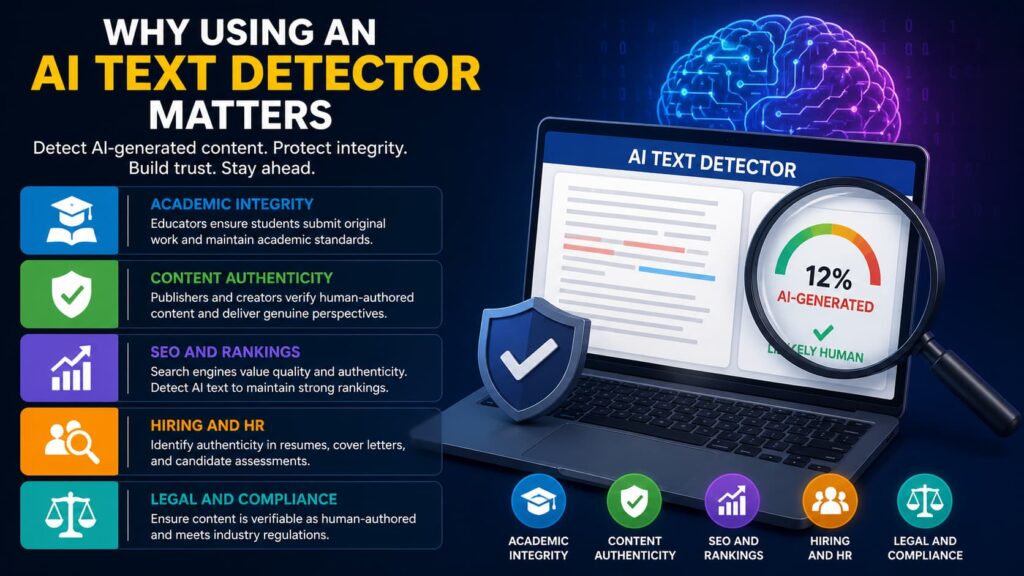
Why Using an AI Text Detector Matters
Before diving into the seven methods, it’s important to understand why detecting AI-generated content is so critical:
Academic Integrity: Educators worldwide are concerned about students submitting work written by AI tools. An AI text detector helps institutions uphold their academic standards and ensure that assessments reflect genuine student effort.
Follow media page for more insights like this.
Content Authenticity: Publishers, journalists, and bloggers need to verify that content is original and human-authored. Running articles through an AI detector ensures readers receive authentic perspectives, not machine-processed outputs.
SEO and Rankings: Search engines like Google are increasingly sophisticated at identifying low-quality, AI-generated content. Using an AI text detector before publishing helps you maintain a strong, trustworthy digital presence.
Hiring and HR: Resume screening, cover letter analysis, and candidate assessments can all be distorted by AI-generated text. An AI text detector helps hiring managers identify authenticity in applications.
Legal and Compliance: In regulated industries, content must often be verifiable as human-authored. An AI text detector plays a role in maintaining compliance.
Now, let’s explore the seven powerful ways an AI text detector identifies machine-written content.
1. Perplexity Analysis The Cornerstone of Every AI Text Detector
The first and most fundamental method used by any serious AI text detector is perplexity analysis. In natural language processing, “perplexity” measures how surprising or unpredictable a piece of text is. Human writing tends to have higher perplexity it’s unpredictable, nuanced, and sometimes rule-breaking. AI text, on the other hand, tends to follow the most probable word patterns, producing low-perplexity output.
When you run a document through an AI text detector, it calculates the perplexity score across the entire text. A consistently low perplexity score meaning the model finds the text entirely “expected” is a strong signal that the content was AI-generated.
This is why even the best AI detector free tools rely heavily on perplexity as their primary metric. Low perplexity is the fingerprint of AI text.
2. Burstiness Detection How an AI Text Detector Reads Rhythm
Alongside perplexity, a high-quality AI text detector also measures burstiness the natural variation in sentence length and complexity that characterizes human writing. Humans write in bursts. We write short sentences. Then we construct longer, more elaborate ones that twist and turn with parenthetical observations, emotional asides, and the occasional grammatical quirk that makes writing feel alive and personal.
AI text lacks this rhythm. It tends to produce sentences of uniform length and consistent structure. There are rarely dramatic swings between a two-word exclamation and a fifty-word complex sentence.
An effective AI text detector looks for burstiness scores alongside perplexity. When burstiness is low and perplexity is low simultaneously, the AI detector can flag the content with high confidence as machine-generated. This dual-metric approach is what separates powerful AI text detector tools from simplistic checkers.
3. Stylometric Fingerprinting Advanced Pattern Recognition in AI Text Detection
The third method used by a sophisticated AI text detector is stylometric analysis, which examines the unique stylistic fingerprint of writing. Every human writer consciously or not has recurring patterns: favorite transitional phrases, characteristic punctuation habits, idiosyncratic word choices, and structural preferences.
AI text generated by large language models tends to exhibit a very different stylometric fingerprint. Common markers include:
- Overuse of hedging language: Phrases like “it is important to note,” “it’s worth mentioning,” or “in conclusion” appear with suspicious regularity in AI-generated content.
- Formulaic structure: AI-generated content almost always follows a predictable pattern introduction, numbered body points, conclusion with little deviation.
- Symmetric paragraph lengths: Unlike human writing, which varies organically, AI text tends to produce paragraphs of near-identical word counts.
- Absence of personal voice: An AI detector will often flag content that contains zero first-person anecdotes, zero emotional texture, and zero idiosyncratic perspective.
An advanced AI text detector can compare a document’s stylometric profile against known human and AI writing patterns to produce a probabilistic score.
4. Token Probability Scoring The Technical Heart of an AI Detector
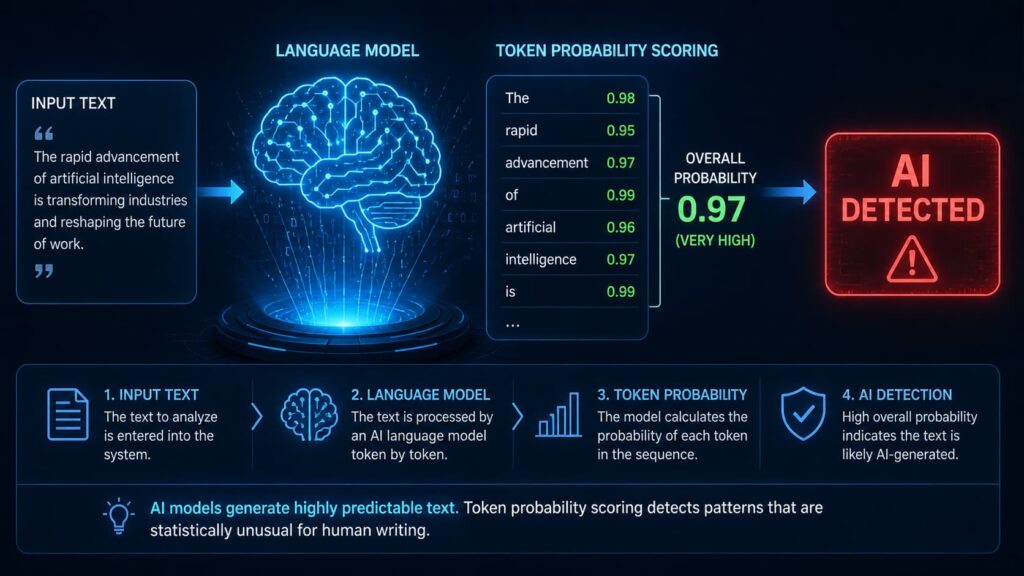
Every AI text detector built on machine learning uses some form of token probability scoring. This method involves feeding the suspect text into a language model and asking: “What is the probability that a language model would produce this exact sequence of tokens?”
If the answer is “very high probability,” the AI text detector raises a flag. This is because AI models generate text by repeatedly selecting the highest-probability next word (or token). The resulting output is statistically predictable in ways human writing is not.
Several popular AI detector free platforms use this approach, including GPTZero and others that have emerged since 2023. These tools essentially ask a model to “grade its own homework” if the model finds the text entirely natural and expected, it was likely AI-generated.
For users looking for an AI detector free option, token probability scoring tools are widely available online and can be used without a subscription. However, premium AI text detector platforms typically offer more refined versions of this analysis, with lower false-positive rates.
5. Semantic Consistency Testing What Makes an AI Text Detector Truly Smart
The fifth method is semantic consistency testing, and it’s what distinguishes a truly intelligent AI text detector from a basic statistical tool. This approach examines whether the ideas and arguments in a piece of text are genuinely developed or simply strung together with surface-level coherence.
AI text is very good at sounding coherent while being semantically shallow. It can produce paragraphs that appear to be building toward a complex argument but are actually just cycling through related concepts without genuine analytical depth.
An AI text detector using semantic consistency testing will look for:
- Circular reasoning: Does the content make a point, then essentially repeat it in different words without advancing the argument?
- Lack of specific examples: Human writers draw from lived experience. AI text tends to reference generic, non-specific examples.
- Absence of contradiction: Paradoxically, human thought contains productive contradictions and nuance. AI-generated content is often suspiciously consistent and conflict-free.
- Surface-level synthesis: Rather than truly integrating ideas, AI text often lists ideas side by side without genuine synthesis.
This is one of the most powerful methods in the toolkit of any serious AI text detector, especially for longer-form content like essays, reports, and academic papers.
6. Watermarking and Provenance Tracking The Future of AI Detection
A cutting-edge development in AI text detector technology is watermarking. Some AI companies including Google DeepMind are now building invisible watermarks directly into AI-generated text at the output stage. These watermarks are imperceptible to human readers but can be detected by a corresponding AI text detector tool.

The watermark works by subtly influencing which tokens the model selects, creating a statistical pattern that is identifiable only if you know the key. Think of it like a digital signature embedded in the word choices themselves.
While watermarking is still in its early stages and not yet universally adopted, it represents a significant leap forward for AI text detector accuracy. Future versions of AI detector tools are likely to rely heavily on this method as it becomes standardized across the industry.
For organizations that use AI writing tools internally, provenance tracking knowing which documents were AI-assisted is becoming an important governance tool. An AI text detector with provenance capabilities can verify the origin of a document across its entire lifecycle.
7. Human-in-the-Loop Heuristics The Manual Checklist Every AI Text Detector Should Inform
The seventh method is not purely algorithmic it’s the human-in-the-loop heuristic approach that complements any AI text detector tool. Even the best AI detector produces false positives and false negatives. Training yourself to read critically alongside using an AI text detector dramatically improves your detection accuracy.
Here are the key heuristics that experienced editors and educators use alongside their AI text detector software:
Check for Generic Authority: Does the text cite specific sources, name real people, and reference verifiable facts? Or does it speak in vague generalities like “studies show” or “experts agree”? AI text loves generic authority without specificity.
Look for Emotional Texture: Human writing carries emotional weight anger, joy, hesitation, irony. If a piece reads as uniformly pleasant, neutral, and inoffensive, that’s a red flag worth feeding into your AI text detector.
Test the Unusual Claim: Ask: would a human writer actually know this, or does it feel like the AI is “hallucinating” a plausible-sounding fact? AI models are notorious for generating confident-sounding misinformation.
Examine the Opening Line: AI-generated content almost universally opens with a broad, context-setting statement. Human writers are more likely to open with a hook, an anecdote, or a provocative claim.
Read Aloud: AI text often doesn’t flow naturally when spoken. It sounds correct but feels robotic. Your ear is one of the best supplementary AI text detector tools you have.
Top AI Text Detector Tools You Should Know
Whether you need a premium solution or a quick AI detector free check, here are some of the most respected AI text detector platforms available today:
GPTZero: One of the most widely used AI text detector platforms, built specifically with educators in mind. It offers both a free tier and paid plans, and uses perplexity and burstiness scores as its core metrics.
Originality.ai: A premium AI text detector designed for content marketers, SEO professionals, and publishers. It scans for both AI-generated content and plagiarism simultaneously.
Copyleaks AI Detector: A trusted AI detector that supports multiple languages and integrates with LMS platforms for institutional use.
Winston AI: A powerful AI text detector with a clean interface, high accuracy, and a free trial option for new users.
Sapling AI Detector: A solid AI detector free option for quick, lightweight checks without requiring account creation.
Turnitin AI Detection: Built into the world’s most widely used academic integrity platform, this AI text detector is now standard at thousands of universities globally.
Each of these platforms approaches AI text detection with slightly different methodologies, so using two or more tools together can significantly reduce false positives and give you greater confidence in your results.
Limitations of AI Text Detectors What You Need to Know
No AI text detector is perfect. It’s important to understand the limitations:
False Positives: Some AI detector tools flag text written by non-native English speakers as AI-generated because their writing patterns statistically resemble those of AI models. This is a significant concern for academic institutions.
Paraphrasing Tools: Writers who paraphrase AI-generated text using tools like QuillBot or Wordtune can sometimes fool an AI text detector, though advanced platforms are catching up.
Hybrid Content: When a human writer uses AI for research assistance but writes the final content themselves, even the best AI text detector may struggle to give a clean verdict.
Model Evolution: As AI writing models become more sophisticated and produce higher-perplexity, more bursty text, AI text detector tools must continuously update their algorithms to stay relevant.
Despite these limitations, using an AI text detector remains one of the most widely used methods available to identify AI text at scale, and the field is evolving rapidly.
Conclusion: Why an AI Text Detector Is Non-Negotiable in 2026
We are living in an era where AI text is everywhere in marketing copy, news articles, academic essays, customer service emails, and social media posts. The ability to distinguish human-authored content from machine-generated output is no longer a luxury. It is a fundamental skill and business requirement.
An AI text detector gives you the power to verify, authenticate, and make informed decisions about the content you read, publish, or evaluate. Whether you use a professional-grade platform or start with a quick AI detector free check, integrating AI text detector tools into your workflow is one of the smartest moves you can make in today’s content landscape.
The seven methods outlined in this guide perplexity analysis, burstiness detection, stylometric fingerprinting, token probability scoring, semantic consistency testing, watermarking, and human heuristics represent the full power of modern AI text detector technology. Together, they create a layered, robust system for help identify AI text with reasonable accuracy.
As AI continues to evolve, so will the AI text detector. Stay informed, use multiple tools, and trust your instincts alongside the data. It will play an important role in maintaining content authenticity.
Frequently Asked Questions (FAQs)
1. What is an AI text detector?
An AI text detector is a tool or method used to identify whether a piece of content was generated by artificial intelligence or written by a human. It analyzes patterns like structure, predictability, and language usage.
2. How does perplexity analysis help detect AI-generated text?
Perplexity measures how predictable a piece of text is. AI-generated content often has lower perplexity because it follows common language patterns, making it easier for models to predict the next word.
3. What is burstiness detection in AI content analysis?
Burstiness detection examines variations in sentence length and complexity. Human writing typically has more variation, while AI-generated text often appears more uniform and structured.
4. What is stylometric fingerprinting?
Stylometric fingerprinting analyzes writing style, including vocabulary, tone, and sentence structure. It helps detect inconsistencies that may indicate AI-generated or mixed-authorship content.
5. How does token probability scoring work?
Token probability scoring evaluates how likely each word (token) is to appear in a sequence based on language model predictions. AI-generated text tends to have higher probability sequences compared to human writing.
Read more informative blogs about such amazing tools here

Hi, I’m Rufqha, the SEO Manager at AIBlogMind. I focus on building content strategies that help websites improve visibility, attract the right audience, and create sustainable organic growth. My expertise includes on-page SEO, keyword research, content optimization, and aligning SEO with user experience and business goals.