
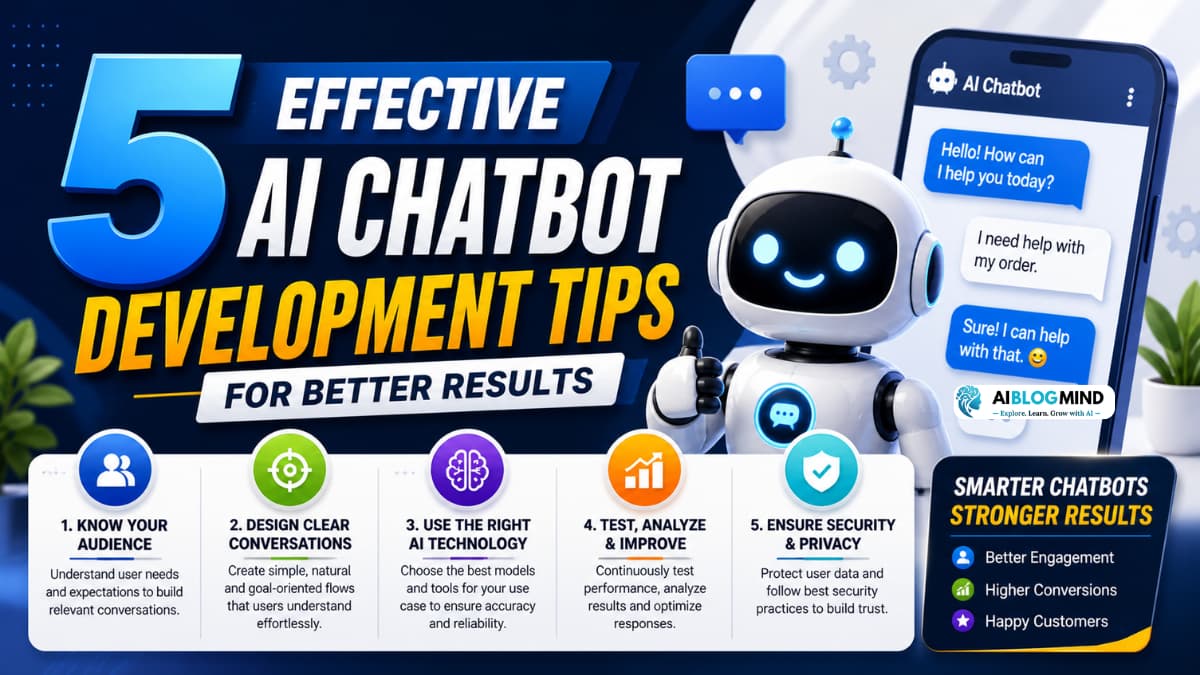
5 Effective AI Chatbot Development Tips for Better Results
Imagine launching a chatbot that frustrates every single user who talks to it.
It misunderstands questions. It gives irrelevant answers. It loops in circles when a customer asks something slightly outside its script. Within days, your support tickets spike, your customer satisfaction scores drop, and the Ai chatbot development done by you for months becomes a liability rather than an asset.
This is not a rare story. It happens more often than most businesses would like to admit. Poor AI chatbot development is one of the most common and most costly mistakes companies make when entering the world of conversational AI.
The problem is clear: building a chatbot is easy. Building a chatbot that actually works, delivers value, and grows smarter over time is a completely different challenge. It requires the right strategy, the right tools, and a clear understanding of what separates a great chatbot from a mediocre one.
The solution lies in following proven AI chatbot development principles backed by practical experience, technical knowledge, and the smart use of modern resources like AI API integration, MLOps tools, and AI automation tools.
In this article, we will walk through 5 effective AI chatbot development tips that will help you build better, smarter, and more reliable chatbots. Whether you are a developer, a product manager, or a business owner exploring conversational AI for the first time, this guide will give you a clear and actionable roadmap.
Benefits of AI Chatbot Development
Before diving into the tips, it is important to understand why investing in proper AI chatbot development is worth every bit of effort.
Round-the-Clock Customer Support
One of the most immediate benefits of AI chatbot development is the ability to provide 24/7 support without hiring additional staff. A well-built chatbot can handle hundreds even thousands of simultaneous conversations, answering common questions instantly and routing complex issues to human agents when needed.
Significant Cost Reduction
Effective AI chatbot development reduces operational costs dramatically. Businesses that replace or supplement their support teams with AI chatbots report savings of up to 30% in customer service costs. When paired with the right AI automation tools, chatbots can handle entire workflows from lead qualification to appointment booking without any human intervention.
Faster Response Times
Speed is everything in customer experience. AI chatbot development enables instant responses at any time of day. Unlike human agents who need time to look up information or compose a reply, a well-trained chatbot delivers answers in milliseconds.
Scalability Without Extra Cost
As your business grows, your chatbot grows with it without requiring additional hiring or training. Proper AI chatbot development, supported by scalable AI API integration, ensures your chatbot can handle increased conversation volumes seamlessly.
Data Collection and Insights
Every conversation your chatbot has is a source of data. Smart AI chatbot development includes mechanisms to capture, store, and analyze this data. With the right MLOps tools, you can continuously monitor chatbot performance, identify weak spots, and retrain your model to improve accuracy over time.
Consistent Brand Voice
Unlike human agents who may vary in tone and communication style, a properly developed AI chatbot maintains a consistent brand voice across every single interaction. This consistency builds trust and reinforces your brand identity at scale.
Limitations of AI Chatbot Development
Responsible AI chatbot development also requires honest acknowledgment of its limitations. Understanding these challenges upfront will help you build more realistic expectations and better systems.
Difficulty Handling Complex or Emotional Conversations
AI chatbot development has come a long way, but chatbots still struggle with highly nuanced, emotional, or multi-layered conversations. When a user is frustrated, grieving, or dealing with a complex problem that requires empathy and judgment, even the most advanced chatbot may fall short. Human handoff capabilities are essential in these situations.
Training Data Dependency
The quality of your AI chatbot development output is directly tied to the quality of your training data. If your data is incomplete, biased, or outdated, your chatbot will reflect those flaws. Investing in clean, diverse, and regularly updated data is non-negotiable for good AI chatbot development.
Integration Complexity
Connecting a chatbot to your existing systems CRM, databases, ticketing platforms, payment gateways requires careful AI API integration planning. Poor integration leads to broken workflows, incorrect data retrieval, and frustrated users. This is one of the most technically demanding aspects of AI chatbot development.
Ongoing Maintenance Requirements
AI chatbot development does not end at launch. Chatbots require regular updates, retraining, and performance monitoring. Without proper MLOps tools and processes in place, chatbot performance tends to degrade over time as language patterns, user expectations, and business requirements evolve.
Security and Privacy Risks
Chatbots often handle sensitive user data personal details, account information, payment data. AI chatbot development must include robust security measures, data encryption, and compliance with relevant data protection regulations. Skipping this step can expose your business to serious legal and reputational risks.
User Adoption Challenges
Not all users are comfortable interacting with chatbots. Some people prefer human interaction, especially for sensitive or high-stakes conversations. Successful AI chatbot development includes designing for user trust making it clear what the chatbot can and cannot do, and always providing a path to a human agent.
5 Effective AI Chatbot Development Tips for Better Results
Now let us get into the core of this guide the five most important tips that will elevate your AI chatbot development from average to exceptional.
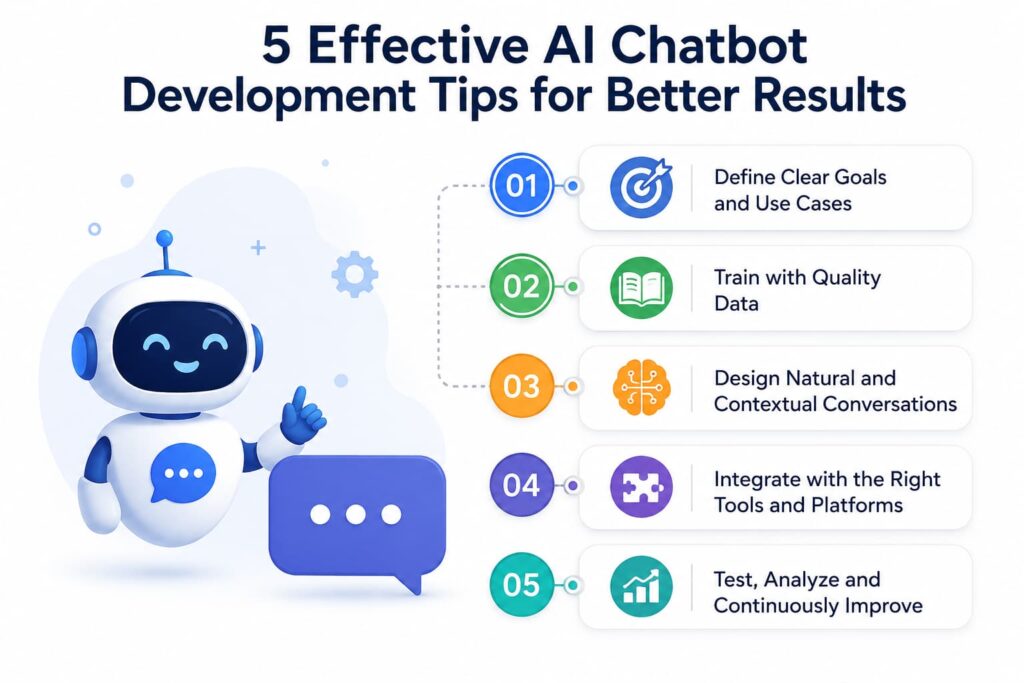
Tip 1: Define a Clear Purpose Before You Write a Single Line of Code
The single biggest mistake in AI chatbot development is building first and planning second.
Before any AI chatbot development work begins, you need to answer one fundamental question: what specific problem is this chatbot solving? A chatbot that tries to do everything usually does nothing well. The most successful examples of AI chatbot development are highly focused they solve one or two core problems exceptionally well.
Start by mapping out the exact use cases your chatbot will handle. Will it answer product FAQs? Book appointments? Process returns? Qualify sales leads? Each use case in your AI chatbot development plan requires its own conversation flows, training data, and success metrics.
Once your purpose is defined, build your AI chatbot development roadmap around it. Identify the key user intents your chatbot needs to understand, the responses it needs to deliver, and the points at which it should escalate to a human. This clarity will guide every technical decision that follows — from choosing the right AI API integration approach to selecting the appropriate AI automation tools for your workflow.
A well-defined scope is the foundation of effective AI chatbot development. Without it, even the best technology will produce poor results.
Tip 2: Invest Heavily in Training Data Quality
In AI chatbot development, your model is only as good as the data you feed it. This is not a minor detail it is the core determinant of your chatbot’s performance.
High-quality training data for AI chatbot development means data that is diverse, representative, clean, and regularly updated. It should reflect the full range of ways your users actually speak including abbreviations, typos, regional language variations, and emotional tone. If your training data only reflects formal, perfectly written sentences, your chatbot will struggle the moment a real user sends a casual, imperfect message.
One of the best practices in AI chatbot development is to collect training data directly from real user conversations. If you are building a new chatbot from scratch, start by analyzing your existing customer support logs. Look at the questions users actually ask not the questions you assume they will ask. This real-world data is gold for AI chatbot development.
Beyond initial training, your AI chatbot development process must include a continuous data improvement loop. This is where MLOps tools become essential. MLOps tools allow your team to monitor model performance, identify conversations where the chatbot failed or underperformed, extract those examples as new training data, retrain the model, and deploy the updated version — all within a structured, repeatable workflow.
Without MLOps tools, this process is chaotic and unsustainable. With them, your AI chatbot development becomes a living, improving system rather than a static product.
Popular MLOps tools used in professional AI chatbot development include MLflow, Weights and Biases, and Vertex AI. These MLOps tools provide dashboards, experiment tracking, and deployment pipelines that make continuous model improvement manageable at scale.
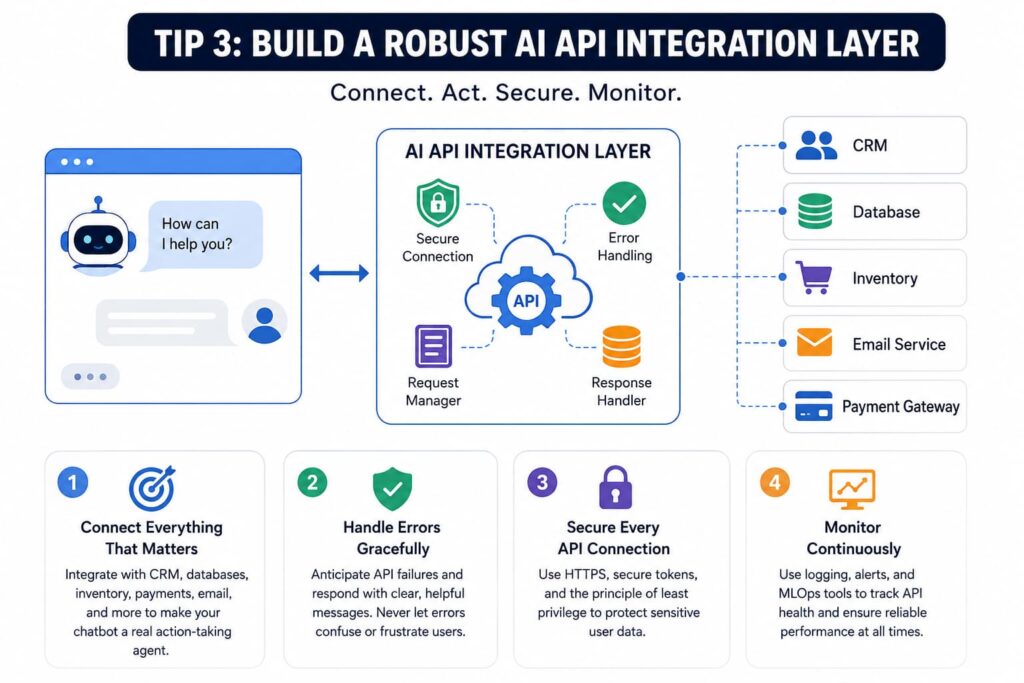
Tip 3: Build a Robust AI API Integration Layer
No chatbot exists in isolation. In modern AI chatbot development, a chatbot’s real power comes from its ability to connect with other systems and that connection happens through AI API integration.
A strong AI API integration layer allows your chatbot to pull live data from your CRM, update records in your database, process transactions, check inventory, send confirmation emails, and much more all within a single conversation. Without proper AI API integration, your chatbot can only answer static, pre-programmed questions. With it, your chatbot becomes a dynamic, action-taking agent that delivers real value.
Here are the key principles of excellent AI API integration in AI chatbot development:
First, design your AI API integration to be modular. Each API connection should be independently maintained so that a change in one system does not break the entire chatbot. Modularity in AI API integration also makes it easier to add new connections as your business grows.
Second, handle errors gracefully. In any AI chatbot development project, API calls will occasionally fail servers go down, timeouts happen, data formats change. Your AI API integration layer must anticipate these failures and respond to users in a clear, helpful way rather than crashing or returning a confusing error message.
Third, secure every API connection. AI API integration in chatbot systems often involves transmitting sensitive user data. Always use encrypted connections (HTTPS), authenticate API calls with secure tokens, and follow the principle of least privilege give each API connection only the permissions it absolutely needs.
Fourth, monitor your AI API integration continuously. Use logging and alerting tools to track the health of your API connections in real time. This is another area where MLOps tools add significant value they can help you monitor not just model performance but also the reliability of your AI API integration layer.
Strong AI API integration is what separates a toy chatbot from a production-grade AI chatbot development project that delivers measurable business results.
Tip 4: Implement AI Automation Tools to Streamline Your Development Workflow
Effective AI chatbot development is not just about the chatbot itself it is also about the development process that creates, tests, and deploys it. This is where AI automation tools make a transformative difference.
AI automation tools can dramatically reduce the manual effort involved in AI chatbot development. From automated testing to continuous integration and deployment pipelines, AI automation tools allow your development team to focus on solving hard problems rather than repeating routine tasks.
Here is how AI automation tools fit into each stage of AI chatbot development:
In the design phase, AI automation tools can generate conversation flow templates, suggest training data based on your use case, and help identify gaps in your intent coverage. This speeds up the early stages of AI chatbot development significantly.
In the testing phase, AI automation tools can simulate thousands of user conversations automatically testing edge cases, measuring response accuracy, and flagging failure points. Manual testing of AI chatbot development outputs is slow and incomplete. Automated testing with AI automation tools is fast, thorough, and repeatable.
In the deployment phase, AI automation tools support continuous delivery pipelines that push updates to your chatbot without downtime. This is critical for businesses where the chatbot is a core part of customer operations. Any interruption to service during AI chatbot development updates can have real business consequences.
In the monitoring phase, AI automation tools track conversation quality, flag anomalies, and generate performance reports. When combined with MLOps tools, AI automation tools create a fully connected development, deployment, and improvement cycle that keeps your chatbot sharp and reliable.
Leading AI automation tools used in professional AI chatbot development include Botpress automation modules, Rasa’s pipeline automation, Dialogflow’s auto-training features, and cloud-native automation services from AWS, Google Cloud, and Azure. These AI automation tools are well-documented, widely supported, and proven in production environments.
The bottom line: if you are doing AI chatbot development without AI automation tools, you are working harder than you need to and delivering slower results.
Tip 5: Design for Continuous Learning and Human-in-the-Loop Feedback
The most sophisticated and most overlooked tip in AI chatbot development is this: build your chatbot to learn continuously, not just at launch.
AI chatbot development does not end when you go live. In fact, the most valuable learning happens after launch in real conversations with real users. The question is whether your AI chatbot development infrastructure is set up to capture and act on that learning.
Continuous learning in AI chatbot development requires two things: a human-in-the-loop feedback system and the right MLOps tools to operationalize that feedback.
A human-in-the-loop system means that human reviewers whether they are QA specialists, customer service managers, or domain experts regularly review chatbot conversations, flag incorrect or suboptimal responses, and submit corrections that feed back into the training pipeline. This human oversight is what keeps your AI chatbot development grounded in real-world accuracy.
MLOps tools make this process scalable. Instead of manually reviewing every conversation, MLOps tools can automatically surface the conversations most likely to contain errors those where users asked for clarification multiple times, rated the chatbot poorly, or abandoned the conversation. These flagged conversations become the priority training material for your next AI chatbot development cycle.
Beyond error correction, continuous learning in AI chatbot development also means adapting to change. User language evolves. Business products change. New topics become relevant. Your chatbot needs to evolve with them. A structured AI chatbot development improvement cycle powered by MLOps tools, AI automation tools, and regular human review ensures your chatbot never becomes obsolete.
This tip is what separates AI chatbot development teams that deliver lasting value from those whose projects quietly fade into irrelevance after the initial launch excitement wears off.
Comparing the 5 AI Chatbot Development Tips
Each of the five tips addresses a different layer of the AI chatbot development stack.
Tip 1 — defining a clear purpose is a strategic tip. It sets the direction for all technical decisions that follow in AI chatbot development.
Tip 2 — investing in training data quality is a data tip. It determines the intelligence ceiling of your AI chatbot development output and is powered by consistent use of MLOps tools.
Tip 3 — building a robust AI API integration layer is a technical tip. It determines the functional power of your chatbot and requires careful planning of your AI API integration architecture.
Tip 4 — implementing AI automation tools is a process tip. It determines how efficiently your team can build, test, deploy, and update AI chatbot development projects, with AI automation tools doing the heavy lifting.
Tip 5 — designing for continuous learning is a lifecycle tip. It determines the long-term trajectory of your AI chatbot development investment and relies on both MLOps tools and AI automation tools working together.
The most successful AI chatbot development projects apply all five tips in combination. Each one reinforces the others strategy informs data collection, data quality enables better AI API integration, AI API integration is tested through AI automation tools, and everything improves through continuous learning supported by MLOps tools.
How to Choose the Right Approach for Your AI Chatbot Development
With five clear tips and a range of tools to consider, the natural next question is: where do you start?
Follow us for more
The answer depends on your current stage of AI chatbot development and your specific business context.
If you are just starting your AI chatbot development journey, focus on Tip 1 and Tip 2. Get your purpose crystal clear and invest the most time in building quality training data. Everything else can be layered on top but without these foundations, no amount of AI API integration or AI automation tools will save you.
If you have an existing chatbot that is underperforming, focus on Tip 2 and Tip 5. Audit your training data for gaps and biases, and implement a human-in-the-loop feedback system with the right MLOps tools to drive continuous improvement in your AI chatbot development.
If you are scaling AI chatbot development across multiple products or teams, prioritize Tip 3 and Tip 4. Robust AI API integration and strong AI automation tools are what allow AI chatbot development to scale without proportional increases in team size and manual effort.
If your chatbot is technically sound but not delivering business value, revisit Tip 1. The most common reason a technically excellent AI chatbot development project fails to deliver ROI is that it was solving the wrong problem from the start.
In every case, integrating MLOps tools and AI automation tools into your AI chatbot development workflow is a non-negotiable step toward professional-grade results.
Final Verdict
AI chatbot development is one of the most powerful capabilities a modern business can invest in but only when it is done right.
The five tips covered in this article defining a clear purpose, investing in training data quality, building a strong AI API integration layer, implementing AI automation tools, and designing for continuous learning represent the complete framework for AI chatbot development that delivers real, lasting results.
What separates successful AI chatbot from failed projects is not the technology itself. The same language models and the same AI API integration platforms are available to everyone. What makes the difference is discipline, strategy, and a commitment to continuous improvement powered by the right MLOps tools and AI automation tools.
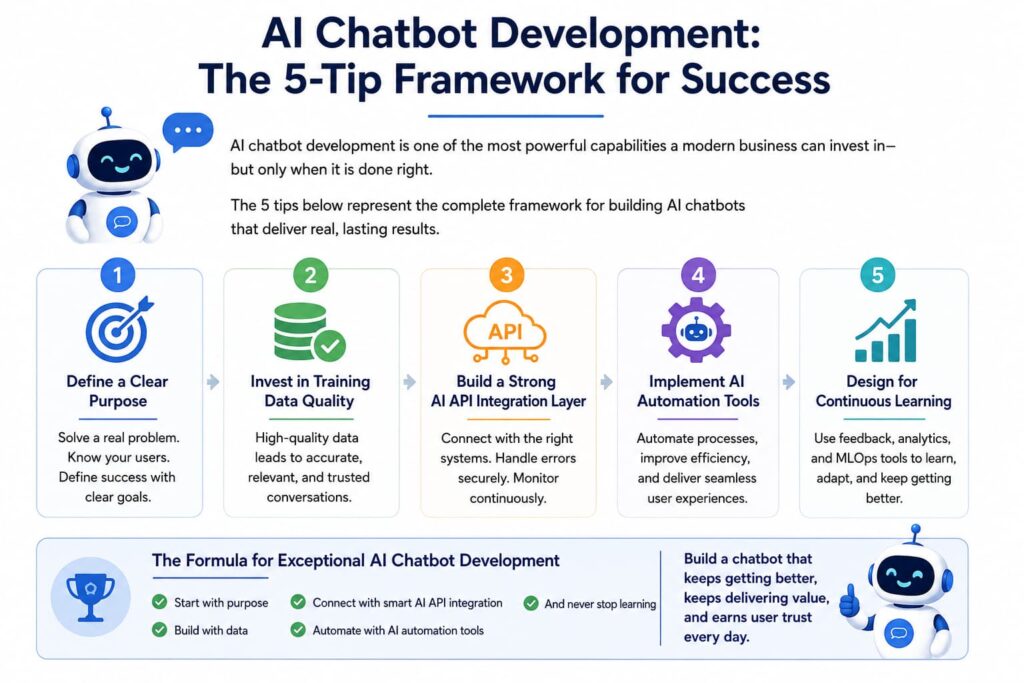
If you follow these five tips in your AI chatbot development work, you will not just build a chatbot that works at launch you will build one that keeps getting better, keeps delivering value, and keeps earning the trust of the users who interact with it every day.
Start with purpose. Build with data. Connect with smart AI API integration. Automate your process with AI automation tools. And never stop learning. That is the formula for exceptional AI chatbot development.
Frequently Asked Questions (FAQs)
What is AI chatbot development?
AI chatbot development is the process of designing, building, training, deploying, and maintaining conversational AI systems that can interact with users through text or voice. It involves natural language processing, machine learning, AI API integration, and continuous model improvement using MLOps tools.
How long does AI chatbot development take?
The timeline for AI chatbot development varies widely depending on complexity. A basic rule-based chatbot can be built in a few days. A sophisticated, AI-powered chatbot with full AI API integration and custom training may take three to six months. Ongoing AI chatbot for maintenance and improvement is a continuous process.
What are MLOps tools and why are they important in AI chatbot development?
MLOps tools are platforms and frameworks that manage the machine learning lifecycle — including data management, model training, deployment, and monitoring. In AI chatbot development, MLOps tools are critical for maintaining chatbot performance over time, automating retraining workflows, and ensuring reliable model deployment.
What is AI API integration in the context of chatbot development?
AI API integration refers to connecting your chatbot to external systems and services through application programming interfaces. In AI chatbot development, AI API integration allows chatbots to retrieve live data, trigger actions in other systems, and deliver dynamic, personalized responses rather than static, pre-programmed answers.
Which AI automation tools are best for chatbot development?
The best AI automation tools for AI chatbot development depend on your stack and use case. Popular options include Rasa, Botpress, Dialogflow, and cloud-native services from AWS Lex, Google Dialogflow CX, and Azure Bot Framework. For CI/CD and testing automation in AI chatbot, tools like GitHub Actions, Jenkins, and Pytest are widely used alongside dedicated MLOps tools.
Can small businesses benefit from AI chatbot development?
Absolutely. AI chatbot is no longer limited to large enterprises. Many platforms offer affordable, scalable solutions that allow small businesses to build effective chatbots without large development teams. Starting with a focused use case, clean training data, and basic AI API integration is enough to deliver real business value through AI chatbot.
Know more about us

Mohammed Viqar Ali is a Digital Marketer, UI/UX Designer, and content creator passionate about AI, technology, SEO, and digital growth. As the UI/UX Designer of aiblogmind, he focuses on creating user-friendly digital experiences while sharing practical insights on artificial intelligence, marketing trends, productivity tools, and online business growth. Through his content, he helps readers discover innovative solutions, stay updated with emerging technologies, and make informed decisions in the digital world.